Eight days after the Israeli airstrikes on Qatar sent tremors across the Guf, Saudi Arabia announced it had signed a new defense pact with Pakistan. Because of the timing, most of the discussion in Washington looked at the Saudi-Pakistani arrangement through the lens of US security interests in the region. The document, which included a solidarity clause, seemed to be a response to the events in Qatar, and more specifically, to the perceived US failure to protect one of its Gulf partners against such aggression.
The fact that Pakistan’s commitment pales in comparison with the US contribution to Saudi security quickly led commentators to dismiss the defense pact as a mere message to the United States that Riyadh would pursue other partners. Crown Prince Mohamed bin Salman’s visit to Washington in early November and the accompanying arms sales (including the F-35s) further supported this view. However, this framing of the Saudi-Pakistani deal omitted one significant dimension: its negative implications for India. In fact, the agreement is much more consequential and more detrimental to Indian interests in the Middle East than to the United States.
Saudi-Pakistani ties are nothing new. Both countries have long-standing ties that involve Pakistan’s migrant labor and close security cooperation. Saudi armed forces have historically relied on Pakistani officers for training purposes. Since 1963, Pakistani soldiers have regularly been deployed to secure the kingdom’s territory, including holy cities like Mecca and Medina. Back in the 1980s, the intelligence services of both countries coordinated (with the United States) their support and training of the Afghan mujahideen against the Soviet Union. Saudi Arabia is also widely believed to have financially supported Pakistan’s nuclear program.
For a long time, this Pakistani influence in Saudi Arabia—and, to a lesser extent, across the Gulf—limited India’s ability to expand its footprint in the area. India’s presence in the Gulf is first a matter of its diaspora: Approximately 9.7 million Indians live in the six countries of the Gulf Cooperation Council. In 2024, they sent $47 billion in remittances back home. However, over the past decade, Indian Prime Minister Narendra Modi’s premiership went beyond this demographic dimension and raised Indian ambitions to become a strategic player in the Gulf. Modi’s policy toward the region translated into a surge in high-level visits. It also included new trade deals, such as the United Arab Emirates (UAE) and India Comprehensive Economic Partnership Agreement of 2022, and Gulf investments to support the modernization of Indian infrastructure. Finally, it also involved greater cooperation on security issues, such as counterterrorism and maritime security.
It helped that during this period, Gulf-Pakistani diplomatic relations deteriorated. In March 2015, after Saudi Arabia formed a coalition to intervene in Yemen against the Houthi insurgency, Pakistan declined Riyadh’s request to participate. Islamabad’s refusal angered Saudi and Emirati officials, who saw it as an ungrateful move from a country that relied heavily on Gulf financial support to avoid bankruptcy. Seen from Abu Dhabi or Riyadh, the growing gap between India, a rising power, and Pakistan, a nation on the brink of financial collapse, prompted Gulf leaders to reevaluate their South Asian partnerships.
However, ten years later, India’s momentum has slowed down. Many Gulf investments in India took years to materialize due to the local byzantine bureaucracy, casting doubt on Delhi’s ability to become the great power it aims to be. As a result, the Asia-Gulf partnerships that truly took off during that period were with China, not India.
And just like with Pakistan, Gulf states moved closer to China in sensitive areas that directly undermined Indian interests. Saudi Arabia, Qatar, and the UAE procured missiles and unmanned systems from China. Then Western governments started suspecting that the UAE and Oman had been discussing with Beijing the provision of Chinese warships with a permanent facility in their ports. The prospect of Chinese naval basing in the Gulf triggered warning signals in Washington. But the presence of China’s People’s Liberation Army Navy in Oman, whose shores are about 2,084 kilometers from India, is an even bigger worry for Delhi.
Until recently, Indian officials were careful not to pressure their Gulf partners (at least publicly) on policies that ran counter to Delhi’s interests. When asked, Indian diplomats acknowledge that the scope of Beijing’s influence in the Gulf may be worrisome, but, as elsewhere in Asia, they also recognize that India can’t yet compete with China in the Middle East on business deals or security cooperation.
Likewise, in my discussions with Gulf officials and intellectuals, India is rarely mentioned in their strategic equation, as if the only actual great power competitors that matter in Abu Dhabi, Riyadh, or Muscat are Beijing and Washington. That is not to say India is neglected, but it is seen as an Asian power—not a global one—that mainly represents a destination for investments and a potential partner on regional issues. In other words, Gulf states believe they can decouple their India policies from their China and Pakistan ones, and Indian officials do not challenge that belief.
The gap between Gulf and Indian perceptions stems from Delhi’s lack of a clear regional ambition. To date, India has not articulated a strategy for the Middle East or the Gulf. China has one (to promote trade and investment while refraining from domestic interference), and so does the United States (to deter Iran, counter terrorist organizations, and contain China’s influence).
Conversely, India only has a collection of bilateral relations. Some remain strong (Israel, the UAE); others are stable, though limited (Saudi Arabia, Iran). Altogether, they do not form a cohesive regional strategy. This is not because Delhi cannot develop one, but because not having one allows its decision-makers to avoid facing inconvenient contradictions in those bilateral policies. For example, India heavily relies on Israel for military procurement (the third supplier of Indian arms imports), but it keeps buying oil from Iran. The Modi government supported Israel for most of its Gaza operation after October 7, but it also increased its financial aid to the United Nations’ Palestinian relief agency, UNRWA, despite Jerusalem’s allegations of ties between the agency and Hamas. (The International Court of Justice rejected in October Israel’s allegations about UNRWA “infiltration by Hamas”).
Indian diplomats may argue that it exemplifies their multi-aligned approach, i.e., maintaining good relations with everyone. However, this multi-alignment can have adverse effects for India, especially when Gulf states adopt it as well and deepen security cooperation with China and Pakistan—the two most significant security threats to India’s national security.
Eventually, India’s difficulties in the Gulf also affect US policy. Over the past five years, Washington has viewed India as a potential new partner in the Middle East. It has engaged Delhi in several new initiatives, including I2U2 (alongside Israel and the UAE), and the India-Middle East-Europe Corridor. However, if Gulf states increase their strategic engagement with China and Pakistan, that will weaken India’s ability to play such a role and could jeopardize the development of those initiatives. US diplomats should take stock of those constraints on Washington’s plans.
Despite these challenges, India’s Middle East policy could still evolve. Noticeably, after Riyadh announced its new defense agreement with Pakistan, Delhi did not stay silent. Asked by the media, the spokesperson from India’s Ministry of External Affairs emphasized the need for Saudi Arabia to remember “sensitivities” surrounding its pact with Pakistan. The diplomat did not dwell on it, but his statement revealed that multi-alignment eventually has its limits. It’ll be worth watching if India also gets more vocal when Gulf states engage with China in the security domain. When push comes to shove, if India wants to be treated as a major power in the Middle East, it must develop a clearer and more assertive regional strategy.
Jean-Loup Samaan is a nonresident senior fellow at the Atlantic Council and a senior research fellow at the Middle East Institute of the National University of Singapore.
Further reading
Tue, Jun 3, 2025
India-Gulf relations are muted—but mobilizing
MENASource By Jonathan Fulton
The depth of Indian-Gulf relations creates a strong foundation for increased India-Middle East integration over the coming decades.
Fri, Sep 26, 2025
The Saudi-Pakistan defense pact highlights the Gulf’s evolving strategic calculus
MENASource By
In Riyadh’s multi-aligned policy, signing a mutual defense deal with Pakistan is complementary, not alternative, to US security guarantees.
Fri, Aug 29, 2025
Is the cautious China-Iran military cooperation at a turning point?
MENASource By Jean-Loup Samaan
With a new war between Iran and Israel still an immediate threat, China might need to ask itself: Is cooperation with Iran worth risking its diplomacy model in the Gulf?
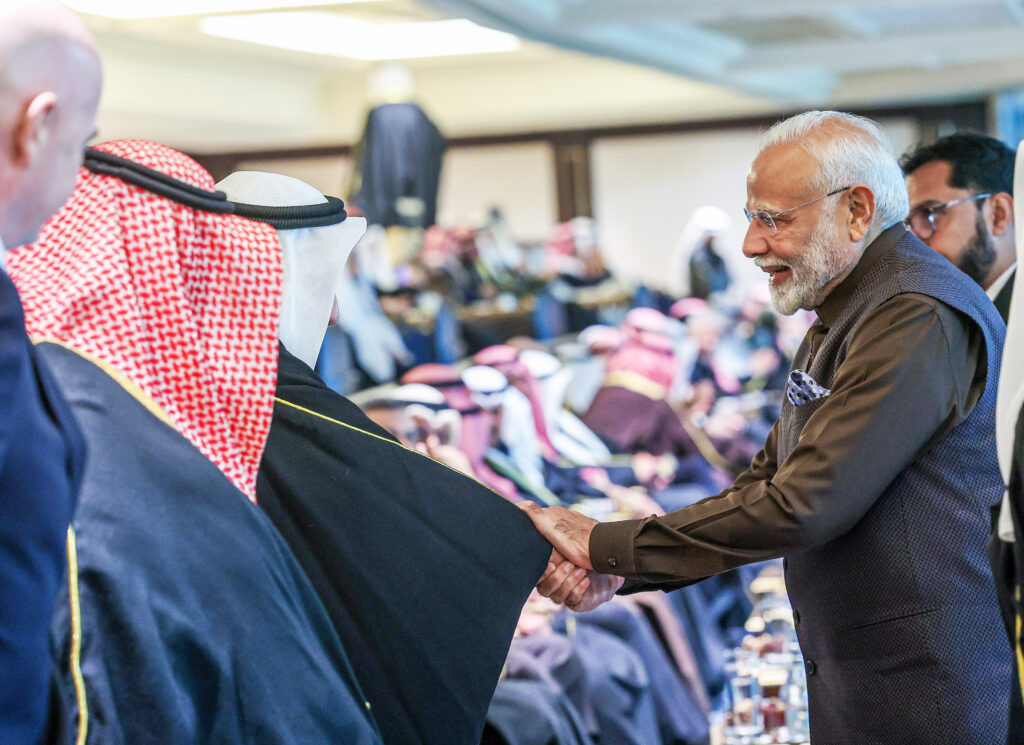
Image: Ardiya [Kuwait], Dec 22 (ANI): Prime Minister Narendra Modi being welcomed at the inauguration ceremony of the Arabian Gulf Football Cup, in Ardiya on Saturday. (ANI Photo)No Use India.