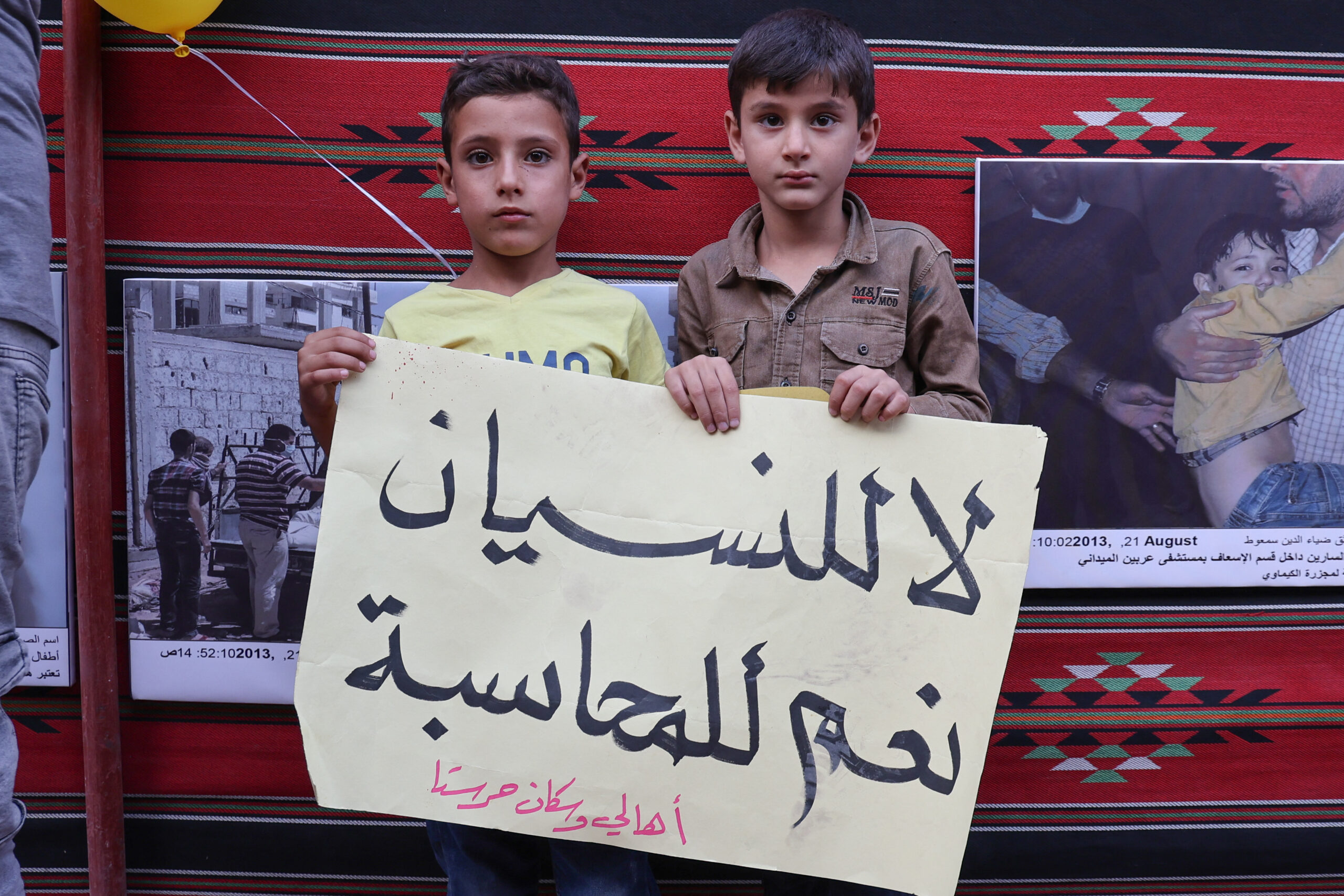
One year after Assad’s fall, here’s what’s needed to advance justice for Syrians
Just over a year ago, the prospect of justice for human rights violations by the Bashar al-Assad regime in Syria was limited. Progress was measured through universal jurisdiction trials in Europe, occurring more than two thousand miles from Syria and focused almost exclusively on low and mid-level perpetrators, alongside sanctions on regime and affiliated actors. United Nations bodies continued to issue statements and reports, document violations, and support universal jurisdiction cases without access to Syria. Syrian civil society persisted for years with tremendous efforts preparing for transitional justice—if and when a transition may ever happen—as well as documentation and ways to creatively secure accountability through existing or new forums.
But the prospect of justice in Syria changed overnight on December 8, 2024. Assad fled his presidential palace and later Syria, flying to Russia as opposition fighters advanced on Damascus, liberating hundreds of political prisoners from Sednaya prison and other notorious detention centers along the way.
Related reading
Over the past twelve months, there have been notable developments in Syria’s justice and accountability space. But progress has been conservative, likely due to a combination of factors. One such factor is the overwhelming nature of the task to secure justice for countless violations from over a decade of brutal war. Another is the Syrian transitional government’s need to build up from zero and its decision to centralize power within the ruling inner circle at the expense of civil society participation. An additional factor at play is a preference across many foreign governments to observe developments in Damascus before determining their level and modes of engagement.
In order to advance prospects of justice for Syrians after more than a decade of war, the second year of a post-Assad Syria requires structural reform, victim-centered leadership, and international reinforcement to prevent this opening from being squandered.
Justice developments in Syria since Assad’s fall
Syria has begun building out its national architecture of transitional justice. In May, transitional President Ahmad al-Sharaa issued Decree No. 20, establishing the National Commission for Transitional Justice with “financial and administrative independence.” Commissioners were appointed three months later, and they have begun meeting with civil society organizations, Syrians across the country and in the diaspora, and representatives from foreign governments, international bodies, and other post-conflict societies. However, the commission’s structure and internal regulations remain unclear, without a statute or terms of reference, and its scope of work is limited to Assad regime violations, excluding violations by other actors and those committed after December 8, 2024.
Syria’s Ministry of Justice has also begun investigating and building cases on Assad regime violations. The Ministry of Justice is investigating judges from the Assad-era Counter Terrorism Court and requesting complaints from citizens. These judges are responsible for presiding over tens of thousands of sham trials that imprisoned or sentenced to death detainees based on vague, trumped-up charges that considered the provision of medical aid and the documentation of human rights abuses, among other acts, to amount to terrorism. The Ministry of Justice has also, according to media reports, requested that Lebanon extradite former Assad regime officials accused of war crimes who fled Syria after the fall of the regime.
Finally, Syria has made progress addressing violations since December 8, 2024. The government established national committees to investigate two episodes of mass sectarian violence: in Alawite-majority coastal areas in March this year and in Druze-majority Sweida in July. The coastal committee was criticized for not releasing its report publicly and failing to acknowledge the government’s responsibility for the crimes. Nevertheless, the committee’s efforts have led to Syria’s first public trial in decades, of fourteen suspects in the March violence in coastal Syria.
Justice developments outside Syria since Assad’s fall
There have also been notable justice developments outside Syria over the past year. Foreign countries have continued pursuing universal jurisdiction trials that were in development before Assad’s fall, and Syrian civil society continues to file new complaints. After German and Swedish authorities carried out arrests in July 2024, parallel trials are now underway in both countries against Assad regime-allied suspects accused of violations in Yarmouk Camp, a district south of Damascus that regime-affiliated forces besieged and bombed during the war.
The United States is scheduled to begin the trial of former Assad regime official Samir al Sheikh in March 2026, after his arrest in July 2024 for immigration fraud, with torture charges added days after the fall of the Assad regime. In France, judicial authorities issued a new arrest warrant against Assad for his role in the 2013 chemical weapon attacks in Damascus suburbs, replacing a French warrant that was annulled in July this year due to his head of state immunity at the time it was issued in 2023. In late November, victims and survivors, supported by Syrian civil society organizations, filed a criminal complaint seeking an investigation into the role Danish maritime fuel company Dan-Bunkering may have played in war crimes and crimes against humanity in Syria by supplying jet fuel to Russian forces that was used in strikes against Syrians.
Foreign states have also launched new arrest warrants, charges, and indictments against high-level Assad regime figures since the fall of the regime. One day after Assad’s fall, US authorities unsealed war crimes charges against Jamil Hassan and Abdul Salam Mahmoud, two architects of Assad regime detention and torture practices, who in May 2024 were convicted in absentia of crimes against humanity in France, along with a third regime official. In November this year, France issued an extradition request to Lebanon for those three former Assad regime officials. This followed France’s September arrest warrant against Assad and six officials for their roles in the targeted killings of journalists in Homs in 2012 (which came one month before the chemical weapons arrest warrant was reissued in October). Finally, in mid-November, Austrian authorities indicted Assad regime official Brigadier General Khaled al-Halabi, who had reached Vienna with support from Israeli and Austrian intelligence, according to media reports citing Austrian intelligence agency memos.
Recommendations to advance justice for Syria
There has been notable progress on justice for Syria. Many of the developments discussed above—namely Syria’s National Commission for Transitional Justice, domestic investigations for Assad-era abuses and public trials, and multiple arrest warrants for Assad himself—were unimaginable just over a year ago. But the work of securing justice for Syria has only just begun, and more significant steps are needed from Syrian, foreign, and international actors.
As an overarching recommendation, Syria’s transitional justice process must center the calls from and preferences of Syrian victims, survivors, human rights defenders, activists, lawyers, and other civil society members who have dedicated more than a decade to pursuing justice for violations. Syria’s justice process should be Syrian-led, but that does not mean it should be led only by Syrian transitional government authorities. Syrian civil society has significant expertise, having led justice and accountability efforts for fourteen years, and the justice process must be designed to serve victims and survivors. It is certainly a welcome sign that victims, survivors, and human rights defenders have been appointed to posts in the National Commission for Transitional Justice, National Commission for Missing Persons, and Ministry of Foreign Affairs. But appointments alone are not enough; efforts must continue to ensure these individuals have influence in their posts, that they are not overpowered by more senior officials or executive authority, and that broader civil society expertise is incorporated within and outside formal structures.
Syrian authorities must undertake significant domestic reform to ensure future domestic accountability efforts will follow human rights standards. The Ministry of Justice, court system, and legal infrastructure helped to commit and enforce violations and corruption under the Assad regime. It will take years to rebuild these institutions and structures—to ensure they support victims rather than further victimize them, and to ensure transparency and legitimacy. Syrian law and procedure also requires significant reform: to abolish vague criminal charges that were weaponized against dissidents under the Assad regime; to adopt legislation criminalizing war crimes, crimes against humanity, enforced disappearance, and torture in line with international standards; to adopt procedures that will ensure victim and witness protection; and to abolish the death penalty, to name only a few. Given that Syrian government institutions have never untaken this work previously, it will also take years for national bodies to develop the specialized expertise required to investigate and prosecute war crimes, crimes against humanity, and other international crimes that are quite complex, and to amass the evidence required to prosecute these cases.
The new Syrian parliament should also adopt an inclusive law allowing for the prosecution of all criminals, regardless of perpetrator group, and committing to undertake all pillars of transitional justice. Syrian authorities should welcome support from specialized foreign and international experts, in addition to victims, survivors, and Syrian civil society actors who have been leading justice efforts for more than a decade. These individuals can advise on rebuilding and reforming national systems and support documentation and case-building—transitional authorities could benefit from more expertise on these tasks, especially from the expertise of international experts and Syrian civil society that have engaged on these tasks deeply. In the meantime, the Syrian authorities should grant victims’ associations and civil society organizations access to both prisons and trials, to monitor, improve transparency, help guarantee best practices, and ensure that torture and enforced disappearances do not occur again.
Finally, Syria’s transition and transitional justice process requires ongoing support and engagement from foreign and international actors. Such engagement and pressure has proven essential for post-conflict trials and transitional justice efforts in other contexts. Although foreign states’ priorities may be the stabilization and return of refugees, this agenda will be best achieved by supporting transitional justice and the rule of law. First, foreign states should continue to pursue universal jurisdiction trials, which are a necessary complement to domestic and international trials. The many perpetrators who fled Syria during the conflict or after Assad’s fall cannot evade justice simply because they left the country. Second, foreign states and international organizations should support Syrian transitional authorities in developing and rebuilding national institutions, systems, and expertise by offering trainings, expertise through secondments, and financial support. Third, foreign and international actors should push Syrian transitional authorities to take reforms or other actions to advance justice when progress stalls. Foreign and international actors should support Syrian victim, survivor, and broader civil society calls on the transitional authorities, using their influence to help ensure Syria’s transitional justice program is victim and survivor-centered. Fourth, foreign and international actors should continue to support the work of victim, survivor, and civil society organizations in documentation, case-building, and advocacy. A robust civil society will be essential to ensuring a just transition for Syria.
The Assad family controlled Syria for more than half a century. The task of securing justice for Assad-era violations is monumental. Syrian transitional authorities, civil society, and foreign and international actors must work together to have the best chance of success.
Elise Baker is a senior staff lawyer for the Strategic Litigation Project. She provides legal support to the project, which seeks to include legal tools in foreign policy, with a focus on prevention and accountability efforts for atrocity crimes, human-rights violations, terrorism, and corruption offenses.
Ahmad Helmi is a nonresident fellow at the Tahrir Institute and a founding manager of the Taafi Initiative, supporting survivors of enforced disappearances and torture. He has worked for justice and human rights in Syria for twelve years and survived three years of imprisonment and torture in Assad regime prisons.
Further reading
Wed, Jul 30, 2025
After Swaida: How Syria’s periphery is shaping its future
MENASource By Ibrahim Al-Assil
What comes next in Syria will not be determined by battlefield victories or summit declarations, but by the evolving realities on the ground.
Tue, Jun 14, 2022
Attacks on hospitals from Syria to Ukraine: Improving prevention and accountability mechanisms
Issue Brief By Elise Baker, Gissou Nia
When Russia invaded Ukraine on February 24, 2022, it soon began implementing one of its frequent—and criminal—tactics that it had already been using in its military intervention in Syria: bombing healthcare and medical facilities.
Thu, Jun 26, 2025
Dispatch from Damascus: Church attack shows transition’s fragility
MENASource By Ibrahim Al-Assil
The bombing at Mar Elias Church is more than an isolated tragedy. It is a signal that Syria’s transition remains vulnerable to sabotage.
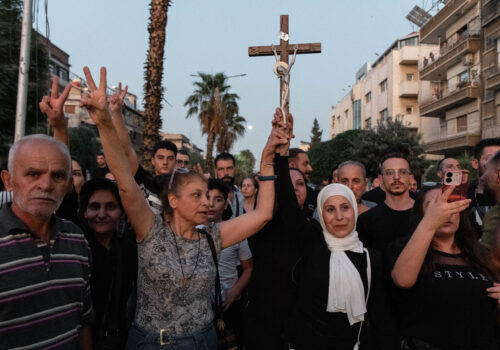
Image: Syrians commemorate the 12th anniversary of the sarin gas chemical attacks carried out by the ousted Bashar al-Assad regime on Ghouta, which killed hundreds of civilians. Damascus, Syria, August 21, 2025. Photo by Mohammad Daher/ABACAPRESS.COM