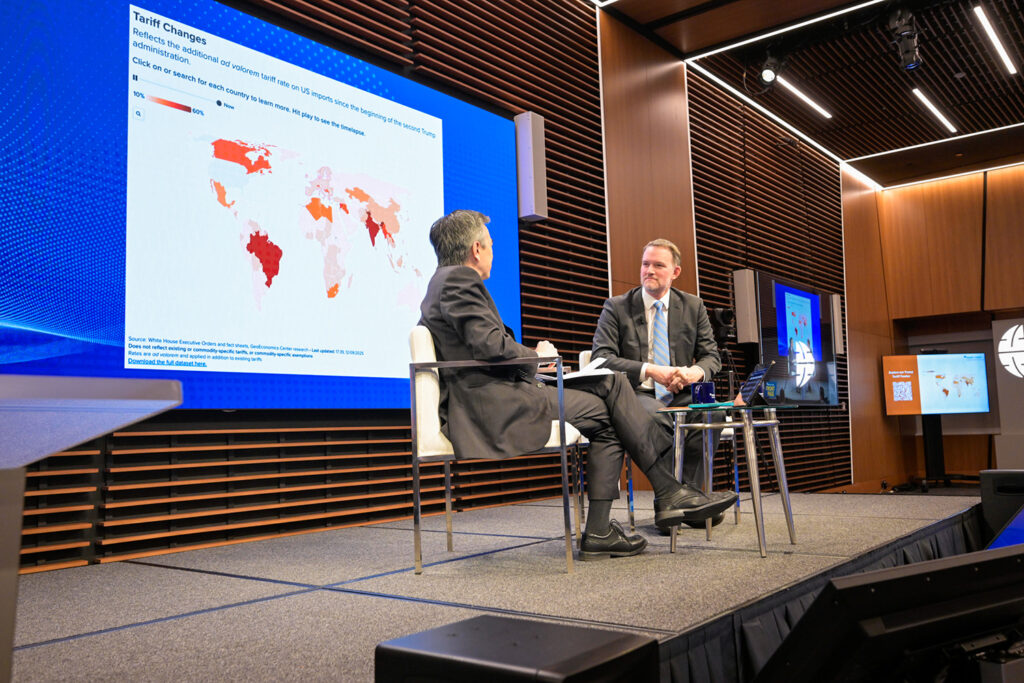
Watch the event
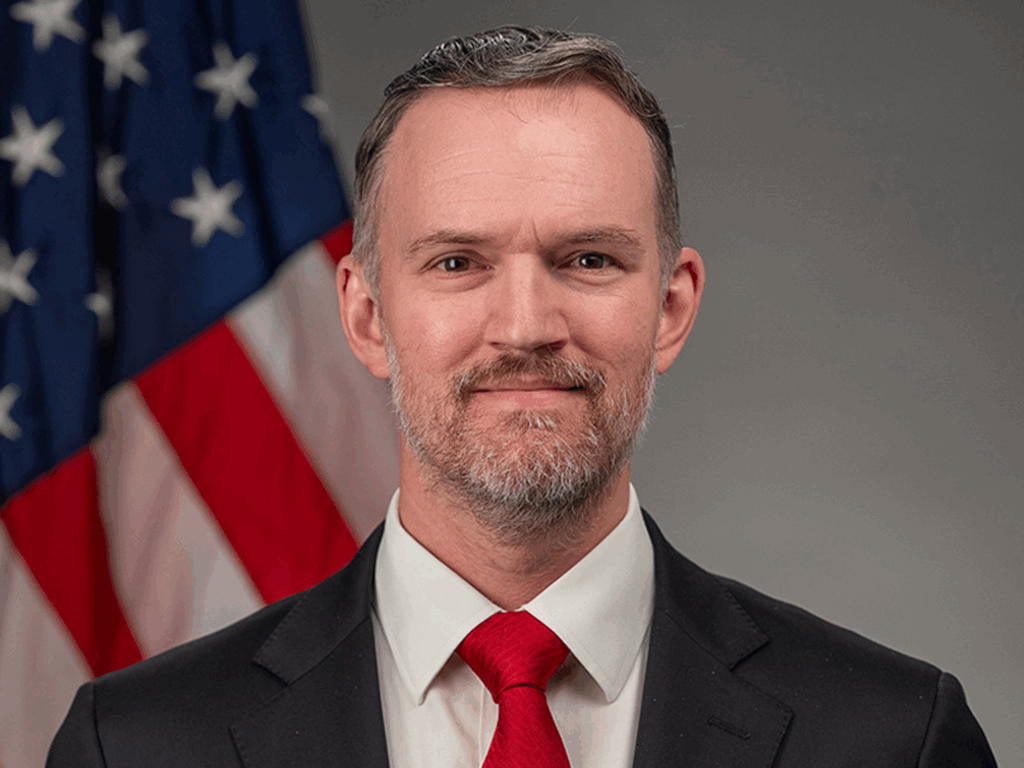
Even with China’s unfair trade practices, the United States and China still “should trade,” said US Trade Representative Jamieson Greer. “Just . . . it needs to be managed.”
Greer spoke at an Atlantic Council Front Page event on Wednesday, hosted by the GeoEconomics Center, where he unpacked a year in which US President Donald Trump implemented an aggressive trade strategy that resulted in clashes with China over tariffs, export controls, and other trade measures.
“The president’s interest is not in blowing up everything,” Greer argued, “and that includes our relationship with China.”
Greer said that the administration’s actions are intended not to solidify geopolitical camps but to address the “giant deficit” in trade. “The landing zone with China is really we just have more balanced trade,” he argued.
Below are highlights from the event, moderated by The Wall Street Journal’s Greg Ip, where Greer talked about the Trump administration’s broader strategy, what it has and has not yet achieved, and what to expect next on tariffs and trade.
Partners and allies
- Greer said that he was “disappointed” to see how the European Union (EU) is implementing the bloc’s digital regulations, with social media platform X receiving the first fine under the EU’s Digital Services Act last week.
- Greer argued that the EU had promised “no discrimination against US digital actors” in trade dealings this summer, but “what we think is fair treatment and what they think is fair treatment is quite different,” he added.
- “With respect to our companies, we’re going to regulate our companies,” he said. “We’re not going to allow that regulation to be outsourced.”
- In discussing whether the EU and United States will take a common approach to China on trade, Greer said that “we’re not really in a position of telling everybody, ‘You’re either with them or you’re with us.’” He added, “if we align in a way that helps America, great. If not, we’re going to take our own actions.”
- Yet, he argued, “it’s in every country’s interest to take action against overcapacity and distortions, whether that’s from China or that’s from Vietnam or Indonesia.”
- On the US-Mexico-Canada Agreement (USMCA), which enters review next year, Greer said that the United States is going to likely talk to each of the other signatories “separately,” because “our economic relationship with Canada is very, very different than our economic relationship with Mexico.” He indicated that all options are on the table for the USMCA—including a withdrawal.
- When Ip raised the idea that the rules-based international order and its fair-trade norms are dead, Greer asked whether “it was ever alive at all,” saying “sometimes we kind of have white lies we tell ourselves in international relations to paper over the actual power politics that really control everything.”
Performance review
- Greer, in jotting up his own report card for the Trump trade strategy, said that while the US trade deficit globally “is tracking higher than it was last year,” he attributed that increase to “people front-running the tariffs.”
- He called attention to other datapoints to show the impact of the Trump administration’s trade policies, including that the trade deficit with China has decreased and that he expects it to be down 25 percent by the end of the year. “It’s clearly going the direction we want it to go, and we expect it to go,” he said.
- Greer also noted that manufacturing as a share of the gross domestic product is up, a sign that some sectors are reshoring their production. And while reshoring has centered around select items “that matter most” (such as cars, pharmaceuticals, and semiconductors), Greer said that “a lot of other manufacturing . . . comes along with it.”
- As reshoring takes place and manufacturing jobs become more plentiful, the US trade representative pointed out that manufacturing jobs in the United States “on average pay more than services jobs,” so Americans shouldn’t “turn up our nose” at such work.
- Despite the impact of tariffs and the reshoring of select items, Greer said that “stores are stocked up and ready for a record holiday season,” quipping, “I’m not the Grinch just yet.”
What comes next
- In response to GeoEconomics Center analysis about the potential impact of the Supreme Court’s review on Trump tariffs, Greer said that if the court blocks tariffs issued under the International Emergency Economic Powers Act, the administration would use alternative instruments to attempt to recreate the nearly $200 billion in tariff revenues.
- “The default position for a long time in the United States was to raise revenue to fund the government, and then we switched to an income tax early in the twentieth century,” he explained. “So it’s not crazy to have revenue helping to fund your government.”
- Greer said his main focus with tariffs is “getting the trade deficit down,” and he pointed out that the countries with the largest trade surpluses with the United States do so because they “have a variety of unfair trading practices,” including overcapacity and subsidization. “Those countries currently have the highest tariffs.”
- On the possibility of working with the US Congress to legislate some of the tariff increases, Greer said that he has “had some interest” from members of Congress. He argued that doing so would “provide a new baseline for companies to understand” that the use of tariffs “is a bipartisan expression.”
- When asked whether next year will be quieter on tariffs, Greer said that it will depend on the president, but he added that the administration is “in the middle” of the tariff project, suggesting more movement to come.
Katherine Golden is an associate director of editorial at the Atlantic Council.
Watch the event
Further reading
Wed, Dec 10, 2025
Inside the Trump trade strategy with US Trade Representative Jamieson Greer
Transcript By
Greer joined the Atlantic Council to discuss the US approach to trade and tariffs in the next year.
Fri, Nov 7, 2025
The Supreme Court might slow Trump’s strategy. But he still has other tariff options.
New Atlanticist By
If the administration’s primary objective is to preserve tariff revenue and counter unfair practices, sections 301, 232, or 122 remain viable alternatives.
Tue, Sep 16, 2025
The Supreme Court’s decision on Trump tariffs will have lasting impact on US economic statecraft
Econographics By
Regardless of how the Supreme Court rules, the case will shape US economic policy for years to come.
Image: US Trade Representative Jamieson Greer speaks at the Atlantic Council on December 10, 2025.