In Southeast Asia, the promise and pitfalls of tariff diplomacy are on full display
This article is part of the Scowcroft Center for Strategy and Security’s series Inside Trump’s Peace Plans, which assesses the patterns, tools, and strategic choices that characterize Trump‘s peace deals—and evaluates whether they can deliver lasting results.
Back in July, US President Donald Trump played a key role in brokering a cease-fire between Thailand and Cambodia—a diplomatic effort that earned him a Nobel Peace Prize nomination from Cambodia and a starring role at an elaborate cease-fire signing ceremony during the Association of Southeast Asian Nations (ASEAN) summit in Kuala Lumpur in October. The timing of Trump’s intervention, combined with his use of tariffs as economic leverage, was instrumental in securing the initial cease-fire agreement. Although the truce was fragile and unraveled within a few months, it nonetheless prevented a dangerous escalation and created space for ASEAN-led mediation to briefly take hold.
Trump’s “victory lap” in Kuala Lumpur served both as a boost to his self-proclaimed campaign for the Nobel Peace Prize—earning him a nomination from Phnom Penh—and as a reminder to Southeast Asian nations that the United States remains a key player in shaping regional dynamics and promoting regional stability. Yet his visit also underscored the region’s growing unease over the United States’ retreat from its traditional role as a reliable economic partner and champion of free trade. Trump’s role in the Thailand-Cambodia conflict highlights a new US embrace of economic coercion, transactional bargaining, and exclusionary dealmaking. His abrupt departure from Kuala Lumpur—skipping the East Asia summit—followed by his early exit from South Korea just before the Asia-Pacific Economic Cooperation (APEC) Leaders’ Meeting, left China in the spotlight to promote its role as the region’s most dependable partner for free trade, infrastructure investment, and development assistance.
Recent events have more starkly called into question the effectiveness of Trump’s tariff-driven diplomacy. The Thai-Cambodia peace process quickly unraveled in November after Thai soldiers were injured by a landmine, sparking renewed fighting and causing Cambodian casualties along the border. Trump again sought to mediate with phone calls to both leaders, but this time Thailand’s Prime Minister Anutin Charnvirakul publicly dismissed the threat of economic coercion, saying “I no longer care” about trade and tariff negotiations: “If we can’t sell to this country, we’ll find others. How can we put our lives in the hands of one country?”
On December 8, the situation worsened dramatically when Thailand carried out air strikes on Cambodian military sites it claimed were stockpiling long-range Chinese-made rockets. Hundreds of thousands of civilians fled the ensuing violence, and the cease-fire crumbled—underscoring how fragile the truce always was. The latest turn of events came on December 12, when in a Truth Social post, Trump announced that he had again spoken with both Anutin and Manet and secured their agreement to halt all shooting. It remains far from certain, however, whether this new pledge will hold amid ongoing tensions. In all, the crisis lays bare the limits of tariff-based diplomacy in resolving conflicts rooted in nationalism, territorial rivalry, and domestic political pressures.
Bitter conflict over an ancient temple and colonial map
The Thai-Cambodia border dispute centers on Preah Vihear, an ancient Khmer temple perched atop a sheer escarpment along a poorly demarcated stretch of the frontier. The roots of the conflict stretch back centuries to the rivalry between the Khmer Empire and the Kingdom of Siam. In the modern era, the dispute rests on a colonial-era treaty and a French-drawn map whose ambiguities have fueled competing territorial claims.
Cambodia brought the case to the International Court of Justice, which ruled in 1962 that Preah Vihear lay on Cambodian territory. But the court did not decide who owned the surrounding plateau—an area far larger and strategically more significant than the temple. That unresolved question, combined with Thailand’s persistent rejection of the French map that informed the ruling, has left the Preah Vihear region a recurring flashpoint.
The last major clashes erupted from 2008 to 2011 after the United Nations Educational, Scientific and Cultural Organization listed Preah Vihear as a Cambodian world heritage site, a move that inflamed nationalist sentiment on both sides. For Cambodians, the temple is a potent symbol of Khmer identity, and political leaders have often invoked heritage and historical grievances to boost their popularity. Thai leaders who have sought compromise have faced backlash from nationalist groups, and the Thai military has at times exploited the issue to bolster its domestic standing and assert leverage over civilian authority. As a result, the dispute over Preah Vihear remains not only a legal matter but also a deeply emotional and politically combustible issue in both countries.
Escalating border clashes and the search for a cease-fire
The latest crisis erupted in late May 2025, when a Cambodian soldier was killed in a border skirmish, triggering a full-blown diplomatic confrontation and rapid troop buildups on both sides. Fighting escalated dramatically in late July, with heavy artillery exchanges, cross-border incursions, and sporadic air strikes. The human and economic toll mounted quickly: at least thirty-eight people were killed, more than 300,000 displaced, and cross-border trade ground to a halt.
ASEAN was initially caught off guard by the rapidly escalating conflict. As the fighting intensified, Malaysia—serving as ASEAN chair—stepped in to try to broker a cease-fire. Malaysian Prime Minister Anwar Ibrahim worked diligently behind the scenes, coordinating closely with the United States and China to open channels for talks. But these efforts were rebuffed by Thailand, which has long resisted third-party involvement in the dispute.
It was at this critical juncture that Trump’s personal intervention helped break the impasse. On July 26, he called Cambodian Prime Minister Hun Manet and Thailand’s acting Prime Minister Phumtham Wechayachai. His message was blunt: sign a cease-fire or face consequences in ongoing trade negotiations. The threat carried weight because US tariffs were set to rise sharply for Cambodia, Thailand, and most other Southeast Asian countries unless they reached trade agreements before the “Liberation Day” tariff deadline on August 1.
Within twenty-four hours, both governments agreed to meet in Kuala Lumpur, and on July 28 they signed an unconditional cease-fire. Trump announced on social media that he had “saved thousands of lives” and declared himself the “President of PEACE.” Manet seized the moment to curry favor with Trump by nominating him for the Nobel Peace Prize, citing his “extraordinary statesmanship” and “visionary and innovative diplomacy.”
Eager to secure Trump’s attendance at the ASEAN summit in October, host country Malaysia invited him to preside over a formal cease-fire signing ceremony. The event was carefully choreographed to spotlight the US president’s role in brokering the deal and the commitments made by Thailand and Cambodia to continue pursuing peace. China was pointedly excluded from the ceremony as a result of US demands for Trump’s participation. Cambodia’s Manet used the moment to remind Trump of his Nobel Peace Prize nomination, Thailand’s Anutin publicly thanked the president for his “personal dedication” to peace, and Malaysia’s Anwar praised Trump for his “tenacity and courage.”
A fragile peace—and its collapse
Despite the July cease-fire, the situation on the ground remained volatile. Violations persisted through August and September. The fragile truce was vulnerable to ultranationalist provocations, inflammatory disinformation circulating on social media, and the absence of any credible monitoring mechanism. Still, the cease-fire had prevented a return to all-out fighting and created space for negotiators to craft a more durable framework to resolve the underlying border dispute.
The agreement signed at the ASEAN summit added several new commitments: withdrawal of heavy weapons from the front line, monitoring by ASEAN observers, and repatriation of Cambodian prisoners of war. The hope was that once these steps were taken, the two countries would tackle the far more difficult process of technical border demarcation, which has remained stalled for years. Yet the most critical ingredient for any lasting settlement is sustained political will at a time when both governments face potentially volatile political situations at home. As Thai analyst Thitinan Pongsudhirak cautioned in October, leaders in both countries “appear intent and incentivized to stoke the flames of nationalism for domestic political gains.”
The rapid unraveling of the peace process in November and December proved these warnings prescient. Just two weeks after the Kuala Lumpur signing, Thailand announced that it would suspend participation in the peace process after four Thai soldiers were wounded, one critically, by a landmine that Thailand claimed was planted by Cambodia after the October peace accord had been signed—an allegation Cambodia denied. The crisis escalated dramatically on December 8, when Thailand launched airstrikes on Cambodian military targets, asserting that Cambodia had mobilized heavy weaponry and repositioned combat units. Fighting spread quickly into civilian areas, causing dozens of casualties and forcing hundreds of thousands to flee, with both sides accusing the other of breaking the truce. Anutin has taken a firm public stance, rejecting ASEAN-led mediation and US tariff pressure in favor of handling the dispute bilaterally with Cambodia. Then came Trump’s December 12 announcement that Anutin and Manet agreed to halt “all shooting” once again.
The confrontation has also offered Anutin a platform to project strength and nationalism at home at a time of economic anxiety and political turbulence in Thailand. This week, Anutin dissolved parliament, setting up a general election in early 2026.
Strategic takeaways for Southeast Asia
Southeast Asia broadly welcomed US involvement in the Thailand-Cambodia crisis and Trump’s visit to the region. After years of sporadic presidential attendance at ASEAN-centered summits under both Trump and former US President Joe Biden, Trump’s presence at the Kuala Lumpur meeting was well received and gave a diplomatic boost to Malaysia and ASEAN.
Yet the downsides were equally clear. The fact that Trump skipped both the East Asia summit and the APEC Leaders’ Meeting reinforced the perception that US engagement remains intermittent and unpredictable. In contrast, Chinese President Xi Jinping seized the opportunity to present China as a stable and reliable partner—championing multilateralism, expanding trade, and financing infrastructure from Laos to Indonesia.
Trump’s use of economic leverage—conditioning tariff relief on cease-fire cooperation—was undeniably effective in bringing Thailand and Cambodia to the negotiating table. But the collapse of the peace process just two weeks after the comprehensive cease-fire was signed also showcases the limits—and potential counterproductive effects—of coercive tariff diplomacy when issues of sovereignty and nationalism are at stake. Tariff pressure may even have backfired, giving the Thai prime minister an opportunity to demonstrate resolve and bolster his nationalist image at a politically opportune moment at home.
More broadly, Trump’s tariff-centric approach sends a highly visible and deeply troubling signal to the region. The United States, once seen as an engine of growth and leader of the liberal trade system, increasingly appears transactional and willing to weaponize trade for political ends. Ironically, that has long been the critique of Chinese engagement in Southeast Asia. Now, with Beijing positioning itself as a defender of free trade and regional multilateralism, the United States risks flipping the script—mirroring the coercive tactics it once condemned.
Meanwhile, China—though still resorting to economic coercion—has deepened its economic engagement, signing free trade agreements, financing ports, railways, and power plants through the Belt and Road Initiative, and expanding development assistance. The United States, by contrast, has dismantled the US Agency for International Development, retreated from ambitious trade deals, and remained a modest player in infrastructure development.
If the United States hopes to re-establish itself as Southeast Asia’s preferred strategic partner, it will need to pair high-level diplomacy and security cooperation with long-term economic engagement—demonstrating that US leadership is durable, reliable, and aligned with Southeast Asia’s long-term development priorities.
Amy Searight is a nonresident senior fellow in the Indo-Pacific Security Initiative at the Atlantic Council’s Scowcroft Center for Strategy and Security and senior adviser at Vriens & Partners. She previously served as US deputy assistant secretary of defense for South and Southeast Asia.
Related content
Explore the program

The Scowcroft Center for Strategy and Security works to develop sustainable, nonpartisan strategies to address the most important security challenges facing the United States and the world.
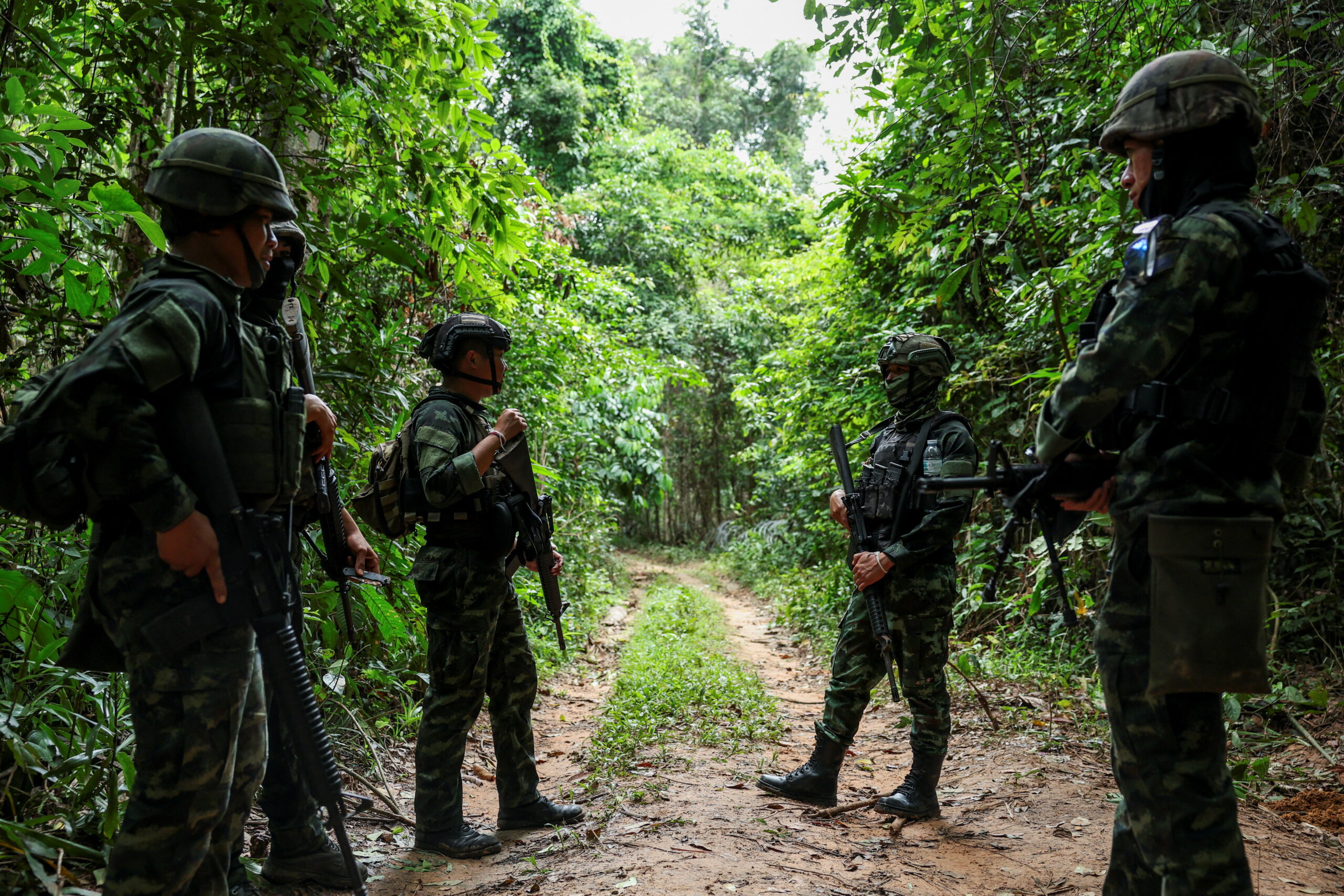
Image: Thai military personnel stand near the disputed border between Thailand and Cambodia in the Chong Bok area, following the first incident on July 16 that severed a Thai soldier’s left ankle while he was on patrol, in Ubon Ratchathani province, Thailand, August 27, 2025. REUTERS/Chalinee Thirasupa