It’s all about Hamas’s disarmament
This article is part of the Scowcroft Center for Strategy and Security’s series Inside Trump’s Peace Plans, which assesses the patterns, tools, and strategic choices that characterize Trump’s peace deals, and evaluates whether they can deliver lasting results.
US President Donald Trump’s successful negotiation of a cease-fire that ended the fighting in Gaza and secured the release of Israeli hostages was a significant diplomatic success.
Driven by exhaustion on both sides and the effective application of US leverage following Israel’s strike against Hamas leaders in Doha, the deal featured Israel and Hamas agreeing to terms that both had long resisted: Israel ending fighting without a guarantee of Hamas’s removal from power, and Hamas releasing all hostages without securing Israel’s full withdrawal from Gaza.
Although Hamas has not yet released all of the bodies of deceased hostages and occasional exchanges of fire continue, the cease-fire is likely to hold in the near term. Hamas needs time to recover from the blows it has endured, and Israel is unlikely to defy Trump as he seeks to claim this win and bolster his campaign for a Nobel Peace Prize.
But phase two of Trump’s twenty-point plan will be far more difficult, with multiple obstacles to implementation.
Gaza’s future hinges on who governs
The core elements of phase two are Hamas’s disarmament, the reconstruction of Gaza, the establishment of an interim Palestinian technocratic government under an international “Board of Peace” chaired by Trump, the deployment of an international stabilization force, and the gradual return of a reformed Palestinian Authority (PA) to governance in Gaza.
All of these objectives hinge on Hamas’s disarmament. That fact has been made irrefutable by videos circulating on social media showing Hamas using its weapons to engage in retribution killings against Palestinians who have resisted the group’s authority—a gruesome method of tightening its grip on the roughly 47 percent of Gaza it still controls.
Following the October 7, 2023, Hamas attacks, I led a State Department task force on “day-after” planning for Gaza. We immediately established as one of our core planning assumptions that unless Hamas was defeated, disarmed, and removed from power, there would be no “day-after.” Following the worst attack on the Jewish people since the Holocaust, neither Israel’s leaders nor its citizens would accept Hamas emerging from another war battered but intact—still armed, still clinging to power, and still preparing for the next round of fighting.
There were also pragmatic reasons for our assessment. The postwar gains we envisioned—Gulf-funded reconstruction, an international security force, and PA involvement in governance—would all be impossible if Hamas remained armed and in control.
No stabilization without disarmament
Since these objectives also form the foundation of phase two of Trump’s plan, it is no surprise that his administration is already confronting those very challenges. Gulf states are reluctant to fund reconstruction in Gaza without a long-term solution to the conflict. Meanwhile, the countries expressing some willingness to deploy stabilization forces—including Indonesia, Azerbaijan, Egypt, the United Arab Emirates, Jordan, and Morocco—have made clear that they will not engage Hamas directly and would prefer to deploy only after the group has been fully dismantled. The PA’s track record does not inspire confidence in this regard either; after all, it was routed from Gaza by Hamas in a brief civil war in 2007.
Disarming Hamas must therefore be the overriding priority. Without it, the conflict will likely remain in suspended animation, recovery will stall, and Gaza will drift toward renewed war.
Leaving disarmament solely to the Israel Defense Forces (IDF) is, at best, a flawed strategy. While the risk of further hostage killings has been removed, other concerns persist: rising civilian and IDF casualties, deepening international isolation of Israel, and the risk of a full-scale Israeli occupation of Gaza—all of which would severely damage US and Israeli national interests and undermine prospects for expanding regional integration.
Qatar and Turkey could play a crucial role
The most viable alternative is the same tool Trump used to persuade Hamas to release all hostages after the Doha strike: leverage over Qatar and Turkey. While Trump pressed Israel to agree to a cease-fire, he used Qatar’s fear of regional escalation—and its long-standing financial ties to Hamas—to pressure the group’s leadership.
Trump also brought in Turkey, which had been largely absent from the Biden administration cease-fire efforts. Trump’s relationship with Turkish President Recep Tayyip Erdoğan—who shares Hamas’s Muslim Brotherhood ideology and has allowed its leaders to live and even operate on Turkish soil—proved pivotal in persuading the group to accept the deal.
Trump leaned heavily on his transactional instincts, declaring a security guarantee for Qatar, signaling openness to an F-35 fighter jet program for Turkey, and, according to reports, easing US legal action against the country’s state-owned Halkbank, which faces charges related to helping Iran evade sanctions.
Qatar and Turkey have proven that, when properly motivated, they can exert decisive influence over Hamas. Trump should once again leverage both, using fresh incentives to press Hamas to surrender its arms to an agreed third party. A critical mass of Hamas fighters and remaining leaders could then accept safe passage into exile, allowing an international stabilization force and technical experts to safely decommission Hamas’s remaining tunnel networks. The United States and Israel have already struck a tentative agreement to allow safe passage for approximately two hundred Hamas terrorists currently in tunnels under Rafah, which, if implemented, could serve as a test case for a much larger effort across Gaza.
The road to recovery
There is precedent for this. In 1982, US diplomats helped arrange the peaceful departure of some fourteen thousand Palestine Liberation Organization personnel from Beirut while the Israeli military besieged the city. A similar effort, coordinated with and financed by key Arab states, could open the door to genuine recovery and a peaceful future for Gaza.
More than Gaza’s future is at stake. Significant opportunities to expand Middle East integration remain as well. With Iran and its proxy network profoundly weakened by Israeli and US strikes, a strengthened coalition of Israel, the United States, and Arab partners would advance the interests of all parties. A Hamas refusal to disarm, however, would freeze Gaza’s recovery and undermine progress toward Israeli-Saudi normalization, or even more modest steps such as renewing and expanding the Negev Forum—a regional cooperation framework comprising Israel, the United States, the United Arab Emirates, Bahrain, Morocco, and Egypt—improving Israeli-Indonesian ties, or completing a non-aggression pact between Israel and Syria.
Hamas leader Yahya Sinwar’s motivation to launch the October 7 attacks included a desire to derail Israel-Saudi normalization. Hamas must not be allowed to continue obstructing this brighter regional future. The United States must marshal all its partners in the region to ensure that the group’s disarmament becomes a shared, non-negotiable priority.
Daniel B. Shapiro is a distinguished fellow with the Scowcroft Middle East Security Initiative. He served as US ambassador to Israel from 2011 to 2017, and most recently as deputy assistant secretary of defense for the Middle East.
Related content

Explore the program

The Scowcroft Center for Strategy and Security works to develop sustainable, nonpartisan strategies to address the most important security challenges facing the United States and the world.
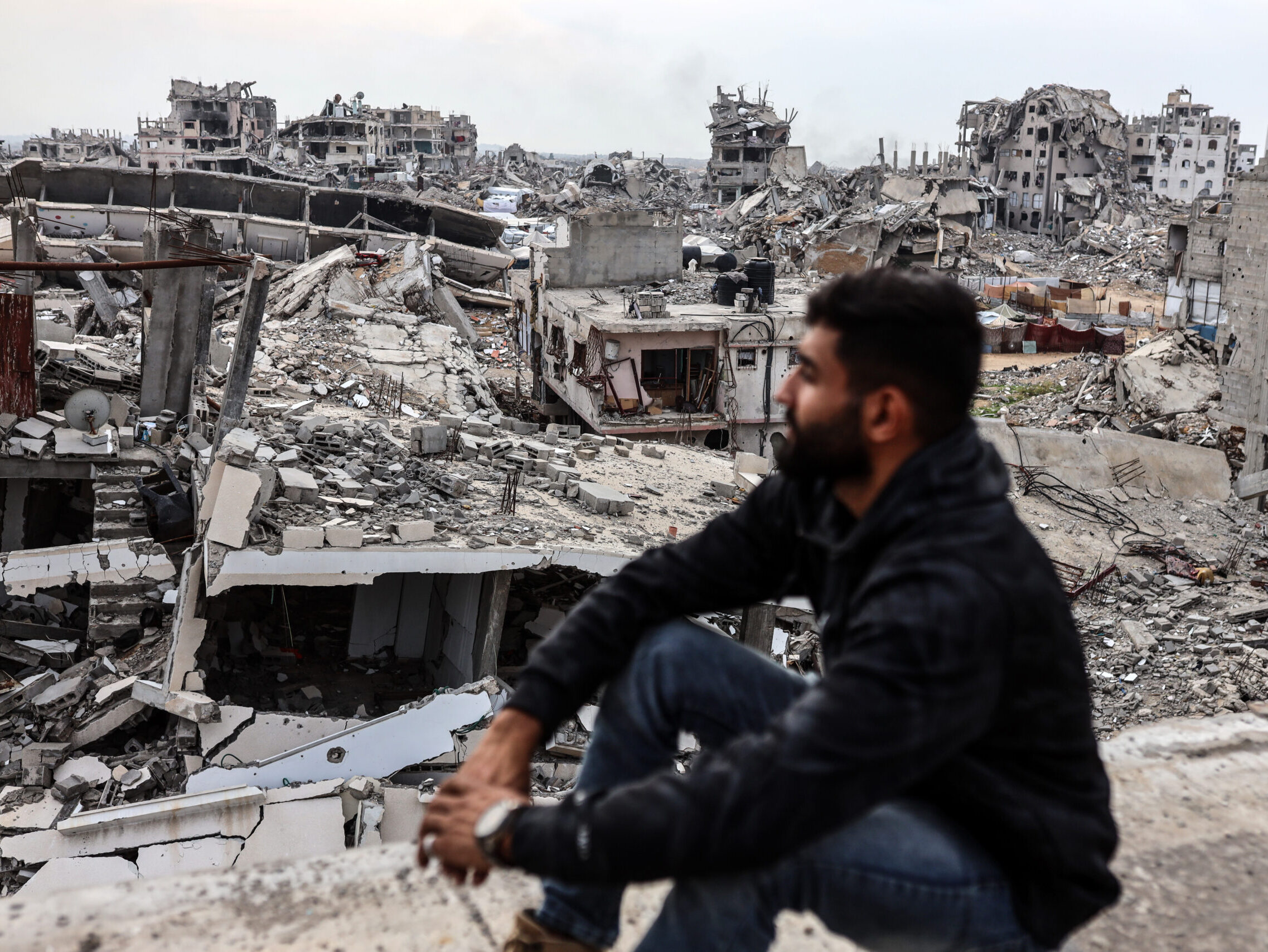
Image: Palestinians walk amid the rubble of destroyed buildings in Gaza City, on November 29, 2025. The Gaza Strip is largely reduced to rubble after two years of fighting, sparked by Hamas's attack on Israel on October 7, 2023, which results in the deaths of 1,221 people. Israel's retaliatory assault on Gaza kills at least 69,733 people, according to figures from the health ministry that the UN considers reliable. (Photo by Majdi Fathi/NurPhoto)