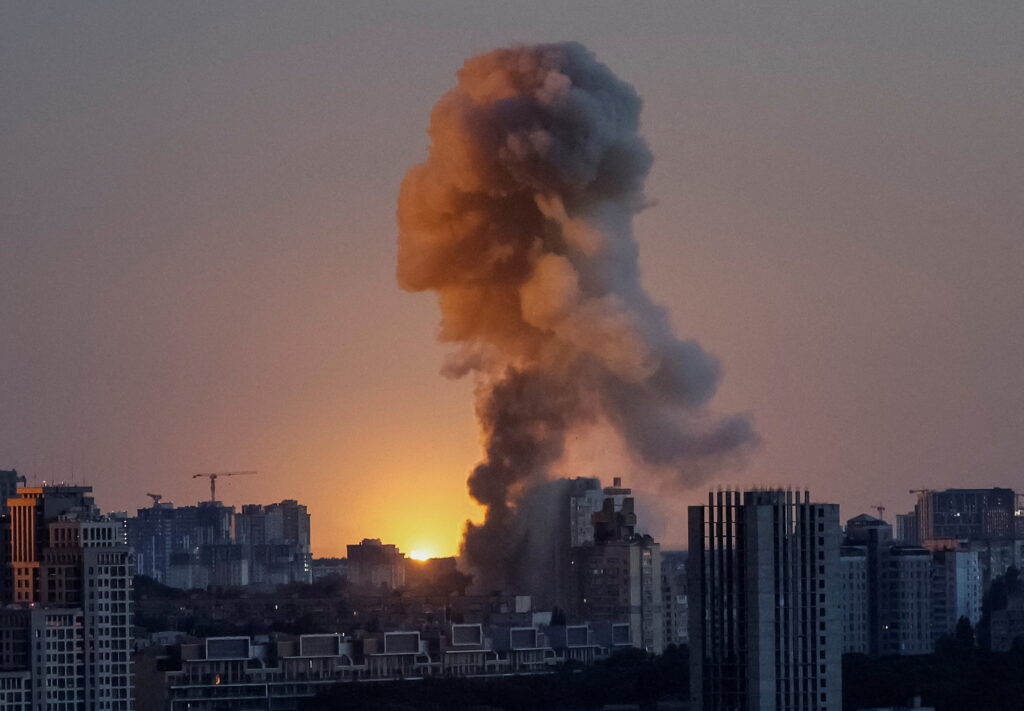
The first signs of spring have been particularly welcome in Ukraine this year as the country begins to emerge from the toughest winter in living memory. Since late 2025, millions of Ukrainians have been plunged into subzero darkness as Russia relentlessly bombed heating and energy networks amid Arctic weather in a bid to freeze the country into submission.
Despite rising temperatures, the Ukrainian civilian population will almost certainly continue to face challenging conditions in the coming months as the strategic emphasis of Russia’s invasion turns increasingly toward destroying Ukraine’s infrastructure and making the country unlivable. This shift reflects changing military realities, with Putin’s invading army unable to achieve any major breakthroughs while suffering catastrophic casualties.
Russia has held the battlefield initiative since late 2023 but has only managed to capture around one percent of additional Ukrainian territory during this period at enormous cost in terms of both manpower and equipment. With drones now dominating the front lines, the potential for conventional large-scale offensive operations has been greatly reduced.
This is forcing Putin and his generals to rethink. The Kremlin dictator remains determined to extinguish Ukrainian independence and force Ukraine permanently back into the Russian orbit. However, he knows that there is little prospect of achieving his ambitious objectives via the bloody battles currently taking place over the rust belt towns and villages of eastern Ukraine’s Donbas region.
In order to break this strategic deadlock, Russia aims to systematically dismantle the conditions that allow Ukraine to function as a state. This means the continued bombardment of energy infrastructure throughout the country; it is also likely to involve expanded attacks on other crucial public utilities, such as municipal water services and sewage treatment. In parallel, Russia will increase strikes on civilian transport with an emphasis on Ukraine’s logistically vital rail network.
The end goal is to deprive Ukraine of the industrial capacity to defend itself and destroy the basic amenities to sustain even a minimum standard of living. Kremlin officials hope this will break Ukrainian morale and enable Putin to dictate the terms of peace.
Stay updated
As the world watches the Russian invasion of Ukraine unfold, UkraineAlert delivers the best Atlantic Council expert insight and analysis on Ukraine twice a week directly to your inbox.
Russia has made no formal declarations regarding its intentions, but the strategic shift toward the bombardment of infrastructure over the past year has been unmistakable. In 2025, Russia launched around 55,000 kamikaze drones at targets in Ukraine, representing a fivefold increase from the total one year earlier. Attacks have sought to deprive individual cities of power while severing Ukraine’s national energy network along the Dnipro River.
The impact of this bombing campaign extends far beyond civilian suffering. By cutting off major power generation assets and disrupting connectivity, Russia is pushing the entire grid into a near-permanent state of emergency. This is placing heavy strain on Ukraine’s defense industry, which is often deprived of the electricity it needs to function. With Kyiv now relying on domestic defense sector output to cover around 50 percent of the country’s military needs, this disruption to production poses a grave threat to national security.
Eurasia Center events

The coming spring season will be crucial. The next few months of warmer weather should be Ukraine’s window to rebuild and recover lost industrial capacity. However, Moscow will be working hard to slam that window shut with waves of attacks made possible by Russia’s surging domestic drone production.
The continued bombardment of infrastructure targets across Ukraine will also help exhaust the country’s limited air defense ammunition supplies. Every interceptor missile used to defend a Ukrainian city or a power substation is one less available to cover front line positions. This will force Kyiv to prioritize between protecting the civilian population or shielding soldiers in the combat zone.
Another key feature of the war during the first half of 2026 will be escalating Russian attacks on Ukraine’s railways. Recent strikes on key routes linking Ukraine to Poland indicate that this campaign is already well underway. Any major disruption to rail services could cause significant economic damage and prevent millions of Ukrainians from traveling. More importantly, it would leave the army under-supplied and logistically isolated during the height of the summer campaigning season when Russia’s offensive capacity is expected to peak.
It is still not too late to counter the Kremlin’s plans, but the clock is ticking. Kyiv’s partners must urgently enhance Ukraine’s air defense capabilities and provide the country with more systems to protect the expanding list of potential infrastructure targets. Efforts should also be made to fortify strategic sites and anticipate future repair requirements by providing likely replacement components in advance.
Russia’s current strategy should come as no surprise. At the very start of his reign, Putin learned in Chechnya that pulverizing infrastructure was a reliable path to victory in a conflict that conventional military force could not resolve. In 2003, the United Nations reportedly called Chechen capital Grozny “the most destroyed city on earth.”
The Kremlin dictator now plans to secure victory in Ukraine by employing similar tactics. If Ukraine’s electricity grid and critical infrastructure are allowed to fragment further, the authorities in Kyiv may find themselves literally powerless to defend their country.
William Dixon is a senior associate fellow at the Royal United Service Institute specializing in cyber and international security issues. Maksym Beznosiuk is a strategy and security analyst whose work focuses on Russia, Ukraine, and international security.
Further reading


The views expressed in UkraineAlert are solely those of the authors and do not necessarily reflect the views of the Atlantic Council, its staff, or its supporters.


The Eurasia Center’s mission is to enhance transatlantic cooperation in promoting stability, democratic values, and prosperity in Eurasia, from Eastern Europe and Turkey in the West to the Caucasus, Russia, and Central Asia in the East.
Follow us on social media
and support our work
Image: An explosion of a missile lights up the sky over the city during a Russian drone and missile strike, amid Russia's attack on Ukraine, in Kyiv, Ukraine. June 23, 2025. (REUTERS/Gleb Garanich)