While all eyes are on competing global powers such as the United States, China, and Russia, “middle powers” such as Turkey, the United Arab Emirates (UAE), Qatar, Saudi Arabia, Iran, Indonesia, Malaysia, and other nations are making remarkable breakthroughs on the African continent. This engagement is profoundly reshaping the African theater.
Their recent footsteps on the continent are becoming more and more attention-grabbing. These include Saudi companies buying 2.2 million tons of carbon credits at a 2023 Kenya auction and, in 2024, the UAE becoming the biggest investor in new business projects in Africa—including an investment of $4.5 billion in clean energy on the continent. At the same time, global attention has focused on Khartoum’s suit at the International Court of Justice alleging UAE involvement in the civil war in Sudan, which broke out in early 2023. The UAE has denied supporting the Rapid Support Forces paramilitary group.
In 2024, the third Qatar Africa Business Forum took place, following the Chinese, Russian, Japanese, US, and European Union summits with African nations. Doha has also been hosting the peace talks between the DRC and Rwanda through the M23 since March 2025, with the meeting between Congolese President Felix Tshisekedi and Rwandan President Paul Kagame under the aegis of the Emir of Qatar, Sheikh Tamim bin Hamad Al Thani. Before the October 7 Hamas attacks, Israel hoped to join this geopolitical trend with the goal of amplifying its ties with African partners beyond traditional security issues. In 2023, Japan celebrated the thirtieth anniversary of the Tokyo International Conference on African Development. Meanwhile, Indonesia sealed $3.5 billion in business deals from the Indonesia-Africa Forum in 2024, nearly six times the amount generated at the first forum six years ago.
As middle-power nations position themselves on the international scene, they are entering into direct competition with global powers such as the United States, China, and Russia. Moreover, new tensions are emerging among middle powers. For example, in April 2025, India held its first-ever Africa-India Key Maritime Engagement (AIKEYME) exercise, co-hosted with Tanzania and involving nine other African nations such as Kenya, Madagascar, South Africa, Djibouti, and others. Part of India’s motivation for this exercise is to offer a non-coercive security alternative in the Indian Ocean—countering China’s increasingly dominant maritime presence in Africa. Observers see India’s large-scale naval outreach as part of a broader geopolitical push: by strengthening maritime ties, India is increasing its influence in Africa at the expense of China’s traditional footprint there.
Even for closer allies such as China and Russia, a competition can exist: Russia providing security, weapons, and political backing in insecure regions risks undermining China’s investments focused on long-term economic stability (infrastructure, trade).
These moves have been triggered by three major internal changes that occurred on the African continent in the past few years: population growth, pro-sovereignty sentiment, and industrial transformation.
The African century
First, Africa is poised to become the next “demographic champion,” behind India and China. It is already on track to double its population by 2050, and may be the most populous continent by the end of the century. On the youngest continent in the world, this shift will have a strong economic impact on business markets with a rising group of African workers, consumers, and clients. The continent had already launched the largest free trade area in the world with the 2018 signing of an agreement to create the African Continental Free Trade Area. The numbers confirm these structural shifts. In February 2024, the African Development Bank noted that Africa featured prominently in a list of the world’s fastest-growing economies in 2024 and had better-than-average growth prospects in 2025, subject to global shocks. Sub-Saharan economic growth averaged 4.0 percent in 2024, exceeding expectations by 0.4 percentage points—but global shocks created a “sudden shift in the economic landscape,” including higher tariffs and greater uncertainty, according to the IMF’s April 2025 sub-Saharan report. When the IMF lowered the global growth outlook for 2025 by 0.5 percent, it trimmed sub-Saharan Africa’s outlook by 0.4 percentage points to 3.8 percent, noting that “regional growth is now expected to slow this year.”
Second, internal sentiment has led to significant external changes. A feature of African public opinion is a strong eagerness to protect African nations’ sovereignty against former colonial powers like France, with collateral impact on those powers’ allies: After France withdrew its military forces from Niger, the United States was asked to close its military bases there in July 2024 and in Chad in May 2024.
Nations without a colonial past in Africa have also faced criticism and pushback, including a growing call for transparency and value creation when it comes to Chinese lending practices and mining exploitation. Meanwhile, Russia’s Africa Corps (the successor to the Wagner Group) has regularly been exposed for its contribution to deadly attacks in the Sahelian countries they are supposed to be supporting with security assistance. The strong aspiration for greater African sovereignty is not limited to authoritarian regimes in the Sahelian countries—Mali, Niger, Burkina-Faso, and Chad—that recently experienced coups d’états. Democratic regimes such as Senegal are pivoting toward a more independent path as evidenced by the presidential campaign of April 2024 and the victory of a “patriotic” candidate.
This powerful trend is visible in various sectors, from defense policy (with the end of military cooperation agreements) to currency (with the growing rejection of the France-linked CFA franc), energy (with new norms of mining exploration), and even arts (with the restitution of African cultural heritage).
Third, industrial transformation has become a priority for many African countries. Observing that humanitarian aid and assistance have not always been productive and cannot meet their huge development needs, most African countries prioritize a transformation-driven vision. In the energy sector, where Africa is home to 30 percent of the world’s critical mineral reserves (cobalt, lithium, rare earth elements, copper, chromium, graphite, manganese, and platinum), expectations for what the sector can deliver are higher than ever. And in Africa’s underdeveloped manufacturing sector, there is “a significant opportunity to leapfrog more developed nations and build a thriving low-carbon manufacturing sector from the ground up,” according to a McKinsey & Company report; to do so would likely require investments of roughly $2 trillion to spur “decarbonization-fueled growth.” Therefore, the question is simple: How can Africa move from the extractive, even predatory, model of which it has often been victim to one that guarantees economic diversification, infrastructure development, increased revenue, fiscal stability, improved environmental management, and workforce training?
Within this transformative context, rising middle powers are playing an opportunistic card to capture the new African demands and take advantage of the diversification of African partnerships. Indonesia, for example, which needs more critical minerals (such as lithium) to feed its electric-vehicle (EV) battery industry, is actively positioning itself in Africa’s mining space, in partnerships and not necessarily at the expense with African states.
This is quite significant because it shows Indonesians are not only investing in resource-rich African countries, but also partnering with local state mining firms. For example, PT Timah (an Indonesian tin mining company) has a signed memorandum of understanding with Stamico, a Tanzanian state-mining corporation, to explore tin, nickel, gold, and even rare earth elements.
Returning to Africa for the twenty-first time on the occasion of the thirty-seventh Ordinary Session of the Assembly of the Heads of State and Government of the African Union, Brazil’s President Luiz Inácio Lula da Silva noted that “more than half of the 200 million Brazilian citizens recognize themselves as Afro-descendants.” During Lula’s first presidency, Brazil opened nineteen African embassies. Meanwhile, India showcased its support for the African Union’s Group of Twenty (G20) permanent seat in September 2023.
Regional routes
Very often, investment expansion starts with a bold airline strategy. Consider Turkish Airlines, which connects more than sixty African destinations and has long been a key tool for Turkey’s influence in Africa. Thanks to its “Action Plan for Africa” in 1998 and its “Opening to Africa” program launched in 2005, Turkey’s international outreach to sub-Saharan Africa has flourished, while the European Union’s doors remain closed to Ankara. Turkey has expanded trade ties with African partners, with bilateral trade growing from $5.4 billion in 2003 to $40.7 billion in 2022. The number of Turkish embassies has also increased from twelve to forty-three between 2009 and 2021.
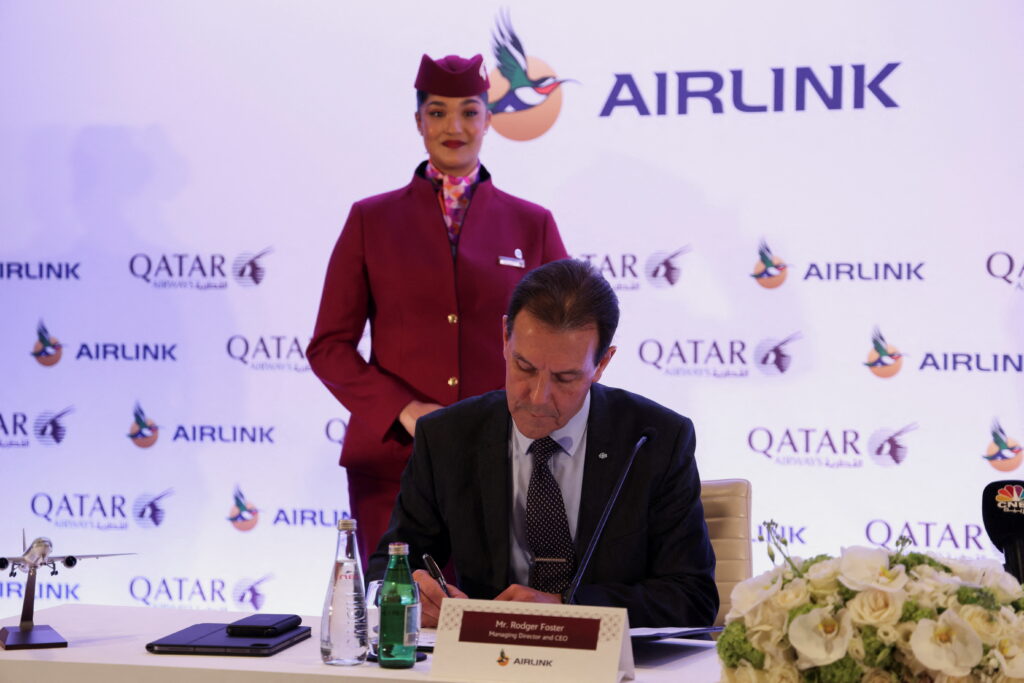
Qatar is taking similar steps, with Qatar Airways investing $1.3 billion to acquire 49 percent of RwandAir in 2020 and, more recently, a 25 percent equity stake in one of Africa’s largest regional airlines, Airlink, which serves fifteen African countries and flies to forty-five destinations.
Building on this experience and taking advantage of their geographical proximity, many Muslim countries in the Middle East have been developing ties with African countries. Water, forests, land, critical minerals: Africa has strategic resources Gulf countries lack. From 2016 to 2023, the commercial volume generated between the Gulf Cooperation Council (GCC) countries—the UAE, Saudi Arabia, Qatar, Kuwait, Bahrain, and Oman—and Africa doubled to $121 billion, according to Afreximbank. The pan-African organization notes that those investments come primarily from the UAE (54.9 percent), Saudi Arabia (25.6 percent), Qatar (7.2 percent), Kuwait (5 percent), and Bahrain (4.2 percent); they have been directed to Egypt (69.8 percent), Morocco (4.6 percent), Algeria (3 percent), Nigeria (2.6 percent), and South Africa (2.3 percent).The level of direct investments in Africa between 2012 and 2022 has outpaced $100 billion, while the Gulf countries spent $9.2 billion in aid in 2022 (equal to 14 percent of global aid received by African countries). The key sectors of investment are construction, environmental technology, energy, transportation, and agribusiness.
What is a middle power?
Despite their geographical diversity, the middle powers that have emerged on the African scene in a significant way share common features.
For sure, we know they are neither superpowers like the Cold War’s United States and USSR nor hyperpowers as the United States was named following the collapse of the Soviet Union in 1991. They don’t belong to the P5, the group of permanent members of the United Nations Security Council (China, France, Russia, the United Kingdom, and the United States). Economically speaking, they are not yet among the richest countries in the world (based on gross domestic product): the United States, China, Germany, Japan, India, the United Kingdom, France, Italy, and Canada. (The case of India is discussed below.) But many are close: Brazil (tenth place), South Korea (twelfth), Indonesia (sixteenth), Turkey (seventeenth), Saudi Arabia (nineteenth), and the UAE (twenty-seventh). Even if some have not reached the top thirty, their ambitions are large enough to place them among Africa’s rising partners, such as Qatar (in fifty-fifth place), which pledged to invest $103 billion across six African countries in 2025.
Beyond belonging to the group of high-GDP countries, middle-power nations have four other common characteristics:
- They make demonstrations of power: e.g., South Africa referred a case to the International Court of Justice in May 2024 accusing Israel of “genocide” in Gaza.
- Middle powers can belong to the neighborhood, like the Gulf countries, or be located far away like South Korea, which organized a June 2024 African summit attracting forty-eight African delegations.
- Their influence is contained because a regional power is not autonomous: It belongs to a more global system of influence like Turkey, which may be expanding its diplomacy in Africa but is limited by its NATO membership.
- Middle powers must be creative by deploying indirect persuasion techniques on the ground: In 2017, Turkey persuaded Senegal to close schools linked to Fethullah Gülen, a cleric Ankara alleges was behind a 2016 coup attempt.
The cases of Russia and India
While some of the countries mentioned above clearly belong to the category of middle powers, two cases remain difficult to classify.
After losing the Cold War and its empire in 1991, Russia, now the world’s eleventh largest power in terms of GDP, has since sought to move from a Eurasian middle power, integrated into the Commonwealth of Independent States, to a global power that spans from its position within the Shanghai Cooperation Organization as far as Africa with the newly renamed Africa Corps, which deploys propaganda operations there.
As for India, the most populous country and the fifthlargest economic power in the world, it has been able to expand its influence in Africa thanks to the longstanding presence of its diaspora in the east of the continent as well as its involvement in the Non-Aligned Movement, which emerged from a summit in Bandung, Indonesia, in 1953.
The uncertainty about the position of Russia and India is not due to their economic power—they are both among the richest countries in the world—but stems from the fact that these two countries have more impact than the middle powers but less than the global powers. They have features of both groups. Time will tell where they will fall. Thus, while Russia was the leading supplier of arms to Africa ($14.6 billion) in 2021—far ahead of the United States ($5.4 billion)—the level of its trade with Africa has remained very low. According to European data, in 2022, Africa’s imports from Russia were less than 2 percent of its total imports; and African exports to Russia were less than 1 percent of Africa’s total exports. This supports the idea that even as trade has grown in absolute terms, Russia is still not a major economic partner for Africa compared to the European Union or China.
Three weight classes
The middle-power nations can be divided into three groups, depending on their economic weight and the depth of their engagement in Africa:
- Level 1: UAE, Brazil, and Turkey
- Level 2: Iran, Indonesia, Saudi Arabia, and Qatar
- Level 3: South Korea and Malaysia
They are all benefiting from the retreat of the former colonial powers, which are essentially European, the most striking expression of which is France in the Sahel. Also of note is the relative weakening of superpowers in Africa: According to a recent Gallup report, China surpassed the United States in popularity on the continent in 2023. At the same time, China’s dominant position is no longer so hegemonic: While the value of China-Africa trade has increased nearly thirty-fold since 2000 to reach $282 billion in 2023—making China Africa’s largest trading partner—China’s official loans totaled less than $1 billion in 2022 for the first time in eighteen years, according to Boston University’s Global Initiative for China. When the world powers are less involved, there is a vacuum that the middle powers have been quick to fill. And African nations are among those interested in interacting with them in regional groups such as the BRICS: South Africa, Ethiopia, and Egypt have all joined the intergovernmental organization.
Creativity and boldness
In any case, the tools of influence that the middle-power nations deploy in Africa are different from those of the traditional powers. Thus, the UAE has established itself, with its maritime giant Dubai Ports World, as one of the world’s largest port operators in the strategic areas of the Red Sea and the Indian Ocean, with the aim of being less dependent on hydrocarbons and ensuring its food security. The cultural influence of regional powers, which is less well-known, has also been crucial in recent years. For example, Saudi Arabia’s investments in West African education systems have increased the use of the Arabic language. The Indian diasporas have served as an effective support for India’s strategy, whose successful Bollywood films participate in the information war. The Qatari channel Al Jazeera and the Turkish news agency Anadolu cover the continent widely. Many middle powers broadcast their messages in local African languages; Turkey’s TRT and Natural TV offer programs in Hausa and Swahili and television series popular in many countries.
As a result, these middle powers have acquired considerable political influence. India took advantage of its presidency of the G20 in September 2023 to take credit for the African Union’s permanent seat in the G20. In 2015, many African countries, including Niger, Chad, and Mauritania, joined the founding members of the Islamic Military Counterterrorism Coalition, created by Saudi Arabia.
While none of these middle powers has been able to replace the traditional global powers or former colonial powers such as France or the United Kingdom in terms of engagement volume, their growing influence on the continent puts them in a position of strength. The competition will not, however, benefit everyone in the long run. No doubt the future belongs to the powers that can navigate the shifts already underway by forming complementary and winning alliances in a more complex geopolitical scene—dominated by interests, not ideology. This is undoubtedly the reason why, in the African theater, Russia and Iran are seeking closer cooperation, as, separately, China and Russia are as well. On these complex alliances, the Western powers are behind. Meanwhile, regional powers may need to clarify their intentions in Africa, such as the case of the UAE in the bloody civil war in Sudan, in order to preserve their comparative advantage vis-à-vis the informed African public, aware of what is happening on their soil.
About the author
Related content


Explore the program
The Africa Center works to promote dynamic geopolitical partnerships with African states and to redirect US and European policy priorities toward strengthening security and bolstering economic growth and prosperity on the continent.
Image: Airlink's CEO Rodger Foster, attends a signing ceremony, in Doha, Qatar, August 20, 2024. Source: REUTERS/Ibraheem Abu Mustafa