As US talks with Russia and Ukraine intensify, attention has turned to the potential terms for a settlement to end the war. Amid recent developments, Turkey has expressed cautious optimism about the path toward peace. Turkish Foreign Minister Hakan Fidan told Die Welt this week that a Ukraine-Russia agreement could secure regional peace for fifty to seventy years, saying such a deal should oblige both sides “not to attack each other under any circumstances.”
However, a premature deal that favors Russia or leaves Ukraine without credible and functional security arrangements would threaten Turkey’s own security, influence, and strategic position in the region. For Ankara, the consequences of a lopsided peace deal that advantages Moscow will continue to be felt long after the immediate cessation of hostilities. Any peace that cements Russian gains would alter the balance of power in the Black Sea region and constrain Turkey’s geopolitical footprint for decades.
The downside for Turkey in recent “peace” proposals
A “Russia-friendly” peace deal—one that legitimizes occupation or implicitly accepts the Kremlin’s claims to expand its territorial gains in Ukraine—would destabilize the region and seriously damage Turkey’s long-term position. A weakened Ukraine, stripped of its territorial integrity and military capacity, would alter the balance of power in the Black Sea in Russia’s favor—a scenario for which Turkey would pay a heavy price. From Crimea to the Caucasus, the consequences would reverberate across Ankara’s geopolitical environment.
As Turkish President Recep Tayyip Erdoğan said last month, a peace plan can only be acceptable if it “meets the legitimate expectations and security needs of both sides, without creating new instability.” And Turkish analysts warn that an unfavorable settlement for Kyiv would directly undermine Turkey’s strategic interests, as Russia has not abandoned its imperial ambitions to reassert control over the former Soviet space—from the South Caucasus and Central Asia to the Baltics.
For its own interests, Turkey should take a strong stance—particularly in its diplomatic interactions with the United States—that any proposal that cements Russia’s territorial gains and prepares the battlefield for Moscow’s next offensive is unacceptable and dangerous for the region.
If territorial concessions formalize Russia’s control over eastern and southern Ukraine and the Sea of Azov, Moscow would effectively turn it into a Russian inland sea. Combined with Russia’s attempts to militarize and dominate the wider Black Sea, this would reverse the naval balance of power, which has been favorable to Turkey since Ukraine’s successful attacks on Russia’s Black Sea fleet.
Crimea is a particularly sensitive issue. For Turkey, it is not an abstract bargaining chip—it defines forward posture in the Black Sea and is home to a Tatar community with deep cultural and historical ties to Ankara. Any deal legitimizing its illegal annexation would not only be a diplomatic defeat for Ukraine; it would be a strategic blow to Turkey. Any deal that allows Russia to expand or consolidate territorial gains would embolden Moscow, enable it to revive its naval capabilities, and deepen its foothold in the wider Black Sea region. Such an outcome would not only threaten Ukraine but also constrain Turkey’s influence from the Caucasus to the Middle East and North Africa and beyond.
What can Ankara do?
While the current talks are being held between US, Russian, and Ukrainian negotiators, European countries have also been conducting diplomatic outreach to Washington to advocate their positions on elements of a potential peace deal that are critical for their interests. Turkey should do the same. Turkey possesses real leverage—diplomatic, economic, and military—to influence the outcome of the peace talks aimed at ending the war. The country’s leaders should not shy away from using it.
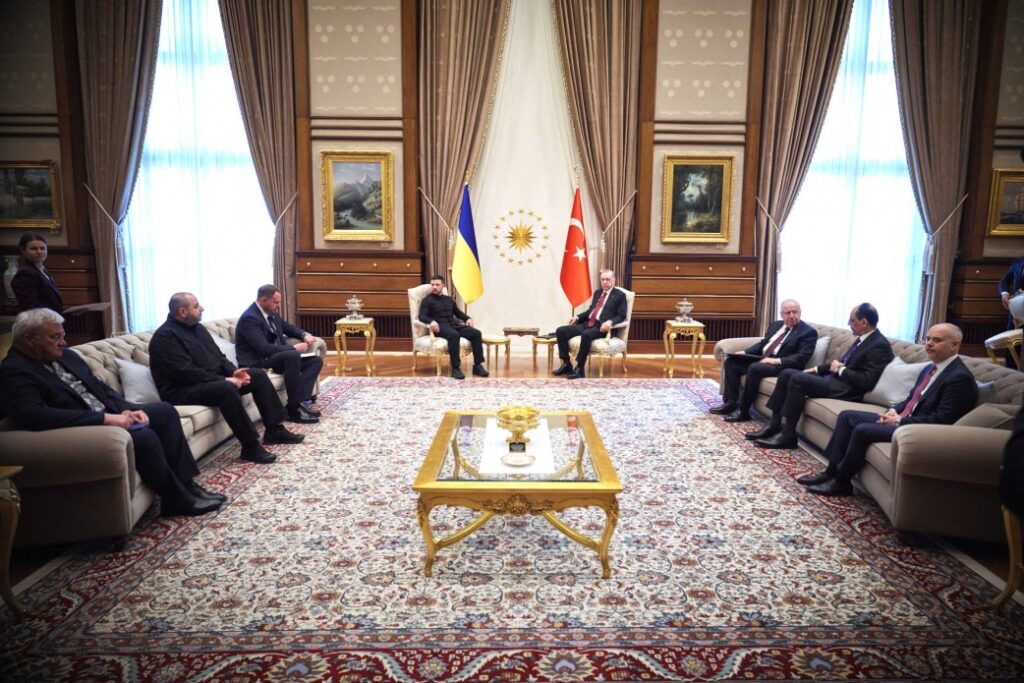
Turkey’s role as a mediator between Russia and Ukraine, especially on the humanitarian track, remains important. For Ukraine, the return of abducted Ukrainian children and all prisoners of war and political detainees, including Crimean Tatars and religious prisoners, is a “mandatory element” for any peace process. During Ukrainian President Volodymyr Zelenskyy’s visit to Ankara last month, these issues were at the core of his discussions with Erdoğan. Taking a proactive role in advocating for the return of Ukrainian prisoners of war and abducted children—including by raising these issues in bilateral engagements with Russia and in multilateral diplomatic fora—would bolster Turkey’s reputation as a key regional actor, humanitarian power, and credible mediator.
Beyond pressing for a fair deal in peace negotiations, Turkey must also take the lead in the maritime coalition of the willing and step up efforts to restore rules-based order and stability in the Black Sea. As NATO’s largest naval power in the region, Ankara is central to regional deterrence. Moscow’s aggression has increasingly spilled into NATO’s maritime space, directly affecting Turkey and Romania. Last month, a Turkish liquefied natural gas tanker operating in the Ukrainian Danube port of Izmail—mere meters from the Romanian border—was struck by Russian drones. Since Russia’s full-scale invasion, several other Turkish or Turkish-flagged vessels have been struck by missiles in Ukrainian ports, including the seaports of Odesa and Kherson. According to the Black Sea Monitoring Group, more than 40 percent of vessels entering Greater Odesa ports this year belong to Turkish companies, the largest share of any country. Thus, these attacks significantly undermine Turkish trade across both the Black Sea and the Danube.
Overall, this year alone, at least fourteen vessels have been hit in Ukrainian Black Sea ports. These are not isolated incidents, but clear indicators of Russia’s attempt to weaponize maritime trade, intimidate neighbors, and test the resolve of Turkey and NATO. Russia has targeted logistics nodes such as the Orlovka–Isaccea ferry terminal, struck Danube ports, and breached Moldovan and Romanian airspace with drones.
On the economic front, Russia has intensified the use of a “shadow fleet” of unregistered, sanctions-evading tankers transporting oil and military dual-use cargoes. This past week, Ukrainian naval drones struck two shadow fleet vessels, demonstrating that Kyiv is determined to deprive Russia of this source of revenue for its war machine. To keep the Black Sea stable, Turkey should step up efforts to counter the shadow fleet, prevent illicit maritime traffic, and ensure that the Black Sea does not become a safe haven for sanctions evasion.
Turkey has expressed concern over the attacks on oil tankers off its Black Sea coast arguing they “have posed serious risks to navigation, life, property and environmental safety in the region.” While Turkey’s call to protect commercial vessels is legitimate, it can hardly extend to unregistered—and therefore unlawful—vessels. Moreover, no comparable arrangements exist to safeguard official commercial shipping bound for Ukrainian ports, which remains subject to sustained Russian attacks.
Limits to only Ukraine’s actions cannot credibly be framed as de-escalatory, as they increase the risk of Russia’s unilateral escalation. Given that sea lanes and energy-export revenues are central to the Kremlin’s war effort, targeting oil tankers and related infrastructure is one of the few effective means of imposing costs and constraining Moscow’s ability to finance the conflict—an approach that may bring an end to the war closer.
To deter Russia’s maritime and aerial attacks, Ankara should invest more political capital and capabilities into the maritime coalition of the willing. Turkey should encourage the expansion of trilateral formats such as the Bulgaria–Turkey–Romania demining group, broadening its mandate to include sea patrols, critical infrastructure protection, and maritime domain awareness. It should deepen coordination with Romania on air defense and contribute to a “Black Sea sky shield” capable of monitoring Russian drone incursions and protecting critical maritime infrastructure and port facilities. Turkey must also continue to restrict the passage of Russian warships through the Dardanelles and Bosporus Straits under the terms of the Montreux Convention—a measure that has prevented Moscow from rapidly reconstituting its naval forces. These steps could serve as real “security guarantees” under any peace plan, rendering Russia’s war in the maritime and air domains operationally pointless.
Turkey has a right to protect its regional interests
Turkey should oppose several potential terms that have been discussed in recent rounds of peace talks.
First, any cap on Ukraine’s armed forces would undermine Turkey’s own deterrence posture. A militarily constrained Ukraine is not a buffer; it is an invitation for renewed Russian aggression and a weakened front line for European security. Ankara does not benefit from a disarmed Ukraine. It benefits from a capable Ukraine that can prevent Russia from projecting power across the Black Sea.
Second, Turkey should reject restrictions on Ukraine’s international defense-industrial cooperation. Ankara has invested heavily in joint development with Kyiv—in drones, naval systems, and engines—which strengthens both countries’ strategic autonomy. Blocking Ukraine’s access to advanced defense ecosystems would weaken Kyiv and strike at Turkey’s ambitions to become a leading regional producer of defense technologies.
Third, Turkey should resist attempts to impose “neutrality” on Ukraine. Turkey has historically supported Ukraine’s integration into NATO because a NATO-aligned Ukraine strengthens the collective deterrence against Russia in the wider Black Sea region. Ukrainian membership would reinforce NATO’s southeastern flank, helping protect the Alliance against Russia, Iran, and other revisionist actors.
More fundamentally, the idea that great powers may unilaterally impose their terms on other nations contradicts Turkey’s worldview: that sovereign states—including regional powers—must have agency to decide their own geopolitical orientation.
The interests of Ukraine, Turkey, and NATO are aligned: deterring Russia, protecting maritime infrastructure, preserving sovereignty, and preventing the normalization of territorial aggression. At this critical moment, Turkey cannot wait until the United States and Russia negotiate outcomes that reshape its neighborhood. It must reassert regional leadership, defend its strategic interests, and help secure a sustainable peace in Ukraine and in the Black Sea.
Yevgeniya Gaber is a nonresident senior fellow at the Atlantic Council Turkey Program. She previously served as a Ukrainian foreign policy adviser and diplomat, including serving in the Ukrainian embassy in Ankara from 2014 to 2018.
The views expressed here are the author’s own and do not represent the official positions of the Atlantic Council or any other institution or government.
Related Reading
Image: Handout - Ukrainian President Volodymyr Zelenskyy meets Turkish President Recep Tayyip Erdogan at the Presidential Complex on May 15, 2025 in Ankara, Turkey. Zelenskyy arrived to attend the Russian-Ukrainian peace talks. Photo by Ukraine Presidency/ABACAPRESS.COM
