Since Russia’s full-scale invasion of Ukraine, the Kremlin has increasingly militarized the Black Sea region, presenting a threat to both NATO and its littoral partners, especially Ukraine and Moldova. Indeed, the region has become a testing ground for Russian hybrid warfare operations. These operations, which engage adversaries below the threshold of war, often seek to undermine civil society with tactics such as assaults on the integrity of elections, attacks on infrastructure, and information warfare.
These tensions have resulted in a new geopolitical landscape in the region, one in which any crisis should be analyzed through the lens of possible Russian subversion or interference. This reality is already reordering regional dynamics. The Kremlin’s militarization of the Black Sea has highlighted littoral allies’ vulnerabilities, including energy availability, gaps in the defense and technological industrial base (DTIB), reinvigorated nationalist and secessionist movements, and challenges to maritime traffic and commercial activity. And the Black Sea’s insecurity has implications far beyond its regional boundaries. Most recently, Russia’s drone and fighter jet actions have violated the airspace of Romania, as well as that of Poland and Estonia, demonstrating that Moscow’s hybrid aggression in the region threatens to spill over into equally vulnerable neighboring states.
To help secure the region and deter further Russian aggression, littoral allies must enhance their energy security and bolster the DTIB, those enterprises and institutions that provide the materials, products, and services vital to national defense. The wider Black Sea region boasts vast oil and gas reserves, and new offshore discoveries link the region with the global economy, while pipelines and commercial maritime activity act as a conduit. As a high-value commodity, hydrocarbons are a prime target for an adversary willing to destabilize an enemy’s economy, military readiness, and civil society.
For example, hybrid threats to offshore energy infrastructure could cause considerable disruptions to countries’ entire energy sectors. Romania’s Neptun Deep and Turkey’s Sakarya gas fields are especially exposed to such risks, requiring new technologies, such as unmanned undersea systems, to counter these hybrid threats. The Black Sea littoral states are also vulnerable to Russian-sponsored lawfare and maritime coercion, including the use of floating mines and other threats to maritime traffic and naval operations. Russia has designated large sections of the Black Sea off limits to maritime traffic for the purpose of military exercises, which impede freedom of navigation and commercial activity. These exercises are often unannounced or conducted with little advance warning, reducing investor confidence, creating timetable delays, and eroding the Black Sea’s longstanding maritime legal regime.
Black Sea regional stability is key to deterring Russian expansion into Eastern Europe, where the Kremlin wishes to splinter NATO and widen its sphere of influence. China and Iran are also trying to gain regional influence, leading to greater tensions on NATO’s southeastern flank. As Russia’s long-term goals in the wider Black Sea region are diametrically opposed to those of the West, much remains to be done to advance a counterstrategy. The Black Sea region’s instability demands greater transatlantic engagement across all domains and economic sectors. The United States’ Black Sea strategy, which was proposed in 2023 under the 2024 National Defense Authorization Act, has languished. On May 28, 2025, the European Commission submitted a Black Sea strategy, but it is too soon to evaluate its impact.
Over the long term, there is a need for more resilient civil-military infrastructure, as well as for increased military capability and interoperability in the region. While all the Black Sea littoral states will benefit from a continued transatlantic presence, three nations in particular stand out. Ukraine is bearing the brunt of Russian aggression in Eastern Europe. Romania’s size, strategic location, and strong transatlantic credentials have positioned it to become a military and economic hub, particularly as more NATO assets are deployed there. Turkey, with its burgeoning defense industry, has NATO’s second-largest military and serves a vital security role as the Alliance’s guardian of the straits, as codified under the Montreux Convention of 1936. NATO’s Black Sea states have taken the initiative in the face of growing regional threats from Russia. For instance, in January 2024, Romania, Turkey, and Bulgaria signed the Mine Counter Measures, which creates a framework for joint efforts to address naval mine threats and improve operational coordination among Black Sea NATO allies.
Countering Russian aggression in the wider Black Sea region will be expensive in both funds and political capital. It will also require greater collaboration among the Black Sea’s non-Russian littoral states. While not a NATO member, Ukraine has emerged as Europe’s most seasoned military power, capable of rapidly innovating and deploying new technologies. For example, Ukraine’s use of unmanned systems has inflicted considerable losses on the Russian Black Sea fleet, forcing it to disperse to safer ports and diminishing its effectiveness. In this regard, the Alliance has much to learn from Ukraine, particularly in twenty-first century multi-domain operations.
Whether or not a lasting cease-fire is implemented in Ukraine any time soon, Russian aggression has forever altered the Black Sea region’s security landscape. This escalation of the Black Sea’s militarization has heightened tensions, forcing regional governments to allocate increasing portions of their budgets to defense. All this portends greater destabilization, increased national debts, and the absence of a predictable commercial environment well into this century.
An effective response from NATO allies and partners requires novel and forceful policies that energize governments and private sectors to address key weaknesses in energy security and the DTIB. Indeed, a special emphasis should be placed on the private sector, which has demonstrated tremendous innovation and flexibility in the rapidly evolving battlespace.
While Kyiv’s role as a bulwark against Russian aggression deserves the greatest attention, Romania and Turkey have a major role to play in the Black Sea region’s security, as well. Both countries have increased their defense expenditures as a percentage of gross domestic product, stepped up joint exercises, and enhanced cross-border collaboration. But further actions will be needed if Turkey, Romania, and their littoral allies and partners are to help defend the Black Sea from Russian aggression. While Turkey has a generally robust DTIB, Romania’s and Bulgaria’s are underfunded and in need of reform. Additionally, the region’s infrastructure is in need of rapid expansion and modernization, especially when it comes to trade routes running north-to-south and energy interconnectors. Admittedly, there have been positive steps on this front, including the launch of the Gas Interconnector Greece-Bulgaria, which became operational in October 2022, among other successful Black Sea infrastructure projects. Romania’s efforts to increase its energy interconnection with Moldova are laudable, as well. And in December, Romania, Greece, and Bulgaria announced a joint project to build three new bridges over the Danube. Even so, time is not on NATO’s side.
These states and their neighbors cannot secure the Black Sea alone; this will require greater support from the transatlantic community. Moreover, the Black Sea states will need to find solutions with limited US involvement; the new 2025 US National Security Strategy makes it clear that Washington’s attention will be on the Western Hemisphere and the Indo-Pacific.
As Russia continues to destabilize and militarize the wider Black Sea region, helping bolster its security will require a concerted focus on informed government policies supported by a robust private sector to advance resilience, capabilities, and interoperability in the face of these growing security threats.
Arnold C. Dupuy is a nonresident senior fellow at the Atlantic Council’s Turkey Program.
The views expressed in TURKEYSource are solely those of the authors and do not necessarily reflect the views of the Atlantic Council, its staff, or its supporters.
Related Reading
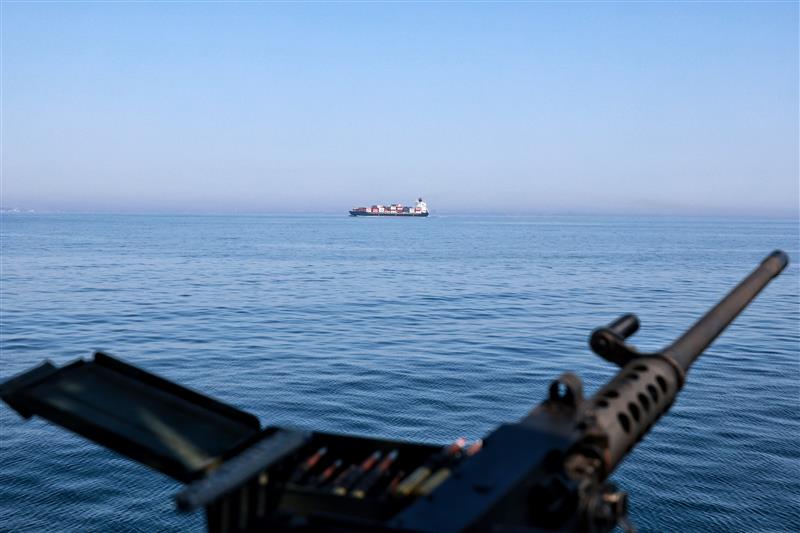
Image: A container ship sails past a Ukrainian Navy cutter equipped with a machine gun while on patrol in the Black Sea along the coast of Odesa, Ukraine, on April 17, 2025. Photo by Nina Liashonok/Ukrinform/Nur Photo via Reuters Connect.