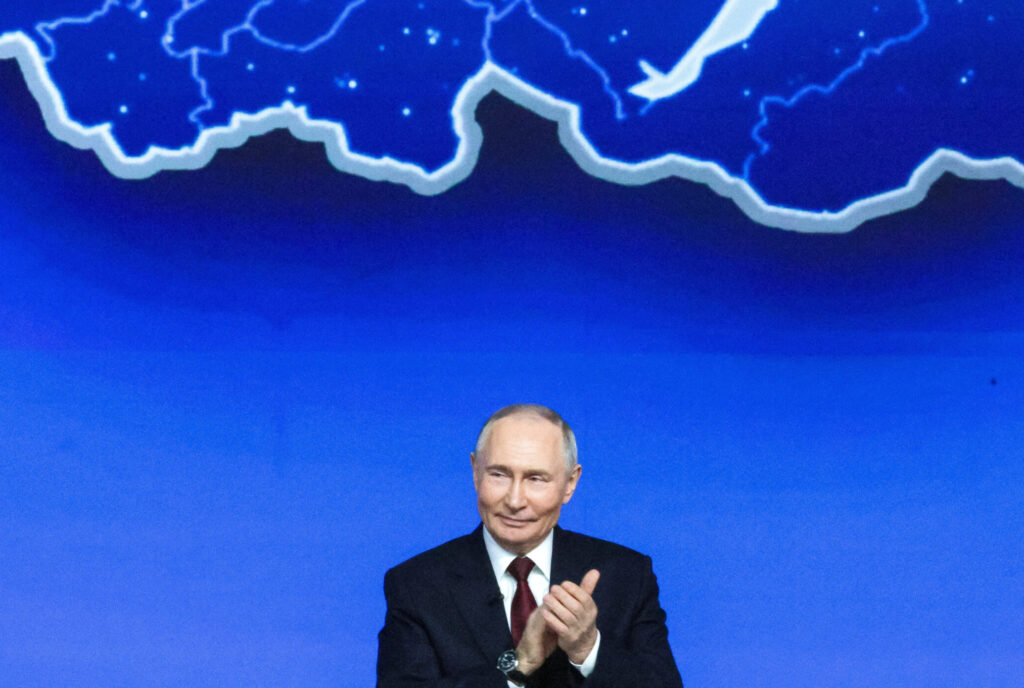
As US officials talk up the prospects of a compromise peace with the Kremlin, Russian President Vladimir Putin has once again signaled that his expansionist appetite is far from sated. In a bellicose address delivered to Russian Defense Ministry officials in Moscow on December 17, Putin declared that the maximalist goals of his Ukraine invasion will be met “unconditionally” and framed the war as a crusade to reverse Russia’s post-Soviet retreat. “If the opposing side and their foreign patrons refuse to engage in substantive discussions, Russia will achieve the liberation of its historical lands by military means,” he declared.
None of this is entirely new, of course. Putin has long been notorious for delivering rambling history lectures to justify Russia’s war against Ukraine, and has directly compared the current invasion to Russian Czar Peter the Great’s eighteenth-century wars of imperial conquest. Nevertheless, at a time when European leaders are already looking to the eastern horizon with trepidation, it makes sense to explore what Putin means by “historically Russian lands” and examine just how far his imperial ambitions may actually stretch.
The most straightforward interpretation of Putin’s latest comments would suggest that he was referring to the portion of eastern Ukraine’s Donbas region that remains under Ukrainian control. After all, this small but heavily fortified and strategically important territory is currently at the heart of negotiations and has been named by Moscow as its price for a ceasefire. However, Kremlin officials are well known for sending contradictory signals regarding their territorial objectives in Ukraine, with Putin himself speaking this month about the “inevitable liberation of the Donbas and Novorossiya.”
Putin’s reference to “Novorossiya” (“New Russia”) raised eyebrows and was widely seen as a signal that Russia may be preparing to increase its territorial demands. The Czarist era term “Novorossiya” was first employed in the eighteenth and nineteenth centuries by imperial administrators to describe large swathes of southern and eastern Ukraine then under Russian rule. It fell into disuse during the Soviet period, only to be resurrected by the Kremlin following the onset of Russia’s Ukraine invasion in 2014.
Russian nationalists have yet to agree on the exact boundaries of Novorossiya, but most envisage a territory stretching far beyond the partially occupied Ukrainian provinces of Zaporizhzhia and Kherson that are currently claimed by the Kremlin. Putin has indicated that his definition of Novorossiya encompasses approximately half of Ukraine, including the country’s entire Black Sea coastline and major cities such as Odesa and Kharkiv.
Then there is the question of Kyiv. According to Russia’s own national mythology, the capital of Ukraine is also the mother of Russian cities and the spiritual birthplace of Russian Orthodoxy. Putin has repeatedly referenced the sacred status of Kyiv in his many essays and speeches denying the legitimacy of Ukrainian statehood. It is therefore extremely difficult to imagine him accepting any peace proposal that secures Kyiv’s postwar position as the capital of an independent Ukraine. Putin can hardly claim to be reuniting Russia’s historic lands if he leaves the most Russian city of them all firmly in the hands of a hostile state.
Stay updated
As the world watches the Russian invasion of Ukraine unfold, UkraineAlert delivers the best Atlantic Council expert insight and analysis on Ukraine twice a week directly to your inbox.
Based on his own public pronouncements and extensive writings on the subject, it seems reasonable to conclude that Putin’s understanding of historically Russian lands includes the whole of Ukraine. Indeed, he has made no real secret of this conviction. “I have said many times that I consider the Russian and Ukrainian peoples to be one people. In this sense, all of Ukraine is ours,” Putin told guests at the St. Petersburg International Economic Forum in summer 2025. The real question is whether his imperial agenda extends beyond the borders of Ukraine.
In a geographical sense, Putin’s vision of historical Russia is definitely not confined to Ukraine alone. Instead, it includes the vast additional expanses of the Czarist Russian Empire and its Soviet successor. “What is the Soviet Union? It is historical Russia,” Putin declared in 2022. A year earlier, he had lamented the fall of the USSR as “the disintegration of historical Russia” by another name. “We turned into a completely different country,” Putin stated. “And what had been built up over 1,000 years was largely lost.”
When European dictators start ranting about lost thousand-year empires, it rarely bodes well for international security. Putin is no exception. The Kremlin dictator’s determination to reverse modern Russia’s fall from grace has come to dominate his reign and has led directly to the biggest European war since World War II. His deeply felt sense of historical grievance over the Soviet collapse has fueled a poisonous obsession with Ukraine, which Putin regards as the ultimate symbol of the injustice resulting from the breakup of the USSR.
Due to its large size, geographical proximity, shared history, significant ethnic Russian population, and perceived cultural closeness, Ukraine occupies a prominent place in Russia’s imperial identity. However, it is wishful thinking to imagine that sacrificing Ukraine will appease Putin or persuade him to forget about the rest of the former Russian Empire. Instead, the same bogus historical arguments used to justify the invasion of Ukraine could easily be applied to a host of other nations. Any country that was previously subjected to Russian imperial rule could technically fall within Putin’s broad definition of historically Russian lands. “We have an old rule,” he commented earlier this year. “Wherever a Russian soldier sets foot is ours.”
Based on the boundaries of the Czarist Empire at its greatest extent on the eve of World War I, potential targets of future Russian aggression could include Finland, Poland, Estonia, Latvia, Lithuania, Belarus, Moldova, Armenia, Georgia, Azerbaijan, and the nations of Central Asia. Nor is this list exhaustive. A truly maximalist approach would also require the inclusion of the many former Soviet satellite states that made up the Eastern Bloc during the second half of the twentieth century.
Eurasia Center events
With the full-scale Russian invasion of Ukraine about to enter a fifth year, many in the West are now beginning to take Putin’s imperial ambitions increasingly seriously. According to Reuters, recent United States intelligence assessments confirm that Putin has not abandoned his aims of capturing all of Ukraine and reclaiming parts of Europe that once belonged to the former Soviet Empire. “The Europeans are convinced of it. The Poles are absolutely convinced of it. The Baltics think they’re first,” the report noted.
Not everyone is so sure. Skeptics tend to question Putin’s ability to wage a major war against the West, with many pointing to his army’s underwhelming performance in Ukraine as proof of Russia’s military limitations. This is comforting but dangerously misleading. In reality, Russia’s lack of progress since 2022 is not a sign of any fundamental weakness; it is testament to the formidable strength and staggering sacrifices of the Ukrainian nation. However, Ukraine’s remarkable resistance against overwhelming odds cannot continue indefinitely and must not be taken for granted. If Ukraine falls, Europe will face a challenge it is utterly unprepared for.
Today, the Ukrainian army is by far the biggest and most experienced fighting force in Europe, other than Russia itself. It is backed by a rapidly expanding and highly innovative domestic military industry that is rewriting the rules of modern warfare. If Putin is permitted to succeed in establishing control over Ukraine, all this will be rapidly integrated into the Kremlin war machine. A partially disarmed Europe will then find itself confronted by a dramatically emboldened Putin, who will have the continent’s two largest armies at his disposal. In such uniquely favorable circumstances, the chances of him choosing not to press home his advantage are next to zero.
The internal logic of the Putin regime is an additional factor driving Russia’s expansionist impulse. Economically, politically, and culturally, Russian society is now deeply militarized in ways that will be extremely difficult to reverse without destabilizing the country. Nor is the Kremlin in any hurry to deal with the hundreds of thousands of Russian soldiers currently fighting in Ukraine. These men are now used to receiving vastly inflated salaries and have been brutalized by the bloodiest invasion in modern history. Keeping them occupied, and preferably as far away from Russia as possible, is now a very real national security priority for Moscow.
Putin may also be encouraged to act by the current geopolitical climate, which presents a once-in-a-lifetime opportunity to advance Russia’s imperial agenda. The return of Donald Trump to the White House has signaled a radical shift in US policy toward the war in Ukraine and the broader defense of Europe. This has led to a mounting sense of insecurity in European capitals amid unprecedented concerns over America’s commitment to NATO collective security. Would a Russian attack on the Baltic states trigger an Article 5 response from the US? Given Trump’s posturing on NATO budgets and his administration’s ambivalent attitude toward Europe, some believe this can no longer be taken for granted.
Europe alone is not yet in a position to defend itself against Russia. After decades of defense sector neglect, effective rearmament will take years to complete. European leaders have also failed to demonstrate the kind of collective political will necessary to deter the Kremlin. The recent failure to agree on the use of frozen Russian assets to fund Ukraine’s war effort was the latest in a long line of climb downs that have signaled Europe’s chronic disunity and crippling fear of escalation. There are many good reasons why Putin may not rush to expand the war, but concern over a potentially decisive European response is not one of them.
As evidence of Western weakness continues to mount, Putin is growing bolder. In recent months, he has escalated Russia’s hybrid war against Europe with sabotage attacks on critical infrastructure and drone incursions across the continent. In the diplomatic arena, Kremlin officials recently renewed calls for NATO to retreat from central and Eastern Europe, a move that would expose more than a dozen countries to the threat of Russian aggression for the first time in a generation. Meanwhile, rhetoric in the Russian state media targeting Finland, the Baltic states, and other front line countries now increasingly echoes the propaganda that preceded the invasion of Ukraine.
As he plots to rebuild the Russian Empire, Putin is unlikely to be working to any set schedule or clearly defined territorial goal. Instead, the gradual escalation of Russia’s Ukraine invasion over the past twelve years indicates that he is an opportunistic imperialist whose appetite grows with eating. At the same time, it is obvious that his radical revisionist agenda is not limited to Ukraine and poses a very real threat to European security.
Putin believes he is on an historic mission to restore Russia to its rightful place as a global superpower and the dominant force in Europe. Erasing Ukrainian statehood is just the beginning. While we cannot know for sure where he will strike next or how far he ultimately plans to go, it is delusional to think that handing Putin victory in Ukraine will convince him to stop. On the contrary, a Russian success in Ukraine would almost certainly mean more war and lead to decades of European instability.
Putin’s vow to liberate historically Russian lands is an open-ended excuse for imperial expansion that makes a complete mockery of US-led efforts to broker a compromise peace based on limited Russian gains in southern and eastern Ukraine. Clearly, this would not be enough to placate Putin and cannot serve as the basis for a sustainable settlement.
The peace terms currently being discussed would leave approximately 80 percent of Ukraine beyond Kremlin control and free to continue integrating with the West. This is exactly what Putin aims to prevent. After four years of fighting to reverse the verdict of the Cold War, any peace deal that safeguards Ukrainian independence would be recognized in Moscow as a Russian defeat of historic proportions. Instead, Putin knows he must continue the invasion until a fully subjugated Ukraine can become a stepping stone for the next stage in his expansionist agenda.
In his quest to secure a place in history among Russia’s greatest rulers, Putin has long since passed the point of no return. He will not deviate from this messianic goal for the sake of sanctions relief or minor territorial concessions. Any efforts to establish a lasting peace must be firmly grounded in this sobering reality. Peace is possible, but only if the pressure on Putin is increased to the point where he begins to fear defeat on the battlefields of Ukraine and potential collapse on the home front inside Russia.
Peter Dickinson is editor of the Atlantic Council’s UkraineAlert service.
Further reading
The views expressed in UkraineAlert are solely those of the authors and do not necessarily reflect the views of the Atlantic Council, its staff, or its supporters.

The Eurasia Center’s mission is to enhance transatlantic cooperation in promoting stability, democratic values, and prosperity in Eurasia, from Eastern Europe and Turkey in the West to the Caucasus, Russia, and Central Asia in the East.
Follow us on social media
and support our work
Image: Russian President Vladimir Putin attends his annual end-of-year press conference and phone-in in Moscow, Russia. December 19, 2025. (Sputnik/Gavriil Grigorov/Pool via REUTERS)