Congress has championed the Abraham Accords. Here’s how it can push them forward.
Bottom lines up front
- Congress has been the most consistent supporter of the Abraham Accords and should pass additional authorizations and appropriations to advance them.
- Lawmakers should pursue legislation that bolsters US leadership on regional economic and trade cooperation, helping lay the groundwork for the Middle Eastern prosperity envisioned by the Abraham Accords.
- Congressional actions should include restoring the Abraham Fund, mandating consistent trade delegations to the region, and providing targeted bilateral leadership through congressional delegations.
Introduction
Following a brief respite after a cease-fire between Israel and Hamas brokered by US President Donald Trump, and in the wake of the twelve-day war and US-backed strikes on Iran’s nuclear facilities, the Middle East appears once again to be sliding toward broader instability. Fractures among the Gulf states over Yemen’s future, growing instability inside Iran, and ongoing efforts to stabilize Syria are only some of the complex challenges confronting the region.
Despite these pressures, the Abraham Accords have endured, reinforcing their long-term significance. The United States—through both executive and congressional leadership—has continued to champion their success. Yet after Congress failed to reintroduce the Regional Integration Normalization Act (RINA) following the disgraceful exit of its former sponsor, Senator Bob Menendez, congressional engagement has largely become incremental and narrowly focused on defense relationships. This need not be the case.
In the summer of 2025, the Atlantic Council’s regional integration project—dedicated to strengthening cooperation between the United States, Israel, and Arab and Muslim countries—led its first-ever congressional delegation focused on the Abraham Accords to the Middle East amid the twelve-day war. Bipartisan engagement with Abraham Accords countries—then, as now—across areas such as interfaith dialogue, trade, and regional investment demonstrates that meaningful progress on normalization is possible, and may even accelerate, during turbulent times. This issue brief offers recommendations for Congress to reassert its leadership role in supporting the Abraham Accords and to expand the scope of US engagement on normalization and regional prosperity.
Advance regional prosperity through the Abraham Accords
Recommendation one: Expand business and commercial delegations supporting the economic integration of Abraham Accords countries.
US trade missions are an essential bridge for US and foreign companies to connect and identify areas of mutual interest. Congress should consider requiring an annual US trade mission focused on a topic of high interest for regional integration, including travel to multiple Abraham Accords countries.
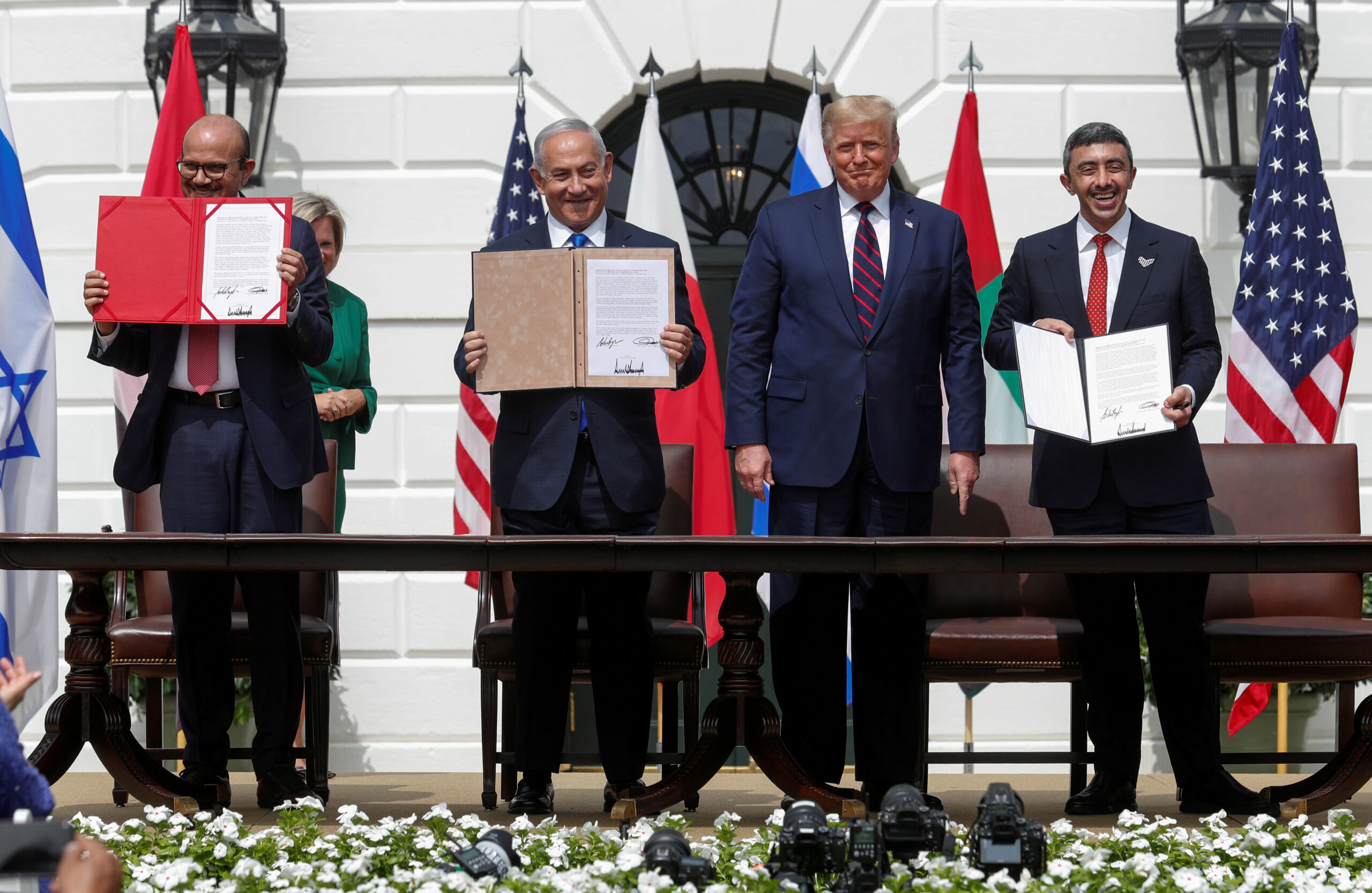
Following the signing of the Abraham Accords in 2020, then Treasury Secretary Steven Mnuchin led a trade delegation to Israel, Bahrain, and the United Arab Emirates (UAE) to support the “expanded economic cooperation” promised by the Accords and announced the Abraham Fund—a planned $3 billion fund designed to support private-sector-led development projects. However, lower-level but consistent missions are also crucial to facilitate regional economic integration and prosperity. In 2022, the US Department of Commerce’s International Trade Administration led two trade missions to the Middle East: one to Israel, Bahrain, and the UAE, engaging aerospace and defense industries, and a flagship “Trade Winds” mission to the UAE that included an optional visit to Israel or Morocco before the main event. While these missions succeeded in connecting US firms with regional industries, there have been fewer recent US-led trade missions supporting regional integration through multi-country engagement. Against this background, Congress should make regional integration a clear priority when it benefits US commercial interests and consider codifying support for the Abraham Accords.
Recommendation two: Expand Abraham Accord Caucus engagement on regional economic projects, including the India-Middle East-Europe Economic Corridor.
The India-Middle East-Europe Economic Corridor (IMEC) is a proposed transportation, energy, and digital corridor designed to provide more efficient and resilient infrastructure capable of meeting the needs of a changing global economy. It could serve as the backbone for regional integration while unlocking substantial economic incentives by leveraging the Middle East’s role as a bridge between Europe and Asia. If the United States can help shape IMEC development—setting standards for ports and digital infrastructure, identifying opportunities for US companies, and countering influence from Russia and China—it could effectively balance against China’s Belt and Road Initiative while reasserting US economic leadership in a critical region.
The Abraham Accords Caucus co-chairs and congressional committee leaders should organize regular briefings with both the administration and relevant private-sector stakeholders to explore how the United States can influence the development of IMEC and ensure opportunities for US companies. While Congress has advanced political and security integration initiatives, economic integration, which is foundational for regional peace and prosperity, has received less attention. IMEC and similar initiatives offer an opportunity for Congress to do more on this front. The Abraham Accords Caucuses should also establish staff-level working groups for frequent engagement on economic integration projects. Recent efforts by Representatives Brad Schneider (who joined the June congressional delegation) and Blake Moore to launch a House Abraham Accords Caucus trade working group offer excellent platforms for such briefings. Additionally, the Abraham Accords Caucus should coordinate with the US Department of Commerce to identify businesses and industries that could benefit from regional integration, generating district- and state-level connections that strengthen Middle East prosperity.
Recommendation three: Formally authorize and support the Abraham Fund and prioritize regional Abraham Accords projects for US International Development Finance Cooperation support.
After the signing of the Abraham Accords, the United States, Israel, and the UAE established a $3 billion fund to support private-sector investments and development initiatives advancing regional economic integration. Efforts by the US International Development Finance Cooperation (DFC) late in the first Trump administration attempted to energize the fund, including a call for proposals for projects in Morocco and a $50 million commitment from Uzbekistan. However, since a 2021 interagency review under then-US President Joe Biden, no public activity has been registered regarding the Abraham Fund.
In 2023, Congress signaled continued interest in supporting economic integration through Section 8 of the RINA, which would have authorized the creation of the “Abraham Accords, Negev Forum, and Regional Integration Opportunity Fund” with $105 million, enabling the US secretary of state to support interagency projects including the Abraham Fund. While this number was far lower than the Abraham Fund’s announced $3 billion, it demonstrated robust bipartisan support for US diplomatic leadership and the potential for a rigorous approach to leveraging development finance. Congress should build on the RINA example by authorizing and appropriating funds for regional economic integration projects while maintaining the current framework for special envoy leadership of the fund and clarifying the role of such an envoy in fund dispersal. By building on recent changes to DFC through the National Defense Authorization Act for Fiscal Year 2026 , Congress can advance the Abraham Fund in parallel with other new initiatives.
Institutionalize and expand US diplomatic leadership on the accords
Recommendation four: Allow exceptions for a dual-hatted Abraham Accords envoy.
Both the Biden and Trump administrations have demonstrated commitment to senior official engagement on expanding the Abraham Accords. Under Biden, this included the appointment of Dan Shapiro, former ambassador to Israel, as the first Abraham Accords envoy. In the National Defense Authorization Act for Fiscal Year 2024, Congress codified the role of Special Envoy for the Abraham Accords, Negev Forum, and Related Integration and Normalization Fora and Agreements. However, despite the creation of this new role, no one has been nominated to the Senate-confirmed position. Members of Congress have expressed interest in seeing the vacant slot filled, including in a widely signed letter in January 2025. One possible reason for the vacancy is that legislation codifying the role explicitly requires that the individual “. . . shall not be a dual-hatted official with other responsibilities,” which may have discouraged both the Biden and Trump administrations from making a nomination. While there is significant value in having a senior official dedicated to advancing the Abraham Accords, the reality is that the kinds of strategic economic, security, and diplomatic cooperation associated with the accords can overlap with existing portfolios within the US government. For example, Special Envoy Steve Witkoff engaged on the Abraham Accords, but this represents just one of his many priorities.
Congress should consider modifying this restriction, enabling more senior US officials with synergistic portfolios to fill the position. This would enable the administration to formally designate a “lead” for the accords, elevating their priority.
Recommendation five: Authorize the State Department to lead a new strategic multilateral forum reflecting US and regional priorities.
While the Negev Forum had a robust start in 2022, a new strategic approach is needed to operationalize the goals of the Abraham Accords. Congress should direct the State Department to develop an updated plan for a new multilateral forum that regularly brings together senior officials, advancing strategic US and regional priorities in energy, investment, and security—topics not fully covered by the Negev Forum. This forum should learn from the disruption that the Negev Forum has experienced over the past two years and adapt to evolving regional dynamics. Congress should consider constructs similar to previous regional integration legislation, such as the Deterring Enemy Forces and Enabling National Defense (DEFEND) Act and the Learning Integrated National Knowledge for the Abraham Accords Act, which authorize specific objectives and activities for the executive branch to carry out and require measurable progress—through strategies, reports, and direct action—to meet congressional intent. Priority areas for multilateral coordination among accords countries include:
- Regional security cooperation: While the present environment might not be conducive to a comprehensive security partnership, a new multilateral forum should incorporate a pathway for regional security cooperation. This could include building on existing platforms such as the Comprehensive Security Integration and Prosperity Agreement (C-SIPA) and leveraging ideas associated with past initiatives, such as the Middle East Strategic Alliance. Section 1299 of the recently passed National Defense Authorization Act for Fiscal Year 2026 provides a foundation for the further expansion of C-SIPA by requiring an assessment of the agreement’s strategic importance and its potential expansion.
- Traditional energy: Many Gulf states are seeking to diversify their economy away from fossil fuels. However, growing energy demand and the need for resilient, diverse energy systems mean that traditional energy sources will remain a critical part of the equation for the foreseeable future. Consequently, Israel, Egypt, and others have continued to develop natural gas and other traditional energy sources and have worked to integrate their projects across the region, leading to regional bodies such as the Eastern Mediterranean Gas Forum, which includes both Israeli and Palestinian representation. In line with Trump’s executive orders titled “Unleashing American Energy,” the State Department should use a revived accords multilateral framework to explore how initiatives like the Eastern Mediterranean Gas Forum can support regional economic integration.
- Investment: In addition to traditional energy, the State Department should encourage more integration in the financial space, including cooperation on regional investments and domestic barriers to intra-regional investments. This could include new forms of cooperation, such as around coordinated regulation of cryptocurrency consistent with the goals of the recent GENIUS Act. While this will take time and trust to build, integrating wealthier states with regional entrepreneurial projects would allow for an immediate and tangible demonstration of how the Abraham Accords advance participants’ prosperity. Efforts to advance investment and financial partnerships are familiar to Congress. Section 9 of the RINA, a bipartisan effort by the then-leadership of the Senate Foreign Relations Committee and all four Abraham Accords Caucus co-chairs in the Senate, outlines a directive for the special envoy for the Abraham Accords to negotiate the creation of such a financial forum.
Mobilize and deepen people-to-people and legislative exchanges
Recommendation six: Authorize and appropriate funds for interfaith religious dialogues to support tolerance and understanding across Abraham Accords countries.
The second paragraph of the Abraham Accords declaration supports promoting “interfaith and intercultural dialogue” to advance the accords’ mission of peace and prosperity. However, no State Department grants have yet been publicly made available to support interfaith dialogues across Abraham Accords countries. Such grants could support the work of organizations such as the Mimouna Association, which connects Jewish and Muslim youths through interfaith programming. The State Department’s reluctance to issue such grants contrasts with a bipartisan and bicameral effort by all eight House and Senate co-chairs of the Abraham Accords Caucus who formally requested their issuance in 2023. In addition to encouraging the use of existing funding for such efforts, the Senate included $1 million for such grants in Section 10 of the RINA. While the act remains only proposed legislation, Congress should revisit the oversight and appropriations efforts from 2023 and renew calls for interfaith and intercultural dialogue grants. The Trump administration has clarified that advancing and expanding the Abraham Accords is a priority. The Abraham Accords declaration clearly supports interfaith dialogues, and the promotion of such dialogues in the Middle East is particularly important in the current environment, as the region seeks to move past historical biases toward new bonds. Few interfaith efforts are as worthy of support.
Recommendation seven: Expand bilateral-focused congressional travel to Abraham Accords countries to support the accords.
While more than a dozen congressional delegations travel to the Middle East annually and engage with Abraham Accords partner countries, fewer delegations travel with the explicit objective of supporting regional integration. Unfortunately, even fewer congressional delegations spend sufficient time in a partner country to build the government-to-government ties essential for moving Abraham Accords countries toward further integration. The Abraham Accords Caucus, or another member-driven initiative, should organize more regular congressional delegations to Abraham Accords partner countries. These delegations should focus on specific projects or initiatives that can generate tangible improvements in bilateral cooperation, such as trade, and ultimately promote regional integration. Congress should look to the US Departments of Commerce, State, and Agriculture to help identify issues and topics that members can use to advance the bilateral relationship toward greater integration. Agencies can also assist in supporting the identification of shared commercial interests or frictions based on members’ constituencies.
Model legislation annex
The following legislative text is provided solely for educational and informational purposes as illustrative “model” language. It is not intended to advocate for or against the passage of any particular bill, nor to influence specific legislation pending before Congress. The sample provisions are offered to demonstrate how recommendations in this report could be operationalized in statutory form. Inclusion of this text should not be construed as lobbying activity but, rather, as a nonpartisan resource for policymakers, researchers, and stakeholders.
Read the full annex
About the author
Explore the program

Through our Rafik Hariri Center for the Middle East and Scowcroft Middle East Security Initiative, the Atlantic Council works with allies and partners in Europe and the wider Middle East to protect US interests, build peace and security, and unlock the human potential of the region.
Image: Bahrain’s Foreign Minister Abdullatif Al Zayani, Israel's Prime Minister Benjamin Netanyahu and United Arab Emirates (UAE) Foreign Minister Abdullah bin Zayed display their copies of signed agreements while U.S. President Donald Trump looks on as they participate in the signing ceremony of the Abraham Accords, normalizing relations between Israel and some of its Middle East neighbors, in a strategic realignment of Middle Eastern countries against Iran, on the South Lawn of the White House in Washington, U.S., September 15, 2020. REUTERS/Tom Brenner TPX IMAGES OF THE DAY
