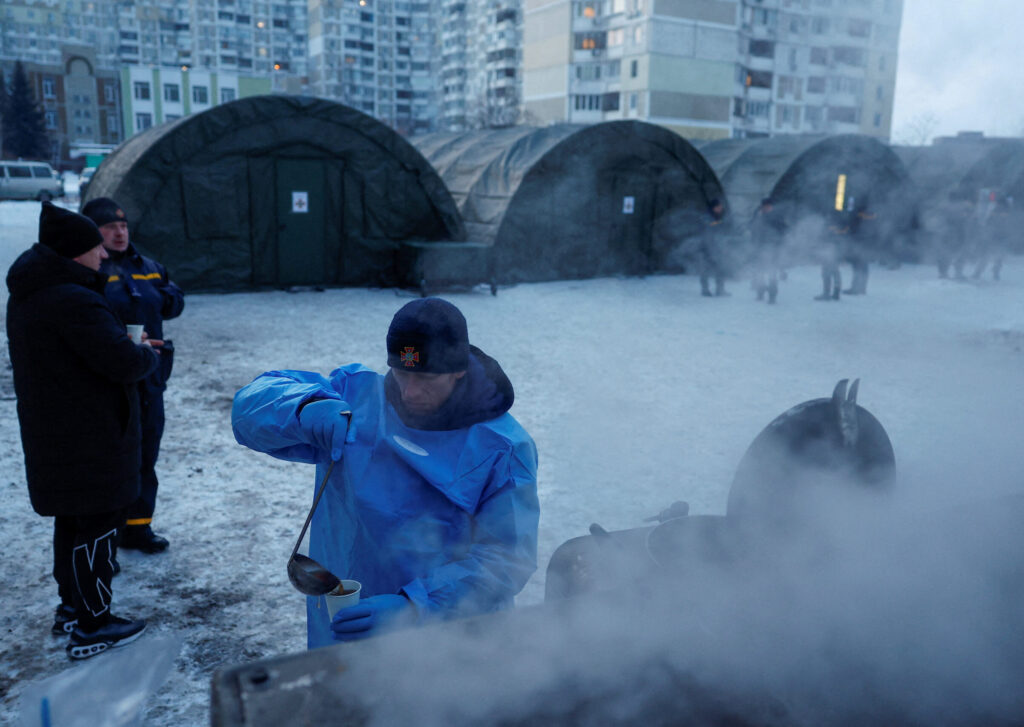
Three years ago, when Ukrainians first began calling Russia’s winter bombing campaign a “kholodomor” (literally “death by cold”), some Western observers dismissed this language as excessive. Few would make the same criticism now. In recent months, Russia has unleashed the most extensive winter bombardment of the war, leaving millions of Ukrainians without access to heating and electricity amid arctic weather conditions. The term “kholodomor” now looks like an accurate and objective description of what is clearly a deliberate Russian strategy to cause a humanitarian catastrophe across Ukraine.
The international skepticism that greeted initial claims of a systematic Russian campaign to freeze Ukrainians was not a new phenomenon. On the contrary, it followed a familiar pattern. For years, Ukrainians have described Russia’s expansionist agenda and imperial ambitions in language shaped by lived experience, only to be told they were exaggerating, overly emotional, or trapped by history.
When Russia first invaded Ukraine in 2014, many international commentators downplayed the enormity of the situation. Rather than acknowledging that a major threshold had been crossed, some chose to amplify obvious Kremlin propaganda and legitimize false narratives of referendums and separatists. Others sought to diminish Russian responsibility by labeling Moscow’s undeclared war an internal conflict. This weak response only served to embolden Putin and helped set the stage for the full-scale invasion of 2022.
Stay updated
As the world watches the Russian invasion of Ukraine unfold, UkraineAlert delivers the best Atlantic Council expert insight and analysis on Ukraine twice a week directly to your inbox.
Russia’s current attacks on Ukraine’s critical civilian infrastructure are neither accidental nor isolated. Power plants, transmission lines, substations, and heating systems have been repeatedly targeted throughout the entire country in a methodical manner to inflict maximum damage. These strikes have intensified in recent weeks as temperatures plunged, underlining the Kremlin’s deadly intent. During the coldest months of the Ukrainian winter, heating and power are not mere conveniences; they are essential for survival.
The present talk of a “kholodomor” in Ukraine not only captures the essence of Russia’s winter bombing campaign. This language also consciously echoes the term “Holodomor” (“death by hunger”), which is used to describe the artificially induced famine of the early 1930s that killed at least four million Ukrainians. Then as now, the Kremlin objective was the destruction of the conditions necessary for life in Ukraine.
Since the onset of Russia’s full-scale invasion in February 2022, Ukrainian analysts and other experts have been warning that history is in danger of repeating itself. By December 2022, humanitarian agencies assessed that 17.7 million Ukrainians would need emergency aid simply to survive the first winter of the war amid the large-scale bombardment of the country’s power grid, a campaign that later resulted in International Criminal Court arrest warrants for the Russian military commanders who orchestrated it.
Putin’s escalating weaponization of winter mirrors Stalin’s use of famine against Ukrainians almost one century earlier. Both atrocities are rooted in genocidal logic that treats the existence of a separate Ukrainian nation as an existential threat to Kremlin imperialism. However, unlike the Soviet authorities during the Holodomor, Putin has made no real effort to disguise or conceal the current targeting of Ukraine’s civilian population. On the contrary, Russian officials and media personalities have praised the destruction of civilian infrastructure and the suffering this inflicts.
Eurasia Center events

Russia’s winter bombing campaign is not only about depriving Ukrainians of the conditions to sustain life. It is also part of a broader strategy to reshape Ukrainian society and force the country to accept an artificially imposed Russian identity. This goal is most immediately apparent in occupied regions of Ukraine, where schools and social services have been repurposed to indoctrinate the population and erase all traces of Ukrainian identity. Rendering large parts of Ukraine unlivable is the first step; remaking the country on Moscow’s terms is the second.
Russian attacks on Ukraine’s energy infrastructure cannot be dismissed as an example of ordinary wartime brutality. Instead, the current bombing campaign must be viewed as part of a deliberate plot to destroy the conditions necessary for Ukrainian society to endure. Genocide is not defined only by mass killing; it is also defined by the deliberate destruction of the conditions of life required for a group’s survival.
As US-led peace talks continue, it is vital that the international community now avoid repeating the mistake of ignoring Ukraine’s warnings about Russia’s true intentions. In 2014 and 2022, Ukrainians were not taken seriously when they tried to alert the outside world to the danger. They are now once again raising the alarm over calls for Kyiv to cede heavily fortified areas of the Donbas to Russia in exchange for ambiguous promises of peace. Ukrainians warn that this would only encourage Moscow and create the ideal conditions for the next stage of Putin’s invasion.
When Ukrainians speak of facing death by cold, they are not attempting to shock or provoke. On the contrary, they are describing the latest stage in a Russian strategy that is historically all too familiar, and one that has become increasingly apparent since 2022.
The sheer scale of Russia’s current winter bombing campaign makes a mockery of attempts to broker a compromise peace and underlines the Kremlin’s determination to destroy Ukraine as a state and as a nation. While international audiences rightly acknowledge the remarkable resilience of the Ukrainian population, they must also recognize the need to address the sense of impunity driving Russia’s invasion. This impunity has convinced Putin that he can now freeze millions of Ukrainians in front of the watching world. Failure to hold him accountable for this crime will condemn other European countries to face a similar fate.
Kristina Hook is assistant professor of conflict management at Kennesaw State University and a nonresident senior fellow at the Atlantic Council’s Eurasia Center.
Further reading
The views expressed in UkraineAlert are solely those of the authors and do not necessarily reflect the views of the Atlantic Council, its staff, or its supporters.

The Eurasia Center’s mission is to enhance transatlantic cooperation in promoting stability, democratic values, and prosperity in Eurasia, from Eastern Europe and Turkey in the West to the Caucasus, Russia, and Central Asia in the East.
Follow us on social media
and support our work
Image: A Ukrainian State Emergency Service employee pours tea into a cup in front of tents of a government-run humanitarian aid point, where residents can warm up, charge their devices, get hot drinks and psychological support, installed next to apartment buildings during a power blackout after critical civil infrastructure was hit by recent Russian missile and drone strikes, amid Russia's attack on Ukraine, in Kyiv, Ukraine. January 25, 2026. (REUTERS/Valentyn Ogirenko)