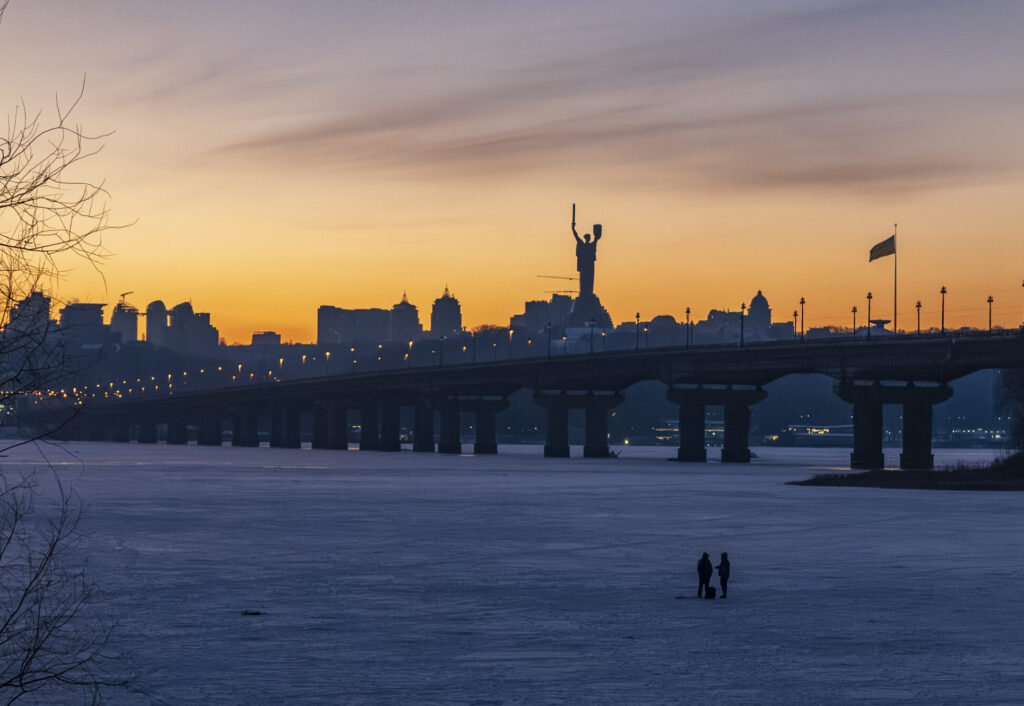
Millions of Ukrainians have spent much of January without electricity and heating amid subzero winter temperatures, sparking fears that the country is on the brink of a humanitarian catastrophe. This desperate situation has been deliberately provoked by a sustained Russian bombing campaign against Ukraine’s critical infrastructure, as Kremlin dictator Vladimir Putin targets the civilian population in order to pressure Kyiv into capitulation.
Russia’s attacks have led to dramatically deteriorating living conditions across Ukraine. Thousands of high-rise apartment buildings in large cities as well as smaller rural homes have been cut off from power, heating, and water for days at a time. As a result, indoor temperatures have dropped to dangerous levels. For the elderly, those with young children, and people suffering from health issues, the risks are particularly grave.
Ukrainian President Volodymyr Zelenskyy has declared a state of emergency in the country’s energy sector, while other Ukrainian officials have appealed to partners for urgent support. While international aid has begun arriving, the sheer scale of the crisis means that much may depend on weather conditions in the coming weeks.
Stay updated
As the world watches the Russian invasion of Ukraine unfold, UkraineAlert delivers the best Atlantic Council expert insight and analysis on Ukraine twice a week directly to your inbox.
Attacks on Ukraine’s civilian infrastructure have been a routine feature of the war ever since the start of Russia’s full-scale invasion in February 2022. According to Ukrainian Energy Minister Denys Shmyhal, every single energy-generating facility in the country has been bombed. “There is not a single power plant in Ukraine that has not been hit by the enemy since the beginning of the war,” he commented last week. “Thousands of megawatts of generation capacity have been knocked out. Nobody else in the world has ever faced a challenge like this.”
Russia’s current aerial offensive began to escalate noticeably during the final months of 2025 ahead of the cold season. As temperatures plummeted in early January, there was a further intensification of attacks on Ukraine’s power and heating infrastructure, with large numbers of drones and missiles concentrated on specific cities to overwhelm air defenses. The timing of Russia’s bombing campaign leaves no room for reasonable doubt; this was a premeditated attempt to target the Ukrainian population by weaponizing the winter weather.
The Kremlin’s goal is easy enough to decipher. By making Ukrainian cities unlivable and threatening to freeze millions of civilians, Moscow aims to break Ukraine’s resistance and force the Kyiv authorities to accept peace on Russian terms. In other words, the present bombing offensive is Putin’s response to US President Donald Trump’s peace efforts. Rather than agree to a ceasefire or offer concessions, Putin uses terror as a negotiating tool to secure Ukraine’s surrender.
Eurasia Center events

The targeting of Ukrainian civilians is not limited to attacks on critical infrastructure. According to the UN Human Rights Monitoring Mission in Ukraine, 2025 was the deadliest year of the invasion for Ukrainian civilians since 2022. In a report released in early January, United Nations officials confirmed that more than 2500 Ukrainian civilians were killed in 2025. This was 31 percent higher than the figure for the previous year and 70 percent more than in 2023. A separate assessment by European governments reached similar conclusions and found that the scale of Russian attacks on Ukrainian civilians increased whenever the Trump administration attempted to advance peace negotiations.
The rising civilian death toll in Ukraine is largely due to increased Russian bombing of Ukrainian cities. Moscow’s mounting air offensive owed much to a spike in domestic drone production, which has made it possible to launch hundreds of drones at Ukraine in a single night. Russia has also been accused of conducting a large-scale campaign of individual drone strikes against civilians in southern Ukraine that terrified locals have branded a “human safari.” UN investigators reported in October 2025 that Russia’s targeted drone strikes on civilians were a crime against humanity.
Russian attacks on Ukrainian civilians have increased amid mounting frustration in Moscow over the slow pace of the invasion. Despite holding the battlefield initiative throughout 2025, Putin’s army failed to achieve any significant breakthroughs and gained less than one percent of Ukrainian territory while suffering heavy losses. With little immediate prospect of military success, Putin seems to have decided that his best chance of victory lies in terrorizing the civilian population.
So far, Russia’s terror tactics do not appear to be working. A nationwide poll conducted in mid-January by the Kyiv International Institute of Sociology found that a majority of Ukrainians continue to reject the Kremlin’s territorial demands in eastern Ukraine. Meanwhile, more than two-thirds of Ukrainians do not believe the present round of US-led negotiations will result in a lasting peace. Instead, most Ukrainians remain convinced that Russia aims to continue the war.
Today’s arctic conditions will eventually give way to milder weather, but the damage done to Ukraine’s civilian infrastructure in recent weeks will take months to repair. Nor is there any reason to believe that Russian attacks on Ukrainian civilians will abate. On the contrary, the Kremlin is likely to escalate further in a bid to demoralize, destabilize, and depopulate the country. By seeking to freeze millions of Ukrainians, Putin has underlined his readiness to target civilians as he seeks to impose an imperialistic vision of peace through submission.
Yuliya Kazdobina is a senior fellow at the “Ukrainian Prism” nongovernmental analytical center.
Further reading
The views expressed in UkraineAlert are solely those of the authors and do not necessarily reflect the views of the Atlantic Council, its staff, or its supporters.

The Eurasia Center’s mission is to enhance transatlantic cooperation in promoting stability, democratic values, and prosperity in Eurasia, from Eastern Europe and Turkey in the West to the Caucasus, Russia, and Central Asia in the East.
Follow us on social media
and support our work
Image: People walk on the ice of the frozen Dnipro River at sunset, with a view of Kyiv's right bank in Kyiv, Ukraine, on January 18, 2026. Air temperatures drop to minus 20 degrees Celsius. (Photo by Maxym Marusenko/NurPhoto)