

PAVLOHRAD—The drive from Kyiv to Dnipro and Pavlohrad reveals a Ukraine of contrasts. Beautiful fields of sunflowers wave in the wind, and gorgeous churches with gleaming golden tops grace the landscape. Children play on playgrounds, while parents sit nearby chatting with friends and drinking coffee. But also, there are burned-out gas stations and shops, recently struck by Russian drones or ballistic missiles. Puffs of smoke hover over a playground from a recent drone or missile interception. Netting encases major roadways to help protect cars from drone attacks. And on the street, many men carry noticeable injuries, including missing hands, arms, or legs.
In other words, it is a beautiful country marred by the horrors of Russian President Vladimir Putin’s unprovoked war that is filled with people who refuse to let those horrors prevail.
I recently had the opportunity to travel to Ukraine along with Congressman Michael McCaul (R-TX), as he visited Ukrainian troops in eastern Ukraine and met with senior government officials. The trip followed the NATO Summit in Ankara, where US President Donald Trump agreed to allow Ukraine to make Patriot missiles, and came as Ukraine continues to deliver strikes deep inside Russia. Four-and-a-half years in, it felt like a conflict that was reaching a turning point.
Battlefield movement
Once we arrived in Pavlohrad, we stopped in town to grab a coffee, and I could not get over the normalcy of it all. There was a large playground area for children, with a beautiful church on one side and a Kentucky Fried Chicken on the other. But that beauty was quickly marred by the sound of multiple explosions. The stray dogs in the area began running around barking, alerting people of the danger. And above the playground a large puff of gray smoke, indicating a Russian drone or missile had been successfully intercepted by Ukrainian forces.
Yet life in the center of Pavlohrad went on. People stopped, looked up, and then continued to sip their coffee while their children played on the playground. Not because they were not afraid, and not because there wasn’t real danger. But because—what else could they do? The Ukrainian military now intercepts at least 90 percent of the longer-range drones that target civilians outside the battlefield. So the best you can do is hope you are not in the other 10 percent.
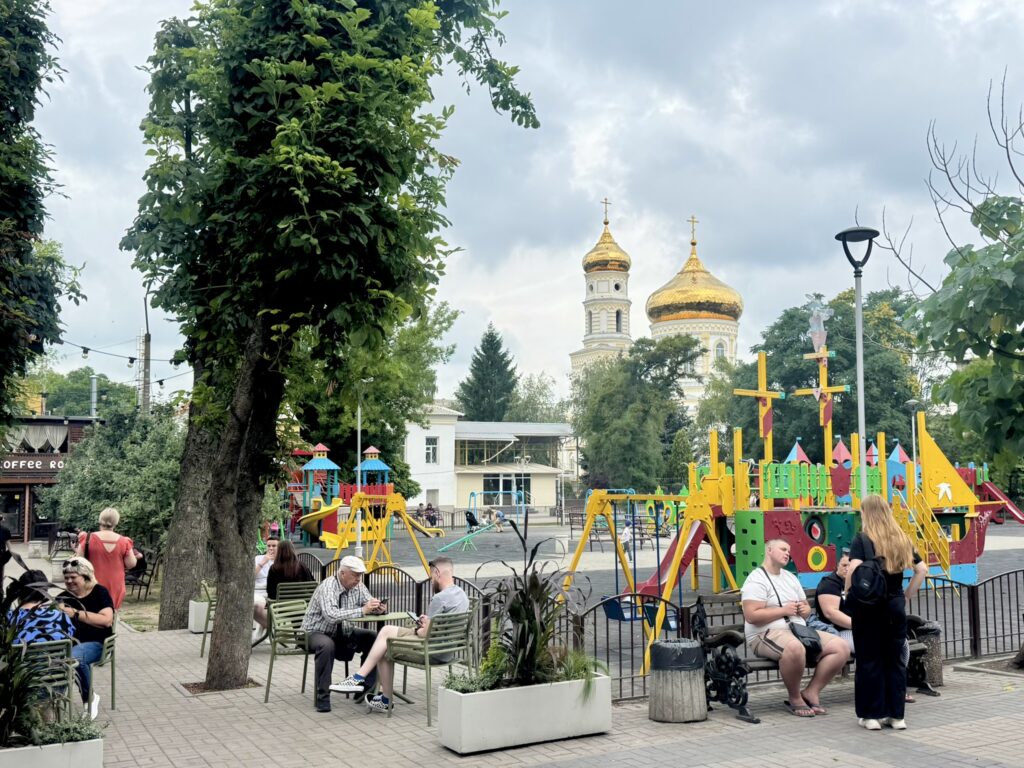
From there, we drove closer to the front lines to meet with a Ukrainian Air Assault Brigade. While this was my first visit to Ukraine, I had met with Ukrainian officials and advocates for years. My meetings this time were different. There was excitement that I hadn’t heard since the very beginning of the full-scale invasion, when Ukraine was able to drive Russian forces from much of the country.
Ukrainians are winning. And, importantly, they know that.
Not far from the front lines, the troops told us they had taken back roughly five hundred square kilometers over the last six months in their area. They showed off the aerial and land drones they have used and walked us through their operations center, highlighting some of their recent successful strikes. One aerial drone they showed us, the Vampire, can carry up to four anti-tank mines, travel twenty meters per second, and fly for forty minutes. It’s a reusable drone, so it can drop the payload and return—and make as many as twenty flights per day. We later visited the drone manufacturer, Skyfall. The company can make almost three hundred Vampire drones per day. If one Vampire can carry up to four payloads and make as many as twenty flights per day, that means Skyfall is able to produce the equivalent of almost 24,000 strikes per day with just this one drone line.
In Kyiv, a need for Patriots
Once we returned from the east, we met with Ukrainian President Volodymyr Zelenskyy, Foreign Minister Andrii Sybiha, Chairman of the Verkhovna Rada Ruslan Stefanchuk, Presidential Commissioner for Sanctions Policy of Ukraine Vladyslav Vlasiuk, and then-Deputy Commander of Ukraine’s Air Force Pavlo Yelizarov.
The Ukrainian officials expressed appreciation to the United States for its support throughout this war, particularly for the invaluable intelligence that Washington has shared with Ukraine. That intelligence has allowed Ukraine to help protect citizens and to successfully conduct some of the recent long-range strikes inside of Russia. The officials also expressed joy and optimism at Trump’s announcement that he would grant Ukraine a license to produce their own Patriot interceptor missiles.
The problem is that Ukraine is currently out of Patriots, the only weapons that can consistently shoot down a ballistic missile. Putin knows this, which is why he is using ballistic missiles to kill civilians in Kyiv. Ballistic missiles are so fast, they hit before the alarms can even warn people to take cover.
The first night I was in Kyiv, a loud explosion rattled my hotel windows at 12:30 a.m. That was immediately followed by the sound of alarms going off around the city and the alarm on the Air Alert app on my phone. By then, it was too late—the damage from the missiles had already been done. Russia had launched five ballistic missiles at Kyiv, along with a bevy of drones. The Air Alert app proceeded to go off every few hours all night long with warnings of incoming attacks. In total, three people were killed and thirteen were injured. The same scene played out on my last night in Kyiv, when Russia launched six ballistic missiles, six cruise missiles, and over 120 drones. Thankfully, no one was killed but twelve people were injured.
Even with a license to make Patriots, it will take time for Ukraine to build the facilities and the interceptors. Between now and then, Ukraine needs a band-aid to stave off Russia’s attacks on innocent civilians. European countries such as Greece that have Patriots that are getting close to the end of their operational lifespan should quickly sell them to Ukraine. Zelenskyy assured us that Ukraine stands ready to use them quickly before the expiration date to protect his people.
Ukraine’s weapons superiority
Beyond the resiliency and determination of the Ukrainian people, the most impressive thing I witnessed in Ukraine was the country’s weapons capabilities, particularly in production. Ukraine can make inexpensive, effective drones in massive quantities that can evade Russian spoofing and signal jamming. And crucially, Ukrainians can quickly adapt those drones as Russian capabilities change. As a result, even though there are about seven times as many Russian troops on the frontline, they are killed or injured six times as often as Ukrainian troops, we were told. The US intelligence community’s own assessment released right after we returned from our trip estimates that a new Russian recruit arriving on the Ukrainian battlefield lasts less than half an hour, on average, before being killed or wounded.
While visiting a drone operations center run by Yelizarov and his unmanned systems unit called Lasar’s Group, we were told of two operations that exemplify this. The first, which took place over two days in May 2025 and June 2025, cost Ukraine about $12 million to conduct and destroyed more than $14 billion worth of Russian equipment, including ten air defense systems—all without risking a single Ukrainian soldier’s life. In the second operation, Ukraine successfully had a reusable drone plant a mine on train tracks that were being used to move fuel for Russian troops. When the mine blew, the fuel caught on fire. For days, Russia tried to send in troops and equipment to put the fire out and salvage the much-needed fuel. Each time, they were eliminated by Ukrainian drones. Russia eventually sent in two S-300 air defense batteries to try to reclaim the air space and secure the fuel train. Ukraine used inexpensive aerial drones to eliminate both batteries, each of which costs an estimated $160 million. Once again, not a single Ukrainian soldier’s life was lost.

Ukraine is not just bleeding Russia dry with offensive weapons. It has also been able to develop effective and cost-efficient interceptors to shoot down Russia’s drones and missiles. The Center for Strategic and International Studies estimates a Shahed drone costs $35,000 on average. One Ukrainian drone company we visited showed us an interceptor it has developed and can produce for $1,000 per unit that can chase a Shahed down and shoot it out of the sky. At the same time, the United States has been using million-dollar interceptors to shoot down Shaheds in the Persian Gulf.
The American technology behind the destruction
One of the most troubling meetings we had was with Vlasiuk, the presidential commissioner for sanctions policy. His office’s research makes clear that American technology is fueling Russia’s war machine. This is most prevalent with American chips. We reviewed page after page of the different American components that had been diverted to Russia and were found in the Iranian-designed and now Russian-built Shahed drones being used on the battlefield in Ukraine—Texas Instruments, Intel, and Analog Devices, to name a few. The United States isn’t alone in this. There were German, British, Swiss, and other European components, as well as South Korean and Japanese components. But the United States was by far the biggest offender.
The good news is that Vlasiuk’s research shows Russia is dependent on US technology. In one example, a hypersonic missile launched against Ukraine in 2022 contained a Texas Instruments chip. The same weapon was found two years later with a Russian-made chip. But by 2026, the weapon once again had a Texas Instruments chip. This suggests that Russia tried to replace American chips, but the Russian versions didn’t work—so it switched back to the American chips. The Netherlands has been able to effectively eliminate its technology from Russian weapons through a mix of compliance enforcement and a focus on end users. If the United States and its allies would replicate what the Netherlands was able to do, it could hobble Russia’s defense industrial base.
Ukraine’s limited asks
It is remarkable what the Ukrainian people have been able to achieve. They have become the most lethal, most experienced, and best equipped fighting force in Europe. But there are fears as to how long they can maintain their superiority—and how many civilians Putin will be able to kill with ballistic missiles before Ukraine can get hold of more Patriots.
Ukrainian officials made it clear that the list of what they need now to continue winning is short. First, they need Patriot interceptors—today. Trump has done his part by offering them a license to build their own. European and other partner countries that have expiring interceptors should sell them to Ukraine as quickly as possible. Second, Ukraine needs the United States and its allies to strengthen sanctions enforcement and track down end users to stop so much US technology from getting into Russian weapons. Third, Kyiv continues to need US intelligence, which has been critical both on the front lines and in long-range strikes against Russia.
