On November 18-19, 2026, the US Department of Energy, the Polish Ministry of Energy, and the Atlantic Council Global Energy Center will convene the seventh ministerial meeting of the Partnership for Transatlantic Energy Cooperation (P-TEC) in Warsaw, Poland.
P-TEC is the leading forum for advancing energy cooperation between the United States and Central and Eastern European countries. Bringing together energy ministers, senior government officials, and industry leaders, it provides a platform to foster dialogue and collaboration on the policies and partnerships shaping the region’s energy landscape.
Building on the momentum of the sixth ministerial meeting in Athens, this year’s convening will advance a shared vision for a more affordable, reliable, and secure European energy future. This program will focus on the investments needed to shape Europe’s next chapter of energy security, from deepening civil nuclear cooperation and expanding reliable access to liquefied natural gas (LNG) to protecting critical infrastructure and accelerating regional integration.
On Wednesday, November 18, the business forum will bring together public and private sector leaders to discuss transatlantic energy investment priorities, as well as collaboration on strategic energy projects. On Thursday, November 19, the P-TEC ministerial will convene high-level government representatives to discuss the future of transatlantic energy cooperation, with a focus on civil nuclear energy and long-term LNG supply security.
New policy: In-person attendees will be required to show photo ID upon arrival, and no on-site registration will be permitted.
By registering to attend in-person, you agree to abide by the Atlantic Council’s Event Code of Conduct.
speakers
View full speaker list
agenda
Day 1 — P-TEC Business Forum
9:00-9:05 a.m. | Welcome remarks
Featuring
Kasia Madera
Anchor,
BBC News
9:05-9:25 a.m. | Fireside chat
Featuring
Chris Wright
Secretary of Energy,
United States
Miłosz Motyka
Minister of Energy,
Poland
Moderated by
Landon Deretnz
Vice President; Energy & Infrastructure; and Morningstar Chair for Global Energy Security,
Atlantic Council
9:25-9:35 a.m. | Signing ceremony
Details to be announced.
10:20-10:30 a.m. | Signing ceremony
Details to be announced.
9:35-10:20 a.m. | Connecting the continent: Removing cross-border barriers to European energy infrastructure
The development and expansion of the Amber Gas Corridor, Vertical Corridor, and cross-border power and gas interconnectors depend on the same inputs: supportive offtake, aligned permitting, harmonized tariffs, transparent congestion management, and political willingness to share the cost of regional benefits. This panel brings together utilities, transmission system operators, regulators, and ministries to identify where progress has been real, where bottlenecks remain, and what the EU Projects of Common Interest framework needs to deliver next.
Featuring
Mechthild Wörsdörfer
Deputy Director-General for Energy, DG ENER,
European Commission
Conor Coleman
Head of Investments and Chief of Staff,
US International Development Finance Corporation
Piotr Kuś
General Director,
European Network of Transmission System Operators for Gas (ENTSOG)
Grzegorz Onichimowski
President of the Management Board,
Polskie Sieci Elektroenergetyczne (PSE)
Kiril Ravnachki
Executive Director,
Bulgartransgaz
Moderated by
Elena Benaim
Deputy Director, Energy Security and Transatlantic Lead, Global Energy Center,
Atlantic Council
10:30-10:45 a.m. | Coffee break
Please join us for a coffee break.
10:45-11:30 a.m. | Strengthening European energy security: Critical infrastructure resilience and supply diversification
Recent disruptions across the Strait of Hormuz, the Bab el-Mandeb, and the Baltic Sea have made clear that the architecture of global energy trade rests on a small number of waterways, pipelines, and cables, each exposed to military, regulatory, or sabotage risk. The magnitude of these risks are evidenced by the evolving tactics used to attack and defend energy infrastructure in Russia’s war in Ukraine. This panel takes stock of what the past five years have taught markets and policymakers: how price formation, insurance markets, and shipping have absorbed shocks; how governments can help their energy sectors defend against cyber and physical attacks; the role of strategic stocks; and what redundancy looks like in practice for European buyers reliant on seaborne LNG, refined products, and uranium. Panelists will assess which choke points are most underpriced, what private-public coordination is needed to harden the system, and which lessons from Ukraine still need to be incorporated across the P-TEC region.
Featuring
Lukas Savickas
Minister of Energy,
Lithuania
Pierre Bechelany
Business Group President, Energy Solutions,
Fluor
Roger Martella
Chief Corporate Officer and Chief Sustainability Officer,
GE Vernova
Moderated by
Benjamin Schmitt
Senior Fellow, Department of Physics & Astronomy, Kleinman Center for Energy Policy, Perry World House,
University of Pennsylvania
11:30-11:40 a.m. | Signing ceremony
Details to be announced.
11:40-12:40 p.m. | Networking lunch
Please join us for lunch.
12:40-1:25 p.m. | Fueling the nuclear renaissance: Exploring supply challenges and opportunities
Renewed global interest in nuclear energy is reshaping expectations for nuclear project supply chains as well as the nuclear fuel cycle. As countries pursue reactor life extensions, new nuclear deployments, small modular reactors (SMRs), and advanced reactor technologies to strengthen energy security, industrial competitiveness, and grid reliability, market participants are increasingly debating whether adequate resources are available concerning nuclear industry capacities. This panel will investigate whether there is sufficient capacity in the supply chain and uranium market, analyzing factors such as capabilities of suppliers, availability of skilled labour, production capacity, enrichment constraints, utility purchasing approaches, supply chain concentration, and the wider impact on European nuclear energy and security, especially as European nations rely on Western nuclear technologies and weigh a potential ban on Russian uranium imports.
Featuring
Mihai Laurențiu Gioară
Chief Executive Officer,
Nuclearelectrica
Dan Lipman
President, Global Business Initiatives,
Westinghouse
Rafał Kasprów
Chief Executive Officer,
Synthos Green Energy (SGE)
Marek Woszczyk
President,
Polskie Elektrownie Jądrowe (PEJ)
Moderated by
Michael Flannigan
Senior Vice President of Government Affairs,
Nuclear Energy Institute (NEI)
1:25-2:10 p.m. | Mobilizing private capital: Financing the next decade of transatlantic energy infrastructure
Meeting long-term energy demand growth from electrification and AI-driven loads as well as the continued buildout of LNG, nuclear, and grid assets will require capital deployment on a scale unseen since the postwar period. Public balance sheets alone cannot carry it. This panel examines how U.S. and European public and private financial institutions are structuring tools such as political risk insurance, blended finance, sovereign guarantees, and equity co-investment, to crowd in private capital for cross-border projects in Central and Eastern Europe. Panelists will address bankability bottlenecks, the role of multilaterals in de-risking first-of-a-kind projects, and how transatlantic partners can move faster without duplicating one another.
Featuring
Thomas Hardy
Deputy Director & Chief Operating Officer (Performing the Duties of the Director),
US Trade and Development Agency
Jakub Jaworowski
Member of the Management Board,
Bank Gospodarstwa Krajowego (BGK)
Jeff Wilson
Chief Strategy Officer,
Export-Import Bank of the United States
Neil Brown
Managing Director,
KKR Global Institute and KKR Infrastructure;
Nonresident Senior Fellow, Global Energy Center,
Atlantic Council
Boštjan Napast
President of the Board,
ENNA Group
Moderated by
Michał Kurtyka
Distinguished Fellow, Global Energy Center,
Atlantic Council;
Former Minister of Climate,
Poland
2:10-2:20 p.m. | Signing ceremony
Details to be announced.
2:20-2:40 p.m. | Coffee break
Please join us for a coffee break.
2:40-3:00 p.m. | Poland nuclear showcase and signing
Featuring
Wojciech Wrochna
Secretary of State, Government Plenipotentiary for Strategic Energy Infrastructure,
Poland
Aleshia Duncan
Deputy Assistant Secretary for International Cooperation, Office of Nuclear Energy,
US Department of Energy
3:00-3:45 p.m. | Poland: The gas gateway to Central and Eastern Europe
Poland is emerging as a strategic gas hub and a key gateway for diversified LNG supplies to Central and Eastern Europe. With its expanding LNG infrastructure on the Baltic coast, extensive cross-border interconnections and substantial transmission capacity, Poland is well positioned to supply neighbouring markets and strengthen regional energy security. For many countries in the region, Poland offers one of the shortest and most economically attractive routes to access global LNG supplies. Its modern infrastructure creates new opportunities to diversify supply sources, reduce energy dependencies and enhance regional resilience. The panel will discuss how Poland can unlock its full potential as a regional gas hub, facilitate cross-border gas flows and strengthen Europe’s energy security through infrastructure investment and transatlantic energy cooperation.
Featuring
Ireneusz Fąfara
Chief Executive Officer,
ORLEN SA
Sławomir Hinc
Chairman of the Executive Board and Chief Executive Officer,
GAZ-SYSTEM
Piotr Listwoń
Chief Executive Officer,
Towarowa Giełda Energii (TGE)
Moderated by
Maciej Filip Bukowski
Resident Fellow, Head of the Energy and Resilience Tracks,
Casimir Pulaski Foundation
3:45-4:30 p.m. | US LNG and Europe: From crisis response to structural partnership
As the EU’s pivot away from Russian pipeline gas nears completion, US LNG has moved from emergency stopgap to become the largest source of European gas imports. With the lifting of the US LNG export licensing pause, a wave of new FIDs, and Europe entering a period of contract recommitment as legacy deals expire, the question is no longer whether US LNG has a role in European energy security but how the relationship is structured for the long term. This panel examines new long-term offtake structures, the implications of EU Methane Regulation and CBAM for US exporters, and the build-out of regasification and storage in CEE.
Featuring
Wojciech Wrochna
Secretary of State, Government Plenipotentiary for Strategic Energy Infrastructure,
Poland
Karel Havlíček
First Deputy Prime Minister, Minister of Industry and Trade,
Czechia
Kaveh Farzad
Assistant Secretary, Office of International Affairs,
US Department of Energy
Kalin Peshov
Chairman of the Management Board,
Glavbolgarstroy Holding (GBS)
Michael Sabel
Chief Executive Officer, Executive Co-Chairman, and Founder,
Venture Global
Moderated by
Gregor Weinzettel
Founder and Chief Executive Officer,
DGW Holding
4:30-5:00 p.m. | Fireside chat
Featuring
Jarrod Agen
Assistant to President Trump and Executive Director of the National Energy Dominance Council,
The White House
Tom Rose
US Ambassador to Poland,
United States
5:00-6:00 p.m. | Reception
Please join us for a networking reception
Day 2 — P-TEC Ministerial
9:00-9:05 a.m. | Welcome remarks
Featuring
Kasia Madera
Anchor,
BBC News
9:05-9:20 a.m. | Keynote remarks
To be announced.
9:20-9:50 a.m. | Keynote remarks
To be announced.
9:50-10:45 a.m. | Civil nuclear at scale: A transatlantic industrial agenda
From large reactor deployments under contract in Poland, Bulgaria, and Ukraine to the SMR order book, the Atlantic alliance has the largest civil nuclear pipeline in a generation. This ministerial session is intended to examine and highlight government commitments on regulatory cooperation, supply chain investment, fuel cycle security (including HALEU), and financing.
Featuring
Wojciech Wrochna
Secretary of State, Government Plenipotentiary for Strategic Energy Infrastructure,
Poland
Iva Petrova
Minister of Energy,
Bulgaria
Dumitru Chisăliţa
Minister of Energy,
Romania
Ted Garrish
Assistant Secretary, Office of Nuclear Energy,
US Department of Energy
Moderated by
Jennifer Gordon
Director, Nuclear Energy Policy Initiative, Global Energy Center,
Atlantic Council
10:45-10:55 a.m. | Coffee break
Please join us for a coffee break.
10:55-11:05 a.m. | Signing ceremony
Details to be announced.
11:05-12:00 p.m. | Transatlantic LNG: Securing the next decade of supply
Since Russia’s invasion of Ukraine in 2022, LNG imports have become a central pillar of Europe’s energy system. This panel will discuss trends in long-term contracting, methane and CBAM alignment, joint storage and emergency response, and the next wave of regasification infrastructure in Central and Eastern Europe.
Featuring
Miłosz Motyka
Minister of Energy,
Poland
Ante Šušnjar
Minister of Economy,
Croatia
Stavros Papastavrou
Minister of Environment and Energy,
Greece
István Kapitány
Minister of Economy and Energy,
Hungary
Lukas Savickas
Minister of Energy,
Lithuania
12:00-1:00 p.m. | Lunch
Please join us for a networking lunch.
2:00-2:40 p.m. | Atoms across the Atlantic: Leveraging PTEC’s evolution to accelerate transatlantic civil nuclear cooperation
Since its inception, the Partnership for Transatlantic Energy Cooperation (P-TEC) has grown from a regional security framework into the premier platform for transatlantic energy resilience, market integration, and commercial alignment. As European nations work toward complete energy independence, civil nuclear energy—encompassing small modular reactors (SMRs), microreactors, large-scale deployments, and robust fuel supply chains—has emerged as a vital pillar of the strategic US–European partnership.
This panel brings together high-level officials from past and present P-TEC Ministerials, as well as from member countries, to reflect on the evolution of P-TEC as a diplomatic tool and discuss concrete strategies to leverage the platform to streamline nuclear regulation, catalyze project financing, build resilient fuel supply chains, and accelerate deployment of US and European civil nuclear technologies across Central and Eastern Europe.
End of programming.
In partnership with


Stay connected
Related content
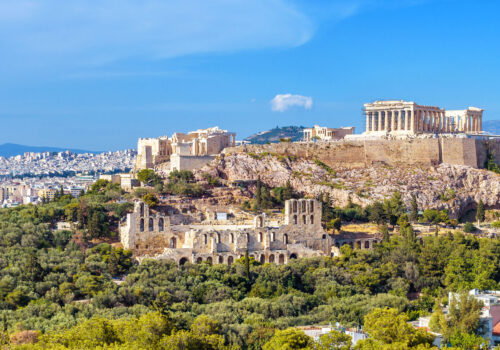


explore the program
The Global Energy Center develops and promotes pragmatic and nonpartisan policy solutions designed to advance global energy security, drive economic opportunity, and foster a sustainable energy future.
Atlantic Council TV
Watch this event and more content on ACTV
Follow the conversations shaping our world. Available on all major platforms.
Follow the conversation on X with @AtlanticCouncil and @ACGlobalEnergy using the hashtag #ACEnergy