Banner: European union flag reflected on modern building glass. (Photo by Fabian Kleiser on Unsplash)
Executive summary
The European Union’s digital sovereignty agenda has a missing institutional pillar.
Over the past decade, the EU has built one of the world’s most ambitious frameworks for regulating digital technologies. It has now added the pursuit of digital sovereignty by investing in technological capabilities to act independently and reduce its reliance on non-EU providers, especially when protecting EU citizens’ rights and the bloc’s democratic processes.
That strategy remains incomplete. The EU is investing heavily in semiconductors, artificial intelligence (AI), cloud infrastructure, and quantum computing. But autonomy over these technologies also requires the independent capability to hold their governance to account. Here, the EU has no comparable strategy.
This paper defines that capability as Europe’s Democracy Stack. It is the collective capacity of independent organizations to generate evidence, monitor implementation, provide independent access to information, undertake strategic litigation, strengthen information integrity, and hold governments and companies accountable across the digital sphere.
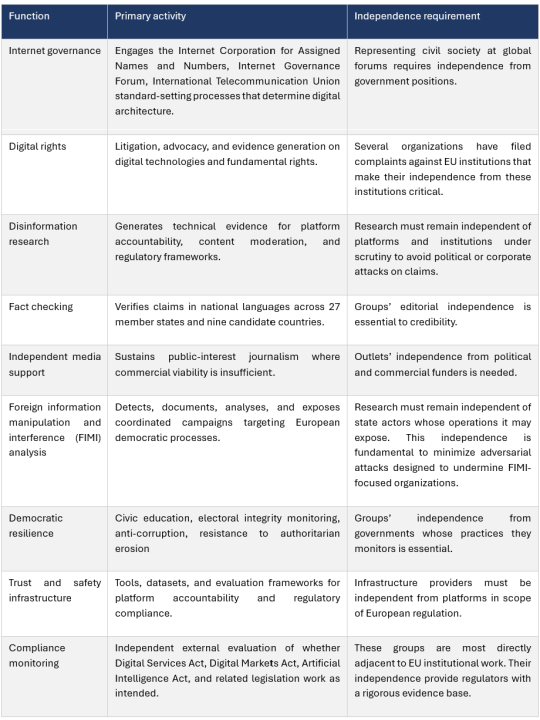
It comprises six interdependent institutional components that perform nine public-interest functions as outlined in Table 1 below. The capability describes a collective distributed capability, not a formal institutional structure.
The defining characteristic of Europe’s Democracy Stack is its independence. That includes legal and governance, editorial and research, and operational and financial independence. Many of the stack’s organizations scrutinize governments and companies, challenge regulatory decisions, litigate against public authorities, and audit the implementation of EU legislation. Others provide independent technical evidence, monitor online platforms, and represent civil society in international internet governance discussions. Their collective independence from both governments and companies is fundamental to protecting free speech, privacy, and other fundamental rights.
Public funding for Europe’s Democracy Stack is not incompatible with the independence on which that capability’s value depends. Public support should not permit funders to select research questions, influence findings, shape policy recommendations, or retaliate against criticism. All institutional funding should be transparent, arm’s length, and subject to independent audit to reinforce the Democracy Stack’s legitimacy with European citizens.
Without such independence, the EU’s current digital sovereignty agenda lacks a legitimate mechanism for democratic accountability.
Key findings
- Europe’s Democracy Stack is a distinct strategic capability. The analysis identifies a nine-function, six-component ecosystem of independent organizations that provides the accountability, evidence, and technical expertise necessary for the EU’s digital sovereignty framework to function effectively. Its defining characteristic is institutional independence from both governments and companies.
- Europe’s Democracy Stack exhibits the characteristics of strategic public infrastructure. It produces public goods with EU-wide public benefits. It requires investment horizons that markets, philanthropy, and short-term EU and member state grants cannot reliably sustain. The mismatch between those needs and current funding mechanisms is structural and highly volatile. The median organization within the dataset experienced annual income fluctuations exceeding 20 percent between 2021–2024, and almost 40 percent suffered an income decline between 2023–2024.
- Europe’s Democracy Stack has a collective annual operating budget of approximately €144 million. That figure is around €0.27 per resident per year across the EU and candidate countries, or less than one-quarter of the price of a single stamp in most EU countries. Of the nine public-interest functions identified in this report, existing EU institutions partially perform, collectively, four of them and do so at a combined annual cost of approximately €0.25 per EU resident. The remaining five functions have no comparable institutional equivalent.
- Europe’s Democracy Stack is financed overwhelmingly from outside EU institutional funds. In 2024, the latest year for which figures are available, EU institutional funding supplied approximately 12 percent of the collective capability’s income. US government and US philanthropic sources supplied approximately 56 percent; EU national governments supplied 14 percent; commercial and membership income supplied 11 percent; and 7 percent was unclassified due to a lack of accessible regulatory files for smaller organizations. This structure reflects the capability’s historical evolution, not a deliberate funding strategy. Much of that external support is now contracting, with confirmed reductions from non-EU actors outlined in Table 4 below.
- The EU’s digital sovereignty strategy contains a structural capability gap. The 27-country bloc is investing billions to reduce its dependence on non-EU technology providers. Yet the independent organizations responsible for holding infrastructure and governments accountable remain dependent on funding decisions made outside of European institutional support. These functions rely on institutional independence and the appropriate policy response is sustained public financing.
- Current EU funding mechanisms do not close the gap. The EU’s existing Multiannual Financial Framework (MFF) 2028–2034 proposals invest heavily in technological sovereignty. They do not yet address the long-term financing of the independent capability required to govern that investment. Existing EU short-term grant funding is structurally mismatched to functions such as strategic litigation, digital regulatory compliance monitoring, and longitudinal information integrity work.
- The analysis identifies two complementary recommendations. The first is cost-neutral reforms to the MFF’s AgoraEU program to create longer-term institutional funding within the existing budget envelope. The second is a €1 billion European Democracy Stack Endowment Fund to provide a permanent funding anchor of approximately one-third of the ecosystem’s current annual income. Together, these reforms establish an EU funding floor without fully replacing non-EU public funding.
This analysis builds on a previous policy paper from the Atlantic Council’s Democracy + Tech Initiative that quantified EU public funding for democratic resilience between 2021 and 2024. It extends that work by identifying and quantifying Europe’s Democracy Stack, analyzing its funding model through empirical data drawn from both recipient organizations and their funders, and proposing reforms to align the EU’s evolving budget architecture with its digital sovereignty ambitions.
Europe’s digital sovereignty will remain incomplete until Europe’s Democracy Stack is recognized and funded as strategic public infrastructure.
Defining Europe’s Democracy Stack
There is a contradiction at the heart of the European Union’s digital policymaking objectives.
The 27-country bloc has built one of the world’s most ambitious digital regulatory frameworks, including efforts to address social media harm, reduce abusive dominance in online markets, and create safeguards around next-generation technologies such as AI. Yet since 2024, the European Commission and EU member states have pushed for greater regulatory simplicity, championed AI economic growth, and reframed the bloc’s digital policymaking priorities around the concept of digital sovereignty.
That strategy remains incomplete. The EU is investing significant amounts of public money in semiconductor supply chains, AI capacity, cloud infrastructure, and quantum computing. But it lacks a comparable strategy for the independent public-interest capability required to ensure those technologies are governed democratically.
This paper defines that capability as Europe’s Democracy Stack. It is the collective capacity of independent organizations to generate evidence, monitor implementation, undertake strategic litigation, strengthen information integrity, and hold governments and technology companies accountable across the digital sphere.
Europe’s Democracy Stack comprises six interdependent institutional components. They include
- institutions with accumulated expertise;
- data infrastructure for monitoring and analysis;
- legal capacity for litigation and enforcement;
- trusted relationships with regulators, policymakers, and international bodies;
- multilingual operational knowledge across EU member states and candidate countries; and
- international representation in global internet governance forums.
Collectively, these six components perform nine public-interest functions (Table 1). The components describe the capability’s institutional structure. The functions, below, describe the public goods it produces. Individual organizations frequently perform multiple functions, so the two frameworks are complementary.
Each of the public-interest functions carries a distinct independence requirement. Some require independence from governments and others from companies, while several require independence from both. Organizations’ efficacy depends on remaining independent of the institutions and companies whose actions they evaluate. This strengthens European citizens’ fundamental rights and the EU’s democratic processes.
Without that independence, the EU’s digital sovereignty agenda lacks an independent mechanism for democratic accountability.
The policy objective is not the preservation of individual organizations within Europe’s Democracy Stack. It is the sustainability of the independent capability required to ensure Europe’s digital rules are implemented effectively and democratically to protect EU citizens’ fundamental rights and the bloc’s democratic processes. Within this framework, organizations are the vehicles through which the capability currently exists.
Table 1: Europe’s Democracy Stack’s nine independent functions
Europe’s Democracy Stack as strategic public infrastructure
Taken together, the nine public-interest functions of Europe’s Democracy Stack constitute the strategic public infrastructure that is missing from the EU’s digital sovereignty strategy. They share three characteristics that justify long-term public investment.
- Many outputs produced by Europe’s Democracy Stack have public good characteristics or generate substantial EU-wide positive externalities. Legal precedents established through digital rights litigation benefit all citizens within the relevant jurisdiction. FIMI analysis that detects a coordinated influence operation against one EU member state strengthens the wider European information environment. Fact checking that debunks AI-generated electoral misinformation benefits citizens beyond a specific national audience. These are public goods that markets systematically underprovide because their benefits cannot be fully captured by the organizations that produce them.
- Europe’s Democracy Stack generates EU-wide positive externalities. Investment by one organization in technical expertise or multilingual monitoring capacity creates value across the EU’s wider governance ecosystem. Regulators rely on the evidence, legislators draw on the analysis, journalists build on the investigations, and citizens benefit from the enforcement actions that follow. These benefits extend beyond the originating organization or project, while private investment remains below the socially desirable level.
- Europe’s Democracy Stack depends on long-term investment horizons. Strategic litigation can take years to resolve. Longitudinal FIMI monitoring spans multiple electoral cycles. Building multilingual fact-checking networks, trusted relationships with regulators, and technical capability to track compliance requires sustained institutional capacity beyond what is possible through short-term projects. Yet most EU public grant programs that support Europe’s Democracy Stack operate on 12- to 36-month funding cycles. The mismatch between long-term institutional needs and short-term project funding is a structural capability gap at the heart of Europe’s digital sovereignty agenda.
These three characteristics—public goods, positive externalities, and long investment horizons—are the conditions that justify public investment in other forms of strategic infrastructure. That includes research institutions, transportation networks, public service broadcasting, national security agencies, and national courts. Europe’s Democracy Stack meets those same requirements.
The operating scale of Europe’s Democracy Stack
The analysis provides the first longitudinal estimate of the operating scale and funding structure of Europe’s Democracy Stack.
The research first mapped 94 organizations active across the capability’s nine public-interest functions and obtained financial data for 84 of them. The remaining 10 are retained in the underlying dataset for ecosystem mapping but excluded from the financial totals, either because they are both funders and implementing organizations or because no comparable financial disclosure could be obtained. The financial data covers the period between 2021 and 2024, using the latest full-year figures available.
The organizations were chosen because they collectively comprised the key functions of the nine public-interest functions of Europe’s Democracy Stack. Three criteria were used for groups: primary operational focus on one or more of the nine public-interest functions; engagement with EU digital policymaking through regulatory participation and engagement; and the existence of a legal entity with statutory financial disclosures for at least one year between 2021–2024.
Non-EU organizations, including the Atlantic Council’s Digital Forensic Research Lab, were included where there was a material connection to the 27-country bloc. That included institutional partnerships, EU grant recipients, policy advocacy, or operational coverage of EU member states and candidate countries. Organizations whose primary mandate was academic research without operational civil society outputs, commercial media without a nonprofit or public-interest mandate, and EU institutional bodies were excluded from the dataset.
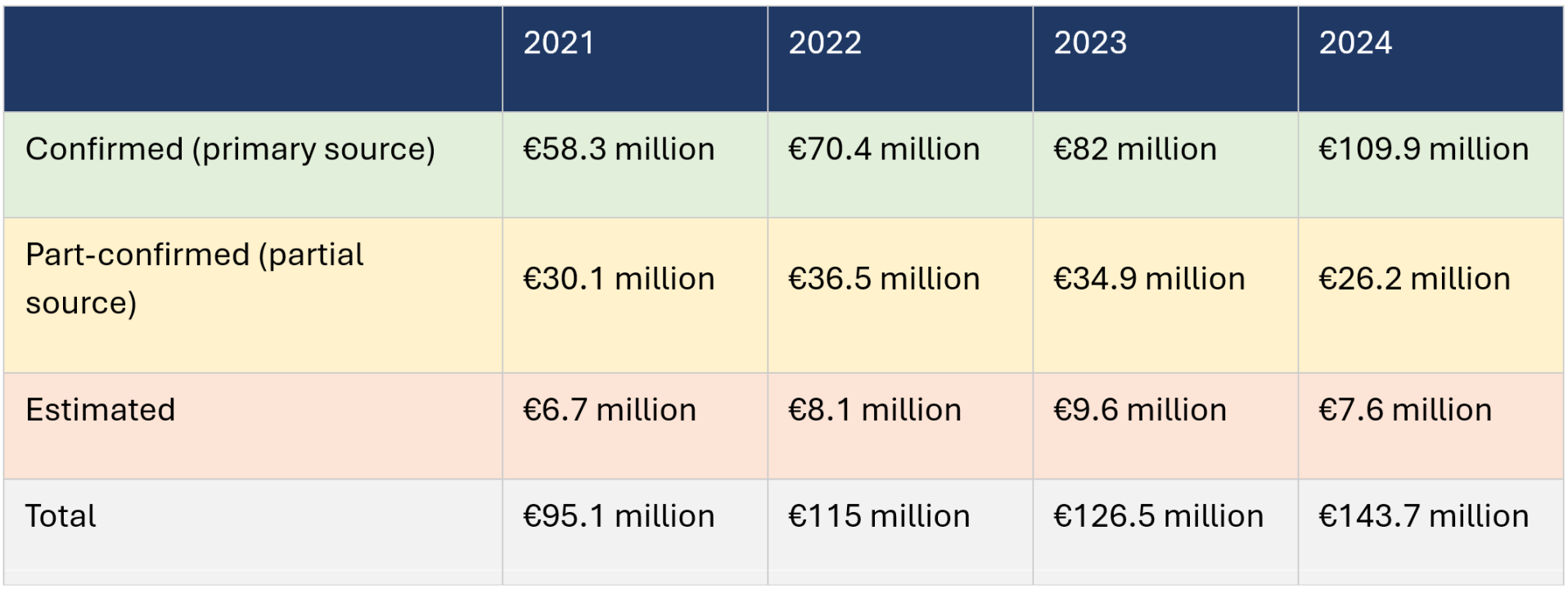
Financial data were compiled from statutory filings and public disclosures. Data were classified as confirmed (primary statutory source), part-confirmed (partial statutory or verifiable public records that were not statutory) or estimated (analytical estimates). Approximately 76 percent of the 2024 dataset is confirmed from primary statutory sources, 18 percent is part-confirmed, and 5 percent is estimated. The residual estimates are concentrated in organizations that fall below mandatory public-filing thresholds in their home jurisdictions or that operate across multiple legal entities without consolidated accounts.
Table 2: Capability income 2021–2024 by confidence level
All figures are anonymized to protect organizations operating in politically sensitive environments, including those within EU candidate countries and conflict-affected regions where public identification could expose them to retaliation.
Between 2021 and 2024, the collective capability’s funding expanded rapidly. Annual income over the period grew by 51 percent to approximately €144 million. This coincided with the implementation of the EU’s Digital Services Act, Digital Markets Act, and Artificial Intelligence Act, a series of European elections, increased philanthropic investment, and the final years of significant US government support.
That aggregate financial growth, however, masked substantial variation across the ecosystem. It also did not include data from 2025 onward due to a lag in full-year public filings; such data would likely show a decline in existing funding based on publicly available statutory data. Some organizations expanded significantly via public and philanthropic support. Others experienced abrupt funding contractions that highlighted the fragility of the collective capability.
One Baltic investigative journalism body, for example, saw its income decline by more than 36 percent between 2021 and 2024 following reductions in non-EU public funding. The annual income of one Central and Eastern European organization fell by almost one-third after a two-year public grant concluded. One of Europe’s largest non-academic digital policy research organizations recorded an almost 10 percent fall in annual income over the same period, driven primarily by a retrenchment in US philanthropy.
Across the dataset, the smallest and most externally dependent organizations proved the most vulnerable to abrupt single-funder changes. One FIMI organization lost almost half its annual income after a single government program ended. Another exhausted almost all unrestricted reserves within two years. Another reduced staff after philanthropic funding was withdrawn. One nonprofit focused on compliance monitoring lost 50 percent of its grant funding within a few months as political pressure from the US government to pull back from tech accountability projects hit in 2023.
These confirmed retrenchments demonstrate that the aggregate ecosystem growth within Europe’s Democracy Stack between 2021–2024 concealed significant organizational vulnerabilities. There was also significant volatility in how Europe’s Democracy Stack was funded.
The median organization experienced average annual income swings of more than 20 percent based on available statutory data. This was not due to a specific funding contraction; it was a feature of the capability’s dependence on short-term philanthropic and project-based funding. Between 2023 and 2024, almost 40 percent of organizations reported a decline in income. Roughly 15 percent of the capability experienced a funding drop that exceeded 20 percent annually. Based on regulatory filings for Europe’s Democracy Stack, most groups have no institutional financial buffer against the reported decline in external funding.
The roughly €144 million collective income for organizations in Europe’s Democracy Stack, for the latest full year available, is equivalent to approximately €0.27 per resident annually across the EU countries and candidate countries where these organizations operated.
For comparison, four EU institutions performing functions comparable to part of Europe’s Democracy Stack had a combined annual budget of approximately €111 million, or €0.25 per EU resident. These institutions included the European Commission’s Digital Services Act enforcement unit, the AI Office, the European External Action Service’s strategic communications division, and the European Data Protection Board Secretariat.
Normalized across the public-interest functions they perform, the comparison public institutions cost approximately €0.06 per EU resident for each of the four functions. Europe’s Democracy Stack costs approximately €0.03 per resident across each of the nine functions.
This comparison is merely illustrative. The functions performed by these EU public institutions differ in scope and complexity from those of Europe’s Democracy Stack. However, the figures demonstrate that the overall scale of investment required for an independent democratic capability is broadly comparable with existing public expenditure in adjacent areas of digital governance.
The comparison is also incomplete. The respective EU public institutions collectively perform only four of Europe’s Democracy Stack’s nine public-interest functions and do so at a reduced scale. Five functions (internet governance, disinformation research, fact checking, independent media support, and democratic resilience) have no comparable EU institutional equivalent.
Where EU public funding exists for activities within these public-interest functions, it is directed primarily through short-term grants to independent organizations within Europe’s Democracy Stack.
Europe’s Democracy Stack depends on external funding
Only 12 percent of Europe’s Democracy Stack is financed through EU institutional funding. The remaining 88 percent depends on funding decisions made outside EU public institutions (see Table 3). This analysis provides the first assessment of the capability’s collective funding model and quantifies the extent to which Europe’s Democracy Stack relies on external financial support.
The purpose is to identify who funds Europe’s Democracy Stack, how that financing structure has changed over time, and whether the current funding landscape is consistent with the EU’s stated policy objective of reducing dependencies within its digital sovereignty agenda.
The analysis is not intended to criticize the failure of EU public institutions or other European funders to financially support Europe’s Democracy Stack. Such entities provide significant funding for European democratic resilience, as outlined in previous analysis from the Atlantic Council’s Democracy + Tech Initiative. Yet the empirical data demonstrates an ongoing reliance on non-EU institutional funders.
Europe’s Democracy Stack performs functions that have become central to the EU’s digital sovereignty agenda. It produces public goods that governments cannot deliver directly because these goods’ legitimacy depends on institutional independence. Yet while the EU has invested heavily in reducing external dependencies in semiconductors, AI, cloud infrastructure, and other strategic technologies, it has not reduced the external dependence of the independent capability responsible for ensuring those technologies are governed democratically.
To quantify that dependency, this analysis maps how Europe’s Democracy Stack was financed between 2021 and 2024, using the latest full-year figures available. It draws on statutory filings, publicly available government data, and cross-checks funding for the 84 organizations examined in this paper against the 2,300-organization EU public funding directory developed for the previous analysis in this series.
Table 3: Estimated funding composition 2024 by source category
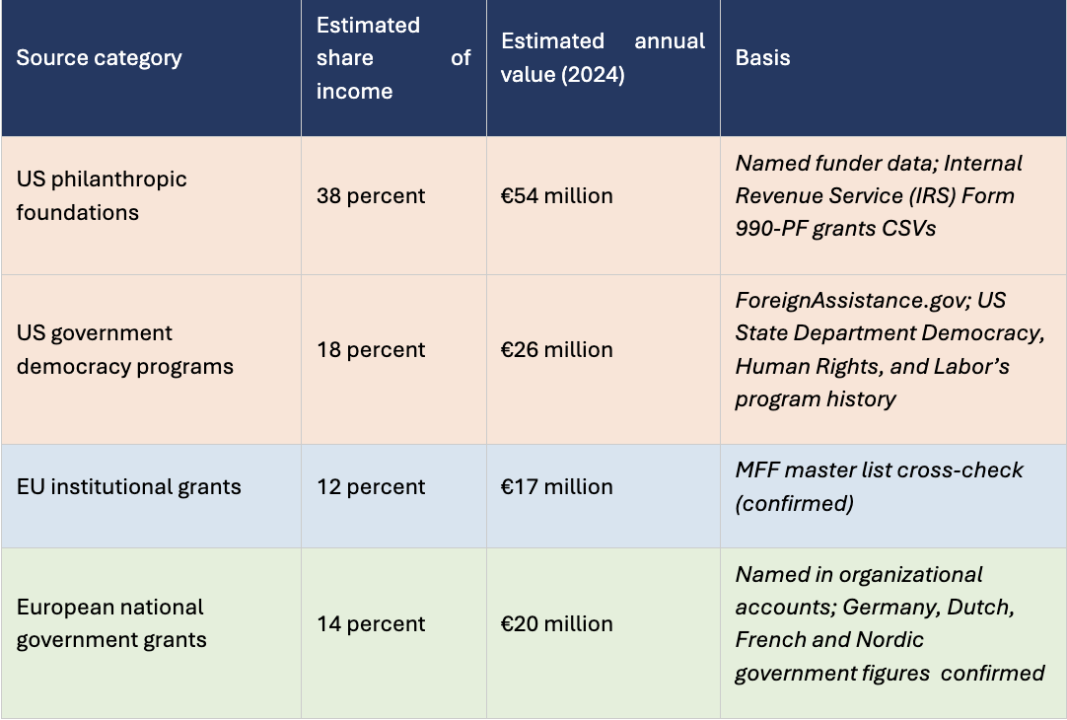
The funding model is clear. EU institutional grants accounted for 12 percent of Europe’s Democracy Stack’s collective annual income. US government programs and US philanthropic foundations together represented 56 percent, while EU member state governments and commercial income provided approximately 25 percent. The remaining 7 percent is unclassified because of incomplete statutory data for smaller organizations.
The current funding model emerged during a period of strategic alignment between EU policy objectives and those of external partners. For more than a decade, EU institutions, US government agencies, and philanthropic foundations broadly shared common objectives around digital rights, platform accountability, election integrity, and democratic resilience. Europe benefited from that alignment. Between 2021 and 2024, it enabled Europe’s Democracy Stack to expand alongside the EU’s implementation of its Digital Services Act, Digital Markets Act, and Artificial Intelligence Act. External funding helped to build the institutional expertise, legal capacity, multilingual capability, and trusted regulatory relationships described earlier in this paper, which are now integral to Europe’s digital sovereignty agenda.
The problem is not that this model failed. It is that the conditions that sustained this alignment are now diminished and less predictable.
Both US public and philanthropic funding have undergone a significant retrenchment that exposes the absence of a comparable European funding base (See Table 4). US government support for democracy programs in Europe (excluding Ukraine) has contracted sharply from its approximately $227 million total spend in 2023. The US State Department’s Global Engagement Center, a federal office dedicated to countering foreign disinformation and propaganda with an annual $61 million budget, ceased operations in December 2024. The US National Endowment for Democracy, whose European grant making had reached $11 million annually, suspended much of its support after access to US congressionally appropriated funding was halted in early 2025.
More recently, US government funding priorities have shifted away from supporting elements of Europe’s Democracy Stack toward programs that openly challenge aspects of this capability. This includes targeting parts of the existing European ecosystem of organizations with visa restrictions and other legal measures.
The philanthropic environment has also shifted.
Analysis of IRS Form 990-PF filings and statutory accounts for foundations that historically anchored Europe’s Democracy Stack shows a consistent pattern of retrenchment (see Table 4). Confirmed regulatory filings identify substantial reductions in annual charitable disbursements, the scaling back of dedicated European operations, and a broader shift from long-term institutional support toward shorter-term project funding.
This analysis does not name specific philanthropic organizations to avoid jeopoarding existing funding relationships between those foundations and organizations within Europe’s Democracy Stack.
Confirmed primary filings showed that one foundation’s annual charitable disbursements declined by more than half from roughly $49 million to approximately $22 million between 2020 and 2024. Its dedicated European operational entity reported income below $50,000 in its most recent statutory records. A second foundation reduced total annual grants by more than 37 percent year on year over the same period. Regulatory filings of a third major foundation confirmed a retrenchment from European programs. Although the value of that reduction cannot be calculated from the foundation’s public accounts, multiple organizations in the separate Europe’s Democracy Stack dataset identified it in their own annual records as a contracting funder.
This retrenchment has had an impact on organizations. A group that remains a critical component of Europe’s Democracy Stack suffered a 42 percent collapse in its annual income after a single non-EU government funder pulled its support, based on the organization’s statutory accounts. The name of the organization has been withheld for confidentiality reasons.
Table 4: Illustrative changes among US funders since 2024
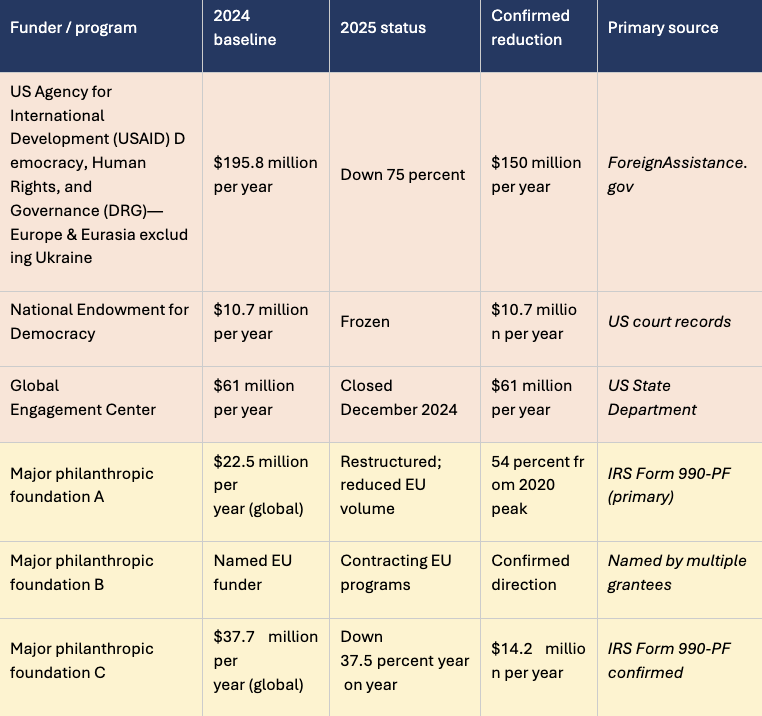
The figures in Table 4 are not estimates of funding lost by organizations within Europe’s Democracy Stack. Instead, they demonstrate the scale and direction of retrenchment across several US funders from which groups within the capability have historically received long-term support.
The policymaking consequence of this retrenchment extends beyond the current financial realities.
Europe’s independent digital democratic capability developed without a comparable European funding base capable of absorbing such external policy changes. Organizations most dependent on a small number of these non-EU institutional funders have experienced significant financial contractions, staff reductions, and pressure on unrestricted reserves.
This reality reveals a structural capability gap that sits uneasily alongside the EU’s digital sovereignty agenda. The 27-country bloc is investing billions of euros to reduce external dependencies across strategic technologies, yet the independent organizations responsible for monitoring, evaluating, and holding those same technologies accountable are still financed overwhelmingly by actors that are now reducing their support.
Digital sovereignty’s missing democratic capability
The previous sections establish two empirical findings. First, Europe’s Democracy Stack performs functions that have become central to the EU’s digital sovereignty agenda. Second, only 12 percent of that capability is financed through EU institutional funding, while 88 percent depends on funding decisions made outside EU institutions.
These findings expose a strategic capability gap at the heart of the bloc’s digital sovereignty strategy.
The European Commission’s proposed Tech Sovereignty Package, published in June 2026, seeks to reduce external dependencies in strategically important capabilities. In the next MFF budget cycle, the EU plans to invest billions of euros in semiconductors, AI, cloud infrastructure, cybersecurity, and quantum computing to strengthen its technological autonomy. Yet no comparable effort has been made to reduce the external dependence of the independent organizations responsible for ensuring those technologies are governed democratically.
This gap cannot be left to markets. Europe’s Democracy Stack produces public goods, generates benefits that extend beyond the organizations that provide them, requires long-term institutional investment, and serves widely dispersed beneficiaries. These are the circumstances in which markets systematically underprovide strategic capability, and where public funding becomes the appropriate mechanism.
Europe’s Democracy Stack also cannot be absorbed into government agencies or other public bodies.
Unlike semiconductor manufacturing or cloud infrastructure, the public value of Europe’s Democracy Stack depends on institutional independence. Many of the organizations examined in this analysis challenge government decisions, litigate against public authorities, monitor implementation of EU legislation, scrutinize regulatory enforcement, and produce independent technical evidence.
These functions fundamentally lose credibility if they become part of the institutions they scrutinize.
An EU-funded platform auditor operating within a procurement contract, for example, cannot credibly challenge a European Commission decision that a platform complies with the Digital Services Act. Strategic litigation cannot independently challenge governments if it is undertaken by a government agency. The legitimacy of fact checking, digital regulatory monitoring, and technical evaluations of AI systems depends on institutional separation from both governments and companies.
Until now, this institutional independence was sustained through non-EU institutional and philanthropic investment that broadly aligned with European policy objectives. As demonstrated above, that alignment has contracted and, in the case of the US government, reversed. For as long as that external funding was available, the structural capability gap in the EU’s digital sovereignty strategy was invisible.
Until 2026, external funding kept the funding gap hidden. Its retrenchment has now made that gap visible.
The consequence is a strategic capability gap. Europe is investing to reduce external dependence across critical emerging technologies—while leaving the independent democratic capability responsible for ensuring accountability overwhelmingly dependent on funding decisions made outside the EU.
The EU’s broader digital sovereignty agenda currently depends on non-EU providers. In principle, that reliance can be addressed through institutional investment, policy interventions, and regulatory requirements on foreign providers. The Democracy Stack’s external funding dependency is structurally different. When non-EU funders contract, no current regulatory mechanism or procurement policy can replace it.
The policy challenge is not whether Europe should replace the institutional independence provided by Europe’s Democracy Stack with capabilities embedded within EU-level bodies or member state agencies. It is how the EU can provide sustained public financing for this collective capacity that preserves the independence and public value of Europe’s Democracy Stack.
Addressing external dependencies
The EU has already accepted that strategic capabilities cannot depend indefinitely on external providers. Within the European Commission’s 2028–2034 MFF proposals, the European Competitiveness Fund identifies such dependences in semiconductors, AI, cloud infrastructure, and other frontier technologies as a strategic vulnerability that requires sustained public investment.
The evidence presented in this paper demonstrates that Europe’s Democracy Stack exhibits the same structural vulnerability. As noted earlier, only 12 percent of its combined capability is financed through EU institutional funding, while 88 percent depends on funding decisions made outside EU institutions.
This is the same logic the EU used for greater public funding for semiconductors, cloud infrastructure, and AI but is applied to a different—and equally valid—strategic capability. In the case of emerging technologies, the 27-country bloc has concluded that strategic capabilities should not depend indefinitely on providers whose priorities might diverge from those of the EU. The same principle similarly applies to the independent organizations responsible for ensuring those technologies are governed democratically.
Current MFF negotiations do not yet reflect that reality.
The proposed European Competitiveness Fund allocates €51.5 billion over the 2028–2034 budget period, or €7.3 billion annually, for its Digital Leadership program to strengthen Europe’s technological capabilities in areas including AI, digital infrastructure, and wider digital sovereignty. By comparison, the collective annual income of Europe’s Democracy Stack is approximately €144 million.
The independent capability expected to provide democratic accountability for those investments operates on a funding ratio of approximately 51:1 compared with the proposed financing via the European Competitiveness Fund’s Digital Leadership program.
The issue is not simply the scale of funding; it is also the structure of that funding.
The previous paper in this series demonstrated that 84 percent of the €243 million allocated to democratic resilience through Horizon Europe and CERV programs, under the EU’s current 2021–2027 budget, is distributed through non-renewable grants that last between twelve and thirty-six months. This funding model does not align with the public-interest functions performed by Europe’s Democracy Stack.
Strategic litigation can last up to 10 years. Longitudinal FIMI monitoring requires continuous institutional capacity across successive electoral cycles. Building multilingual fact-checking capability, technical expertise, and trusted regulatory relationships requires sustained investment over multiple MFF cycles.
The current negotiating positions of both the European Parliament and the Council of the European Union recognize the importance of democratic resilience. But neither treats Europe’s Democracy Stack as a strategic capability within the EU’s digital sovereignty agenda. As a result, the proposed MFF funding architecture separates long-term investment in Europe’s technological infrastructure from the current short-term grants for the independent democratic capability required to ensure that such technological infrastructure is governed effectively and held accountable.
The EU does not need to fundamentally alter its concept of digital sovereignty. It must apply the existing policy logic consistently across both hardware infrastructure and the public-interest capabilities necessary to oversee those investments. If the EU accepts that technological sovereignty requires sustained investment in strategic infrastructure, then the same objective applies to the independent democratic institutions that enable technologies to be governed in the public interest.
Europe’s digital sovereignty will remain incomplete until Europe’s Democracy Stack is recognized and funded as strategic public infrastructure.
Building Europe’s democratic capability
The analysis points to two complementary priorities within the current 2028–2034 MFF negotiations. The first involves targeted changes to the proposed AgoraEU implementing regulation. The second is the creation of a €1 billion European Democracy Stack Endowment Fund to address the structural dependency on external funding.
The two tracks require different decisions and operate on different timelines. Changes to AgoraEU’s implementing regulation can be adopted by the European Commission—subject to European Parliament and Council of the European Union scrutiny—independently of the wider MFF budget negotiations. The endowment requires a separate capitalization decision as part of the 2028–2034 MFF package.
Given that confirmed contractions in external funding for wider European-focused democratic resilience work already exceed the entire 2024 income of Europe’s Democracy Stack, a delayed capitalization decision for the endowment is not a neutral outcome. That fund completes the EU’s digital sovereignty architecture by providing the independent democratic capability that current investment proposals lack.
AgoraEU: Addressing EU-wide problems
Europe’s Democracy Stack is an EU-wide public good that requires an EU-wide response. The platforms it monitors are principally governed by EU legislation. The information threats it addresses cross national borders. Multilingual monitoring across 27 EU member states and nine candidate countries exceeds what any single government can reasonably finance. Internet governance is global. Organizations that challenge EU institutions require institutional independence from the public bodies they scrutinize.
The previous paper in this series proposed two changes to AgoraEU to meet those public-interest needs. The financial evidence presented above strengthens the case for both.
First, AgoraEU should explicitly protect and fund Framework Partnership Agreements (FPAs) via predictable multiyear operating grants. FPAs are the principal EU instrument capable of providing multiyear support to EU-level organizations. Eligibility must extend across all nine public-interest functions of Europe’s Democracy Stack, with a minimum share of Citizens, Equality, Rights, and Values (CERV+) funding reserved for such multiyear agreements.
Second, create a Democratic Resilience Institutional Grant tier within AgoraEU. These grants run for five to seven years, are renewable once, require no co-financing, and remain open to organizations across all nine public-interest functions that are part of Europe’s Democracy Stack. Table 5 describes how these functions map against current 2028–2034 MFF proposals.
Both reforms are cost neutral within AgoraEU’s existing CERV+ envelope. They change how already-programmed funding is structured and distributed but not the program’s overall budget allocation. As they are delivered through the AgoraEU’s implementing regulation, they can proceed on the European Commission’s implementation timetable irrespective of the wider outcome of the 2028–2034 MFF negotiations.
Table 5: Europe’s nine digital democratic capability functions mapped against the 2028–2034 MFF
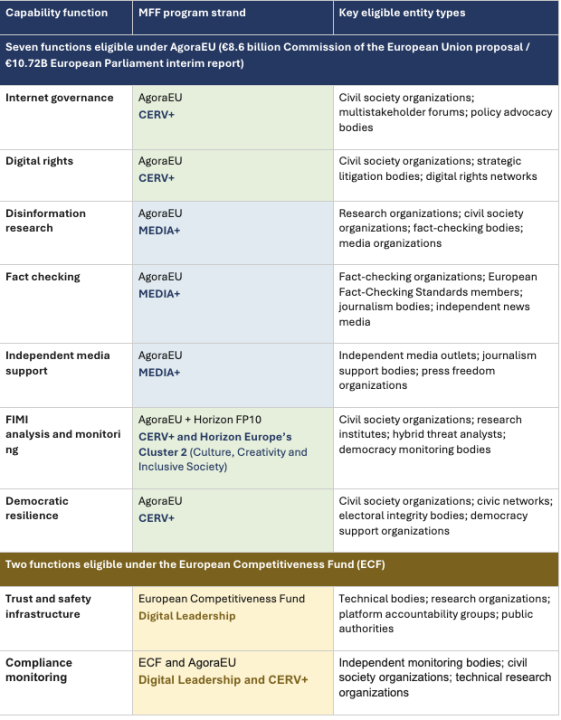
The European Parliament’s proposal to earmark regulatory fines for civil society funding as part of its AgoraEU position requires specific attention.
The evidence in this paper demonstrates why institutional independence is fundamental to Europe’s Democracy Stack. An organization whose income depends on fines imposed on the platforms it monitors cannot credibly oversee those platforms. Fine-contingent funding is inherently unreliable. The European Commission’s €120 million Digital Services Act fine against X (formerly Twitter), for example, is currently subject to three legal proceedings that might take years to resolve. Linking civil society funding to regulatory penalties also exposes recipient organizations to adversarial attacks and claims they have a financial interest in enforcement outcomes.
The European Parliament must remove its support for earmarking regulatory fines for civil society. Stable budget-line, long-term funding is the appropriate mechanism for Europe’s Democracy Stack.
European Democracy Stack Endowment Fund
The AgoraEU reforms mentioned above address weaknesses in the EU’s existing funding architecture but do not resolve the systemic external funding dependencies. That requires a structural instrument aligned with the EU’s digital sovereignty objectives.
A €1 billion European Democracy Stack Endowment Fund must be created through one-off public capitalization. That figure represents less than two percent of the European Competitiveness Fund’s Digital Leadership €51.5 billion sub-program. The endowment is not an additional policy objective within the EU’s digital sovereignty agenda or the ongoing MFF negotiations, but the governance layer required to complement that wider investment.
The €51.5 billion comparison illustrates the scale of the endowment proposal; it does not determine it. The fund’s size is derived independently from the quantified funding requirements of Europe’s Democracy Stack.
Endowments are designed for institutions that produce long-term public value but cannot reliably generate commercial income. Universities, scientific academies, museums, and public-interest foundations use these instruments to separate permanent institutional capability from annual funding cycles. Europe’s Democracy Stack exhibits the same structural characteristics and requires a similar funding mechanism.
The EU already applies this endowment funding model to its external neighborhood. The European Endowment for Democracy (EED) is an independent foundation supported by EU and member state contributions to provide funding support for pro-democracy activities in the EU’s neighborhood. Its grant making is insulated from direct European Commission control and is governed by a board with civil society nomination rights.
By the end of 2024, for example, the EED had provided almost €250 million in grants to roughly three thousand initiatives since its establishment in 2013. Its average grant size was between €40,000–€60,000, it accepts applications on a rolling basis with no fixed deadlines, and it reaches organizations that cannot access conventional EU institutional support.
The EED demonstrates that the EU can provide long-term public funding through an institution designed to maintain operational independence. The same institutional model applies to the EU’s internal democratic capability through Europe’s Democracy Stack.
One possible legal vehicle could be an independent foundation under EU law that draws on governance precedents set by the EED. The appropriate legal basis for an EU budget contribution, ownership of the invested funding corpus, investment authority, and applicable financial controls would require additional structural and legal design.
The proposed €1 billion one-off capitalization is based on financial evidence. Europe’s Democracy Stack currently has a collective annual operating budget of approximately €144 million. The endowment can provide a permanent structural anchor equivalent to roughly one-third of that figure, or approximately €45 million annually. That level of support establishes a permanent funding floor without displacing philanthropic, national, or other external funding.
At a sustainable annual payout of 4.5 percent (based on existing norms within endowment structures), that requires approximately €1 billion in initial capital. Table 6 shows this figure holds across a range of payout assumptions from 4–5 percent.
Table 6: Endowment payout scenarios against structural anchor threshold
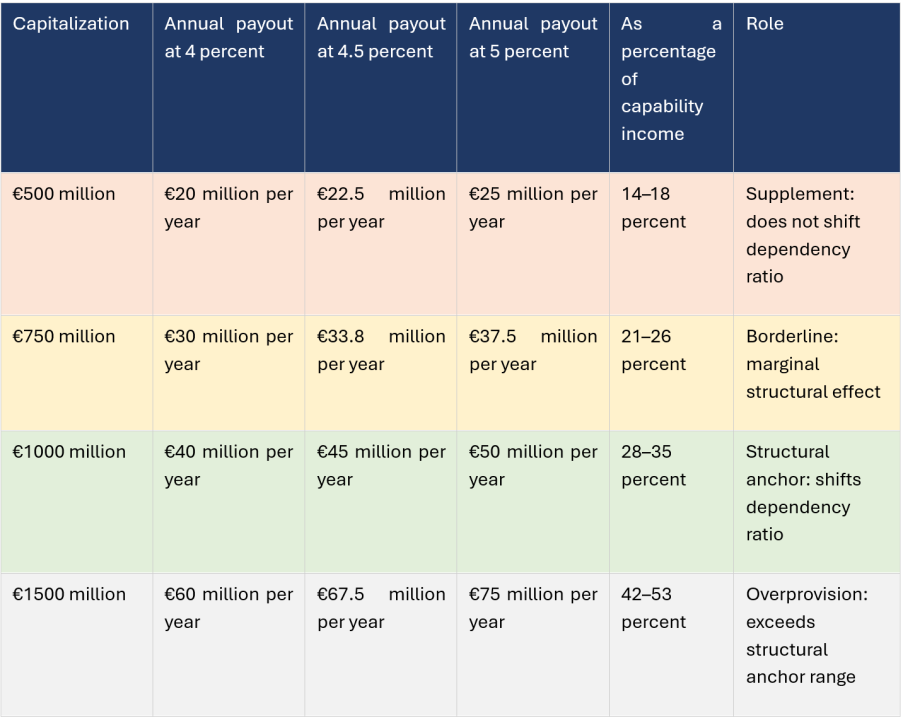
The previous paper in this series proposed a €500 million endowment fund. The new financial evidence shows that figure would generate only 14–18 percent of the capability’s current collective operating budget. It would supplement existing funding but would not materially reduce existing dependence on non-EU institutional funding.
At €1 billion, annual distributions of €40–€50 million create a structural funding anchor capable of materially reducing the current external funding dependency while allowing noninstitutional funds to provide most of the annual support. The endowment would provide a permanent anchor for Europe’s Democracy Stack. It would not become its sole financial support.
A structural anchor for the capability of approximately one-third of collective funding meets two objectives: it is sufficiently large to reduce exposure to the withdrawal of any single external funding source, and it leaves annual funding from philanthropy, national governments, commercial income, and other sources as the major source of annual financing.
Public funding at this scale requires significant safeguards to guarantee institutional independence and transparency for European citizens. The endowment replicates key features of the EED model, including
- an independent board with civil society nomination rights;
- transparent grant criteria covering all nine public-interest functions;
- fixed investment mandates to insulate grant making from political cycles; and
- annual reporting to the European Parliament and European Court of Auditors without operational control over individual funding decisions.
The endowment relies on two distinct precedents for its governance and financial structure.
For its governance, the EED demonstrates that the EU can capitalize an independently governed grant-making body that draws on contributions from the European Commission and EU member states through a board of governors with civil society nomination rights.
For its financial structure, the perpetual endowment model used by major public-interest foundations is the precedent. This allows for a permanent invested corpus that generates annual distributions at a sustainable payout rate of roughly 4–5 percent. An illustrative capitalization could comprise €400 million from a one-off EU budget provision, €400 million from collective voluntary EU member state contributions; and €200 million from European institutional investors operating under a public-interest mandate.
The endowment institutionalizes Europe’s Democracy Stack beyond successive MFF cycles. It replaces the current structural dependence on external funding with a permanent European funding anchor that preserves the institutional independence that gives the capability its public value. In doing so, it closes the missing structural capability gap within the EU’s current digital sovereignty agenda.
Conclusion
The EU’s digital policy agenda has expanded. Having built one of the world’s most comprehensive digital regulatory frameworks, it has added the pursuit of digital sovereignty, reducing external dependencies in strategically important emerging technologies and strengthening Europe’s capacity to act independently in the digital sphere.
Europe’s Democracy Stack performs nine independent public-interest functions that generate evidence, monitor implementation, undertake strategic litigation, strengthen information integrity, and hold governments and companies accountable. Yet only 12 percent of that capability is financed through EU institutional funding. The remaining 88 percent depends on funding decisions made outside EU institutions.
As much of that external funding contracts, Europe faces a structural dependency within the capability responsible for ensuring its digital sovereignty agenda is governed democratically.
The contradiction is clear. The 27-country bloc is reducing external dependence across strategic technologies while leaving its accountability capability externally dependent. The resolution is already established. The EU has already concluded that strategic technological capabilities should not depend indefinitely on external providers. The evidence demonstrates that the same objective applies to Europe’s Democracy Stack.
The goal is not to replace philanthropic support, EU member state funding, or other external financial sources. Europe’s Democracy Stack also must not be incorporated into EU or member state institutions. Its public value depends on institutional independence from both governments and companies. The challenge is to establish a permanent European funding anchor that strengthens that independence and reduces structural dependence on external funding.
This paper proposes two complementary reforms.
The first strengthens the MFF’s AgoraEU program. It protects Framework Partnership Agreements, creates a five-to-seven-year Democratic Resilience Institutional Grant tier, and removes the European Parliament’s proposal to earmark regulatory fines for civil society funding, which is incompatible with the institutional independence on which Europe’s Democracy Stack depends.
The second establishes a €1 billion European Democracy Stack Endowment Fund. Capitalized through one-off contributions from EU institutions, member states, and European institutional public-interest investors, the endowment provides a permanent European funding floor equivalent to roughly one-third of the capability’s current annual income. This allows the endowment to provide a foundation for the capability without crowding out other funding sources. It establishes a permanent European funding anchor independent of annual budget negotiations and the policy priorities of any single external funder.
The 2028–2034 MFF negotiations must also explicitly recognize the capability’s democratic oversight function as strategic public infrastructure alongside the semiconductor, cloud, and AI capabilities currently supported via the MFF’s European Competitiveness Fund. That recognition aligns the EU’s long-term funding architecture with the digital sovereignty principles it already applies across other strategic technologies and public infrastructure.
These recommendations do not create a new policy paradigm within Europe’s digital sovereignty objectives. Instead, they apply an existing principle consistently across all forms of public infrastructure. If digital sovereignty means Europe can shape its digital future independently, it must also mean Europe can independently hold that future to account. Within that definition, sovereignty extends beyond technological infrastructure to include the independent democratic capability on which that governance depends.
Without that change, Europe’s digital sovereignty will remain incomplete until Europe’s Democracy Stack is recognized and funded as strategic public infrastructure.
Methodology
This analysis mapped 94 organizations that are active across the nine public-interest functions of Europe’s independent digital democratic capability and obtained statutory financial data for 84 of them. The remaining 10 lacked accessible public financial disclosures for 2021–2024. They remain in the underlying dataset for ecosystem mapping purposes only.
Organizations were included if they met three criteria: primary operational focus on one or more of the nine public-interest functions, discrete legal entity with statutory financial disclosures for at least one year during 2021–2024, and significant engagement in EU digital policy. Engagement was defined as documented participation in EU regulatory processes, receipt of EU institutional funding for relevant activities, formal partnership with EU institutions or regulators, or sustained operating activity within EU member states or candidate countries.
Longitudinal comparisons between 2021–2024 use a constant organizational dataset. Changes in aggregate income do not reflect additions to the underlying corpus of organizations.
The dataset includes 61 organizations registered within EU member states and 33 groups registered outside of the 27-country bloc. Non-EU organizations, including the Atlantic Council’s Digital Forensic Research Lab, were included where there was a significant EU connection through institutional partnerships, EU grant receipts, policy advocacy, or operational coverage of EU member states and candidate countries.
Where an organization operated multiple legal entities, income was attributed to the entity primarily responsible for EU-focused work. Network secretariats were included and counted separately from member organizations. Where a US parent organization funded a European subsidiary, that unit’s accounts were used and US–EU transfer was treated as external income to that entity.
Financial data sources and confidence classification
Financial data were compiled from primary statutory sources on a country-by-country basis. This included data from the UK Charity Commission; Belgian Crossroads Bank for Enterprises (KBO) and National Bank statutory accounts; Dutch Chamber of Commerce (KvK) filings; published annual reports where statutory filings were the primary source available; IRS Form 990 and Form 990-PF returns accessed via ProPublica Nonprofit Explorer; German Bundesanzeiger filings; and national nongovernmental organization (NGO) registries across France, Ireland, Austria, Poland, Greece, the Czech Republic, Spain, Italy, Croatia, and other EU member states and candidate countries.
EU grant income was cross-referenced against the EU Financial Transparency System, Community Research and Development Information Service (CORDIS), and European Education and Culture Executive Agency (EACEA) beneficiary databases. US philanthropic income was verified, where possible, against funder grants databases and IRS Form 990-PF filings. USAID income was verified against ForeignAssistance.gov data.
Each income figure between 2021–2024 was assigned one of the following confidence classifications:confirmed (drawn directly from primary statutory accounts or IRS Form 990 returns); confirmed with qualification (confirmed with a scope or methodological note); part-confirmed (drawn from partial statutory disclosures or incomplete year coverage); reported (income figures reported by the organization in public communications, but not independently verified from statutory filings); self-reported (income figures provided directly by the organization); or estimated (analytical estimates derived from comparable organizations, known funder grant amounts, or parent organization 990 ratios).
Currency conversion
All figures are reported in euros. Non-euro income was converted using annual average exchange rates for the relevant fiscal year sourced from the European Central Bank’s published reference rates. For organizations whose fiscal year did not align with the calendar year, the exchange rate for the calendar year in which most of the fiscal year fell was applied.
Scope and pass-through treatment
Where an organization’s work extended beyond the nine public-interest functions, a scope percentage was applied to total income to derive a capability-relevant figure. Scope percentages were assessed from published annual reports and program descriptions. Where an organization acted as a fiscal sponsor or regranting vehicle, its income was not added to the ecosystem total where recipient organizations were also included in the dataset.
Funder composition estimates
The funding composition figures for Europe’s Democracy Stack are estimated by source category and not derived from confirmed grant award data cross-referenced against the EU Financial Transparency System. European national government income was derived from named funder disclosures in statutory accounts for organizations for which such a breakdown was available. US philanthropic and US government figures were derived from funder-side data, including IRS Form 990-PF grant schedules and ForeignAssistance.gov data.
External funding contraction figures
Table 4 reports confirmed reductions in the broader external funder pools from which Europe’s Democracy Stack historically drew support. These figures measured changes in total funding pools and not confirmed reductions in income received by the 84 organizations in the dataset. The broader pool figures in Table 4 are provided to illustrate the scale of structural change in the external funding landscape. They are not presented as a direct measure of income reduction experienced by the organizations mapped in this paper.
Limitations
The EU institutional funding share of Europe’s Democracy Stack (12 percent) carries a meaningful margin of error. It was derived from cross-checking two non-matched datasets and should be treated as an estimate, not a precise figure. The philanthropic contraction figures in Table 4 were drawn from global disbursement data, not European-specific allocations. The figures illustrate the scale of structural change in the philanthropic funding environment, not confirmed direct reductions to the groups mapped in this paper. The 84-organization dataset is a floor estimate of the total scale of Europe’s Democracy Stack. Smaller organizations that operate below mandatory public filing thresholds are not represented.
Authors
- Mark Scott, Senior Resident Fellow, Atlantic Council’s Democracy + Tech Initiative
- Richard Woods, Policy and Research Director, Global Disinformation Index
Cite this policy paper:
Mark Scott, Richard Woods, “Digital sovereignty and Europe’s democracy stack: Delivering on the European Union’s priorities for the 2028–2034 Multiannual Financial Framework,” Digital Forensic Research Lab (DFRLab), Global Disinformation Index, September 14, 2026, https:/dfrlab.org/2026/09/14/digital-sovereignty-and-europes-democracy-stack-delivering-on-the-european-unions-priorities-for-the-20282034-multiannual-financial-framework.