
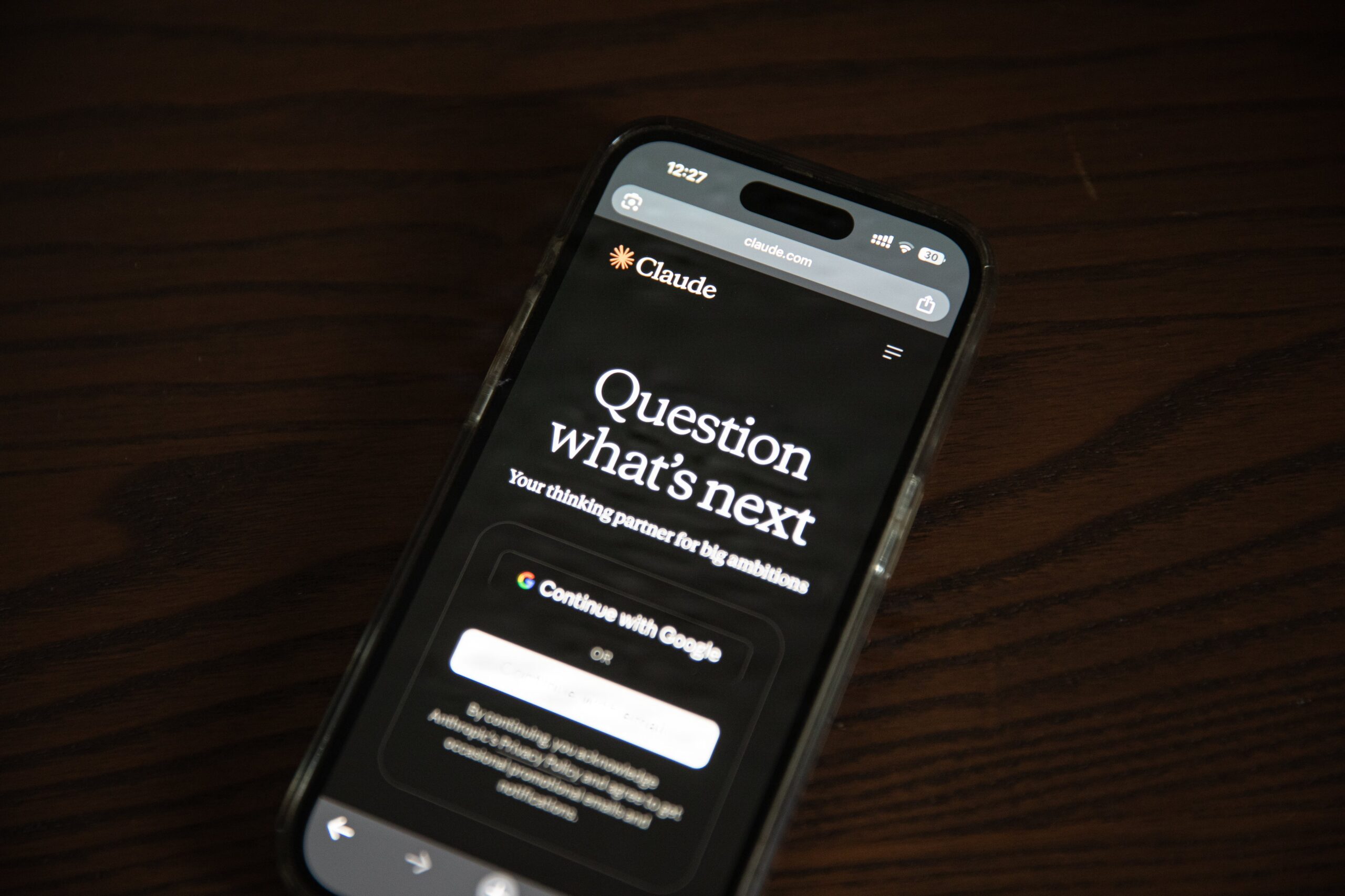
WASHINGTON—The agents are coming. Last month, Meta announced that its new agentic offering, Muse, garnered ten million users in its first six weeks. Estimates of the projected growth of the AI agent market suggest a compound annual growth rate of 45–50 percent over the next five to seven years. Agents promise optimization, efficiency, and other buzzwords, all in the name of freeing up our time. But should we keep running away from friction? What do we lose when we offload our judgment onto a tool designed to make us feel certain?
Information is imperfect, but AI is imperfect-er
Mathematician Claude Shannon (now immortalized as the namesake of Anthropic’s large language model, Claude) published a landmark paper in 1948, which defined information in terms of how much a message reduces the receiver’s uncertainty. The engineering goal, then, is to deliver more signal with less loss. Many companies building AI tools borrow this logic and apply it to human decision-making: if every step between intent and outcome is noise, remove it.
However, according to Shannon, not all friction is noise. Some redundancy makes communication reliable. The information a message carries also depends on how “surprising” it is: a predictable message carries little information and a surprising one carries a lot.
These principles apply to how the average internet user’s consumption of content has evolved. The internet widened the aperture, but the onus was on the individual user to discern between “good” information and noise, find trustworthy sources, and read competing accounts. As a result, information abundance led to less felt certainty, and the democratization of information didn’t necessarily lead to a democratization of ideas.
The advent of large language models (LLMs) has flipped that dynamic. Chatbots give fluent answers, sparing users from the friction-laden process of finding different sources and viewpoints. In reality, users are not always getting better, or even more democratized, knowledge. In fact, different LLMs tend to produce remarkably homogeneous creative outputs and ideas, while human responses tend to be much more diverse.
The human part of searching is being removed from search. Google’s AI overviews, for example, remove the need to navigate several pages to find what a netizen is looking for. However, even with this tailored summary and links, users click and, presumably, verify links within those summaries only 1 percent of the time. LLMs remove friction, but they also reduce the actual information we encounter—the uncertainty that prompts users to explore the limits of our knowledge. In Shannon’s terms, “I don’t know” is itself information. In a Chinese magazine article soliciting readers’ experiences with “Artificial Challenged Intelligence,” a 39-year-old man from Wuhan put it this way, as translated by ChinAI:
“For all its brilliance—having digested everything humanity has ever created or is currently creating, and possessing a perspective that could be described as ‘omniscient’—AI is paradoxically trapped by that very omniscience. No matter the question, it never falls silent or admits, ‘I don’t know.’”
While models do sometimes decline to answer, fluency is their default, and their confident tone carries no signal about the uncertainty behind an answer.
Agents vs. agency
AI agents go even further. At its 2026 developer conference, Google announced “a new era for AI Search,” with agents that monitor the web on users’ behalf, synthesize updates from blogs, news sites, and real-time data. These agents then generate custom interfaces synthesizing this data on the fly. As the Montreal AI Ethics Institute observed, the shift changes not just how people find information, but what kind of internet remains to be found: one people passively receive rather than one they actively navigate.
Agents also, paradoxically, reintroduce the familiar problem of noise. User instructions to AI are imperfect, so chatbots fill the gaps with their own assumptions. If a user is working with multiple agents, and one hands off its work to others, each handoff can lose fidelity, taking the result further and further from what the user sought. In the end, the user may feel perfectly informed without ever having seen the evidence or being exposed to contrary opinions.
To be clear, AI agents can make us smarter, informed human beings, but only if we are smarter about how we use them. AI is already woven into the tools most of us use every day, and agents are close behind. Whether these systems sharpen our judgment or dull it depends on how we choose to use them, and on how the people building them choose to do so.
As users navigating this new information-poor ecosystem, humans can choose to slow down. Users should ask their LLMs for sources and uncertainty. “What are you least sure about?” is a legitimate prompt. And they should take a moment to notice what is no longer visible. If an agent assembles information, users should ask what it left out. How does the agent “decide” what to include and what to exclude?
The engineers and UX designers building these systems also have a role to play. One design choice could be a “community note” layer, a concise record of where sources disagree and what readers who dug deeper added or flagged. With this step, some of the context that is smoothed away is restored. Another idea draws from “Socratic AI,” but deployed sparingly. Some AI “tutors” will quiz you into oblivion without actually capturing the substance of the Socratic method. The version that works asks one well-placed question at the right moment.