Featured analysis

Latest analysis

Dollar Plaza Accord

Econographics

Feb 18, 2022

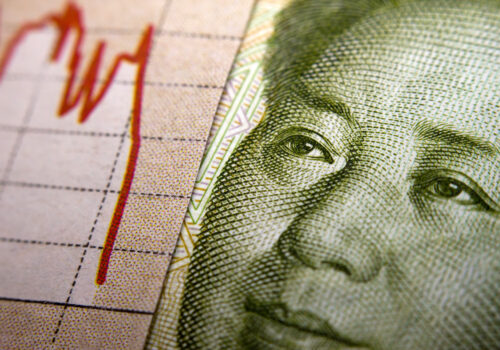
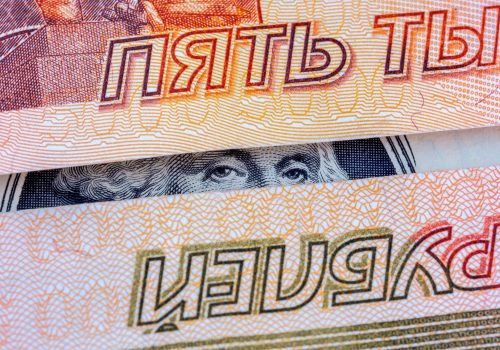
Russia and China: Partners in dedollarization

By Mrugank Bhusari, Maia Nikoladze

Russia has virtually stopped receiving Dollars for its exports to China. Does the US have reason to be concerned?

China
Economy & Business

Econographics

Feb 17, 2022

The path forward on the US-China technology competition

By Clete R. Willems

2022 will be a key inflection point for trade and technology policy. Congress will decide how to proceed with China competitiveness legislation, the Administration will be finalizing the its Indo-Pacific trade agenda, and both will assess concerns about the size and activity of large US technology platforms. Democrats and Republicans should depoliticize these issues and consider their policy choices through the lens of strengthening US economic and technological competitiveness with China.

China
Defense Technologies

Econographics

Feb 9, 2022

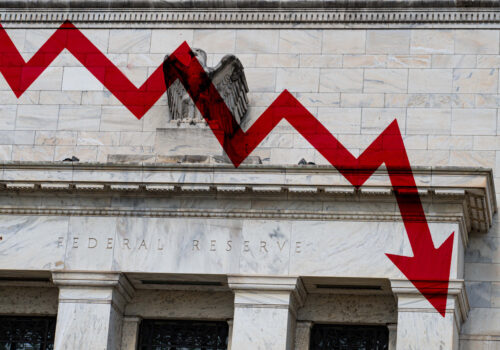
US fiscal policy must be ready for the return of secular stagnation

By Jeff Goldstein

In the years ahead the United States will likely move past current inflation challenges and will once again be battling secular stagnation.

Economy & Business
Fiscal and Structural Reform

EconoGraphics

Feb 6, 2022

Global Sanctions Dashboard: Groundhog edition

By Julia Friedlander, Michael Albanese, Maia Nikoladze and Castellum.AI

Who sanctions Russia and why, Colombia’s narcotics trafficking, Iran’s balancing act, and Chinese military sanctions.

Belarus
China

Econographics

Feb 3, 2022

Foreign Direct Product Rule: Is Russia the next Huawei?

By Annie Froehlich

In response to Russia activity in Ukraine the US is considering deploying a Russia-focused Foreign Direct Product Rule (FDPR). If such a rule is implemented, it could cripple Russia’s ability to source critical items produced from US-origin technology.

Defense Technologies
Economy & Business

Econographics

Jan 31, 2022

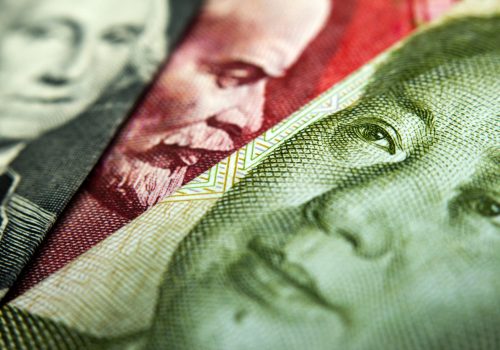
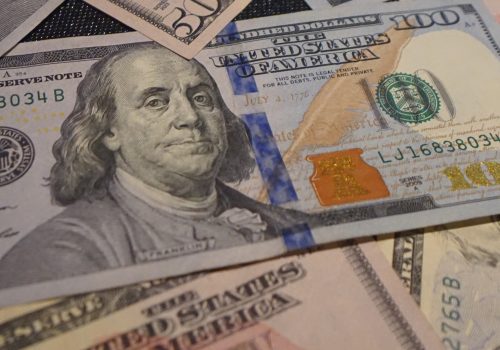
Ukraine and Dollar Weaponization

By George Pearkes

America has responded to Russian aggression with an unconventional weapon: the dollar.

Economy & Business
Financial Sanctions and Economic Coercion

Econographics

Jan 31, 2022

Strengthening ties: China and the GCC

By Inbar Pe’er, Niels Graham and Mrugank Bhusari

As China continues expanding its trade ties across the world while the US focuses on its domestic economy, the US will find itself without a seat at the table when the norms for the multilateral trading system are set.

China
Economy & Business

Econographics

Jan 28, 2022

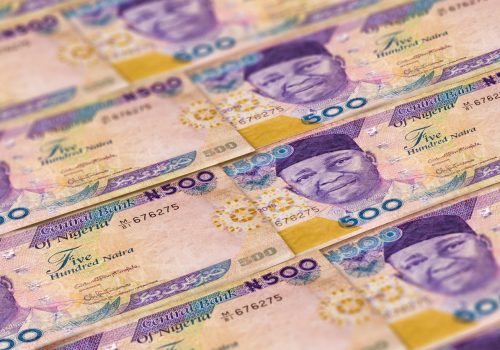
eNaira: Same Naira, more possibilities for innovation

By Naomi Aladekoba

Nigeria’s eNaira aims to improve the availability and access to central bank money, support a resilient payments system, encourage financial inclusion, and reduce the cost of processing cash.

Digital Currencies
Digital Policy

Econographics

Jan 13, 2022

Up, up, & away: Global stock growth in 2022

By Niels Graham

In 2022 stock markets generating impressive returns in despite uncertainty over the pandemic. Market gains will likely continue into 2022.

China
Economy & Business

Econographics

Jan 10, 2022

Is the US going to screen outbound investment?

By Sarah Bauerle Danzman

There is a growing consensus in Washington that the U.S. government needs more tools to prevent the People’s Republic of China (PRC) from using U.S. capital markets to amass military capabilities and control supply chain chokepoints.

China
Economy & Business

Content

EconoGraphics

Oct 25, 2016

CETA: Why “Comprehensive” Matters

By Filippos Letsas

On October 14th, the regional parliament of Wallonia, a French-speaking region of 3.6 million people in Belgium, voted to block the Comprehensive Economic and Trade Agreement (CETA), a proposed trade agreement between the European Union (EU) and Canada, which has been negotiated for over 7 years.

Economy & Business
European Union

EconoGraphics

Oct 7, 2016

Europe′s Fiscal Burden in Focus

By Filippos Letsas

The European Union’s (EU) Stability and Growth Pact requires Eurozone countries to annually lay out their fiscal plans for the following three years. The European Commission (EC) then compares the member states’ reports with its own projections and those produced by independent bodies, such as the International Monetary Fund (IMF), to evaluate whether the member states are on track to reach their Medium-Term Budgetary Objectives (MTOs).

Economy & Business
European Union

EconoGraphics

Sep 30, 2016

Myanmar: Post-Sanctions Landscape

By Filippos Letsas

On the occasion of Myanmar’s State Counselor Aung San Suu Kyi’s recent visit to the United States (U.S.), President Obama announced that executive sanctions on Myanmar would soon be lifted. This will grant Myanmar greater access to the U.S. market and encourage U.S. companies to invest in the country. Trade between the two countries remains at relatively low levels (i.e. $225 million in 2015), with U.S. investment to Myanmar accounting for only 0.2% of the country’s Foreign Direct Investment (FDI).

Economy & Business
Financial Sanctions and Economic Coercion

EconoGraphics

Sep 13, 2016

TTIP = So (Ger)Many Benefits

By Filippos Letsas

As the most export-driven major economy in the European Union (EU), Germany stands to benefit greatly from a robust Transatlantic Trade and Investment Partnership (TTIP) agreement.

Economy & Business
European Union

EconoGraphics

Jul 12, 2016

Taking Stock of European Banks: Improvements Amid Challenges

By Nathaniel Rome

Since the British referendum, Europe’s banking sector has come under renewed scrutiny from financial markets as well as European Union officials and finance ministers. A primary focus is on Italy - which has accumulated $400 billion in gross bad loans - and the EU-Italy talks about how to recapitalize the weak Italian banks.

Economy & Business
European Union

EconoGraphics

Jun 29, 2016

Econographics – TTIP

By Nathaniel Rome

The United Kingdom’s (UK) vote last week to leave the European Union (EU) has raised questions about the future of the Transatlantic Trade and Investment Partnership (TTIP). TTIP is a trade agreement currently being negotiated by the United States (US) and the EU that will eliminate tariffs, reduce red tape, and set a new standard for international trade agreements. Following the Brexit vote, US Trade Representative Michael Froman and European Commissioner for Trade Cecilia Malmström released statements reaffirming their commitment to TTIP.

Economy & Business
European Union

Bremain vs Brexit

Jun 21, 2016

London Riches Falling Down

By Nathaniel Rome

London is the undisputed financial capital of Europe, and is rivaled only by New York City for the top spot worldwide (Global Financial Centers Index). When competing on a level playing field, London outperforms other major European financial centers because of the superior human capital, infrastructure, and regulatory environment of the city. London dominates 78 percent of European FOREX trading and generates a trade surplus worth tens of billions of pounds (UK Office of National Statistics).

Economy & Business
European Union

Bremain vs Brexit

Jun 9, 2016

Britannia, Rule the Trade!

By Nathaniel Rome & TK Spandhla

The decades following World War II experienced an explosion of global trade. The annual growth rate of global exports averaged 8 percent in the 1950s, 9 percent in the 1960s, and 20 percent in the 1970s (World Trade Organization). During this boom of global trade, the volume of UK exports grew in absolute terms. However, up until the mid-1970s, the UK trade growth lagged behind the global average.

Economy & Business
European Union

EconoGraphics

Jun 1, 2016

Not The Time to Falter: Economic Sanctions Against Russia

By Alvaro Morales Salto Weis

As the European Union (EU) prepares to unanimously extend its economic sanctions on Russia when they expire on July, it is a good opportunity to take a closer look. After Russia´s illegal annexation of Crimea and interference in Eastern Ukraine, the U.S. and the EU enacted economic sanctions in a coordinated manner, which were followed by other Allies and partners like Canada and Australia.

Economy & Business
Europe & Eurasia

EconoGraphics

Apr 13, 2016

Europe’s Path to Budget Equilibrium

By Alvaro Morales Salto Weis & TK Spandhla

The European Union’s 28 member nations are required by Stability and Growth Pact to keep their budget deficits to within 3 percent of GDP. According to the European Commission forecast (as of winter 2016) six countries will exceed this level in 2016: the U.K., France, Spain, Greece, Croatia and Portugal. Romania will post a deficit at the threshold. This is an improvement from 2009 and 2010, when no fewer than 22 EU countries overstepped the deficit limit.

Economy & Business
European Union