The closure of the Strait of Hormuz, a choke point for about 20 percent of global oil supplies, and 30 percent of global liquefied natural gas (LNG) supplies was precisely the kind of national security emergency the Jones Act was designed to weather. The initial purpose of the 1920 law was to shield domestic shipping from foreign competition and support national security by requiring that vessels transporting goods on the water between US ports be American built, owned, and crewed. Instead, the Iran crisis triggered a cascade of failures and forced the White House to admit that the Jones Act itself was a liability.
A glaring failure was in LNG. Because there were no Jones Act-compliant LNG carriers (until a French-built ship called American Energy appears to have begun delivery to Puerto Rico about a year ago), it is impossible to ship much of America’s own abundant natural gas from the Gulf Coast to ports in New England under the current Jones Act regulations. It is also difficult to ship plentiful crude oil or refined products from the Gulf Coast to refiners or terminals on the East or West Coast. Instead, it is normally less expensive to frequently receive fuel from other countries. These regions, occasionally reliant on foreign imports, faced the prospect of catastrophic supply shortages as available tankers were diverted to more lucrative international routes. The United States, the world’s leading energy producer and exporter, found itself more able to supply global markets than other parts of the United States due to its own laws.
Faced with this crisis, the administration’s only viable move was to suspend the very law meant to guarantee maritime security. On March 17, 2026, the Department of Homeland Security issued a broad, multi-month waiver of the Jones Act.
This 2026 stress test clearly demonstrates that the law has created a paradoxical system that is both economically burdensome in peacetime and operationally brittle in crisis.
The United States needs a new maritime policy framework focused on the goal of maximizing operational capacity. There should be a radical rethinking of the Jones Act, starting with the elimination of its most counterproductive requirement, the domestic build rule.
The Jones Act’s original promise and decades-long decline
In the summer of 1920, an anxious America, awash in surplus ships from the Great War yet fearful of its long-term maritime fragility, sought a new solution. Senator Wesley L. Jones provided that with the Merchant Marine Act, which became known as the Jones Act. For a century, that protective law has stood. But the Iran War revealed the deep flaws in the old law. The White House found itself in a massive maritime crisis that disrupted critical flows of oil, gas, fertilizers, and other key products.
For decades, the debate over the Jones Act has been a somewhat stale, niche contest between protectionist dogma and free-market theory. The real question should be whether the Act continues to deliver the specific national security capability it originally promised: reliable sealift capacity and robust industrial base for a protracted conflict.
Proponents of the Jones Act have argued that its economic costs are a necessary price for national security. The numbers, however, tell a story of precipitous decline. In 1950 there were 434 Jones Act-eligible oceangoing vessels (of at least 1,000 gross tons), but this number has collapsed to just ninety-three ships in 2026, despite the American economy growing tenfold. This hollowing out is evident across three areas: fleet performance in wartime, material readiness, and the industrial base meant to support it.
In addition to its failure to ensure the transport of oil and gas and other commodities in the current energy crisis, the performance of the Jones Act fleet in major conflicts, its primary security justification, has been underwhelming. During Operations Desert Shield and Desert Storm, the US military’s sealift effort relied heavily on government-owned ships and foreign charters. Of the 281 Ready Reserve Force and commercial ships chartered by Military Sealift Command, only eight were Jones Act-eligible: one roll-on/roll-off ship, one heavy-lift vessel, and six tankers. Foreign-flagged vessels carried 27 percent of dry cargo; US-flagged commercial vessels carried 13 percent. Vice Admiral Paul Butcher, then deputy commander of US Transportation Command, was blunt that without foreign-flag sealift, “It would have taken us three more months to complete the sealift ourselves.” While supporters argue the domestic fleet’s main role is providing a pool of trained mariners for reserve ships, this single point of success is not sufficient to uphold the wider failures.
The government’s surge sealift fleet, the Ready Reserve Force, is basically a floating museum of forty-five ships, with an average vessel age of over 45 years, more than double the current average age of just over 22 years per the United Nations Conference on Trade and Development (UNCTAD), and well above the average scrappage age of 25-30 years, depending on vessel type. The consequences of this neglect became obvious during a 2019 stress test. The fleet achieved a dismal mission success rate of just 41 percent, a massive failure measured against the 85 percent target. US military readiness depends on this lackluster capability to rush tanks, helicopters, and supplies to a war zone. Had a major ground force been required in the Iran war, the US military would have faced the logistical nightmare of activating its highly inadequate Ready Reserve Force.
The decay extends beyond the ships to the people and the shipyards. The United States now faces a critical shortfall of over 1,800 mariners needed to sustain major sealift operations. Simultaneously, the shipbuilding industry the Jones Act was meant to protect has become a global footnote. The United States produces a minuscule 0.1 percent of the world’s commercial ships, while China has a shipbuilding capacity 232 times greater.
A strategic impasse: Washington’s two flawed solutions
Failure of the Jones Act during the Iran War should have catalyzed a strategic maritime rethink, but so far the proposals seem at odds with ensuring security.
The first path is to double down on the Jones Act’s original sin: the US-build requirement. Proponents point to the successful, albeit small-scale, National Security Multi-Mission Vessel program, and argue for a massive new domestic-build program for commercial ships. The impulse is understandable as it aligns with a broader political desire to reshore American industry. But US shipyards are charging up to five times the price of their foreign competitors, and so recapitalizing the entire domestic fleet this way is fiscally unattainable.
The second path is the one the Pentagon is already on. The Vessel Acquisition Management program, which buys used, foreign-built ships to plug the holes in the Ready Reserve Force, is a de facto admission that the domestic-build requirement is unworkable for national security needs. While this “buy used” strategy is pragmatically needed, it sends US taxpayer dollars to the very foreign shipping conglomerates that then use the capital to build new ships in Chinese and South Korean yards. It is a policy that finances the competition while providing the US military with aging, suboptimal vessels.
One part of the government is forcing work into a non-competitive domestic industry, while another part is buying ships from the global market precisely because that industry has failed. As long as Washington oscillates between these two flawed tactics, the US maritime industrial base will keep cracking.
Forging true maritime industrial endurance
The current Iran conflict has forced a reckoning that 106 years of debate had not. A law designed specifically to ensure the United States could never again be caught short of maritime capacity in a national emergency was suspended, within weeks of a genuine emergency, precisely because the fleet it had built was too small and too specialized to fill the gap. The waiver’s modest effects on gasoline prices confirmed what critics had long argued: that domestic shipping costs, while real, are a minor driver of fuel prices compared to global crude markets.
The singular goal of US maritime policy must maximize operational sealift capacity. This requires eliminating the Jones Act’s US-build requirement while retaining its US-flag, -crew, and -ownership mandates. Allowing US carriers to acquire modern, affordable ships on the global market would unleash a recapitalization of the fleet. A larger, younger fleet would, in turn, help create a surge in demand for the American mariners needed to crew it, directly solving the workforce shortage.
Whether Congress uses the 150-day experiment as evidence for structural reform or allows the waiver to expire in August 2026 and the law to resume unchanged will depend on the durable political economy of the Jones Act.
Morgan D. Bazilian is a nonresident senior fellow with the Atlantic Council Global Energy Center, the director of the Payne Institute for Public Policy, and a professor at the Colorado School of Mines.
Jahara Matisek is a senior fellow at the Payne Institute for Public Policy and a visiting scholar at Northwestern University.
Alex Gilbert is a fellow at the Payne Institute for Public Policy and principal at Rocinante Fieldworks.
Jamie Webster is a fellow at the Payne Institute for Public Policy and at the Global Center for Energy Analysis.
The views expressed are those of the authors.
stay connected
Sign up for PowerPlay, the Atlantic Council’s bimonthly newsletter keeping you up to date on all facets of the energy transition.
related work


our work

The Global Energy Center develops and promotes pragmatic and nonpartisan policy solutions designed to advance global energy security, drive economic opportunity, and foster a sustainable energy future.
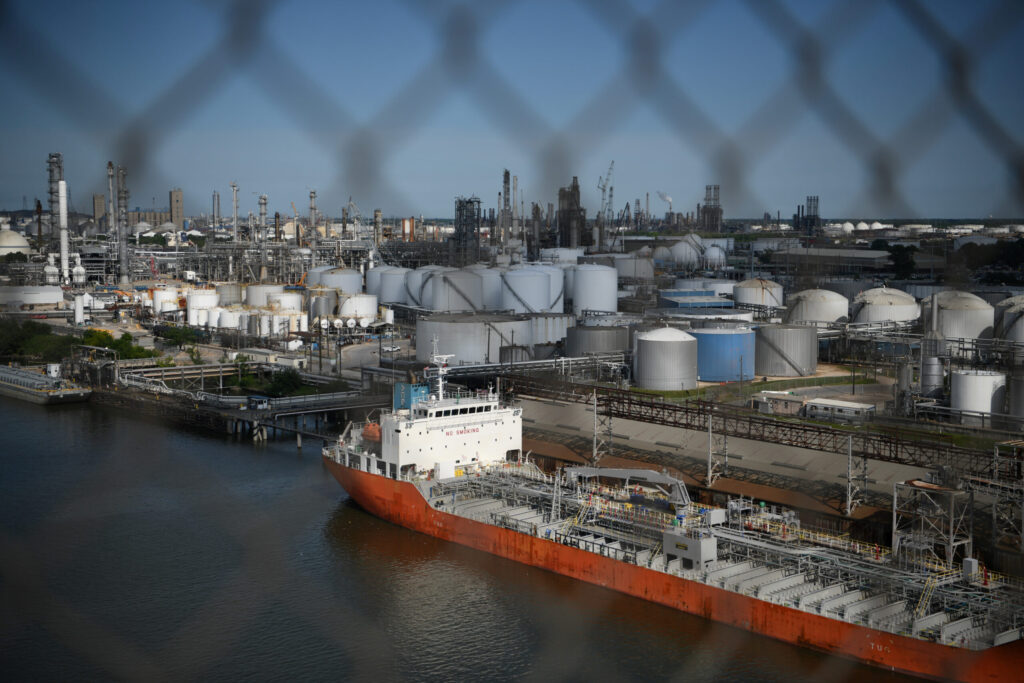
Image: The Houston Ship Channel and adjacent refineries, part of the Port of Houston, are seen in Houston, Texas, U.S., May 5, 2019. REUTERS/Loren Elliott