This article is part of Realign for Palestine’s The Future of Money in Palestine series, which examines the monetary policy frameworks needed for Gaza’s reconstruction and seeks to provide a practical blueprint for establishing a financial system that Palestinians can trust.
As Gaza enters its reconstruction phase, the Palestinian economy faces a crucial question: which monetary and financial architecture can best support recovery and sustainable development in both Gaza and the West Bank? Four currency arrangements merit consideration: maintaining the shekel-based system, establishing an independent Palestinian currency, using a cryptocurrency such as Bitcoin, or adopting the US dollar. A currency board could provide an intermediate framework for a future Palestinian currency but would not itself constitute a separate currency arrangement.
The Palestinian territories’ current currency framework is heavily reliant on the shekel, leaving the economy exposed to monetary and financial decisions made by the Israeli government. This dependence limits the autonomy of the Palestinian Monetary Authority (PMA) and creates broader risks for economic stability. While multiple currency and monetary models have been explored historically, developments in financial technologies and changes in the global financial system create an opportunity to reconsider the role of the shekel in the Palestinian economy. Any assessment of alternative arrangements should therefore begin by defining the economic and institutional objectives that a new currency framework would need to achieve.
A currency must provide three basic functions: it must serve as a reliable means of payment, a unit of account, and a store of value. It can also support economic growth by reducing exchange-rate risks, attracting investment, and providing policymakers with tools to manage inflation and unemployment. Broad accessibility is equally important, as a currency can facilitate trade, strengthen economic integration, and contribute to a sense of national pride and economic autonomy.
To compare the available policy options, we evaluate each against four criteria: economic benefits, institutional feasibility, political feasibility, and time horizon. Since no single option performs well across all four dimensions, the analysis focuses on the trade-offs associated with each arrangement and its particular strengths and weaknesses. Before turning to this assessment, however, it is important to understand the history and structure of the Palestinian monetary system.
The Palestinian territories’ currency challenge
The Paris Protocol on Economic Relations, signed in 1994, established the framework for economic relations between Israel and the Palestinian Authority (PA). The agreement did not designate a single official currency. Instead, it allowed the new Israeli shekel, the Jordanian dinar, and the US dollar to circulate as legal or semi-legal tender. The protocol also left the door open to future change, stating that both sides would continue to discuss the possibility of introducing an agreed Palestinian currency or interim alternative arrangements. The PMA, established in 1994 and operating as a de facto central bank, is still not authorized to issue its own currency.
In practice, however, the shekel became the dominant currency, driven in large part by Israel’s control over trade and customs. Retail prices are almost always listed in shekels, the Palestinian budget is managed primarily in shekels, and before the war, around 20 percent of the Palestinian labor force worked in Israel and received their wages in shekels.
The resulting monetary framework has left the PA with limited policy tools and contributed to persistent external imbalances. The lack of an independent currency and fully autonomous central bank constrains the PA’s ability to conduct monetary policy, while the Palestinian territories’ lack of recognized sovereign status prevents access to international debt markets. These obstacles have dampened the prospects for sustained economic development and keep Palestinians trapped in dependence on foreign aid. Between 1993 and 2021, more than $40 billion was channeled to the PA from international donors, making it one of the largest per-capita aid recipients worldwide.
Yet large volumes of aid have not translated into sustained improvements in socioeconomic conditions. Moreover, because of the shekel’s dominance, 71 percent of foreign aid to Palestinians ultimately flows into the Israeli economy, equivalent to 3.7 percent of Israeli GDP. Since most Palestinian trade passes through Israel and is priced in shekels, aid funds are converted into shekels, increasing demand for the currency and contributing to the accumulation of foreign-currency reserves at the Bank of Israel. This has also contributed to the appreciation of the shekel, which has risen 25 percent against the dollar over the past twenty years.
Nonetheless, the Palestinian economy operates with several currencies. In 2001, the PMA estimated that the annual volume of financial activity in shekels amounted to approximately 50 billion—around $14.5 billion. At the same time, the US dollar plays an important role in the financial system. Around 60 percent of bank deposits and 68 percent of commercial credit are held in dollars, while most rent payments and international money transfers are conducted in dollars. The Jordanian dinar also remains in circulation, mainly for historical reasons. Around 23 percent of bank deposits in the West Bank are still denominated in dinars, and some West Bank municipalities still issue invoices in dinars.
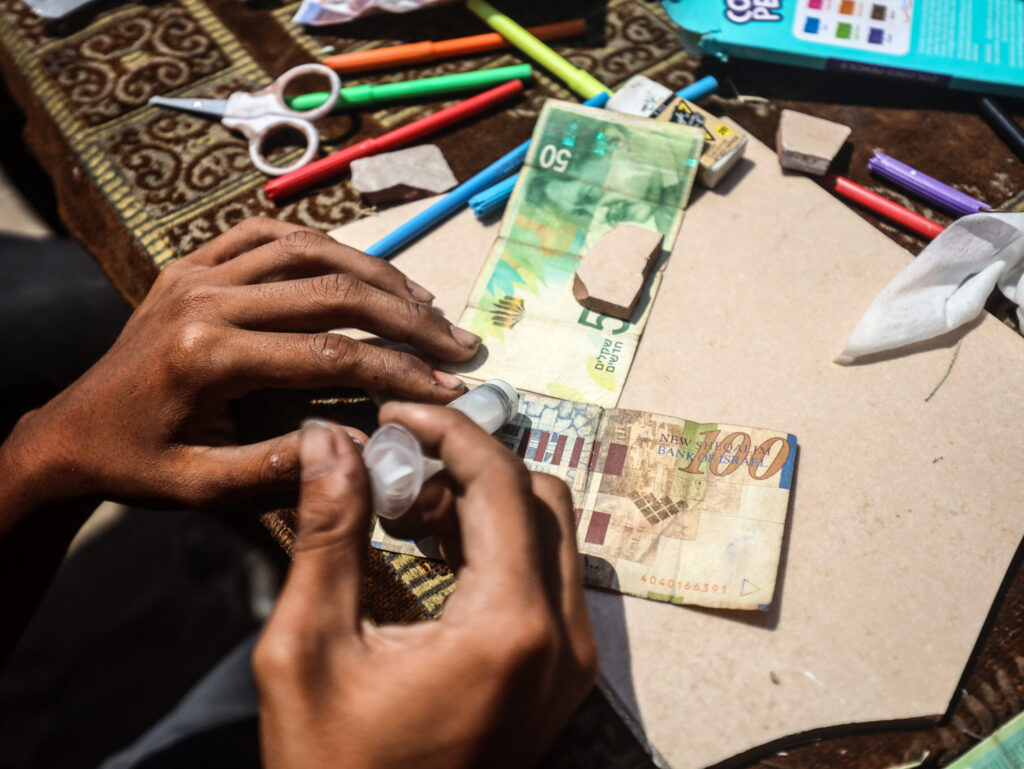
In recent years, particularly since the outbreak of the war, the Palestinian dependence on the shekel has become increasingly problematic. And one of the most significant challenges is the accumulation of physical shekels in the vaults of Palestinian banks. Cash flows into the West Bank and Gaza from several sources, including Palestinian workers receiving wages in Israel, transactions with Israeli settlements, and increased demand for cash as financial risks have spiked. This inflow is estimated at around 20 billion shekels per year. However, the Bank of Israel allows Palestinian banks to transfer only up to 18 billion shekels in cash annually through correspondent banking channels in exchange for deposits. Israeli authorities cite compliance and anti-money-laundering and counter-terrorist-financing (AML/CTF) concerns as the rationale for these limits.
As a result, Palestinian banks continue to accumulate excess shekels. By the end of 2025, the surplus was estimated at around $4 billion worth of shekels. These funds cannot easily be converted into interest-bearing assets, leaving banks exposed to inflation and reducing their ability to deploy capital. The surplus has reduced Palestinian bank profitability by around 20 percent, while some banks have banned the opening of cash accounts, further complicating economic recovery. It also makes routine operations, including cross-border clearing, more difficult.
The liquidity problem is compounded by fiscal pressures on the PA, which can also directly affect the stability of the banking system. Under the Paris Protocol, Israel collects customs duties, value-added tax, and other clearance revenues on behalf of the PA and is supposed to transfer those revenues back to it. However, Israel typically refuses to transfer these taxes, claiming they fund the families of terrorists. In April 2026 alone, approximately 590 million shekels—around $198 million—was deducted from the $249 million collected, with the funds allegedly used to cover the PA’s debts to the Israel Electric Corporation, water companies, and Israeli environmental bodies.
Since February 2025, no clearance revenues have been transferred to the Palestinian treasury, and according to the Palestinian finance minister, the total amount of frozen funds stands at around $4.4 billion. As a result, despite international financial support, the PA’s fiscal deficit reached approximately $1.3 billion in 2025 and is projected to grow to around $1.6 billion in 2026—and potentially to $3.8 billion if clearance revenues continue not to be withheld.
The damage to the PA’s revenues has spilled over into the banking system. On the one hand, the Authority is unable to pay its employees full salaries. In January 2026, all public sector employees received a uniform partial payment of around $600 only, the lowest payment since the onset of the crisis. On the other hand, to finance the deficit, the PA has increasingly relied on borrowing from Palestinian commercial banks. Credit to the public sector grew by 19 percent in 2025, bringing the banking system’s exposure to sovereign risk to approximately $5.3 billion, equivalent to around 42 percent of total banking sector credit. This situation constrains the banks’ ability to provide credit to the private sector and further limits the PMA’s capacity to recover from the war.
Meanwhile, the banking sector in Gaza has been devastated. Around 93 percent of bank branches and 88 percent of microfinance institutions were destroyed during the fighting, and residents are forced to pay commissions of up to 40 percent to informal brokers simply to obtain cash. At the same time, more than $71.5 billion from countries around the world has been earmarked for the reconstruction of Gaza and the West Bank.
Despite these challenges, an unexpected opportunity has emerged: the destruction of Gaza’s physical banking infrastructure has accelerated the adoption of digital financial tools. iBuraq, the government’s instant payments system, processed 3.5 million transactions worth approximately $442 million in Gaza in January 2026—an increase of about 200 percent since September 2025. As of today, 80 percent of Gaza’s residents have smartphones and internet access. The number of active digital wallet accounts in Gaza has surpassed 790,000, and the value of wallet transactions nearly tripled between January and June 2025. This digital infrastructure, which has emerged out of crisis, may serve as the foundation for the adoption of a digital currency, whether a stablecoin or a central bank digital currency, and could eliminate the need to convince the public to adopt a new means of payment from scratch.
But questions remain: Which currency should underpin this emerging digital ecosystem? And could reconstruction provide an opportunity to transition the entire Palestinian economy to a foreign currency, freeing it from Israel’s political stranglehold?
Policy option one: Continuing to use the shekel
Retaining the shekel as the primary currency, alongside the dollar and the dinar, represents the default option. The shekel offers several practical advantages. First, it is familiar, stable, and convertible. During periods of crisis, including the Second Intifada and the current war, the Palestinian banking system has continued to function on this basis. Moreover, 85 percent of Palestinian exports and 55 percent of imports pass through Israel, including electricity, water, and food, with this trade conducted in shekels. Wages paid to Palestinian workers in Israel, which account for a significant share of Palestinian GDP, are also paid in shekels. Keeping the shekel therefore avoids currency-conversion risks and the costs of introducing a new currency. It also avoids the need to build foreign-exchange reserves to support that currency and eliminates the risk of a currency crisis.
Palestinian elites have additional reasons to favor the shekel-based system. First, as holders of monopolies on key imports and exports, they benefit from the absence of currency conversion costs and can pass higher import costs on to consumers. Second, a large portion of Palestinian government pension funds and institutional investment portfolios is denominated in shekels. Given the weakening dollar, Palestinian investors have little incentive to shift out of shekel-denominated assets for fear of further dollar depreciation. Third, Palestinian employers benefit from cheap labor and the wage gaps associated with the shekel-based system. Finally, and perhaps most importantly, terrorist organizations such as Hamas benefit from Gaza’s largely cash- and shekel-based economy, because it allows them to operate without oversight or monitoring. Taken together, these interests would make a transition to a new currency politically and economically difficult without strong incentives for powerful Palestinian actors.
At the same time, using the shekel perpetuates economic dependence on Israel. Israel controls the flow of cash into the territories, giving it significant economic leverage. For example, when Israel refuses to allow correspondent banks to convert cash into deposits for Palestinian banks, the entire Palestinian economy can enter a downward spiral. This risk is set to increase dramatically, as one of Israel’s two correspondent banks, Hapoalim, is expected to end its correspondent banking services for Palestinian banks in October 2026. But even in normal times, changes in Israeli interest rates directly affect interest rates in the Palestinian market, regardless of conditions in the Palestinian economy.
In addition, the PA forgoes seigniorage revenues—the profit that accrues to a government from the difference between the cost of producing currency and its face value. Estimates suggest that this loss amounts to between 2 percent and 5 percent of GDP per year ,or approximately $443 million annually, totaling roughly $7.7 billion from 1995 to 2018. Furthermore, without an independent currency, the Palestinian leadership has no tools to stabilize the domestic economic cycle or to respond to external supply shocks through interest rate adjustments or monetary expansion. This leaves the already limited fiscal policy as the primary tool for economic stabilization. The status quo persists despite its costs because Israel has little incentive to change it. Palestinians account for roughly one-third of the shekel’s total user base, providing Israel with a source of economic leverage that Israeli officials are unlikely to give up voluntarily.
Policy option two: Establishing an independent Palestinian currency
Establishing a Palestinian national currency is a long-standing aspiration of the Palestinian leadership. The currency would symbolize sovereignty and legitimacy, strengthening public confidence in Palestinian institutions and signaling to the world the intention to build an independent economy. On a practical level, issuing a currency would generate direct seigniorage revenue for the PA, potentially worth 2 to 5 percent of GDP. But most importantly, an independent currency would give the Palestinian economy greater flexibility during times of crisis. It could allow the exchange rate to depreciate, making domestic products cheaper relative to foreign goods, restoring competitiveness, and boosting exports. This is a vital mechanism for responding to external shocks, such as a decline in international aid or conflict.
Despite the enthusiasm among Palestinian economists for creating an independent currency, it is not clear that Palestinian institutions are practically ready for it. A transition to a new currency would be expensive and cumbersome, requiring investment in institutional infrastructure, currency printing, public awareness campaigns, and systems for repricing goods and services. The PMA, which is not an official central bank, would also need to establish the monetary credibility required to manage a stable monetary policy and anchor inflation expectations. At present, the PMA has no reputation at all in that area, meaning it would have to be built over time. In the meantime, markets would price this uncertainty through higher interest rates and greater currency substitution.
Issuing a currency also requires substantial foreign reserves. According to estimates, up to $2.1 billion would be needed at the initial stage—funds the Authority does not currently possess. Even if the PMA succeeds in building credibility, the Palestinian economy is too small and too open to benefit meaningfully from an independent monetary policy. In large, relatively closed economies, a central bank can depreciate the currency to make exports cheaper and stimulate growth. But with trade volumes equivalent to nearly 100 percent of GDP, almost every good consumed domestically is either imported or priced against imported goods. A currency depreciation would therefore do less to stimulate exports than to immediately raise the cost of goods Palestinians buy, fueling inflation and wiping out whatever competitive advantage the depreciation was intended to create. It is worth noting that attempts in Bolivia, Mexico, and Peru to force a transition to local currencies also resulted in capital flight and a loss of government credibility.
Public acceptance would present another challenge. Palestinians could hardly be forced to abandon dollars and shekels against their will without causing severe damage to the economy. From the Israeli perspective, an independent Palestinian currency is also likely to trigger resistance. Israel has historically restricted even the import of Jordanian dinar banknotes into the West Bank. It is therefore unlikely to permit such a transition without a significant prior political agreement and evidence of fiscal and institutional credibility.
Policy option three: Bitcoin as a currency
Even before the war, particularly in Gaza, a grassroots culture of Bitcoin use developed, mostly among younger Palestinians looking for a way to connect to the global financial system. Users in Gaza transacted through mobile apps, Telegram groups, and physical shops that performed cash-to-crypto exchanges—and some of those stores even recorded users’ IDs. For storage, they used wallets such as Binance, Payeer, and Blue Wallet. It should be noted that the PMA blocked direct crypto purchases through bank accounts while leaving open a loophole for purchasing USDT, which was seen as “close enough to the dollar.” In practice, USDT therefore became the main entry point into the crypto market—and Bitcoin served as one of the few ways to send and receive money freely from outside Gaza.
The central advantage of Bitcoin from the Palestinian perspective is its independence from political and financial leverage. Palestinians have no control over the shekel or the dollar, but Bitcoin operates without a central authority, and transactions are verified by a decentralized network of miners and nodes. It also enables relatively fast and low-cost cross-border transfers compared with traditional banking. And when the Lightning Network is available, transaction fees are negligible. Before Bitcoin, Palestinians sending remittances from the Gulf to Gaza often had to rely on a chain of intermediaries—including banks in third countries and currency exchange offices—with brokers taking up to 30 percent of the transfer value. Using Bitcoin, however, funds can be transferred directly to a recipient’s wallet. Supporters of the cryptocurrency also argue that it can serve as a long-term store of value because, like gold, its supply is capped, theoretically protecting it against inflation. Palestinians wouldn’t be the first to adopt Bitcoin. In 2021, El Salvador made Bitcoin legal tender, though the experiment had limited success.
Despite these advantages, Bitcoin has fundamental challenges that complicate its use as a viable everyday currency. The first is price volatility, as Bitcoin can lose tens of percent of its value within just a few days. Between November 2021 and November 2022, for instance, its value fell from an all-time high of roughly $69,000 to about $15,500. In everyday life, Gazans need to know how much money they have for food and rent, and Bitcoin does not provide a stable unit of account for this purpose. This contrasts sharply with dollar-based stablecoins such as USDT, which are designed to maintain a one-to-one peg to the dollar. The second problem is the cost and speed of transactions: the Bitcoin network is limited in capacity, and during periods of congestion users might pay higher fees to have their transaction included in the block. This system is unpredictable and expensive for small, frequent payments. Transaction confirmation takes an average of about ten minutes, and the transaction fee has a median of approximately $20 at peak congestion.
The third problem is that Bitcoin operates without central governance, which makes it difficult to embed compliance mechanisms. And fourth, although Bitcoin is often described as offering anonymity, in practice every transaction is permanently recorded on the public blockchain. Governments investing in tools such as Chainalysis, which holds multimillion-dollar contracts with the FBI and others, are therefore capable of tracing large transactions. At the same time, Israel has already seized Hamas’s Bitcoin wallets, and it is well known that Hamas has raised donations in Bitcoin. The partial anonymity Bitcoin provides is sufficient to enable sanctions-evading financing, but not enough to protect Palestinian users from surveillance.
Bitcoin is a tool for long-term wealth preservation, and Palestinian citizens in Gaza should be allowed to access it without interference in its grassroots adoption. However, Bitcoin is not suited to serve as the operational currency of the Palestinian economy because of its volatility and the risk of terrorist financing. Israel’s posture toward Bitcoin is likely to be shaped less by monetary competition than by security concerns—and it has demonstrated both the willingness and capacity to seize Bitcoin wallets linked to Hamas financing. While it would be premature to reject Bitcoin outright, pushing it institutionally as a national currency solution would be equally misguided, both for financial-stability reasons and because doing so would likely provoke a stronger Israeli security response than the current informal status quo.
Policy option four: Full Dollarization
Dollarization means the official adoption of the US dollar as the sole legal currency, eliminating dependence on the shekel. No Arab country has taken this path before, but given the context of Gaza’s reconstruction and the volume of funds expected to flow into the strip in dollars—with estimations reaching $70 billion—it may be worth revisiting this option. Specifically in February 2026, it was reported that officials within the “Board of Peace” are exploring the creation of a stablecoin pegged to the dollar for Gaza, as an intermediate step toward dollarization.
Dollarization has many advantages. First, the dollar eliminates exchange-rate risk, since foreign investors and donors do not face a “depreciation premium” when depreciation expectations exist, which lowers the cost of capital and attracts investment. Second, the cost of adopting the dollar would be relatively low compared to a new local currency, as there is no need to build a new issuing institution, accumulate reserves, or convince the public to exchange currencies. Dollarization could also be marketed to the public as removing the symbol of occupation represented by the shekel, even if the dollar is not an independent currency.
The prospect of dollarization through stablecoins adds another layer of benefits. From a security perspective, dollarization through dollar-backed stablecoins would allow the US to send aid directly into the digital wallets of businesses and citizens in Gaza without conversions, reducing transaction costs, increasing transparency, facilitating know-your-customer and compliance controls, and reducing the risk of money reaching Hamas. This is because stablecoins are typically issued by organizations that hold reserves to prevent liquidity crises and operate under increasing regulatory oversight—as under the EU’s Markets in Crypto-Assets regulation and the US GENIUS Act, for example—requiring reserve disclosure and collateral maintenance and providing financial institutions with regulatory certainty. In addition, stablecoins, unlike Bitcoin, are less volatile and operate on fast, multi-chain blockchain networks such as Ethereum, Solana, Tron, and others, enabling low-cost, fast transactions suited to everyday payment needs.
However, similar to the current situation, a country dependent on dollars—either in traditional or stablecoin form—has no ability to control monetary policy. Therefore, Palestine would not be able to depreciate its currency during a crisis and would be forced to make adjustments to the price level through wage and price cuts—a process that is painful, slow, and harmful to growth. In addition, the US, like Israel, does not manage its currency with consideration for Palestinian needs. The Federal Reserve’s interest rate is set according to the needs of the American economy alone. This means that when the US raises interest rates, the Palestinian economy would slow as well. Moreover, if the shekel weakens against the dollar, Palestinian exports to Israel would become relatively more expensive and lose competitiveness. This is exactly how Argentina lost competitiveness in 2001 when Brazil depreciated the real. Finally, if dollarization applies only to Gaza within the Board of Peace framework, it could deepen the economic fragmentation between the two parts of the Palestinian territories.
Israel’s reaction to dollarization is hard to predict because dollarization cuts in two directions at once. On the one hand, it reduces the leverage Israel currently holds through its control over shekel cash transfers and correspondent banking. On the other hand, a dollarized, digitally monitored Gaza financial system is arguably easier for Israeli and international security bodies to oversee than the current cash-heavy, partially informal shekel economy. Israeli approval is likely to depend more on how such a transition is framed and structured, with an emphasis on AML/CFT rather than presenting dollarization primarily as a step toward Palestinian monetary independence.
What can we learn from Ecuador’s dollarization process?
On January 9, 2000, Ecuador adopted the US dollar as its national currency, becoming the first country in the twenty-first century to officially dollarize its economy. Like Palestine, Ecuador was in the midst of a deep economic crisis at the time. Its economy was on the verge of hyperinflation after prices increased by around 60 percent in the last quarter of 1999, the local currency—the sucre—collapsed, the banking system fell into crisis, and foreign exchange reserves were negligible. The Ecuadorian president was ousted just ten days after the announcement, but his successor upheld the decision and formally ratified dollarization.
Despite the political turmoil surrounding its adoption, Ecuador’s dollarization process is considered a success. It anchored inflation expectations, lowered interest rates, and prompted a rapid recovery in bank deposits. The move to the dollar also encouraged investment and repatriation of capital that had fled during the crisis, improving Ecuador’s balance of payments. As a result, GDP grew by 2.3 percent in 2000 and 5.4 percent in 2001, after contracting by 7.3 percent in 1999.
That said, Ecuador’s experience also highlights several risks that would be particularly relevant in the Palestinian context. First, inflation did not stop immediately. Prices continued to rise for two years after the transition, partly because the conversion was done at too low a rate, which contributed to real wage erosion. The PA should therefore align exchange-rate expectations well in advance of any transition. The resulting real wage cuts hit women and the poor the hardest, while the thin social safety net did little to protect vulnerable households. Similarly, in a transition to the dollar, especially under a stable currency regime, the most vulnerable populations—particularly those without access to digital wallets or phones—are likely to suffer if price levels continue to rise alongside cash conversion fees. Any currency transition should therefore be accompanied by measures to expand financial inclusion in Gaza and the West Bank.
Second, neighboring countries such as Peru and Colombia maintained flexible exchange rates, putting pressure on the competitiveness of Ecuadorian exports. Because Ecuador could no longer control its own monetary policy or boost competitiveness through depreciation, its exporters were exposed to currency movements in Ecuador’s immediate neighborhood. A similar situation could threaten Palestinian exports if the shekel weakens. Given that Israel already effectively compels Palestine to direct most of its exports toward the Israeli market, this could further strangle Palestinian economic activity in a way that is different from, but potentially no less damaging than, the status quo. Third, Ecuador transitioned to the dollar without first establishing an adequate legal framework. Legislation covering banking, accounting, and labor law was passed through the Ecuadorian parliament only after the dollarization, forcing workers and financial institutions to adjust to the new system without clear rules in place. Many workers were harmed when their salaries were converted in an unregulated manner, while banks took time to develop new dollar-based financial instruments. In the Palestinian case, it will therefore be essential to avoid putting the cart before the horse: the necessary legal and regulatory framework would have to be developed alongside, and ideally before, any currency transition.
That said, it is important to note a key difference between the two economies. Unlike Ecuador, the Palestinian economy is not trying to escape a collapsing currency, with relatively stable levels of inflation, but seeking an alternative to a foreign currency that undermines its sovereignty. In Ecuador, dollarization was an “emergency rescue.” For Palestine, it is a political-economic option that requires far more preparation. In both cases, the central lesson is the same: monetary reform without fiscal and banking reform is unstable. If Palestine transitions to the dollar—or issues a currency—before the PA achieves fiscal discipline, the results could be devastating.
On a more optimistic note, Ecuador demonstrated that even under conditions of extreme fragility, dollarization can stabilize expectations and restore growth. For post-war Palestine, where the physical banking infrastructure has been destroyed and public trust is at a low point, this option may offer a relatively rapid path to stability during an initial reconstruction phase, even if it is not the long-term solution.
The intermediate solution: A currency board
If a decision is nonetheless made to issue a Palestinian currency, the International Monetary Fund and most economists recommend doing so through a currency board rather than a regular central bank. A currency board is an institutional framework in which every unit of local currency issued is backed fully by foreign exchange reserves—similar to an American private stablecoin—with interest rates and the money supply responding automatically to capital flows rather than being set at the discretion of the government. The board buys and sells the local currency at a fixed exchange rate to accommodate market demand. Such a board would greatly facilitate the attraction of foreign investment, since the commitment to maintaining a peg to the dollar eliminates exchange-rate risk and can lower interest rates relative to the existing rate.
As long as the board is properly governed by law and maintains its reserves, the PA would not be able to force the PMA to purchase government debt and thereby destabilize the economy. A currency board would therefore combine many of the advantages of dollarization with the benefits of seigniorage and the symbolic value of a national currency. This approach also has historical precedents: Estonia, Bulgaria, and Lithuania operated currency boards successfully during their post-Soviet transitions. The model thus offers a way to “import” monetary credibility rather than attempting to build it from scratch.
The trade-off, however, is the loss of monetary independence. A currency board cannot print money to finance deficits and has no capacity to act as a lender of last resort to banks during a crisis. The PMA would have no control whatsoever over the money supply, which would instead expand or contract with the flow of foreign currency into and out of the economy. Foreign currency entering through exporters or investment would expand the money supply, while payments for imports, foreign debt, or overseas investment would reduce or contract it. In addition, even with a currency board, a Palestinian currency could be perceived as less reliable than the dollar, particularly if the regulatory framework surrounding it is weak or there is a perception that the PA could eventually manipulate or abandon the peg.
One way to mitigate these challenges would be to introduce the currency gradually rather than replacing existing currencies immediately. This could mean issuing only cash in circulation initially, rather than the broader M1 measure, which also includes bank deposits. This would allow the new currency to enter circulation incrementally while maintaining existing currencies and deposits during the transition. The PA could also gradually begin paying its employees in the new currency, using its monthly payroll of approximately $175 million to expand circulation over time. In this scenario, circulation could eventually reach the $2.1 billion in reserves required to fully sustain the currency.
A pragmatic path toward monetary independence
In light of the analysis above, a phased approach offers the most path forward: near-term dollarization, primarily through a regulated, dollar-backed digital instrument, followed by a longer-term transition toward an independent currency under a currency board once the necessary preconditions—fiscal discipline, functioning institutions, and adequate reserves—are in place.
A digital, dollar-backed instrument would reduce exchange-rate risk for transactions denominated in dollars, improve traceability for donors and compliance bodies, and align with the direction the Gazan economy is already moving through the growth of digital payment systems like NeoCash and iBuraq. It would not, on its own, resolve the withholding of PA clearance revenues, restrictions on correspondent banking between Israeli and Palestinian institutions, or the Palestinian economy’s structural dependence on Israeli-controlled trade. Dollarization would, however, remove one specific channel of Israeli pressure: the shekel’s role as a currency that can be manipulated for political purposes. It is also the option least likely to trigger active Israeli obstruction, provided it is framed and structured around compliance and monitoring rather than Palestinian monetary sovereignty.
It is important to distinguish between full dollarization, meaning the US dollar becomes the primary legal means of payment, and a dollar-backed stablecoin, which is a digital instrument pegged to the dollar but issued and governed by a specific entity under its own reserve, custody, and compliance architecture. The two are complementary, but they are not identical. A stablecoin is only one plausible vehicle for implementing dollarization in practice, particularly given Gaza’s damaged banking infrastructure and existing digital-wallet adoption. “Moving to the dollar” and “issuing a Gaza-specific stablecoin” raise different institutional questions, particularly about who would issue the instrument and who would hold the underlying reserves.
An independent Palestinian currency, by contrast, is unlikely to be achievable in the near term, given the need for a degree of Israeli cooperation that does not currently exist and the same conditions required for a credible currency: fiscal discipline, functioning institutions, and adequate reserves. The longer-term recommendation is therefore to build toward an independent currency under a currency board once fiscal credibility and institutional capacity are in place. Any currency choice made without genuine fiscal reform and banking supervision is likely to fail.
The Board of Peace and the National Committee for the Administration of Gaza (NCAG) must make a decision on this matter now. Dollarization is already taking place in practice, driven by the rapid adoption of dollar-based digital payment systems during the war and the flow of dollars from international organizations into reconstruction, salaries and aid. If the current trend continues, the economy will increasingly operate through two circuits. The first, trade, will remain primarily shekel-based: importers and exporters will continue to hold shekel accounts to pay Israeli suppliers, receive trade revenues, and manage business operations. The second, retail and aid, is gradually shifting toward the dollar. Beyond aid transfers, dollar usage is likely to expand into salary payments and private savings.
Given this trend, there is a strong case for the Board of Peace, NCAG, and international financial institutions to coordinate and formalize the transition now, helping ensure that it gives Palestinian institutions genuine agency and incorporates Palestinian input on governance rather than being imposed unilaterally. NCAG—or whatever future body is granted jurisdiction over Gaza’s currency framework—should treat currency policy as an urgent near-term decision rather than an issue to revisit once other reconstruction priorities are settled. The rapid, uncoordinated shift toward dollarization is already becoming entrenched in practice. In parallel, engagement with the PMA to stabilize the Authority’s finances and gradually build institutional capacity will be essential to the longer-term goal of establishing an independent currency board.
Avia Liberman is an economic analyst and a junior fellow at Realign for Palestine, a project of the Atlantic Council’s Rafik Hariri Center and Middle East programs.
Related content


Explore the program

The Realign For Palestine project at the Atlantic Council aims to amplify pragmatic voices who courageously advocate for Palestinian statehood and self-determination, unequivocally reject violence, terrorism, and extremism and acknowledge a two-nation solution, including Israel’s right to exist in safety. Decades of violent conflict have proven that all who support Palestinians must realign our words and actions to finally achieve lasting peace.
Realign For Palestine fosters innovative thinking, advocacy, and action toward regional peace, security, and nation-building of two homes for two people.
Image: Palestinians rehabilitate and restore damaged and worn-out banknotes due to the halt in currency transfers from Israeli banks to Palestinian banks. Source: REUTERS/Majdi Fathi/NurPhoto.