
Oil watchers were stunned this weekend when the US government announced a purportedly “historic” deal with the Venezuelan government, which will allegedly include seventeen major Venezuelan oil fields and an estimated 65 billion barrels in oil reserves for a century-long concession agreement. In its most expansive interpretation, this still lightly-detailed bilateral agreement would give the US government direct control over more than 7 percent of known global proven oil reserves. President Donald Trump himself declared on Sunday that oil produced from this agreement will help to refill the historically low US Strategic Petroleum Reserve (SPR) as a “Gift from Venezuela to the People of the United States.”
While the administration is right to use its leverage to make sure that Venezuela has a competitive framework that maximizes revenue for Venezuelans and attracts capital, that leverage would be better spent in improving the Organic Hydrocarbons Law and implementing regulations.
We await further details of the deal, but in the meantime highlight four major factors that will determine the viability of this plan as it has been elucidated in reports thus far.
1. Will this agreement provide reassurance for oil and gas companies still uncertain about Venezuelan investment at scale?
The basic framework, as alleged so far in various reports, of this new agreement is profoundly unconventional within the century-old international oil and gas sector: a new private company, reportedly headed up by controversial Venezuelan mogul Alejandro Betancourt, will receive a 100-year concession for a set of Venezuelan oil fields with an estimated 65 billion barrels in reserves. The US government, through the Department of Defense’s Office of Strategic Capital, will take 55 percent of output from these fields including an equity stake and a guaranteed right to purchase the oil at cost (presumably, setting this project up as the ideal low-cost resupply option for the depleted US SPR).
But even with former Venezuelan President Nicolás Maduro long gone from Caracas, the facts on the ground for the country’s oil sector have changed little in the last eight months.
As we predicted in our January analysis, the harsh realities of a decayed local industry combined with deep political uncertainty above ground have left the most well-capitalized oil and gas companies reluctant to consider major new investments in the country, apart from shoring up existing operations and general stabilization of production. Developments we could not have predicted—namely, a series of devastating earthquakes—have added to Venezuela’s profound difficulties and a deepening humanitarian tragedy.
For all of these reasons, Venezuelan oil production has seen only moderate increases (mostly from operational restoration at existing facilities) since the installation of the interim government; major new investments from the oil majors and supermajors (who have the resources to build crucial new infrastructure and open fields for production) have been so far lacking even throughout a period of higher oil prices and tight markets amid the Iran conflict.
Typically, companies in this sector will work with governments, or specified representatives, to secure leases and then hammer out agreements on matters like lease duration and timeline, producer responsibilities, production sharing, the role of a local national oil company, termination rights, and much more. These are intensively technical and complex agreements. In other words, investors must be certain of what the contractual terms and conditions they are operating under before they commit billions of dollars in resources to a given project.
Rather than pursue this deal’s unusual approach of an opaque, US-managed bilateral concession agreement, to change the realities on the ground, the Trump administration should instead encourage Venezuela to continue down the path of reform–namely, reforms that would produce competitive bidding and leasing frameworks with the legal certainty that is the industry standard. Companies considering multi-billion dollar investments in Venezuela should have the ability to directly negotiate fair, aboveboard contracts with the confidence that they will be respected and enforced.
2. Is there a legal foundation for this bilateral agreement?
In addition to the contractual challenges above, there is the wider question of the legal viability of the bilateral agreement altogether.
Venezuela’s constitution provides that the government owns all natural resources, but it may enter into contracts, compensable either in a share of production, or in tax and royalty, for their exploitation. At the outset, therefore, the foundation of a hundred-year concession agreement appears to stretch the limits of what is allowable within this framework.
Is the framework actually harmonious with the Venezuelan constitution and its new Organic Hydrocarbons Law passed earlier this year? For example, will the United States’ purchase of crude oil “at cost” produce the levels of mandated royalties required in that new law, and which Venezuelan oversight entities will review and verify those payments anyway? If the United States is not paying for these royalties, would the private sector oil producer instead be on the hook, or would the Venezuelan people instead receive less for the exploitation of their assets than their own new laws require they should?
Dozens of similar questions can be—and are being—raised about this bilateral agreement. But they all boil down to the same likely outcome: that any projects involved in this concession framework would be subject to legal challenge by parties ranging from any existing contract holders to Venezuelan citizens, and of course subject to challenge by a future Venezuelan government.
There is also a question as to what legal authority an agency of the US government has to enter into an agreement for oil exploitation in another country. The Office of Strategic Capital has never been leveraged for a program like this or the management of such a vast equity stake in a foreign country’s national assets (assets which that country’s own constitution forbids the sale of). As in Venezuela, it is entirely plausible that future US governments may likewise look askance at this agreement—particularly if, as we explore further below, it is not resulting in the massive oil production increases that are presently hoped for.
3. There is no Venezuelan political consensus in support of this agreement: Can it be politically durable?
The issue of legality leads to another one, that of political durability. The Rodriguez government, which is attempting to defend the bilateral concession agreement it just signed, is an interim government. Its own legitimacy is questioned by Venezuela’s political opposition, whose partisans are already decrying this purported agreement as unconstitutional and “a massive land grab.”
In theory, the Trump administration’s own tentative democratic transition plans would produce a government that would have far greater legitimacy at some undetermined future point. Potential investors will therefore need to ask themselves whether a future Venezuelan government will see these arrangements as legitimate, and whether they will adhere to them or instead attempt to walk away. Would this bilateral agreement be robust enough to survive a change in governance in Venezuela—or even the United States itself? Would individual contracts entered into by private companies be likewise defensible should the bilateral agreement falter and the hundred-year concession be called into question?
There have been suggestions that the creation of a new private corporate entity, headed by a Venezuelan, will make this agreement more durable and the Venezuelan government less likely to seriously challenge its terms or activities. But expropriation of assets and violation of contracts, is hardly a new phenomenon in Venezuela; indeed, these actions against private companies in the oil and gas sector form a significant part of the Venezuelan industry’s long decline over the past two decades.
For now, it appears that few in Venezuela—apart from President Delcy Rodriguez and her upper cadre—are defending this agreement. Protests were reported in Caracas over the weekend as both regime opponents and Chavistas rallied against its terms. Without broader support, it would be reasonable for investors to question what would happen if Rodriguez herself were to fall. What would become of her concessions? If opposition solidifies against it, would Rodriguez stall or stonewall any sort of implementation of its terms even if she retains power?
These uncertainties are likely to give pause to potential foreign investors, whose skills, monies, and resources are desperately needed to restore the Venezuelan oil and gas sector.
4. Will the deal change the on-the-ground reality in Venezuela’s oil and gas sector?
In addition to the points above, a fundamental problem remains: not all that much has changed in Venezuela since January, and oil and gas majors and supermajors may stay reluctant to sign contracts for these fields even at the behest of the US government.
All the above-ground challenges—fiscal, infrastructure, political, legal, and regulatory—which have kept companies on the sidelines will exist even if this concession agreement moves forward. Many of the fields reported to be in the hundred-year concession lack even the most basic infrastructure, such as electricity, processing equipment, or pipeline connections to export terminals. Who builds that, who pays for what, and when? How many years will it take to prepare these fields for initial development and scale production to exportable levels?
The country as a whole will need adequate electricity for energy exploration and transportation, which it still lacks. Its export terminals require major upgrades to handle new production, and political certainty and credible institutions like an energy regulator must be established. Having the US government serve as the entity overseeing or managing exploration opportunities does not resolve these issues.
The primary US benefit touted by the administration—the assurance that a major portion of products will go to the United States “at cost” and that the United States will have first right of refusal—may be a serious negative for investors. The prospect of having the US government as a project’s sole buyer or a requirement that all oil be sold with no profit, for potentially decades, is an impediment to revenue maximization. The United States is after all the world’s largest oil and gas producer on its own; although US strategic reserves are at historic lows, they are unlikely to remain so for the next two or three decades—approximately the timeframe a standard oil field is likely to be operated on land.
Will the United States be the ideal buyer, able and willing to pay competitive prices for that entire length of time? Would anyone who signed up to develop one of these fields find themselves also agreeing to selling oil cheaply to the US government or a small pool of US buyers, rather than sell it at a premium to buyers in energy-hungry Europe and Asia? For major private companies, the economics of this framework raises a host of questions on what a return on investment looks like when you are a captive seller. Those uncertainties, combined with the pre-existing political and infrastructure challenges, must be addressed to spur the needed investors forward.
Stay tuned
The path ahead for this concession agreement is undeniably fraught, with a host of critical and highly detailed answers needed for its future, theoretical implementation. The answers will be of the upmost importance to potential new entrants, as well as returning entrants, into Venezuela’s oil and gas sector. More importantly, they could be definitive for the future of that country’s most valuable and important assets at present and, by extension, the future prosperity of the Venezuelan people.
After decades of tragedy, these assets must be leveraged and offered to external parties with no less than sound deliberation and clear-eyed caution. The people of Venezuela, after so many disasters, deserve no less. Alas, the framework announced this weekend seems ill-suited to deliver to the Venezuelan people the benefits and security they are entitled to and desperately need.
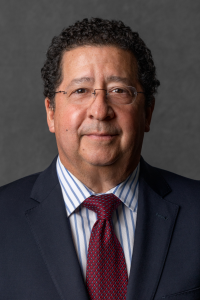
David Goldwyn is chairman of the Atlantic Council’s Energy Advisory Group and a former special envoy for international energy affairs at the US Department of State and assistant secretary of energy for international affairs.
Andrea Clabough is a nonresident fellow with the Atlantic Council Global Energy Center.
about the authors

stay connected
Sign up for PowerPlay, the Atlantic Council’s bimonthly newsletter keeping you up to date on all facets of the energy transition
related work

our work
The Global Energy Center develops and promotes pragmatic and nonpartisan policy solutions designed to advance global energy security, drive economic opportunity, and foster a sustainable energy future.
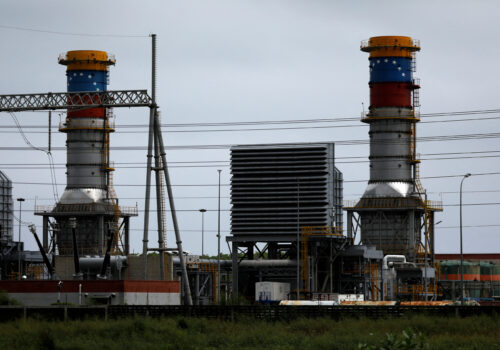
Image: Installations at the El Palito refinery of Venezuelan state oil company PDVSA, after the National Assembly approved a major reform of the country's main oil law, in Puerto Cabello, Venezuela, January 22, 2026. REUTERS/Gaby Oraa