This article is part of Realign for Palestine’s The Future of Money in Palestine series, which examines the monetary policy frameworks needed for Gaza’s reconstruction and seeks to provide a practical blueprint for establishing a financial system that Palestinians can trust.
Before October 2023, Gaza had developed a small yet functioning digital workforce. Around 90 percent of households had internet access, and thousands of educated graduates who faced limited opportunities in the local labor market had turned to freelancing and remote work as a source of income.
At the time, the military occupation and the blockade in place since 2007 had already gradually eroded Gaza’s traditional economic sectors, including agriculture, manufacturing, and industry. What remained was largely non-tradable services, alongside small informal firms and small and medium-sized enterprises. About 55 percent of the Palestinian labor force aged fifteen and older was employed in services, while only 6 percent worked in agriculture, 6.3 percent in manufacturing, and 4 percent in construction.
The resulting lack of local employment opportunities left many educated young people with few ways to use their skills, which helped fuel the growth of remote work. At the same time, many residents were pushed toward working for Hamas or other organizations as a reliable source of income. Unemployment was already around 46 percent before the war, and women faced particularly severe barriers. In 2023, 67 percent of working-age women were unemployed, compared with 40 percent of men. Moreover, as of 2020, 60 percent of highly educated women in Gaza were out of work, compared with 38 percent in the West Bank.
The war dramatically worsened these conditions. Gaza’s GDP collapsed, falling by 83 percent in 2024 compared with 2023 output. About 201,000 jobs were lost between October 2023 and January 2024. The unemployment rate reached 78 percent in 2024 and remained at 68 percent in 2025.
The damage to infrastructure has been unprecedented in scale. According to the United Nations Satellite Centre, approximately 198,273 structures across Gaza were damaged, of which 123,464 were completely destroyed. Among the ruins are offices, coworking spaces, computing equipment, and communications infrastructure.
With physical reconstruction likely to take years, remote work may remain one of the few viable options for highly skilled Gazans to earn a civilian income. In the near term, it could provide a form of humanitarian income support. Over the longer term, it could become a building block for reconstruction financing that reaches people directly rather than only through aid channels.
Realizing that potential, however, will require overcoming a wide range of barriers that the war has created for skilled Gazans seeking to participate in the global labor market.
Barriers to developing the digital freelance sector
Access to work
The most basic question in any discussion of remote work is simply: is there access to the market at all? Before the war, Gazans had access to several freelancing platforms. As of 2018, more than three thousand Palestinians from Gaza were registered on Freelancer.com, around two thousand on Upwork, and roughly seven thousand on the Arabic platform Mostaql. By 2022, the pool of graduates seeking online work had exceeded twelve thousand workers.
Some platforms continued to function during the war. Upwork and Freelancer.com are the largest international platforms on which Gazan freelancers operate. Mostaql is an Arabic platform widely used before the war and remains active. And Fiverr—founded in Israel—also allows Palestinians to register, though there have been reports of Palestinian accounts being closed without an appeals process. Moreover, Gaza Talents, which was founded during the war, connects Gazan freelancers with international clients and claims to have helped workers generate more than $600,000 in income.
In practice, one of the major challenges that has emerged during the war is that international clients sometimes refuse to hire Gazan freelancers out of concern about missed deadlines caused by power outages, connectivity failures, and displacement. Workers report concealing their location for fear of losing contracts. The influx of newly unemployed workers onto freelancing platforms since October 2023 has increased competition and pushed rates down, further reducing earnings for workers already operating on thin margins.
Electricity
Electricity is arguably the single most critical barrier to remote work in Gaza. Even before October 2023, residents regularly experienced power cuts of more than eight hours a day. Since then, the situation has deteriorated further. Electricity is frequently unavailable, and when it is available it is often unstable and subject to repeated outages. Costs have also risen sharply. According to testimonies, electricity reached around $12 per kilowatt-hour, compared with about $1.50 for 10 kilowatt-hours before the war.
Gazans are attempting to offset these shortages through solar energy. Taqat Gaza, for example, is a network of coworking spaces powered by solar generators that has enabled dozens of freelancers to continue working despite unreliable grid electricity.
Telecommunications services
Gaza was already suffering from a structural technology gap before the war, with only 2G service. While Israel upgraded to 4G and then 5G, West Bank residents only gained 3G access in 2018, and Gaza remained stuck on 2G, a slow, outdated network that cannot support intensive remote work. Israel controls the entire telecommunications infrastructure, including spectrum allocation and network infrastructure. Any telecom change in Gaza requires Israeli approval, and delays in that approval cost the Palestinian economy between $0.4 and $1.5 billion in lost revenues between 2013 and 2015 alone.
Since October 2023, much of the existing infrastructure has collapsed. As of April 2025, 64 percent of mobile towers in Gaza were out of service. In Rafah, cellular coverage collapsed to just 27 percent, down from near-universal coverage before the war. In January 2024, a near-total telecom blackout lasted for several hours. The sector’s value crashed from $13 million in 2023 to $1.5 million in 2024, an 89 percent drop, and total reconstruction costs are estimated at over $90 million.
To work around the restrictions, many Gazans try to obtain Israeli or Egyptian SIM cards to access faster networks, often unofficially and with great difficulty. As a temporary solution, coworking spaces like those run by Taqat and Gaza Sky Geeks (GSG) offer stable WiFi.
Physical spaces
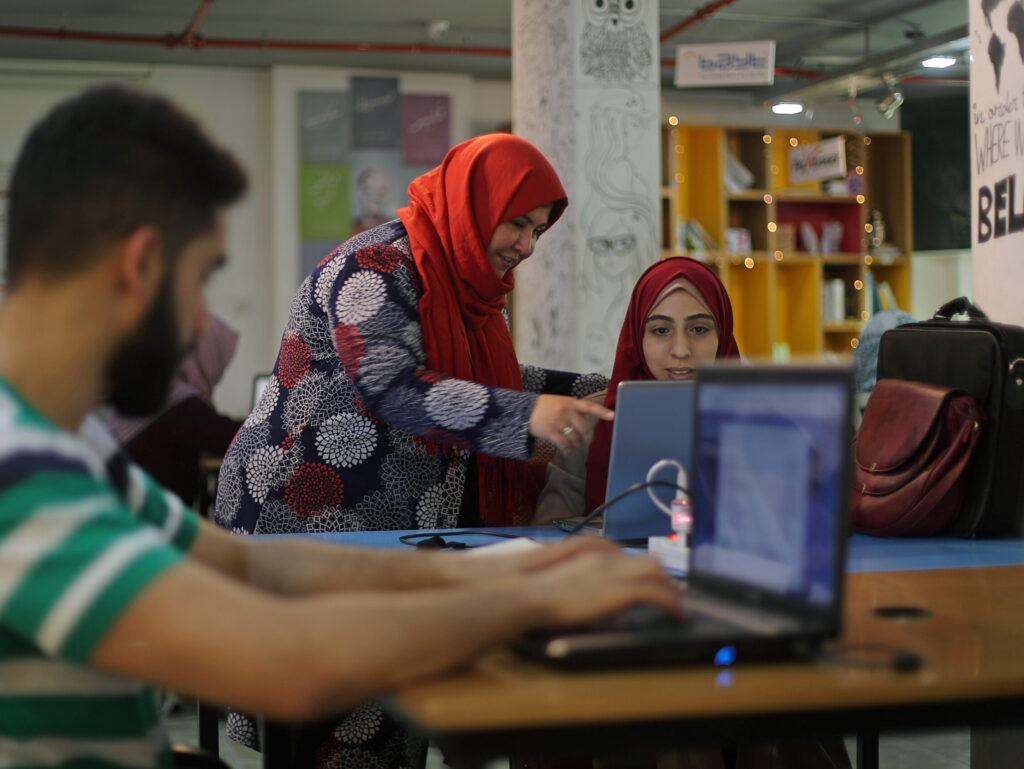
Physical coworking spaces have become another critical bottleneck. GSG, for example, was founded in 2011 with Google’s support and operated by Mercy Corps. To this day, it is the largest tech and coworking hub in Gaza. GSG has trained thousands of young people and connected local freelancers to global markets. By 2023, it employed around 40 staff in Gaza and five in the West Bank. Four companies that grew within GSG raised investments ranging from $30,000 to $65,000. Its offices and shared spaces allowed hundreds of Gazans to work regularly.
Since the war, however, two of GSG’s three locations were destroyed in airstrikes. Despite this, GSG supported more than thirty Palestinian tech companies in 2024. In August 2025, it launched a pilot to support five independent coworking spaces, covering their internet and electricity bills. Other workspace initiatives also expanded during the war. Taqat Gaza, for instance, currently serves around five hundred freelancers, and Hope Hubs provides free connectivity and space for more than 1,300 workers, including Gazan refugees in Egypt.
Payment platforms
The payment barrier is one of the most glaring obstacles to remote work and has attracted considerable public attention. But the problem differs across platforms. Some platforms do not operate in Palestinian territories at all. Others allow Palestinians to open accounts but restrict specific functions, such as certain currencies, withdrawal methods, or cross-border transfers. PayPal falls into the first category: it operates in two hundred countries, including conflict zones like Yemen and Somalia, yet refuses to serve Palestinians in the West Bank and Gaza, while Israeli settlers living just across the fence can operate active PayPal accounts. According to one survey, around 80 percent of Palestinian households would use PayPal if they could. In 2023, PayPal shareholders submitted a resolution calling for a policy change, and pressure was applied in US Congress as well, but the company has yet to change its policy.
For other payment platforms such as Payoneer, Wise, Revolut, and Stripe, access is often technically possible but difficult to use in practice. Interviewees in Gaza report account closures triggered by IP address detection, repeated identity-verification failures, and an inability to withdraw funds already earned through Wise and Revolut. In one case, a Wise business account application failed because up-to-date passports and business licenses could not be produced under wartime conditions. In another, Payoneer’s requirement for a linked bank account became unworkable when Palestinian banks were unable to open new accounts during the war.
Companies frequently cite regulatory uncertainty as the reason for restricting service in Gaza. Sanctions and anti-money laundering (AML) exposure, correspondent banking risk, card network restrictions, or a partner bank declining to process Palestinian-linked transactions can all result in the same outcome: a blocked or severely limited account. However, the Palestine Monetary Authority has implemented AML safeguards that meet international standards, Palestinian banks maintain correspondent relationships with US and European banks, and Visa, Mastercard, and Apple Pay all operate locally without incident.
Local alternatives exist but remain largely siloed from the global economy: PalPay and similar domestic wallets handle Palestinian online payments in shekels, but cannot receive payments from clients overseas, which limits their usefulness to purely domestic commerce. On the freelancing side specifically, GSG partnered with Mastercard in 2020 to study exactly this problem and identify lower-cost payment pathways for Palestinian freelancers. In practice, freelancers report losing 20 to 30 percent of their earnings to currency exchange firms and informal intermediaries regardless of which platform they use. One freelancer described earning around $200 a month through Upwork, but after the company’s 10 percent commission and currency-exchange fees of up to 30 percent, what actually reached his hands was considerably less. Some Gazans manage to find workarounds: routing payments through relatives abroad, using Western Union or MoneyGram, registering a company in the US through services like Stripe Atlas, or using crypto, typically USDT.
Gaza Talents and Freelanceo have developed partial solutions. Gaza Talents works with the Bank of Palestine to enable local transfers, while Freelanceo allows international clients to pay by credit card and lets freelancers receive payment through the Palestinian bank with no commission and within twenty-four hours. These models show that the gap can be narrowed, but their reach remains far below that of major international platforms.
Computers and equipment
Over 70 percent of information and communications technology assets in Gaza were damaged or destroyed during the war. Today, computer technicians in Gaza are forced to cannibalize components from broken machines recovered from destroyed buildings to keep existing devices running. Basic work equipment—a laptop, mouse, and keyboard—has become a scarce resource, making access to hardware a significant constraint on remote work. Equipment donations are therefore among the stated needs of support organizations operating in this space.
Training and education
training programs. Some studied in neighboring countries such as Egypt or through distance learning. GSG was the primary bright spot, offering a freelancing academy, hackathons, and coding tracks that provided a pathway into higher-skilled digital work. Graduates of its programs reached an average income of $1,100 per month, roughly four times the local average wage. Over the past several years, 30 percent of GSG program participants were based in Gaza itself—the rest joined remotely. Today, under wartime conditions, the organization’s training programs have moved entirely online.
Legal protection and social rights
Gazan freelancers operate in a legal vacuum. Palestinian Labor Law No. 7 of 2000, the primary legislation governing employment law in the West Bank and Gaza, does not mention remote work at all. And the Palestinian Ministry of Labor has explicitly stated that it has no authority over remote workers. This leaves Gazan workers exposed to clients abroad who refuse to pay, platform account closures, and unexpected fees, with little or no legal recourse. Documented cases of payment refusal appear in multiple reports. The absence of regulatory protection also increases the risk of fraud and exploitation, particularly for women.
A framework for rebuilding Gaza’s remote-work economy
These barriers are not inevitable features of operating in a conflict zone. They largely reflect gaps in infrastructure, market access, and regulation that can be addressed through targeted intervention. Implementation will require creating a coalition among funding bodies, the National Committee for the Administration of Gaza, the Israeli government, and private payment service providers. The Board of Peace and the World Bank could potentially condition reconstruction funds on cooperation to establish a functioning legal and telecommunications framework.
Three priorities should guide this effort. First, maintaining the basic infrastructure needed for remote work, including electricity, telecommunications, equipment, and physical space. Second, connecting workers to global markets through payment platforms, non-discrimination measures, and support for new entrants. And third, building institutional resilience through legal protections, gender-responsive mentorship, and related measures.
The following interventions could help translate these priorities into a practical framework for rebuilding Gaza’s remote-work economy:
- Launch a gender-responsible employment initiative focused on integrating women into new work opportunities and strengthening labor protections: A dedicated initiative should include women-only coworking hours or spaces where security concerns and social norms create barriers to participation; mentorship pipelines connecting Gazan women with diaspora and regional professionals; and monitoring of gender balance across all program beneficiaries. Any stabilization fund should also track and report outcomes by gender, including participation, hiring, earnings, and retention.
- Designate remote work as a formal humanitarian and economic policy: Remote work in Gaza should be recognized as a central economic sector, rather than an informal coping mechanism, by the US government and other donors and recovery bodies. It should be incorporated into reconstruction plans, funding priorities, and economic recovery strategies. Palestinian institutions should also update Palestinian Labor Law No. 7 of 2000 to cover remote and platform-based work, establishing basic protections for workers in the sector.
- Create a remote work stabilization fund to de-risk hiring for international clients: International clients frequently decline to hire Gazan freelancers due to concerns about delivery reliability under conflict conditions. A stabilization fund, administered by a third party such as the World Bank, could address this risk by providing milestone-based payment guarantees or partial compensation when delivery is disrupted by infrastructure failures or displacement. Donor governments could provide the initial capitalization, with the fund structured to sunset as operating conditions stabilize.
- Establish a network of resilient, solar-powered coworking hubs with subsidized equipment: The models developed by Taqat Gaza and GSG should be scaled into a network of shared workspaces providing reliable internet, solar-powered electricity, and basic work equipment. Donors could map coverage gaps across Gaza to fund a minimum viable network of hubs. Each hub should include device-lending programs or subsidized options for workers who cannot afford suitable equipment.
- Launch a coordinated payments initiative bringing together Palestinian banks, payment providers, card networks, correspondent banks, regulators, and freelancing platforms: Rather than treating payment access as a matter of pressuring individual companies, the more durable fix is to bring the relevant actors together to identify the legal and technical barriers and establish shared compliance standards. In the near term, the initiative should prioritize measures that do not require new regulatory agreements: subsidizing transaction and currency-conversion costs for Gazan freelancers; supporting escrow or payment-aggregation services that pool individual transactions into fewer, larger, more compliance-friendly flows; and expanding verified local payout partners like Gaza Talents and Freelanceo so more freelancers can access international payments despite platform-level restrictions. Over the longer term, the initiative should work toward formal regulatory agreements that give payment companies a clear compliance basis for operating in Palestinian territories, digital identity systems that reduce the verification burden, stronger consumer protections for Palestinian account holders, and deeper integration of Palestinian financial institutions into global payment networks.
- Construct telecommunications infrastructure and expand independent spectrum access where possible, including through independent Palestinian entities: Beyond reconstruction, Israel’s longstanding restriction of Palestinian telecommunications to 2G in Gaza and delayed 3G in the West Bank must be addressed in any diplomatic engagement on post-conflict arrangements. Palestinian operators should have the ability to deploy at least 4G technology independently. Securing Israeli approval for 4G access in Gaza should therefore be a political priority. The Board of Peace and the US government should treat 4G authorization for Palestinian operators as a defined deliverable with a clear timeline and implementation benchmarks.
- Scale virtual training opportunities in healthcare, technology, and education to rebuild Gaza’s workforce for both virtual and local work: The GSG model of training Gazans to compete in global digital markets demonstrated measurable results, with graduates earning an average of $1,110 per month, four times the local wage. This model should be expanded and diversified beyond software development to include healthcare IT, data annotation, digital content, translation, and legal process outsourcing, particularly in sectors with growing global demand and low infrastructure requirements. Training should be designed to function under intermittent connectivity, with offline-capable curricula and asynchronous delivery.
Avia Liberman is an economic analyst and a junior fellow at Realign for Palestine, a project of the Atlantic Council’s Rafik Hariri Center and Middle East programs.
Melanie Robbins is the deputy director of Realign for Palestine.
Related content


Explore the program

The Realign For Palestine project at the Atlantic Council aims to amplify pragmatic voices who courageously advocate for Palestinian statehood and self-determination, unequivocally reject violence, terrorism, and extremism and acknowledge a two-nation solution, including Israel’s right to exist in safety. Decades of violent conflict have proven that all who support Palestinians must realign our words and actions to finally achieve lasting peace.
Realign For Palestine fosters innovative thinking, advocacy, and action toward regional peace, security, and nation-building of two homes for two people.
Image: Dalia Shurrab, a Palestinian entrepreneur and a social media coordinator, at Gaza Sky Geeks office in Gaza City in June 13, 2019. Source: REUTERS/Mohammed Salem.