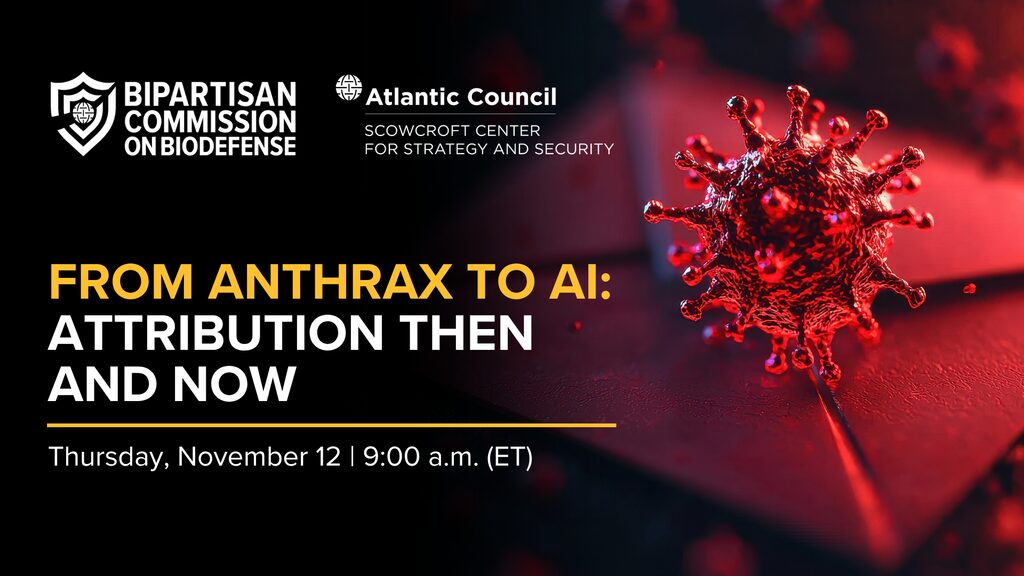
On Thursday, November 12, at 9:00 a.m. ET, the Bipartisan Commission on Biodefense at the Atlantic Council will explore how biological attribution has evolved since the 2001 anthrax attacks and how emerging technologies are reshaping the challenge.
The 2001 anthrax attacks exposed the challenges of identifying the source of a biological attack and responding amid uncertainty. More than two decades later, advances in artificial intelligence (AI) are creating new questions about how biological threats can be investigated and attributed.
This meeting of the commission will examine how lessons from the anthrax attacks inform biodefense today, how attribution shapes national security decisions when evidence is incomplete, and how AI is changing the biological threat landscape and the capabilities available to investigators. The discussion will also consider how evidence can guide public health responses before the source of an outbreak or responsibility for an attack is established.
This event will not be livestreamed. A recording of the event will be made available at a later date.
New policy: In-person attendees will be required to show photo ID upon arrival, and no on-site registration will be permitted. Guests will not be admitted later than twenty minutes after the event’s start time.
By registering to attend in-person, you agree to abide by the Atlantic Council’s Event Code of Conduct.
Please complete the form below to register for this event.
Speakers
More speakers to be announced.
Agenda
9:00–9:20 a.m. | Welcome remarks
Speakers
Chrissy Houlahan
US House of Representatives, PA-6,
Ranking Member, Subcommittee on Open-Source Intelligence, Permanent Select Committee on Intelligence,
US House of Representatives
Pat McCrory
Former Governor,
North Carolina
Donna Shalala
Co-Chair,
Bipartisan Commission on Biodefense,
Atlantic Council
Tom Ridge
Co-Chair,
Bipartisan Commission on Biodefense,
Atlantic Council
9:20–9:45 a.m. | Panel one: Lessons from anthrax and the future of biodefense
Speakers
Tom Daschle
Commissioner,
Bipartisan Commission on Biodefense,
Atlantic Council
Raj Panjabi
Commissioner,
Bipartisan Commission on Biodefense,
Atlantic Council
9:45–10:05 a.m. | Panel two: Biological attribution and national security
Featuring
Thomas G. DiNanno
Under Secretary for Arms Control and International Security,
US Department of State
10:05–10:15 a.m. | Break
Break in programming.
10:15–11:05 a.m. | Panel three: Biological attribution: Evidence, response, and readiness
Speakers
Karen Kafadar
Commonwealth Professor, Department of Statistics,
University of Virginia
James Giordano
Director, Center for Disruptive Technology and Future Warfare, Institute for National Strategic Studies,
National Defense University
11:05–11:55 a.m. | Panel four: AI and the next attribution challenge
Speakers
Todd Treangen
Associate Professor of Computer Science,
Rice University
Anemone Franz
Postdoctoral Scholar, Reilly Center,
University of Notre Dame;
Visiting Research Fellow,
American Enterprise Institute
11:55–12:00 p.m. | Closing remarks
Speakers
Donna Shalala
Co-Chair,
Bipartisan Commission on Biodefense,
Atlantic Council
Tom Ridge
Co-Chair,
Bipartisan Commission on Biodefense,
Atlantic Council
related content

Stay connected
explore the programs
The Bipartisan Commission on Biodefense at the Atlantic Council provides a comprehensive assessment of the state of US biodefense and recommends changes to policy and law that strengthen national biodefense while optimizing biodefense resources.

The Scowcroft Center for Strategy and Security works to develop sustainable, nonpartisan strategies to address the most important security challenges facing the United States and the world.
Follow the conversation on X with @Biodefensecomm, @ACScowcroft, @AtlanticCouncil