In January, I wrote that Saudi Arabia’s Vision 2030 was “coherent, ambitious, and increasingly credible,” with “the potential not only to transform the kingdom, but to reshape the broader region.” Ten months later, while I continue to believe in Vision 2030’s ambitions, the economic and geopolitical environment in which those ambitions must be realized has changed. First, global capital has become more expensive, while Saudi Arabia’s financing requirements continue to grow. In addition, regional conflicts have introduced new risks to the kingdom’s economic transformation. These developments do not necessarily undermine the objectives of Vision 2030, but they demand a reassessment of the assumptions underlying its execution.
A decade of transformation
When Vision 2030 started ten years ago, interest rates were low, and the current account and fiscal deficit or surplus were largely dependent on the price of oil. Saudi Arabia was expanding its export of capital, while gross domestic product (GDP) per capita was plateauing in a society where the proportion of young people is rising. Thus, the impetus of Vision 2030 was born from both ambition and necessity, as new knowledge-based industries were becoming the drivers of wealth and prosperity in the emerging new century. The results were substantial. In July of this year, the International Monetary Fund stated: “Reforms since 2016 have advanced economic diversification, strengthened governance and institutions, and improved policymaking, supporting stronger economic performance.”
Yet fully scaling Vision 2030’s ambitions requires harnessing productivity and producing a risk-adjusted return on capital. Saudi policymakers, as I argued in January, need to take critical steps to foster a deeper culture of risk-taking and to fully support small- and medium-sized enterprises (SMEs), the true engines of job creation, along with the development of a stronger domestic capital market. Furthermore, to assess risk and returns effectively, investors require greater transparency, reliable financial reporting, and consistent rule of law, elements essential to attracting sustained private investment at scale.
The rising cost of global capital
Rising global interest rates and stress in the debt and currency markets in France, Japan, and elsewhere present challenges to the Gulf Cooperation Council (GCC) economies at a time of geopolitical uncertainty. In my view, these challenges will manifest financially through a rising cost of credit. Hurdle rates, the minimum acceptable rate of return for investors, for infrastructure and other investments will rise. The nonhydrocarbon and SME sectors are likely to be the most impacted. This may even postpone or derail some plans to fund economic diversification. That said, Saudi Arabia remains highly solvent, and these same challenges also present opportunities for the kingdom as both an exporter and importer of capital in an environment of rising returns.
Nonetheless, a growing consideration for Saudi Arabia is higher capital costs, because capital is needed for growth and investment. Because the Saudi currency is tied to the US dollar, the kingdom’s monetary policy is linked to that of the United States, even if domestic macroeconomic fundamentals differ. This translates into higher capital costs for Saudi Arabia at a time of widening current account and fiscal deficits, partly due to regional war.
In January 2026, Saudi Arabia’s minister of finance approved the kingdom’s 2026 borrowing plan, projecting total financing needs of $57.9 billion. The proceeds are intended to fund a projected fiscal deficit of $44 billion, equivalent to 3.3 percent of Saudi Arabia’s GDP. That fiscal deficit is now projected to be $65 billion, roughly 4.9 percent of GDP, according to the Ministry of Finance. At the same time, the IMF October 2026 World Economic Outlook projects Saudia Arabia’s current account deficit to 3.5 percent of GDP compared with a forecast of just 0.3 percent in July 2026, underscoring the deterioration in the kingdom’s external financial position and the importance of Saudi Arabia’s access to the financial markets.
During the first week of January, the kingdom demonstrated ample access by issuing $11.5 billion of senior unsecured bonds, drawing reported demand in excess of $20 billion from global fixed-income investors, particularly for longer-duration tranches. The below table details yield and credit spreads at issuance along with today’s yields and credit spreads. As noted in the table, yield levels have increased from 72 basis points to 110 basis points depending on the maturity. However, it should be note that credit spreads, which measure Saudi-specific risk, have not risen materially, with only the thirty-year benchmark showing an increase of a nominal 29 basis points.
The rising global cost of capital changes this equation at a time when the kingdom increases the size of its current account deficit and fiscal deficit. Given Saudi Arabia’s strong balance sheet, it will continue to be an exporter of capital, but given its growth ambitions, it will be increasingly reliant on foreign capital, especially for investments in the non-hydrocarbon sector.
The distinction between the fiscal deficit and the current account deficit is important. The former reflects the government’s financing requirements, while the latter reflects the broader economy’s relationship between national savings and investment. Saudi Arabia’s movement from substantial current account surpluses to deficits reflects changing external financial conditions and the demands of domestic investment, alongside fluctuations in oil revenues. These changes require Saudi policymakers to reconsider how capital is allocated, how productivity is generated, and how productivity is sustained to produce results for shareholders and citizens.
The productivity imperative
Last month, the Atlantic Council’s MENA Futures Lab held a gathering in New York City with public- and private-sector leaders to discuss Vision 2030 and the kingdom’s economic transformation. The event reinforced my view that human capital will ultimately be more important than financial capital in the next phase of the kingdom’s development. In the eighteenth century, economist Adam Smith argued that land, labor, and capital were the fundamental sources of production and national wealth. This premise has remained relevant to modern-day economics, though it has evolved over the centuries to include a measure of productivity from technological progress.
I believe Saudi Arabia needs to build a national consensus on efficiency and productivity. This is as much a mindset as it is a policy prescription. Ambition is a necessary ingredient for transformation, but it must be calibrated with pragmatism. Capital has a cost, and that cost is clearly rising. Investing in one project or idea means that other ideas will not be funded. Moreover, focusing on massive “moon shoot” projects may create valuable brand visibility, but if unsuccessful, they destroy value for shareholders and citizens alike.
At the same time, investing in innovation will not have a 100 percent success rate. Innovation, especially innovation from SMEs, is a worthy public policy endeavor, because SMEs are historically the largest driver of job creation. But as the cost of risk capital climbs, if you cannot lower the hurdle rate, increase the return. Saudi Arabia, in my view, must make this a national slogan.
The geopolitical cost of economic transformation
Saudi Arabia can strengthen its defenses, build redundant infrastructure, diversify supply chains, and develop alternative transportation corridors. But it cannot unilaterally eliminate geopolitical threats. In fact, the more Saudi Arabia becomes integrated into international financial markets, tourism, logistics, advanced manufacturing, and global technology supply chains, the more its economy depends on regional stability. This, combined with Saudi Arabia’s much larger land mass in relation to the other GCC nations, makes it much more vulnerable to asymmetric attacks on pipelines, power stations, and data centers.
Protecting every strategically important asset, while simultaneously defending prominent civilian targets such as airports, would require a comprehensive defensive umbrella that would be expensive and operationally difficult to manage. The challenge is that relatively inexpensive offensive systems can threaten infrastructure that costs billions of dollars to construct and maintain. Thus, the Saudis themselves must measure the costs of escalation and calibrate policy appropriately. Recent efforts at diplomacy with Iran in concert with Turkey and Pakistan, Saudi Arabia’s partners in the Mecca Joint Defense Agreement, is a delineation of such a measured approach.
The next decade of Saudi Arabia’s transformation will be determined by how much capital the kingdom can mobilize and how productively it can deploy that capital. It will also be determined by regional geopolitical stability, which would help sustain the ability of those investments to generate lasting value. I believe that at the intersection of geopolitical and geoeconomic risk for the GCC, there is a compelling need for cooperation and integration. Saudi Arabia cannot eliminate geopolitical risk through regional cooperation. But cooperation can reduce the economic consequences of disruption, improve the efficiency of defensive investments, and potentially lower the risk premium demanded by international capital.
Indeed, the geography of the Arabian Peninsula itself—with six nations surrounded on three sides by strategic waterways—underscores the value of collective resilience. Integrated energy infrastructure, transportation networks, supply chains, and security arrangements can provide a degree of protection and economic efficiency that individual nations may find difficult or prohibitively expensive to achieve independently.
The benefits extend beyond security. Greater regional integration can reduce duplication of capital expenditures, improve the productivity of existing infrastructure, and strengthen the GCC’s collective attractiveness to international investors. Ultimately, geopolitical instability is therefore not simply an external risk to Vision 2030. It can become an additional cost of capital and a constraint on productivity. Saudi Arabia’s challenge is to finance its transformation and ensure that the economic returns from that transformation can justify its rising financial and geopolitical costs.
Khalid Azim is the director of the MENA Futures Lab at the Atlantic Council’s Rafik Hariri Center for the Middle East.
The MENA Futures Lab would like to thank Barclays and DLA Piper for their support for programming on Saudi Arabia’s Vision 2030. This article was written and published in accordance with the Atlantic Council’s Intellectual Independence Policy, which requires all donors to agree to the Council maintaining independent control of the content and conclusions of its work.
Related Reading

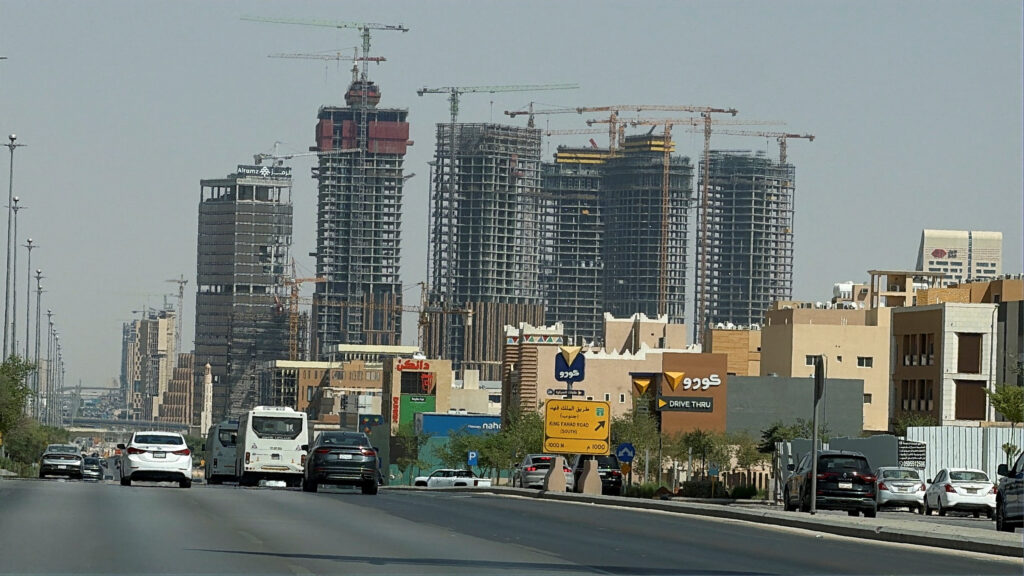
Image: Construction site of multi-tower complex in Riyadh, Saudi Arabia, October 16, 2026. Picture taken with a mobile phone. REUTERS