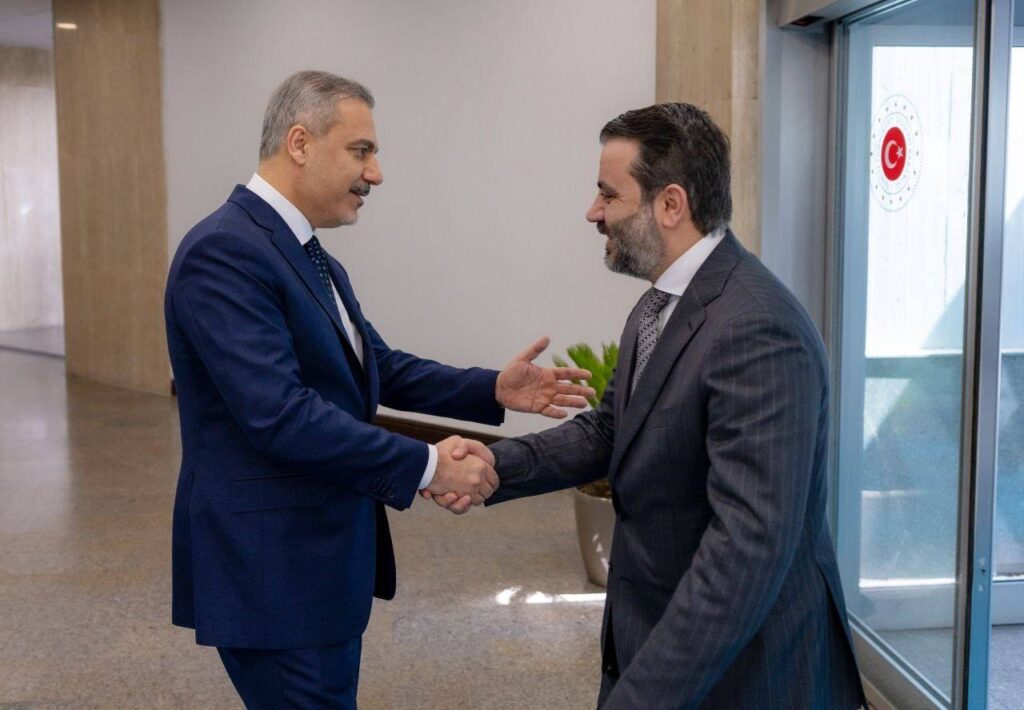
In April 2025, I attended a meeting in New York between Syrian Foreign Minister Asaad al-Shaibani and members of the Syrian-American community. During the meeting, al-Shaibani mentioned that Syria aspires not only to move beyond its conflict, but to be able to play a mediation role in other conflicts around the world. For a country devastated by war and at the time still under heavy sanctions, the ambition was striking. I left the meeting wondering if the Syrian leadership would maintain that vision when it is faced with the ever-changing dynamics of the region. Eighteen months later, during the Manama Security Dialogue, al-Shaibani announced that Syria is weighing whether to join the Mecca Alliance, a mutual defense pact between Saudi Arabia, Turkey, and Pakistan.
While the two visions between New York and Manama are not incompatible, the prospect of Syria joining the alliance raises two strategic questions: one for Syria and one for the pact. For Syria, the question is whether joining the alliance would make the country more secure and facilitate its transition. For the alliance, it is whether admitting Syria would make it stronger. I argue that the answer to both questions is no.
It is important for Syria to deepen its bilateral cooperation with the members of the alliance on all economic, military, and security levels, but that doesn’t require Damascus to join a formal alliance. Joining the alliance would expose Syria to a new set of threats. At the same time, admitting Syria into the alliance would mean admitting a member with an exposed geography that’s difficult to defend and increases the potential for regional escalation for members of the alliance.
What Damascus is thinking
The temptation for Syria is real. The fourteen-year conflict devastated Syria’s armed forces. In the first forty-eight hours after the fall of Bashar al-Assad, Israel conducted hundreds of air strikes that destroyed what was left of Syria’s air defenses. Repeated Israeli incursions into southern Syria, reported detentions of Syrian civilians, and new military posts Israel is building inside Syria have increased the sense of vulnerability among Syrians and the urge to develop their defense capabilities. In late October, Jordanian airstrikes, which caused civilian deaths in southern Syria, were what many Syrians described as adding insult to injury. In recent conversations I had with Syrians, many of them expressed their frustration of other countries violating Syria’s sovereignty and the inability of the Syrian government to protect its citizens.
For the Syrian leadership, joining the Mecca Alliance could seem like a window of opportunity that brings Syria what it craves the most: protection and recognition. It would prove that Syria has been able to secure an alliance with powerful players to both its population and regional actors. Membership could provide Syria with a collective defense commitment from three regional powers, potentially deterring future attacks and giving Damascus greater confidence in its security.
Syria also needs to rebuild its military capabilities, including its air defenses and military institutions. Its growing relationship with members of the alliance offers opportunities for military cooperation, as well as diplomatic and economic support for reconstruction. Saudi Arabia has been an important supporter of Syria’s reintegration into the international community, and Damascus has an interest in strengthening that relationship.
Following an Israeli airstrike on a Syrian airbase in August, al-Shaibani rejected what he described as an Israeli attempt to interfere in Syria’s external choices. Syria has the right to choose, but exercising that agency does not mean it should go into formal alliances. If Syria joins the alliance, and Israel continues its pattern of attacking Syria, that would move the decision to respond to the Israeli actions from Damascus to Ankara, Riyadh, and Islamabad. That does not help Syria repair its sovereignty, it structurally weakens it.
The alliance’s next moves
The Mecca Alliance is already grappling with challenges of its own. Saudi Arabia is facing an escalation in Yemen, and has an immediate interest in securing additional military support. For the alliance, widening the pact would signal momentum, at a time when some analysts are already raising questions about its effectiveness and credibility. Turkey may see a longer-term interest in Syria joining the pact, consolidating a strategic relationship with Damascus that already includes military training, intelligence, and operational support.
But admitting Syria now could make the alliance appear to be forming an anti-Israel front, given Israel’s occupation of Syrian territory. Admitting Syria would expand the geography of the alliance and serve as an essential part of a Saudi-Turkish corridor through Jordan. That geography, nevertheless, is an exposed geography. It is likely that Syria would become the next test for the alliance if it is admitted while Israeli-Turkish tensions are ongoing. In the case of an Israeli or Iranian attack on Syria, would Saudi Arabia, Turkey, and Pakistan step in to defend Syria, risking widening the conflict and engaging in new fronts? Or would they restrain and further weaken the credibility of the alliance? Syria, in this scenario, could become an attractive target to test the alliance without acquiring reliable protection.
Another important angle is a potential Syrian role in Yemen. Syria is reportedly weighing military aid to Saudi Arabia, although al-Shaibani recently denied that Syrian troops had been deployed to Yemen. Military support for Saudi Arabia could become one of the expectations placed on Syria if it joins the alliance. That move is consequential. Syria is still consolidating its armed forces and establishing a unified command and a national, inclusive army. Sending troops to Yemen would distort this process and the country’s efforts to build institutions. In addition, joining the war in Yemen could create expectations that the new Syria would join the wars of others, which would complicate its relationship with Israel further.
The argument above doesn’t mean Syria should distance itself from Saudi Arabia, Turkey, or Pakistan. On the contrary, these relationships are important for Syria’s recovery. However, the benefits Syria could reap from its external relationships do not require a membership in a military alliance. Syria could pursue military training, intelligence sharing, border security cooperation, and support for building defense capabilities through different forms of bilateral and multilateral relationships, without committing to a military alliance that would not offer Syria the protection it seeks nor offer the alliance the strength it needs.
Pakistan, which has a long history of military training and intelligence cooperation with Syria, could also contribute to rebuilding Syria’s armed forces and military institutions without requiring Damascus to join the alliance. The defense cooperation agreement that Syria and Saudi Arabia signed on November 4 is already an example of how such cooperation can advance without Syria joining the alliance. On the economic side, the Saudi Fund for Development has signed six concessional loan agreements worth more than $403 million to support reconstruction in sectors including energy, water, health, housing, and infrastructure.
Furthermore, economic integration, investment, infrastructure development, and trade corridors could be advanced through arrangements that do not commit Syria to participate in regional wars or be exposed to them. This formula is also beneficial for the members of the alliance. They could strengthen Syria without committing themselves to defending it militarily or being dragged into a military confrontation inside Syria. This is in the interest of all members and in the interest of the United States.
Al-Shaibani’s vision of Syria contributing to peacebuilding beyond its borders is worth honoring. The Syrian leadership needs to look beyond what Syria could gain from joining a military alliance and ask a broader question: what regional role does Syria want to develop in the years ahead? Syria faces a generational task of rebuilding its state and society. Its decisions about participating in regional conflicts today could shape expectations and commitments for its foreign policy for years to come. Joining a military bloc might make this vision more difficult to achieve, especially if Syria gets involved in other regional conflicts. Syria’s partners could support Syria’s recovery on the economic and security levels without involving it in an alliance that might burden its institutions and distort their evolution.
The region needs new ideas for how its states could build relationships, including regional security cooperation without obligations to participate in partners’ conflicts. That might seem far away, which is exactly why it is needed most.
Ibrahim al-Assil is a nonresident senior fellow with the Atlantic Council’s Syria Project, senior research fellow at the Harvard Kennedy School’s Middle East Initiative, and project lead of the Syria Transition Lab.
Related Reading
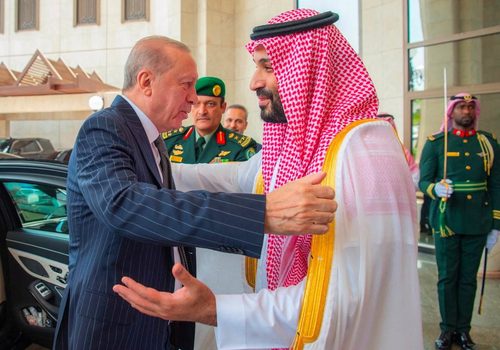
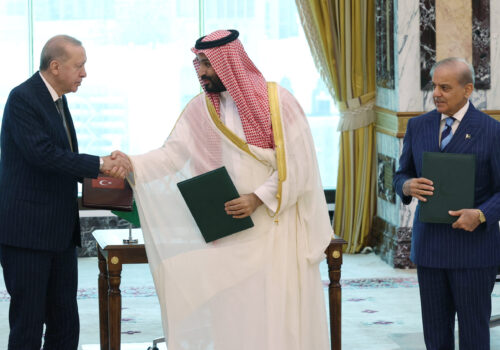

Image: Syrian Minister of Foreign Affairs and Expatriates Asaad Hassan Al-Shaibani (R) meets with Turkish Foreign Minister Hakan Fidan on the sidelines of the trilateral meeting of the foreign ministers of Syria, Turkey, and Jordan to discuss several joint security and economic issues, in Ankara, Turkey, on May 12, 2025. (Photo by Syrian Arab News Agency (SANA), via Reuters.)