
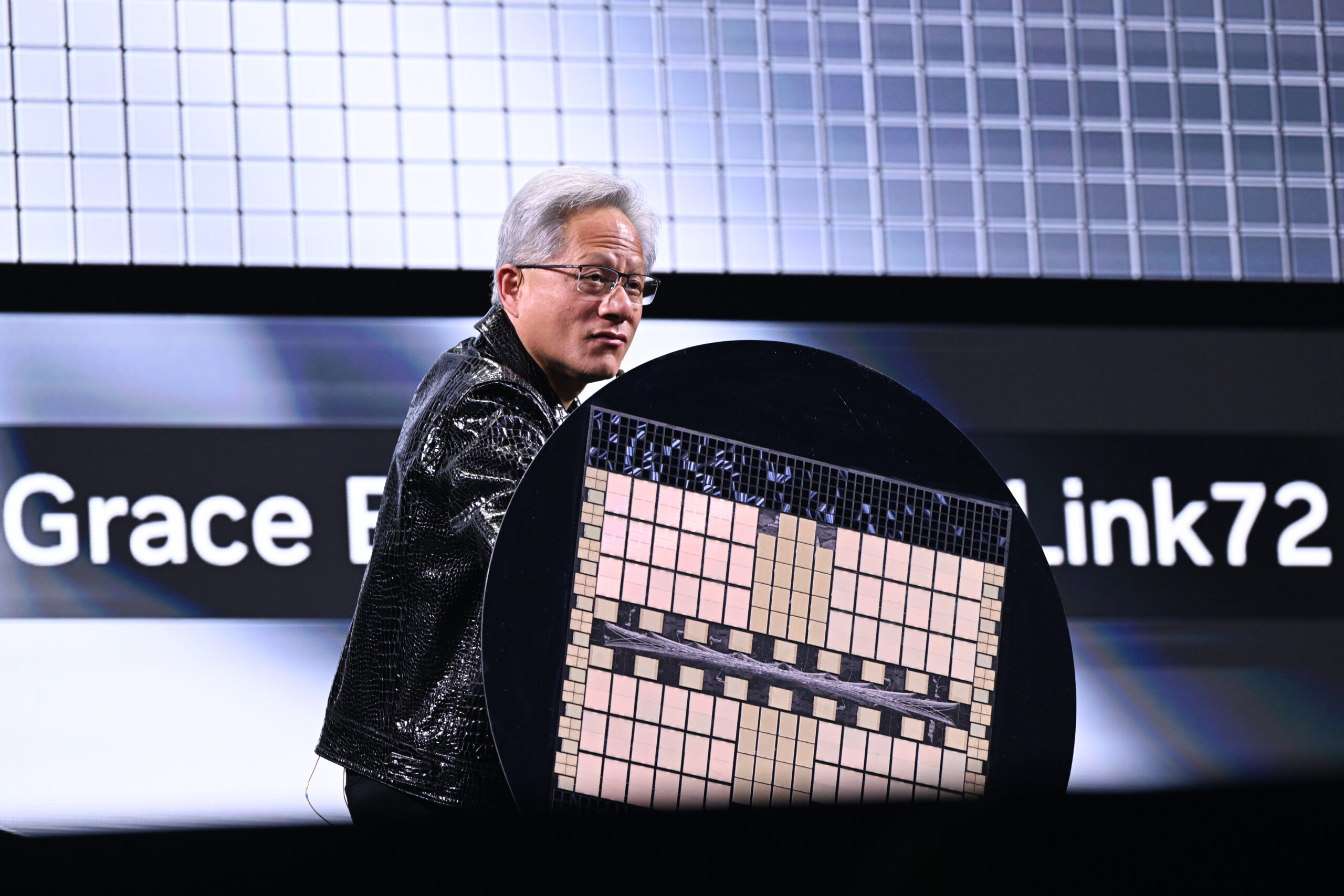
WASHINGTON—Jensen Huang’s departure as Nvidia CEO today is not the end of the story. The US chip giant continues to face scrutiny over how its artificial intelligence (AI) chips are reaching China despite US export restrictions, as well as over the role that an alleged Chinese intelligence asset may have played in facilitating the purchases. For the past year, reports have questioned Nvidia’s relationship with Megaspeed International, a Singapore-based technology company that serves as a “neocloud,” renting out computing capacity at data centers across Southeast Asia. And while much attention has focused on Huang’s personal conduct, the case also raises broader questions about the extent to which the US can rely on private companies to protect technologies critical to national security.
Nvidia and the growing challenge of AI chip diversion
The recent attention on Huang was precipitated by reports that Alice Huang, a former Megaspeed executive, not only had a personal relationship with the then-CEO of Nvidia but was also recruited by Beijing’s Ministry of State Security to learn about US chips and potentially influence Nvidia to lobby for exporting more of its chips to China. Since 2023, Megaspeed has risen to become Nvidia’s largest Southeast Asian buyer and a key partner in the regional data center boom, driven largely by Chinese demand for cloud computing. The company imported at least $4.6 billion worth of Nvidia technology between 2023 and 2025. In facilities across the region, Megaspeed rents Nvidia chips to Chinese tech giants such as Alibaba, an arrangement that does not violate current US export control regulations. But the company also faces suspicions that it has physically diverted restricted chips to China, which is prohibited under export controls. Megaspeed denies wrongdoing, and no charges have been filed. Similarly, Nvidia has stated that there was nothing unusual about its cooperation with Megaspeed.
The diversion of Nvidia’s restricted AI technology to China has posed a challenge for enforcement since 2022, when the Biden administration set up one of the most extensive export control regimes on advanced AI technology. Since then, smuggling networks have emerged to move advanced chips into China. The US government has taken several enforcement actions against entities and individuals facilitating their diversion, but it has been unable to stem the flow completely. For example, earlier this year, Washington charged a top executive at Super Micro Computer Inc., a California-based assembler of AI servers and a key partner of Nvidia. The indictment alleged that the executive and two others worked with a company in Southeast Asia and several third-party brokers to divert $2.5 billion worth of Nvidia-powered servers to China.
In response to concerns about chip diversion, Nvidia has made some efforts to strengthen monitoring and compliance. Recently, it rolled out its “fleet intelligence” system, which can track hardware metrics, including location. However, enrollment is voluntary and only covers Nvidia Cloud Partners. Additionally, while Nvidia has the tools to geolocate chips, it has remained cautious about using them, and it does not by default require customers to share location data with the company or the US government. Outside of this monitoring system, Nvidia has also reviewed its list of pre-approved chip buyers, removing more than half of its Asian buyers. More recently, Nvidia has reportedly begun instructing cloud partners not to rent more than half of their computing power to Chinese companies, although US regulations do not require this restriction.
At the same time, Nvidia has advocated in Washington for more access to the Chinese market, arguing that restrictions on high-end semiconductor sales to China are counterproductive because they encourage the development of domestic alternatives. Huang has also claimed that Nvidia found no evidence of Super Micro being involved in AI chip diversion schemes. He has also defended Nvidia’s commercial relationship with Megaspeed. Moreover, there is some disagreement within the tech sector about the best approach: firms such as Amazon and Microsoft—two of Nvidia’s biggest clients—support legislation that would further limit Nvidia’s ability to export chips to China. These competing incentives raise the question of whether it is realistic to expect the private companies to prioritize national security when their primary objective is to maximize profit and maintain competitiveness.
What Washington should do next
The recent attention on Nvidia comes as export-control enforcement has become a lower priority on the US government’s agenda over the past two years. In 2025, the Trump administration reversed the AI Diffusion Rule, which would have required licenses for advanced chip sales to much of Southeast Asia. The US Department of Commerce has twice drafted rules aimed at restoring some of these licensing requirements to curb diversion to China, first targeting Malaysia and Thailand specifically, and later through a global permit framework. However, the Malaysia and Thailand rule was never issued, and the global framework was withdrawn shortly after it was sent for interagency review. Beyond this, throughout 2026, the Trump administration has allowed sales of Nvidia’s H200 chips to China through case-by-case licensing, with the US government taking a 25 percent cut.
The pendulum may now begin to swing back toward more oversight. The incoming Democrat-controlled Congress, for example, seems likely to bring renewed scrutiny to export-control enforcement, particularly with respect to AI technologies. The next Congress might even start with existing bills, such as the Chip Security Act and the Remote Access Security Act. The Chip Security Act would require the Department of Commerce to mandate location verification for advanced AI chips before export, turning capabilities such as Nvidia’s “opt-in” tracking tool into a common standard. It passed the House Foreign Affairs Committee unanimously in March 2026. Meanwhile, the Remote Access Security Act would give the Bureau of Industry and Security explicit authority to regulate remote access to controlled chips through cloud services, closing the gap that allows Chinese firms to rent computing power from data centers elsewhere in Southeast Asia. It passed the House 369–22 in January 2026 but has not yet moved in the Senate.
Beyond legislative action, Congress could also exercise its oversight authority by holding hearings on export controls enforcement, particularly with officials from the Department of Commerce. Recent reports indicate that the department gave permission to Nvidia to sell its advanced H200 chips to dozens of Chinese firms with alleged ties to sanctioned entities. Earlier this month, the Financial Times reported that several departments, including the State, Energy, and Treasury Departments, have been pushing for the inclusion of Megaspeed on the Commerce Department’s Entity List, but Commerce has so far not taken action. These findings, combined with the Commerce Department’s central role in administering and enforcing export controls, could provide grounds for congressional inquiry into whether existing enforcement and compliance mechanisms are adequate.
Finally, the Nvidia episode also exposed the growing threat of economic espionage and the need for private firms to strengthen their counterintelligence capabilities in coordination with government agencies. The National Counterintelligence and Security Center, part of the Office of the Director of National Intelligence, in coordination with the Federal Bureau of Investigation, should expand its outreach to companies in strategically sensitive sectors, helping them build capacity to identify and counter foreign espionage. These efforts should also involve foreign intelligence partners, including members of the Five Eyes alliance.