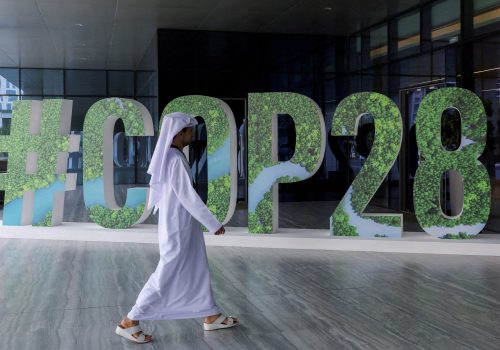
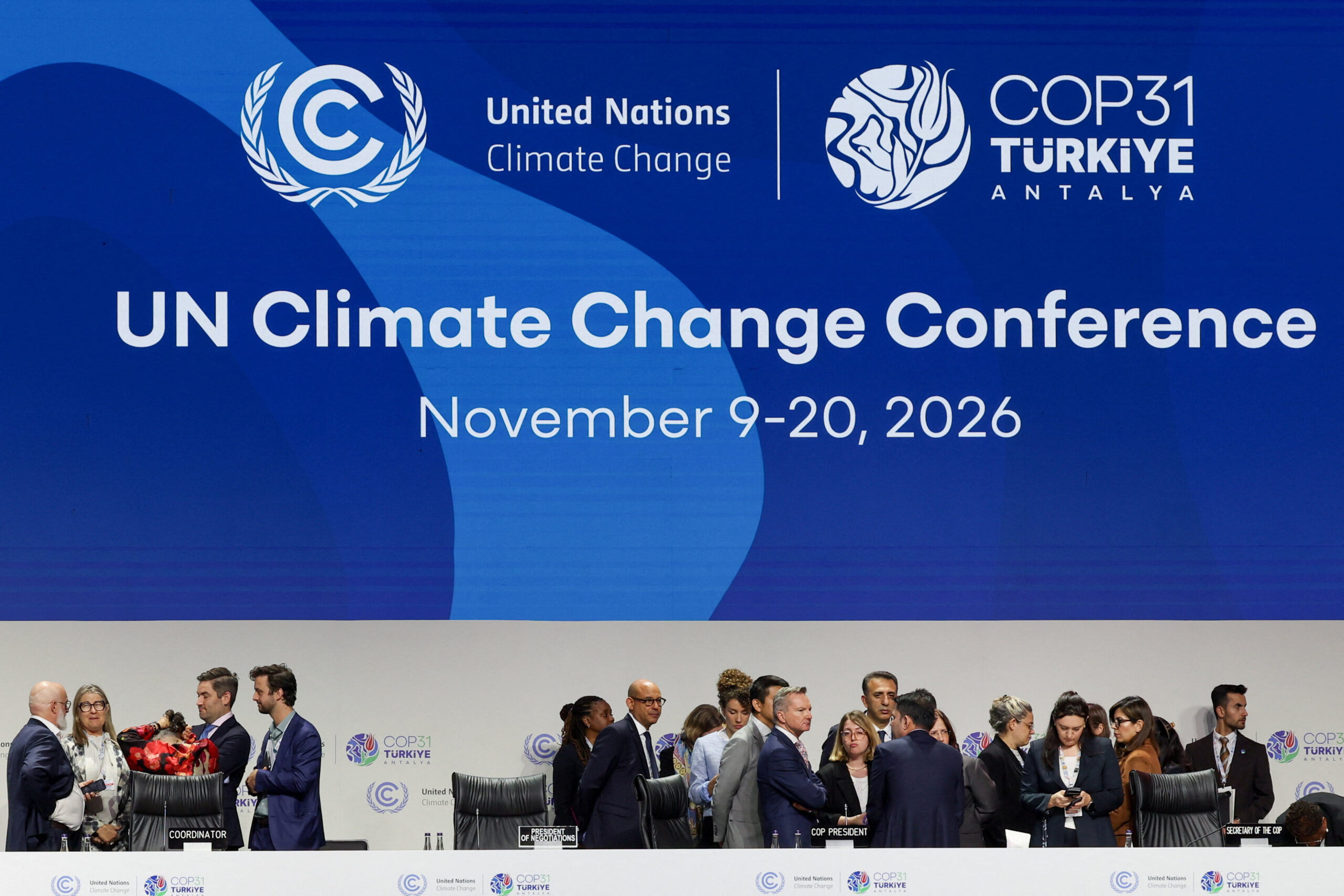
No deal. This year’s United Nations climate change conference, known as COP31, ended on Sunday without the parties reaching a final agreement—the first such failure in seventeen years. Reports of the marathon negotiating session indicate that fossil fuels and electrification proved to be particular sticking points. Several of our Atlantic Council experts were on the ground for the gathering in Antalya, Turkey, and below they share their insights about what happened and what it means for global climate policy.
Click to jump to an expert analysis:
Jorge Gastelumendi: A disappointment, but the Paris Agreement commitments still stand
Landon Derentz: Climate policy must work with the realities of the global economy
Defne Arslan: COP31 proved that consensus isn’t everything in climate policy

Jorge Gastelumendi is the senior director of the Atlantic Council’s Climate Resilience Center and a former climate negotiator for the government of Peru.
A disappointment, but the Paris Agreement commitments still stand
It’s important for those less familiar with the COP process to understand that there are two core tracks: the official negotiation track that results in agreements and cover decisions, and the action agenda that runs in parallel with civil society and the private sector alongside government representatives.
On the negotiations track, the failure to reach a cover decision represents a lost opportunity to bring parties closer to align on shared efforts to avoid exceeding 1.5 degrees of warming over pre-industrial levels, including a deeper technical and political discussion on transitioning away from fossil fuels.
Indeed, phasing out fossil fuels has been portrayed as the probable culprit for failing to reach an agreement this time around, but let’s not forget that countries already agreed back in 2023 in Dubai on a decision to transition away from fossil fuels, and they are still bound by it. In Belém last year, a new effort advanced by sixty countries—the International Conference on Transitioning Away from Fossil Fuels—emerged as a credible path forward on this matter.
So, this COP was a political miscalculation from the presidencies, this year jointly held by Turkey and Australia. Momentum exists, but they didn’t capitalize on it to close an agreement.
But we must remember that a COP political decision or cover decision is meant to ratchet up the ambition established already by the Paris Agreement in 2015. If a decision is not achieved, as was the case this year in Antalya, it doesn’t negate the obligation parties have to deliver on the Paris Agreement and any decisions that have been taken since then.

Landon Derentz is the Atlantic Council vice president for energy and infrastructure, Morningstar Chair for Global Energy Security, and senior director of the Atlantic Council Global Energy Center.
Climate policy must work with the realities of the global economy
“We can’t put out the fire while pouring fuel on it,” UN Secretary General António Guterres declared following COP31. But neither can we put out the fire without the political and economic stability necessary to address it.
Thirty years of climate diplomacy have succeeded in elevating climate change to the highest levels of international politics. Yet the COP process has become increasingly detached from the working realities of the global economy. The problem is not the climate science, nor the original objective of preventing human-induced impacts on the climate. It is whether the policy framework developed over three decades remains fit for purpose.
Energy security, affordability, industrial competitiveness, and geopolitics continue to shape national priorities, often taking precedence over climate ambitions. Yet the COP process has struggled to adequately account for these realities.
The world needs growing supplies of affordable, reliable energy. Hydrocarbons still account for roughly four-fifths of global energy supply, even as electrification and alternative technologies grow in scale and pace of adoption.
The central challenge is to separate energy supply from its associated emissions. Every sector and value chain has an emissions footprint, and climate policy should create market-based incentives to improve efficiency, deploy abatement technologies, and reward lower-emissions production. This helps explain the prominence of carbon accounting and related policies in Antalya, as governments and businesses seek to connect climate objectives more directly to the commercial decisions that shape the global economy.
It is also why the growing prominence of the COP Action Agenda is so revealing. While formal negotiations remain consumed by disputes over language, coalitions of governments and businesses are pursuing practical initiatives focused on investment, infrastructure, technology, and measurable emissions reductions.
The failure to reach a political agreement at COP31 should prompt more than another debate over who blocked consensus. It should provoke a deeper examination of whether the institutions and policy instruments of climate diplomacy have become too rigid to accommodate the economic and political realities on which meaningful progress depends.
The COP process does not need to abandon its original objectives. It needs to reconsider whether its current policy toolkit is capable of achieving them.

Defne Arslan is the senior director and founder of Atlantic Council Turkey Program, leading the Council’s global work and programming on Turkey.
COP31 proved that consensus isn’t everything in climate policy
The outcome of COP31 is very unfortunate. I and many others came to COP31 expecting decisions of previous COPs to be converted into solid actions with new commitments.
This outcome is also another testament that “globalization” is no longer the force it once was. However, climate action is one of few topics the globe needs to decide and act on together. No country is exempt from the consequences of global warming.
Three major areas of deadlock caused the outcome in COP31. There was a lack of consensus about whether to mention fossil fuels in the final document, about how much developed countries would contribute for climate adaption financing, and about whether a focus on electrification was implicit “green washing.”
Even as the political pact collapsed, about eighty nations signed onto the “35-by-35” target, which aims to raise electricity’s share of global final energy consumption to 35 percent by 2035. Delegates also adopted frameworks for a new global “just transition” mechanism and agreed on measures to bolster early-warning systems.
I believe no country should have walked away, and no presidency should end the talks without any outcome. But no COP outcome should fall below the previous consensus. The Paris Agreement adopted in 2015 set the legally binding international framework to limit global warming to well below 2 degrees Celsius above pre-industrial levels, while pursuing efforts to cap it at 1.5 degrees Celsius. All countries still have a long path to reach that target.
For years, COPs have operated on the principle that decisions must be made by consensus, and this has helped build far-reaching agreement around significant goals. But there are now fewer issues on which total consensus is apparently possible, and perhaps it is time to talk about restructuring the COP process so that some decisions can be by majority vote.