
The G20 needs more carrots to rebalance away from China
Summer vacation is over. Washington is once again reaching for the “sticks” in its economic statecraft toolbox, from an escalating tariff fight with Canada to secondary economic sanctions targeting countries still trading with Iran.
Geoeconomic tensions seem poised for escalation as central bankers meet in the shadow of the Tetons and as Group of Twenty (G20) finance ministers prepare to gather near the Blue Ridge Mountains at the end of the month. One of the biggest challenges on their agenda will not be solved by tariffs or sanctions alone: how to address global imbalances emanating predominantly from China.
Unwinding China’s global imbalances without triggering broader economic destabilization will not be easy. The good news: the United States, the Group of Seven (G7), and others agree on the broad goal and are pursuing complementary initiatives across overlapping plurilateral frameworks. But success will require deploying the positive elements of the economic statecraft toolkit—the “carrots”—in addition to the tariff-related sticks.
Favorable tariff rates, export credits, regulatory exemptions, and other tools promise to power mutually beneficial economic growth among trade partners. Indeed, bilateral and plurilateral trade deals have been proliferating at least as fast as punitive tariffs over the last year. They point toward a more constructive path for diversifying supply chains and rebalancing geoeconomic power.
How to derisk without destabilizing
How the United States and its partners de-risk from China, and how Beijing reacts, could help shape the twenty-first century’s geopolitical balance of power. Beijing already appears to perceive coordinated efforts to diversify supply chains as a threat to its export-led economic growth model.
The priority, then, must be to align the economic interests of the world’s largest economies while minimizing the risks of a disorderly unwinding of global imbalances or mutually destructive economic self-help measures. As the premier plurilateral discussion forum for geoeconomic issues and one of the few opportunities to bring US and Chinese leaders together, the G20 has an important role to play. Its members must remain focused on strategic priorities that will outlast individual electoral mandates.
Three mechanisms can help policymakers maintain that focus.
First, distinguish structural differences from trade wars
Not every trade conflict is a trade war. The spiraling US-Canada tariff conflict is indeed a bilateral trade war. Plurilateral structures like the United States–Mexico–Canada Agreement and G20 discussions cannot defuse this situation. Strategic economic policy differences with China, by contrast, are structural and affect markets and trading partners across the global economy.
China’s state-sponsored growth model is inconsistent with the current underpinnings of the global economy. China does not share the G7’s commitment to healthy competition among purely private-sector actors. In particular, decades of industrial policy have contributed to overcapacity and export dependence, pushing Chinese firms to seek growth in global markets as domestic demand fails to keep pace.
These structural differences help explain why so many policymakers globally agree with the Trump administration that the Bretton Woods system is no longer fit for purpose. They also help explain the G7’s growing willingness to take government equity stakes in critical minerals companies.
Describing the China challenge as a trade war needlessly increases geostrategic tensions and creates the false impression that trade policy tools such as tariffs, export restrictions, or trade finance can deliver a swift solution. Failure to deliver quick “wins” in this context increases the twin risks of voter backlash and destabilizing economic ruptures.
Second, align interests
A disorderly unwinding of China’s global imbalances would create risks for both China and its trading partners. Broad-based agreement already exists within the G7 on the need to diversify supply chains away from China—from pharmaceuticals to critical minerals. Policymakers have been taking plurilateral action for nearly a year. Three significant success stories stand out:
- The Turnberry Agreement, ratified by the European Parliament earlier this year, delivers greater certainty and stability to the transatlantic economic relationship at a time of significant change.
- The US-led Pax Silica promises to counter Beijing’s dominance in the critical minerals sector by providing fifty-four partners with accelerated access to advanced technology and export credits. The United States may also require partners to forgo similar arrangements with China.
- The EU, Canada, and Japan have also turned to bilateral economic and investment partnerships. The 2026 G7 Joint Statement on critical minerals supply chains expressly endorsed plurilateral agreements as the preferred framework for crafting diversified supply chains.
These policy choices are understandable. As I argued in 2024, gridlock at the World Trade Organization should not prevent like-minded countries from moving forward with trade liberalization in high-priority areas.
Balancing the global economy requires G20 policymakers to invest political capital in aligning China’s growth interests with a more diversified global economy.
Third, articulate the benefits
Reducing concentration risk in supply chains may not initially be welcomed in China. Policymakers in Beijing recognize that their successful export-led growth model has created unwelcome vulnerabilities to external coercion. At the same time, they appreciate the leverage that other countries’ dependence on Chinese markets and supply chains can provide. Supply chain diversification may thus be seen as a threat to China’s growing geoeconomic prominence and, potentially, its economic growth.
But reducing an unhealthy reliance on China need not create an existential threat to the country. Ironically, supply chain diversification could also align with other Chinese strategic goals. Beijing promotes accelerated growth across a range of developing nations (most of which are located in the Global South). It has also consistently eschewed US-style global leadership roles and responsibilities. China cannot have it both ways. It cannot be the world’s sole critical minerals supplier while promoting a multipolar order.
Countries in the Southern Hemisphere and near the equator currently have a unique opportunity to accelerate economic and technological advances by increasing domestic production and advanced manufacturing, financed by generous G7 export credits and multilateral development bank financing. Plurilateral trade and investment agreements like Pax Silica could propel dramatic economic growth in these countries. China can benefit from these trends. Global demand for advanced computing and other technologies could create room for new suppliers without necessarily coming at the expense of Chinese production, all while supporting global growth.
The G20’s opportunity
Leaders facing generational challenges succeed when they articulate the benefits of a policy priority. The negative case alone cannot sustain structural policy shifts, much less create incentives for policy change among adversaries. The price of failure can be high; strategic, multiyear policies without articulated benefits often founder at the ballot box.
Successful deployment of positive economic statecraft over the coming decade requires the United States and its allies to articulate the concrete domestic and partner benefits of export credits, regulatory preferences, lower tariffs, and tariff exemptions. Economic growth and job creation can occur across the supply chain.
Pax Silica provides a good template for promoting the “carrots” in the economic statecraft toolkit because it promises to offer different but complementary benefits to supply chain partners, such as supply-chain access, increased investment, or infrastructure cooperation. Even if China were not the dominant supplier, the positive geoeconomic case for enhanced, accelerated cooperation in this field would remain compelling.
The G20’s informal structure was designed to provide a flexible framework for discussing global imbalances and financial fragility. It is one of the few forums that brings together the world’s largest economies for difficult geoeconomic conversations. The G20 is thus the best forum for deploying the positive tools of economic statecraft to support diversification away from Beijing without scuttling China’s economy.
Barbara C. Matthews is a nonresident senior fellow at the Atlantic Council’s GeoEconomics Center. A former US Treasury official, she is also the CEO and Founder of BCMstrategy, Inc. a company that generates structured text and quantitative data automatically from the language of public policy.
Related Reading

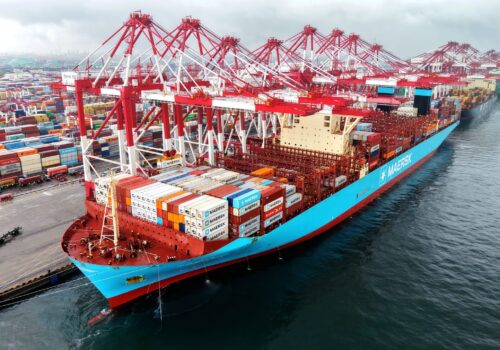

Image: Products container in shipping cargo port with Chinese flag for import export business (China Concept via Shutterstock)