
At the beginning of his second term, President Donald Trump set an expansive agenda for accelerating the deployment of new nuclear energy at home and advancing US industry leadership abroad, doubling down on the previous administration’s goal to increase nuclear energy capacity.
The challenge is how to achieve this agenda fast. For an industry that rightly puts safety and caution front and center, this will be a tough job—but doable with strong policy support.
The following measures would enable Washington to accelerate the United States’ expansion of peaceful civil nuclear energy domestically and strengthen export potential to partners and allies.
Building new nuclear in the United States
To facilitate nuclear energy expansion domestically, US policymakers, regulators, and investors have at their disposal at least two primary mechanisms: creating market incentives and enabling new sources of financing.
Update market mechanisms to incentivize the firm, baseload power nuclear delivers. Currently, hourly and daily electricity pricing systems create perverse incentives leading to over-investment in fluctuating power supplies from wind and solar. Not only does this potentially redirect investment away from reliable baseload power generators, it can also create stress on the grid. California’s solar-driven “duck curve” for power supply is an example of this. Europe’s price swings from negative to exorbitant, depending on solar and wind fluctuations, are another result of misplaced incentives that harm consumers and industrial users alike.
Involve Wall Street. While some nuclear energy start-ups have attracted single-digit billions of dollars, Wall Street has yet to step into nuclear project development finance in a serious way. One good use of the global $3.9 trillion in environmental, social, and governance (ESG)-focused investment funds would be to move some of the nearly $1.4 trillion (35 percent) invested in financial institutions and instruments into nuclear project finance. Key institutions like the European Union and the World Bank now group nuclear into the “green” or “carbon-free” investment category. Rebalancing 10 percent of the total from finance could raise nuclear investments by nearly $400 billion. That would be a win-win for industry and for firm, clean power for economic growth.
Financing mechanisms to enable US exports
To promote civil nuclear energy exports, policymakers have several financing options at their disposal to enable the US nuclear industry to compete in overseas markets.
Reauthorize the US Export Import Bank (EXIM). This must be a top priority for Congress. Without EXIM, US nuclear exports simply won’t be able to compete with other exporters, such as Russia and China. Congress is already reviewing draft legislation that rightly separates high dollar nuclear loans from the general default cap, an important step to liberate the EXIM team to move more aggressively on nuclear loans.
Increase funding for capacity development activities with international partners. The United States reaps huge returns on small investments in technical assistance programs like the State Department’s Foundational Infrastructure for the Responsible use of Small Modular Reactor (SMR) Technology (FIRST) program, and other programs run through the Departments of Energy and Commerce. FIRST alone has a fifty-country wait list for bilateral programs even with the cash and in-kind contributions from our key partners, including Argentina, Canada, Finland, Japan, Korea, and the UK.
Establish a US government revolving fund to make equity investments in new nuclear projects globally. One billion dollars a year for five years would be enough to leverage local capital investment to get at least twenty-five individual reactor projects (five per year) through the initial feasibility and front-end engineering stages to final investment decision. Once the reactors are built and operational, the US equity stake could be sold to private investors, likely at a profit, to replenish the fund or return the resources to the US Treasury. The investment funds the United States created to support Central and Eastern European countries’ transition to market economies offer a successful template.
Protect international projects from cost overrun and technology risk. Pooling several projects in adjacent markets using the same technology vendor would mitigate first-of-a-kind risk and enable participants to share lessons learned. The State Department’s SMR Pan-Regional Interest Nuclear Group (SPRING) program (part of FIRST), which brings together prospective customers for US SMR technologies in Central Europe, offers a replicable template for derisking fleet-scale deployments of multiple reactor technologies.
Securing the US’ long-term competitive advantage
Beyond supporting the nuclear energy ambitions of partners and allies through exports, the United States’ collaboration with importing countries can deepen ties through diplomacy and shared standards, fuel supplies, and technical expertise.
Strengthen nuclear diplomacy. The value and market signaling power of diplomacy is invaluable—and there are already effective mechanisms the United States can and should leverage: 123 Agreements (required under US law to allow nuclear technology and materials exports), intergovernmental agreements (to help US firms secure projects), and memoranda of understanding (to regularize government-to-government engagement).
Support the Nuclear Regulatory Commission’s (NRC) work to rationalize and speed up licensing processes. The NRC sets the world’s standard for safe, secure, responsible licensing and is key to promoting US technology exports. The United States needs to ensure that the reforms both respond to technological developments and strengthen global trust in the NRC.
Accelerate work on setting safety and nonproliferation standards for transportable and civil maritime reactors.Industry is ahead of government in developing new types of micro-reactors that can power remote communities and industrial operations. It is also working toward the design and deployment of small modular reactors to power global shipping. To ensure the United States has a commercial and security advantage on these fronts, the government would need to take the lead in establishing global standards for these designs.
Abandon the “once-through” nuclear fuel model and update regulations to allow the return of spent nuclear from outside the United States. Even after fuel has been used in a reactor, it stores enough energy to be recycled into new fuel. For a variety of reasons, including economic, the United States has followed a once-through model, in which nuclear fuel is used and then stored as waste, even though it could be processed and used again. Some US competitors already offer spent fuel take-back programs, making them potentially more appealing partners than the United States. New US business models, however, are emerging that could make spent-fuel recycling profitable. Enabling domestic fuel recycling and take-back programs in the United States could give it a competitive edge.
Build a larger nuclear fuel bank at home and create secure “branch office” depots with trusted allies. Iran’s closure of the Strait of Hormuz has made clear that energy security requires diversity of supply. This applies not only to oil and gas but to any energy supply chain, including nuclear. Fuel banks in the United States and allied countries would create a secure supply network.
Incentivize US reactor operators to share their expertise globally. US technology vendors, even when they have a construction partner to build international projects, often lack operational counterparts to support partner countries. This puts US projects at a competitive disadvantage compared to countries such as Russia or China, which offer all-in-one nuclear energy exports. These models include construction, financing, and operational services. The US reactor fleet, however, operates at the highest capacity factor (over 92 percent) of any around the world, making the inclusion of US nuclear operational expertise key to compelling financial results for partners.
Delivering on US nuclear leadership
These proposed measures are mutually reinforcing. While instituting all at the same time is not necessary, starting with three or four will position US industry to better deliver on the president’s quest for restoring US leadership in the nuclear sector.
Justin Friedman is a nonresident senior fellow with the Atlantic Council Global Energy Center’s Nuclear Energy Policy Initiative.
Author’s note: an initial version of this paper was first presented at a conference organized by the Massachusetts Institute of Technology Center for Advanced Nuclear Energy Systems.
about the author

stay connected
Sign up for PowerPlay, the Atlantic Council’s bimonthly newsletter keeping you up to date on all facets of the energy transition
related work


our work
The Global Energy Center develops and promotes pragmatic and nonpartisan policy solutions designed to advance global energy security, drive economic opportunity, and foster a sustainable energy future.
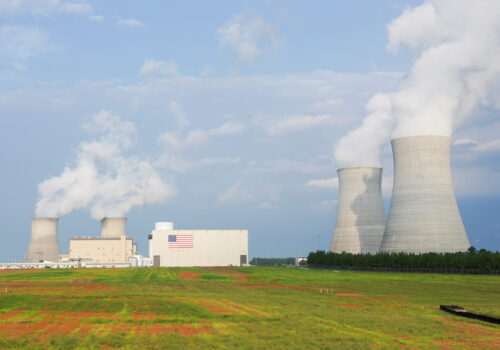
Image: Cooling towers at the former Three Mile Island Nuclear power plant during a tour by Constellation Energy in Londonderry Township, Pennsylvania, U.S., June 25, 2025. REUTERS/Eduardo Munoz