
Amid the Iran and Ukraine wars, tightening energy supplies, and rising fuel prices, European Commission President Ursula von der Leyen’s State of the Union speech on September 16 recognized the range of serious energy challenges these conflicts present. At the same time, von der Leyen also spoke to the broader, longer-term context of climate, energy security, and public support. Our experts weigh in on what was particularly telling about the speech, including the merging of climate, energy, and social agendas, and how the EU must not only set targets, but also act on the multifaceted demands that will shape European energy policy.
Click to jump to an expert analysis:
Michał Kurtyka: The EU still needs a unifying, pragmatic European energy policy
The EU still needs a unifying, pragmatic European energy policy
Ursula von der Leyen’s speech accurately identifies one of the central problems facing Europe’s energy sector: with structurally high energy prices, Europe will be unable to sustain either a strong industrial base or public support for the transition. It is welcome that the president systematically links climate policy not only to emissions reduction, but also to security, competitiveness, and resilience.
The diagnosis is convincing. First, Europe’s dependence on Russian gas and now the disruption in the Strait of Hormuz have shown the high price the continent pays for imported fossil fuels: with recent developments, a gallon of diesel in Germany now costs more than $10. The answer, however, is still unconvincing. Europe should be able to expand its own energy supply without ideological disputes over a single correct solution. The technology-neutral approach advocated by von der Leyen—but still not implemented among EU institutions—is essential to a pragmatic European energy policy.
Europe is addicted to setting ambitious targets rather than delivering them. Environmental and climate targets became unique drivers of energy policy, and wider tradeoffs were put aside or ignored afterward. The central question—and it is not a new one—is whether the EU can build an energy policy that would be coherent with its industrial assets and geopolitical uncertainty. The problem, therefore, is not a lack of ambition or investors. Europe needs to mobilize its capital and improve cooperation among member states to become stronger, and not only to serve as the role model for others.
This challenge must also be viewed in a broader security context. The war in Ukraine and growing hybrid threats are reminders that grids, terminals, storage facilities, and digital control systems are strategic infrastructure. Protecting them against sabotage and cyberattacks must become part of European security planning.
European energy sovereignty cannot, however, mean isolation. It should mean the freedom to choose and the capacity to cooperate from a position of strength. Europe must reduce risky dependencies while building stable partnerships with the United States, Canada, Norway, the United Kingdom, Australia, and other reliable partners. The EU relationship with China requires protective instruments but also sustained dialogue and a search for areas where cooperation remains possible.
Europe will not bring down energy prices through declarations alone. It needs a policy shift, then investment, cross-border interconnections, faster decisions, and a fair distribution of transition costs. This is how energy security can become a project that unites Europe rather than another source of division.
Michał Kurtyka is a distinguished fellow with the Atlantic Council Global Energy Center.
Heatwaves have done what Brussels could not: Merge the climate, energy, and social agendas
In her EU State of the Union address, European Commission President Ursula von der Leyen framed energy issues by war. She recalled Russia’s gas cutoff and this year’s closure of the Strait of Hormuz, which she said has cost Europe an additional €90 billion in imported fossil fuels “without a single molecule of energy added,” and she pledged to harden Ukraine’s power and heating supply through another war winter. Those shocks explain the renewed push for homegrown, technology-neutral supply.
Yet, it’s weather, along with partnerships and China, rather than war, that yielded the speech’s most consequential announcements that aim to prioritize climate, energy, and public interest in concert.
Responding to punishing summer heat
Europe’s “summer of truth,” as von der Leyen called it, forced nuclear units in Hungary and Romania offline as the Danube ran low and pushed cooling demand through a building stock designed to keep heat in rather than out.
A key takeaway from this State of the Union was, therefore, the European Heatwave Plan and the climate resilience framework due next month.
This approach affirms that Europe has a heating strategy but no cooling plan, as I argued last year. A heatwave is not a demand event; it is a compound stress event that hits energy generation, networks, and consumption at once. The EU plan’s focus on urban adaptation, cooling, and the most vulnerable is the right instinct. Its test is whether energy ministries write it alongside health ministries, and whether it connects to the Climate Insurance Alliance—only a quarter of Europe’s catastrophe losses are insured—and to the new water initiative, since power plants need water as much as crops do.
Seeking common ground among transatlantic partners
The speech’s other headline, opening the door for Canada to become the EU’s first “associate member,” matters for energy more than the ceremony suggested. The proposed Alliance for the Future names energy, critical minerals, and batteries as priorities for cooperation. As one of the world’s largest uranium producers, a potential liquefied natural gas supplier, and a partner with comparable climate ambitions and Arctic exposure, Canada could significantly strengthen its trade and geopolitical relationship with the EU. On resilience, the overlap in understanding between the EU and Canada is almost complete: both experience wildfires that sever grids and droughts that threaten energy supplies, whether nuclear or hydropower. Next month’s EU-Canada summit in Montreal will show whether their shared approach becomes joint procurement and shared standards.
A true transatlantic partnership would, of course, also mean stronger ties with the United States, still the backbone of Western energy security. But those ties have been volatile, and the latest signals point the wrong way: Washington is reportedly weighing restrictions on exports of refined products, diesel above all, to ease domestic prices before the midterms. Such a measure would land on European buyers who turned to US barrels after the Russian ban. Yet, on resilience, the issues on both sides of the Atlantic are nearly identical—heat-driven peaks, wildfire-exposed grids, water-constrained generation—and a transatlantic effort would pay off exponentially.
Reducing reliance on China for energy materials
Partners matter as much for minerals as for megawatts, and here the speech was specific: with Europe more than 80 percent dependent on China for many critical raw materials, and 90 percent for some rare earths, von der Leyen announced a European Corporation on Critical Raw Materials. Mandated to secure and stockpile resources, the corporation is to treat raw materials as the binding constraint they are. But stockpiles buy time, not independence. Europe’s exposure sits in processing and refining, where China holds the leverage as the October deadline in EU-China trade talks approaches. The €1 billion-a-day deficit shows why the topic is inextricably geopolitical. Thus, offtake guarantees and processing capacity built with partners such as Canada will matter more than the size of the warehouse.
Finally, no policy speech would be complete without politics, which are hard to miss. Cooling, water, and energy-related topics speak to the voters hit hardest this summer, while 2027 brings elections in several countries, including France, Spain, and Italy—three of the countries most exposed to extreme weather events—where mainstream parties face challengers who have turned energy costs and Brussels into their favorite targets. Much of the agenda laid out in the EU State of the Union address is designed to show that Europe protects people, not only the climate. That is a legitimate aim, and if it pulls resilience into the center of energy policy, a necessary one.
Andrei Covatariu is a nonresident senior fellow with the Atlantic Council’s Global Energy Center.
stay connected
Sign up for PowerPlay, the Atlantic Council’s bimonthly newsletter keeping you up to date on all facets of the energy transition.
related content
our work

The Global Energy Center develops and promotes pragmatic and nonpartisan policy solutions designed to advance global energy security, drive economic opportunity, and foster a sustainable energy future.
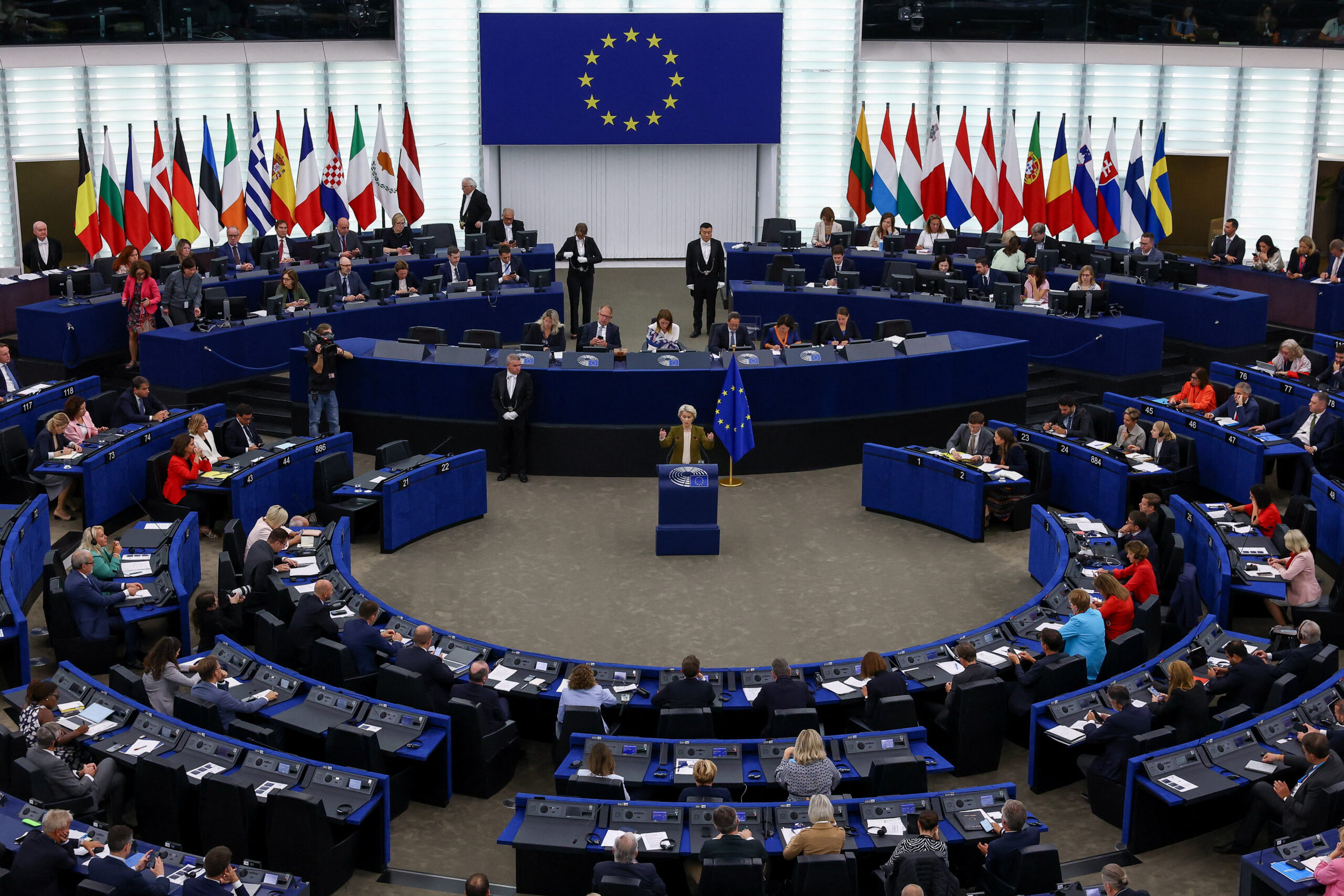
Image: European Commission President Ursula von der Leyen delivers the State of the European Union address (SOTEU) to the European Parliament, in Strasbourg, France, September 16, 2026. REUTERS/Yves Herman