
On September 1, Russian President Vladimir Putin proudly announced that his troops had captured the Ukrainian city of Sviatohirsk. Less than a week later, Putin’s claim came back to haunt him when Ukrainian commander Andriy Biletsky posted a video address recorded in the center of Sviatohirsk demonstrating that the city was still very much under Ukrainian control. “I would like to appeal to Russia’s military and political leadership. Take off your clown noses and stop making fools of yourselves,” Biletsky commented as he strolled through a rather calm and tranquil-looking Sviatohirsk.
Biletsky’s recent video was not the first time Putin has been humiliated in this manner after being caught lying about Russian advances. The most notorious incident occurred in December 2025, when Ukrainian President Volodymyr Zelenskyy personally traveled to Kupyansk in eastern Ukraine and recorded a selfie video mocking Putin after the Kremlin dictator had repeatedly and falsely boasted of capturing the Ukrainian city. “The Russians seem to have had a lot to say about Kupyansk,” Zelenskyy quipped. “The reality speaks for itself.”
Stay updated
As the world watches the Russian invasion of Ukraine unfold, UkraineAlert delivers the best Atlantic Council expert insight and analysis on Ukraine twice a week directly to your inbox.
Putin’s habit of exaggerating Russia’s battlefield gains reflects his mounting unease over the credibility gap between the Kremlin’s superpower pretensions and his army’s underwhelming performance during the invasion of Ukraine. Since the initial stages of the war, Putin has sought to project confidence and portray Russian victory as inevitable, but his swagger has become increasingly out of step with military realities on the ground. With the invasion now well into its fifth year, Russia currently controls less than 20 percent of Ukraine and is still fighting over villages located within walking distance of the original front lines in February 2022. For a country that entered the war with a reputation as the world’s second most powerful military, this a remarkably poor return.
Russia’s lack of battlefield progress has become particularly striking during the current year. Since the start of 2026, Russian advances have slowed to glacial pace, with Ukraine actually recording net territorial gains in multiple months according to independent open source analysis. In early September, Black Bird Group co-founder Emil Kastehelmi confirmed that according to the Finnish organization’s latest mapping data, Russia’s invasion was almost at a standstill, despite continuous attacks on a wide front. “The Russian summer campaign of 2026 can be considered a failure,” he noted.
Faced with this unfavorable military outlook, Putin continues to predict imminent breakthroughs while toasting imaginary military successes. “I have no doubt that the enemy will crumble,” he declared recently. Anyone in Russia who dares to disagree with this rose-tinted view of the invasion risks an uncertain fate. Leading Russian economist Andrei Klepach was removed from his post at the country’s national development bank last month after a speech was made public in which he dismissed hopes of a Ukrainian collapse and warned that Russia was “almost certainly” headed for a social crisis.
Eurasia Center events

Putin’s misleadingly optimistic military assessments have a number of intended audiences. The primary targets appear to be Western leaders, with the objective of convincing them that continued support for Ukraine is futile. Putin has repeatedly fed US President Donald Trump tall tales of Russian triumphs and fictitious accounts of encircled Ukrainian forces; during his recent meeting with Trump envoys Steve Witkoff and Jared Kushner, Putin reportedly insisted that Russia was making “real progress” on the battlefield.
The Russian ruler is also eager to assure domestic audiences that his invasion is still under control and going according to plan. Putin has sought to shield the Russian public from the impact of the war, but as the death toll mounts and Ukrainian drone strikes reach deeper into the country, this is becoming more and more challenging. Talking up the achievements of the Russian army in Ukraine distracts from these setbacks and creates a vision of victory that the Kremlin propaganda machine can sell to the general population.
Not everyone in Russia is fooled, of course. Members of the country’s vocal warblogger community have been highly critical of Putin’s frequent false claims, with many blaming the trend on a deeply entrenched culture of dishonesty inside the Russian military among commanders who seek personal rewards or simply prefer not to be the bearers of bad news. The US intelligence community may share this assessment. CIA chief John Ratcliffe’s secretive recent Moscow visit was reportedly in part aimed at sharing his bleak assessment of Russia’s invasion amid doubts over whether Putin’s advisers were giving him honest assessments of the war’s trajectory and toll.
This does not mean that the invasion has reached a dead end. On the contrary, the Russian army continues to grind forward, leaving a trail of death and destruction in its wake that dwarfs anything witnessed in Europe since World War II. Nor is Putin focused solely on the front lines of the war. With a decisive battlefield breakthrough proving elusive, his current plan is to bombard Ukraine into submission by overwhelming the country’s limited air defenses with relentless waves of jet-powered drones and ballistic missiles. In parallel, he is escalating Russia’s campaign of gray zone aggression across the EU in a bid to intimidate European leaders into abandoning Ukraine.
Russia’s invasion is now entering an exceptionally dangerous new phase as Putin seeks to terrorize the civilian population in order to finally break Ukrainian resistance. Ukraine cannot hope to withstand this onslaught without increased backing from the country’s partners. At this pivotal moment, the fact that Putin feels the need to invent fictional victories should be seen as a source of hope. Despite its terrible capacity for destruction, the Russian military is clearly not invincible and can be successfully countered on the battlefield. With sufficient international support, Ukraine can stop Putin’s invasion in its tracks and create the conditions for a plausible peace.
Peter Dickinson is editor of the Atlantic Council’s UkraineAlert service.
Further reading

The views expressed in UkraineAlert are solely those of the authors and do not necessarily reflect the views of the Atlantic Council, its staff, or its supporters.

The Eurasia Center’s mission is to enhance transatlantic cooperation in promoting stability, democratic values, and prosperity in Eurasia, from Eastern Europe and Turkey in the West to the Caucasus, Russia, and Central Asia in the East.
Follow us on social media
and support our work
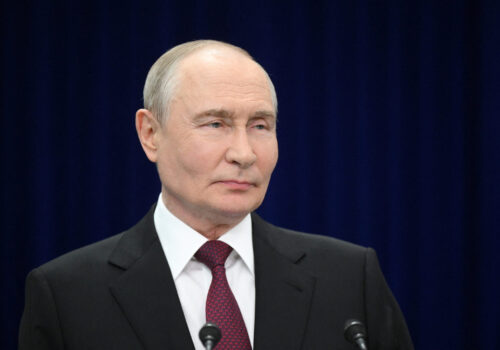
Image: Russian President Vladimir Putin attends a meeting with acting head of the Republic of Dagestan Fyodor Shchukin in Moscow, Russia. September 7, 2026. (Sputnik/Mikhail Metzel/Pool via REUTERS)