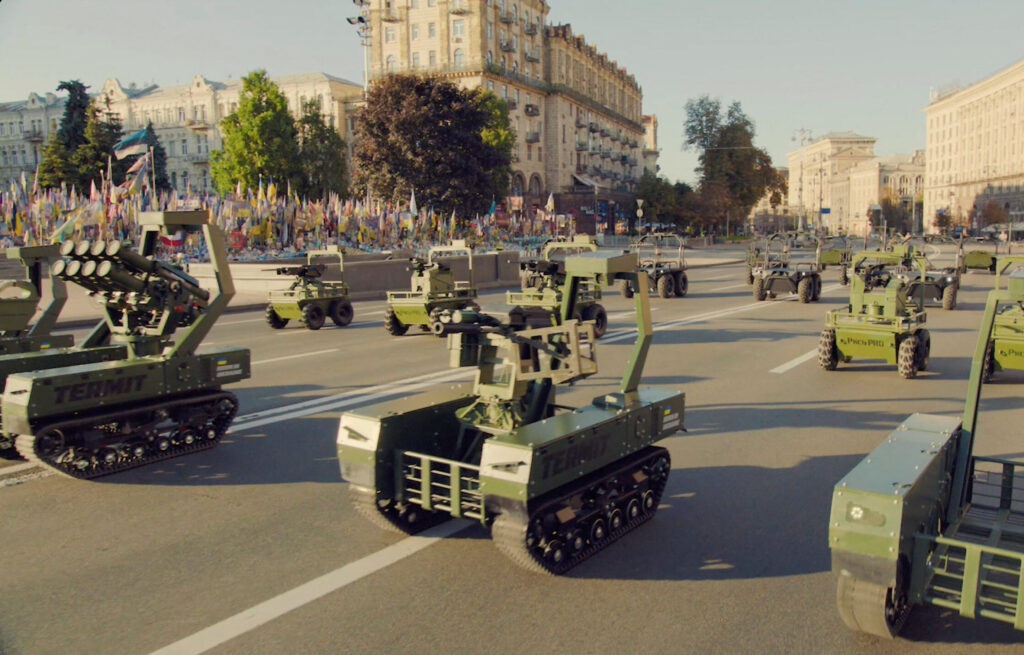
Ukraine marked the thirty-fifth anniversary of the country’s declaration of independence this week with a novel military parade made up exclusively of unmanned systems. This drone parade in the center of Kyiv was touted as the first of its kind, underlining Ukraine’s emergence as a global leader in the field of drone warfare.
Ukraine’s drone superpower status is a key aspect of the country’s remarkable wartime transformation. Since 2022, Russia’s full-scale invasion has fueled the unprecedented expansion of the Ukrainian armed forces and the dramatic growth of the country’s once stagnant defense industry. As a result, Ukraine has become a major military power that is now redefining the art of war.
Stay updated
As the world watches the Russian invasion of Ukraine unfold, UkraineAlert delivers the best Atlantic Council expert insight and analysis on Ukraine twice a week directly to your inbox.
When Russia’s full-scale invasion began in February 2022, the initial stages of the war differed little from the major conflicts of the late twentieth century, with both sides relying heavily on artillery and tanks. In order to counter Russia’s overwhelming advantages in terms of manpower and firepower, Ukraine was soon experimenting with the use of cheap drones in surveillance and attack roles. Drones also allowed Ukraine to reduce its dependence on military aid from the country’s Western partners, which was often subject to delays and vulnerable to changing political moods.
Over the past four years, Ukraine’s domestic drone industry has grown rapidly to meet surging demand. At the onset of the full-scale invasion, the country had only a handful of drone producers. In contrast, there are now hundreds of Ukrainian companies manufacturing drones. Meanwhile, annual output has risen from around one million drones in 2024 to approximately seven million this year.
The Ukrainian military has incorporated drone technologies into virtually every aspect of the country’s war effort. Surveillance and strike drones now dominate the skies above the battlefields of southern and eastern Ukraine, accounting for more than three-quarters of Russian losses and creating a kill zone tens of kilometers deep.
The dominance of drone-based precision firepower has forced the dispersal of troops and equipment, leading to a shift away from clearly defined front lines and rendering large-scale offensive operations extremely challenging. The use of advanced robotic systems has also made it possible for Ukraine to preserve precious manpower and defend large sections of the front with minimal troop deployments.
In addition to aerial drones, Ukraine has developed a wide range of unmanned ground vehicles (UGVs) that perform logistics support roles and carry out medical evacuations of wounded soldiers in combat conditions. This is changing the way the Ukrainian army operates in the field. During the first eight months of 2026, Ukrainian UGVs conducted over one hundred thousand combat support missions.
Ukraine’s innovative use of drone technologies and robotic systems on the battlefield has made it possible to stem the tide of Russia’s invasion despite widespread expectations in 2024 and 2025 that Kyiv’s manpower deficit and mobilization problems would soon lead to a collapse of the country’s defenses. These negative forecasts were based largely on outdated twentieth century military logic. Crucially, most of the doubters failed to fully appreciate that Ukraine is fighting a very different twenty-first century war. By countering manpower shortages with robotic and drone technologies, Ukraine has been able to reduce Russian advances and inflict a high price in terms of casualties.
Eurasia Center events

Beyond the battlefield, Ukraine has also employed drones to great effect. In the Black Sea, Ukrainian marine drones have sunk or damaged dozens of Russian warships, forcing the remnants of Putin’s fleet to retreat from occupied Crimea.
Ukraine’s expanding arsenal of domestically developed long-range drones is making it possible to bring the invasion home to Russia with a strategic bombing campaign that has caused the country’s worst fuel crisis since the collapse of the Soviet Union. Most recently, the development of a new generation of mid-range drones is enabling strikes far behind the front lines that are disrupting Russian military logistics and threatening to isolate the Crimean peninsula.
Ukraine’s reinvention as a military innovator is being driven by a vibrant startup culture that is supported by a number initiatives including the Brave1 platform, which provides support for defense sector companies while helping connect them with the state, the military, and potential funding. There are now growing signs of international interest in Ukrainian defense tech companies, including from investors and those seeking to establish joint ventures.
Ukraine’s battlefield success and military innovations are changing the way the country is perceived internationally. Back in early 2025, US President Donald Trump famously pushed his Ukrainian counterpart Volodymyr Zelenskyy to accept Kremlin-friendly peace terms while declaring that Ukraine “didn’t have the cards.” More recently, however, the US leader has acknowledged that the Ukrainian military has been “very effective.”
Others have gone further. Since the outbreak of hostilities between the United States and Iran in February 2026, countries across the Middle East have sought to access Ukrainian expertize in order to defend against Iranian drones. NATO members are now relying on Ukrainian instructors to provide training in drone warfare, while Ukraine is widely recognized as a key contributor to European security.
When Putin launched the full-scale invasion of Ukraine in 2022, he cited the “demilitarization” of the country as his key war aim. More than four years later, it is becoming increasingly apparent that the invasion he unleashed has backfired and transformed Ukraine into a major military power. This status is now the main factor safeguarding Ukrainian independence, and looks set to define the country’s future place in the wider world for many years to come.
Mykola Bielieskov is a research fellow at the National Institute for Strategic Studies and a senior analyst at Ukrainian NGO “Come Back Alive.” The views expressed in this article are the author’s personal position and do not reflect the opinions or views of NISS or Come Back Alive.
Further reading


The views expressed in UkraineAlert are solely those of the authors and do not necessarily reflect the views of the Atlantic Council, its staff, or its supporters.


The Eurasia Center’s mission is to enhance transatlantic cooperation in promoting stability, democratic values, and prosperity in Eurasia, from Eastern Europe and Turkey in the West to the Caucasus, Russia, and Central Asia in the East.
Follow us on social media
and support our work
Image: Unmanned ground vehicles take part in the country's first-ever drone parade marking Ukraine's Independence Day, amid Russia's attack on Ukraine, on Khreshchatyk street, in Kyiv, Ukraine, in this handout picture released on August 24, 2026. (Ukrainian Presidential Press Service/Handout via REUTERS)