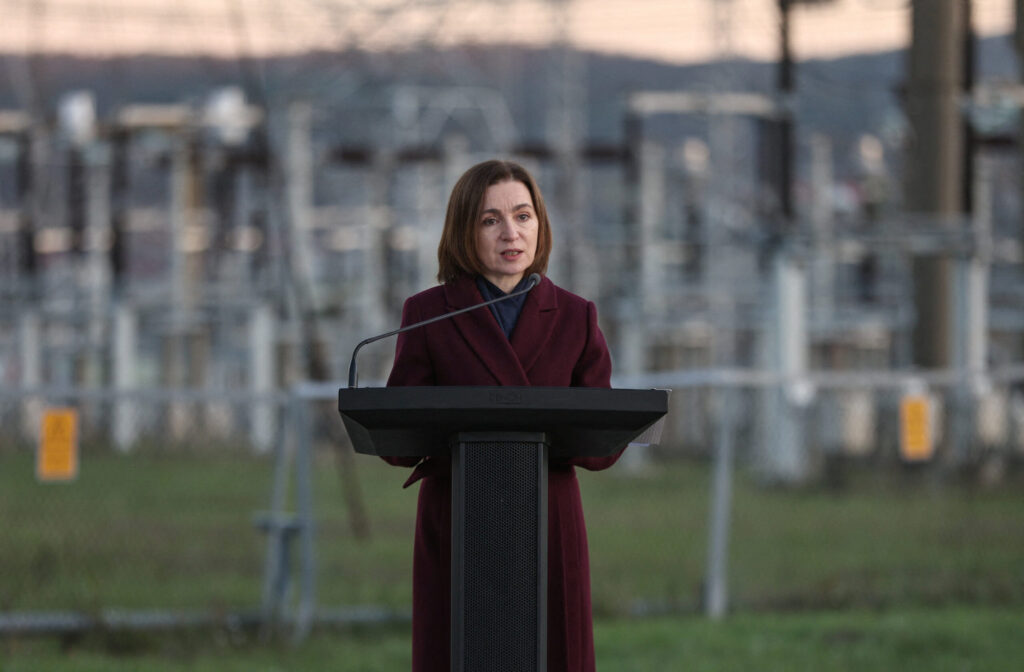
Moldova launched the long-awaited Vulcanesti–Chisinau power line on November 8, connecting the Moldovan capital to the southern electricity hub linking the country to Romanian and wider European electricity supplies. Five years after Russia tried to bring Moldova to its knees through energy pressure, this new line removes one of Moscow’s last remaining levers over the country.
Originally due for completion in August 2024, the project arrived more than two years late due to repeated delays. The power line itself does not create a new cross-border interconnection with Romania, nor does it open up the possibility for more imports. However, its strategic importance is enormous.
Crucially, the new line allows electricity arriving from Romania and the European market to reach central Moldova without passing through the MGRES/Cuciurgan power node in Russian-controlled Transnistria. This removes a critical grid vulnerability inherited from the Soviet era and marks the culmination of a remarkable effort to dismantle Moscow’s energy leverage over Moldova.
Stay updated
As the world watches the Russian invasion of Ukraine unfold, UkraineAlert delivers the best Atlantic Council expert insight and analysis on Ukraine twice a week directly to your inbox.
Although Moldova gained independence from Moscow in 1991, it remained deeply embedded in Russia’s political and economic orbit for the next three decades. The Kremlin’s tools included a complex web of energy dependencies. With virtually no domestic fossil fuel resources, Moldova relied heavily on Russian gas and the Kremlin-controlled Transnistria enclave for around three-quarters of its electricity.
At the heart of this dependence was an unusual arrangement that bound both banks of the Nistru River to Russia. On the right bank, Moldova bought Russian gas at commercial prices. Russian gas also flowed through Moldova to Transnistria on the left bank of the river, where it was effectively consumed without payment being collected from the separatist authorities.
Much of that gas was burned at the Russian-owned MGRES power plant in Transnistria, which then sold electricity back to Moldova and supplied the majority of the country’s needs. The result was a circular system of dependence: Russia supplied the gas, Transnistria turned it into electricity, and Moldova paid for power.
The consequences stretched far beyond energy. This arrangement left Moldova exposed to Russian supply and pricing pressure, while generating vital revenues for Transnistria. In practice, Moldovan electricity consumers were helping sustain a separatist economy whose energy model ultimately rested on subsidised Russian gas.
The electricity grid reinforced that vulnerability. Built around Soviet-era infrastructure and regional connections, it physically embedded Moldova in the same system of dependence that shaped the gas and power trade.
Eurasia Center events

Moldova’s battle to break this dangerous dependence began in earnest in October 2021, just weeks after a new pro-EU government took office and less than six months before the Kremlin launched its full-scale invasion of Ukraine. Over the following years, Moscow repeatedly wielded energy as a pressure point, restricting gas and electricity supplies before ending gas deliveries to Transnistria in January 2025.
Moldova received European support and held its ground. In less than five years, this resulted in a fundamentally rewired energy system. The country has now moved from dependence on Russian gas to a grid synchronized with Europe, electricity sourced from Romania, and gas purchased competitively across multiple European markets.
Despite this progress, the physical structure of the electricity grid itself remained an issue. Even after Moldova and Ukraine disconnected from the Russian-controlled power system in February 2022 and synchronized with Europe, electricity imported from Romania or via this country from other EU neighbors still had to pass through the Cuciurgan/MGRES node in Transnistria before reaching the principal consumption centers in Moldova.
The Vulcanesti-Chisinau power line changes this. The 157km line can carry more than half of the country’s electricity consumption, including imports from Romania and the European market, without crossing the MGRES node. In strategic terms, the new power line closes one of the last physical vulnerabilities in Moldova’s extraordinary effort to break Russia’s grip over its energy sector.
Moldova’s battle for energy security is not over yet. The country still needs more domestic generation and stronger cross-border links with Romania to provide redundancy, flexibility, and sufficient supply during periods of high winter demand. Two further Romanian high-voltage connections are planned, which will also allow Moldova to secure more electricity from Romania and help the country to meet internal demand.
The Vulcanesti-Chisinau line represents something bigger than a new piece of transmission infrastructure. It is the physical expression of Moldova’s true independence and a firm step toward shaping its own future.
Dr. Aura Sabadus is a senior energy journalist who writes about Eastern Europe, Turkey, and Ukraine for Independent Commodity Intelligence Services (ICIS), a London-based global energy and petrochemicals news and market data provider. Her views are her own.
Further reading


The views expressed in UkraineAlert are solely those of the authors and do not necessarily reflect the views of the Atlantic Council, its staff, or its supporters.


The Eurasia Center’s mission is to enhance transatlantic cooperation in promoting stability, democratic values, and prosperity in Eurasia, from Eastern Europe and Turkey in the West to the Caucasus, Russia, and Central Asia in the East.
Follow us on social media
and support our work
Image: Moldova's President Maia Sandu attends a ceremony to launch Vulcanesti-Chisinau high-voltage power line designed to link Moldova’s power grid directly to Romania and the European electrical market, at electrical sub-station outside Chisinau, Moldova. November 8, 2026. (REUTERS/Vladislav Culiomza)