
Russian President Vladimir Putin declared last week that Ukrainians have no right to the occupied regions of their own country. “I think it is not their territory, but the historical territory of Russia,” he stated.
This is nothing new, of course. Since 2022, the Kremlin dictator has routinely referred to Ukrainian lands as “historically Russian.” Nevertheless, Putin’s most recent comments are worthy of closer inspection as they shed light on the scale of his imperial ambitions, while also highlighting the true extent of the threat posed by a revisionist Russia.
A clearer understanding of Putin’s imperial agenda is particularly important amid US-led efforts to revive stalled peace talks between Russia and Ukraine. With three-way negotiations set to resume next month, American officials are currently focused on Moscow’s immediate territorial demands in eastern Ukraine’s Donbas region. “People keep talking about a war in Ukraine. That war is about Donbas. It’s about one region of the country,” US Secretary of State Marco Rubio commented last week.
Critics claim this emphasis on the Donbas is dangerously shortsighted. They argue that while the US side appears to be treating the peace process as a geopolitical real estate deal, Putin believes he is on a far grander historic mission to extinguish Ukrainian statehood and revive Russia’s great power status.
Stay updated
As the world watches the Russian invasion of Ukraine unfold, UkraineAlert delivers the best Atlantic Council expert insight and analysis on Ukraine twice a week directly to your inbox.
Putin’s recent comments certainly seem to leave little room for doubt that he aims to go far further than the Donbas. Indeed, it is difficult to conceive of any interpretation that would classify the areas of Ukraine currently under Kremlin control as “the historical territory of Russia,” while at the same time excluding the rest of the country. On the contrary, Putin’s quest to reclaim “historical Russian lands” almost certainly includes the whole of Ukraine.
Putin has made no secret of his opposition to Ukrainian independence. Speaking last year at the Saint Petersburg International Economic Forum, he stated: “all of Ukraine is ours.” He has also laid claim to numerous individual Ukrainian cities such as Black Sea port Odesa, which he has branded as a “Russian city.”
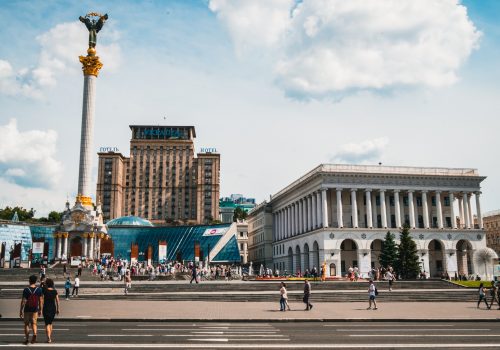
Then there is the question of Kyiv. According to Russia’s officially endorsed national narrative, the Ukrainian capital is in fact “the mother of all Russian cities.” In a very real sense, therefore, Kyiv is more sacred to Russian imperialists than much of Russia itself. If Putin wants to secure his place in Russian history, he can hardly agree to a compromise peace that leaves this holy city in the hands of a hostile power.
Eurasia Center events
There is little reason to think that Putin’s revanchist dreams are limited to Ukraine. He is notorious for lamenting the collapse of the Soviet Union, which he has referred to as “the disintegration of historical Russia.” He is also fond of stating that “Russia’s borders do not end anywhere.”
While Ukraine unquestionably occupies a special place in Russia’s national mythology, it would be reckless to assume that the doctrine of reclaiming historically Russian lands will not be applied to others in future. The precedent has now been set, creating the conditions for further expansionist adventures framed as revisionist crusades.
The list of potential Kremlin targets is long. At its greatest extent in 1914, the Russian Empire incorporated territory that today belongs to at least fifteen independent countries stretching from Northern Europe to Central Asia. All could become victims of a revanchist Russia if Putin is not stopped in Ukraine.
In an even broader sense, Putin’s quest to reclaim historically Russian lands is a recipe for endless international instability. Every single border in Europe could be contested on historical grounds, while the rightful owners of entire continents would be up for debate. If Putin is permitted to establish the principle of seizing foreign land based on historical claims, the repercussions will shake the global order to its very foundations.
Peter Dickinson is editor of the Atlantic Council’s UkraineAlert service.
Further reading


The views expressed in UkraineAlert are solely those of the authors and do not necessarily reflect the views of the Atlantic Council, its staff, or its supporters.

The Eurasia Center’s mission is to enhance transatlantic cooperation in promoting stability, democratic values, and prosperity in Eurasia, from Eastern Europe and Turkey in the West to the Caucasus, Russia, and Central Asia in the East.
Follow us on social media
and support our work
Image: Russian President Vladimir Putin and Chairperson of the African Union and President of Burundi Evariste Ndayishimiye attend a press conference during the third Russia-Africa Summit in Moscow, Russia. October 29, 2026. (Sputnik/Alexander Kazakov/Pool via REUTERS)