Featured analysis

Latest analysis

Econographics

Nov 11, 2022

The target of limiting global warming to less than 1.5 degrees is practically dead. Why do emissions per capita matter?

By Amin Mohseni-Cheraghlou

Achieving the target to limit global warming to below 2, preferably 1.5 degrees Celsius, by the end of the century seems more unfeasible than ever. The reason is simple. The most critical of greenhouse gases have continuously risen in the past decade and CO2 emissions are only expected to grow more in 2022 and for the foreseeable future. COP27 needs to pave the path for a renewed international cooperative and enforceable framework to reduce global greenhouse gas emissions by the world’s top emitters both in absolute terms and in per capita terms.

Climate Change & Climate Action
Economy & Business

Econographics

Nov 8, 2022

What US outbound investment screening means for Transatlantic relations

By Elmar Hellendoorn

Whether the EU follows through with new outbound investment controls and what those might look like will also depend on the evolution of American national security policy and transatlantic diplomacy.

China
Economy & Business

Econographics

Oct 31, 2022

The global infrastructure financing gap: Where sovereign wealth funds and pension funds can play a role

By Amin Mohseni-Cheraghlou and Naomi Aladekoba

Having more than $65 trillion in assets, institutional investors such as SWFs and pension funds are uniquely positioned to bridge low-income economies’ infrastructure financing gap in the coming decades. The Bretton Woods Institutions (BWI) can encourage investment in developing countries’ infrastructure through providing various guarantee and insurance mechanisms, thereby reducing risk for private investors.

Economy & Business
Inclusive Growth

EconoGraphics

Oct 28, 2022

How the US compares to the world on unionization

By Jeff Goldstein

Explore how US unionization rates compare to other economies and what that means for US labor markets going forward.

Economy & Business
Inclusive Growth

EconoGraphics

Oct 24, 2022

Dual circulation in China: A progress report

By Hung Tran

Faced with a challenging international environment and hostile efforts by the United States to restrict China’s access to high technology and its products, China has adopted a dual circulation strategy to make its economy more balanced and resilient. Dual circulation means reducing the role of foreign trade in driving the Chinese economy while improving the quality of trade.

China
Economy & Business

Econographics

Oct 12, 2022

Companies on the front line: Trends in overseas Chinese listings

By Maia Nikoladze

Delisting more than 150 Chinese companies is a bigger hit than Chinese private sector can take at this time. However, we don’t yet know whether Beijing will follow through on its side of the audit-sharing deal. 

China
Economy & Business

Econographics

Sep 8, 2022

Global Sanctions Dashboard: Sanctioning soars across the board

By Charles Lichfield, Maia Nikoladze, and Castellum.AI

Iran nuclear deal negotiations; Russia’s domestic sanctions against terrorism and extremism; Latin America drug trafficking sanctions.

Europe & Eurasia
European Union

Econographics

Sep 8, 2022

Zambia: A template for debt restructuring?

By Hung Tran

Zambia shows that progress can be made to render the Common Framework more workable. However, more needs to be done to refine a comprehensive, efficient, and effective sovereign debt restructuring procedure.

Africa
China
Dollar Currency Exchange rate

Econographics

Sep 7, 2022

Don’t expect a Plaza Accord 2.0 to reverse the dollar’s surge

By Mrugank Bhusari

Neither China, nor the original participants of the Plaza Accord, are willing to engage in such market intervention to return a soaring dollar to normal levels.

China
Economy & Business

Econographics

Aug 25, 2022

Delisting Chinese companies from the New York Stock Exchange: Signs of decoupling

By Hung Tran

China’s decision to delist five companies from the NYSE is motivated by its unwillingness to comply with US regulations.

China
Economy & Business

Content

Econographics

Jan 19, 2024

The IMF’s perspective on CBDCs

By Tobias Adrian

Tobias Adrian outlines the IMF's view on CBDCs' potential for payment systems, financial inclusion, and cross-border payments, emphasizing innovation and collaboration for effective implementation.

Digital Currencies
Digital Policy
China, In the center of the capital in a new commercial building construction

Econographics

Jan 10, 2024

China’s local government debts are coming due

By Jeremy Mark

China's economic slowdown brings local government debts into sharp focus, threatening infrastructure and social services.

China
Economy & Business
The view of boats on the red Sea.

Econographics

Jan 8, 2024

The long shadow of the Red Sea shipping disruption

By Alex Mills

Recent attacks on shipping moving through the red sea have exposed broader risks around international maritime commerce. Policy makers must use this wake-up call to build a more resilient international shipping ecosystem.

East Africa
Economy & Business

Econographics

Jan 3, 2024

Five under-the-radar economic trends that could define 2024

By Josh Lipsky, Sophia Busch

We picked five under-the-radar trends that will matter for the global economy in 2024. Each shows the potential weak spots in the global economy alongside the forces that could stabilize growth.

China
Economy & Business
Building with EU flags

Econographics

Dec 19, 2023

Three next steps for the EU’s approach to economic security

By Elmar Hellendoorn

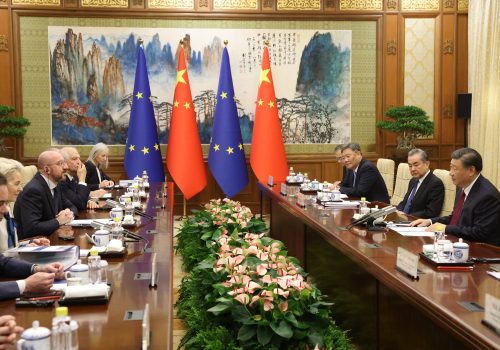
The EU’s Strategy on Economic Security, published this summer, was the first official effort to present a more coherent view on the European policy approach at the intersection of economics and geopolitics. In the end, however, the EU's approach to economic security can only be successful if it is tied to Europe's long-term political objectives.

European Union
Eurozone
Ships on Red Sea

Econographics

Dec 18, 2023

What attacks in the Red Sea could mean for the global economy

By Hung Tran

Recent missile attacks on ships in the Red Sea by Iran-backed Houthi rebels have escalated regional tensions and disrupted global trade. Large shipping companies are now avoiding the route, causing significant costs and delays, which is impacting the the already fragile economy.

Economy & Business
Macroeconomics

Econographics

Dec 11, 2023

China’s manufacturing overcapacity threatens global green goods trade

By Niels Graham

Chinese lending is exacerbating a growing glut in its green manufacturing sector. Beijing is increasingly looking abroad to absorb excess capacity. This may have devastating effects for the global trading system as economies move to protect their own domestic industry.

China
Economy & Business

Econographics

Dec 7, 2023

Germany’s debt brake isn’t working

By Hung Tran

Germany’s coalition government was dealt a fiscal crisis when the country’s Constitutional Court ruled that repurposing €60 billion of unspent money from the pandemic emergency support facility to the Climate and Transformation Fund was unconstitutional.

Economy & Business
Financial Regulation

Econographics

Dec 1, 2023

Financialization has increased economic fragility

By Hung Tran

Since the 1980s, financial activities and assets have played an increasingly dominant role in the global economy. At the same time, underlying economic activity as measured by global GDP has been growing more slowly. The result has been an ever-larger gap between the volume and value of financial activity relative to the real economy. And […]

Financial Regulation
Macroeconomics

Econographics

Nov 30, 2023

Geoeconomic fragmentation is threatening the green energy transition

By Amin Mohseni-Cheraghlou

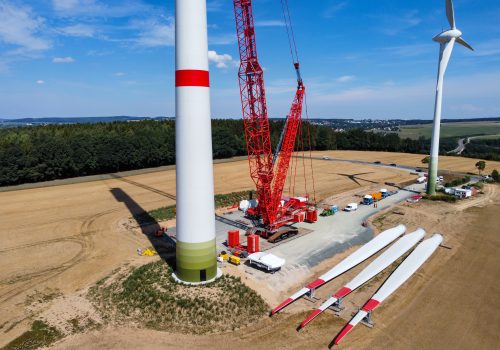
The energy transition depends on trade—and on China. Geoeconomic fragmentation could impact global climate targets.

Africa
China