Featured analysis

Latest analysis

Econographics

Jan 9, 2023

Fed reverse repos hit a new record: An unhealthy development

By Hung Tran

The Fed’s large footprint in private short-term financial transactions will have largely negative implications for the US financial system and economy.

Economy & Business
Macroeconomics

Econographics

Dec 15, 2022

A different monetary policy path in 2023

By Ole Moehr

Decisions and statements this week from the Fed, ECB, and the BOE tell us how they will each deploy tools at their disposal differently in 2023.

Economy & Business
Europe & Eurasia

Econographics

Dec 8, 2022

The numbers that drove China’s Zero-COVID policy

By Niels Graham

China’s adherence to zero-COVID was primarily driven by poor vaccination rates among seniors and weak health care infrastructure. As the country opens, both factors remain key health risks.

China
Coronavirus

Econographics

Nov 23, 2022

US-China competition after the US midterms and the CCP 20th Congress

By Hung Tran

For the first time since becoming President, Joe Biden met face-to-face with Secretary General Xi Jinping on November 14, 2022, at the outset of the G20 Summit in Bali, Indonesia. Against the backdrop of rising tensions between the two countries, the United States hoped it would “put a floor under the relationship.” But the recent […]

China
Economy & Business

Econographics

Nov 17, 2022

Global Sanctions Dashboard: What’s coming in 2023?

By Charles Lichfield, Maia Nikoladze, and Castellum.AI

Fall sanctions against Russia and Iran; implications of US semiconductor export controls against China; projected sanctions trends in 2023.

China
Europe & Eurasia

Econographics

Nov 11, 2022

The target of limiting global warming to less than 1.5 degrees is practically dead. Why do emissions per capita matter?

By Amin Mohseni-Cheraghlou

Achieving the target to limit global warming to below 2, preferably 1.5 degrees Celsius, by the end of the century seems more unfeasible than ever. The reason is simple. The most critical of greenhouse gases have continuously risen in the past decade and CO2 emissions are only expected to grow more in 2022 and for the foreseeable future. COP27 needs to pave the path for a renewed international cooperative and enforceable framework to reduce global greenhouse gas emissions by the world’s top emitters both in absolute terms and in per capita terms.

Climate Change & Climate Action
Economy & Business

Econographics

Nov 8, 2022

What US outbound investment screening means for Transatlantic relations

By Elmar Hellendoorn

Whether the EU follows through with new outbound investment controls and what those might look like will also depend on the evolution of American national security policy and transatlantic diplomacy.

China
Economy & Business

Econographics

Oct 31, 2022

The global infrastructure financing gap: Where sovereign wealth funds and pension funds can play a role

By Amin Mohseni-Cheraghlou and Naomi Aladekoba

Having more than $65 trillion in assets, institutional investors such as SWFs and pension funds are uniquely positioned to bridge low-income economies’ infrastructure financing gap in the coming decades. The Bretton Woods Institutions (BWI) can encourage investment in developing countries’ infrastructure through providing various guarantee and insurance mechanisms, thereby reducing risk for private investors.

Economy & Business
Inclusive Growth

EconoGraphics

Oct 28, 2022

How the US compares to the world on unionization

By Jeff Goldstein

Explore how US unionization rates compare to other economies and what that means for US labor markets going forward.

Economy & Business
Inclusive Growth

EconoGraphics

Oct 24, 2022

Dual circulation in China: A progress report

By Hung Tran

Faced with a challenging international environment and hostile efforts by the United States to restrict China’s access to high technology and its products, China has adopted a dual circulation strategy to make its economy more balanced and resilient. Dual circulation means reducing the role of foreign trade in driving the Chinese economy while improving the quality of trade.

China
Economy & Business

Content

Econographics

Aug 25, 2023

Understanding the growing use of local currencies in cross-border payments

By Hung Tran

Local currencies don’t threaten the dollar, but they’re changing how payments are made around the world.

China
Economy & Business

Econographics

Aug 23, 2023

What Brazil’s “multipolar” foreign policy means for the Bretton Woods institutions

By Jack Tapay-Cueva and David Dong

The BWIs must address the evolving attitudes of countries like Brazil to maintain their relevance in an ever-changing global order.

Brazil
China

Econographics

Aug 17, 2023

The Chinese economy’s moment of macro weakness—in charts

By Niels Graham

The Chinese economy is weakening as seen through indicators related to its property and manufacturing sectors, unemployment, inflation, and trade.

China
Economy & Business

Econographics

Aug 15, 2023

Two credit downgrades in the US are a much-needed warning 

By Hung Tran

Fitch's decision to downgrade US long-term credit ratings is another warning sign. Neither the complacency of markets nor the forced optimism of officials reflects the seriousness of rating agencies’ concerns with the US economy.

Economy & Business
Fiscal and Structural Reform

Econographics

Aug 3, 2023

Southern Europe is the continent’s new economic growth engine

By Sophia Busch and Phillip Meng

The Eurozone returned to growth in the second quarter of 2023. Yet this modest success story has not applied to everyone. Southern Europe’s major economies are driving European economic growth, thanks to roaring tourism and demand for services and luxury goods.

Economy & Business
Europe & Eurasia

Econographics

Jul 31, 2023

China isn’t the only Asian country expanding its trade with Africa

By Phillip Meng

When it comes to Asia-Africa trade, many think of China first. But Beijing is not the only country growing ties. South Korea has accelerated trade, investment, and development initiatives—expanding trading volumes significantly.

Africa
China

Econographics

Jul 27, 2023

The G20 still hasn’t made a breakthrough on sovereign debt restructuring

By Hung Tran

The G20's recent meeting failed to make progress on sovereign debt restructuring, disappointing low and middle-income countries. Zambia's deal favored China's preferences, revealing the challenges in establishing an equitable framework for debt relief.

Africa
China

Econographics

Jul 19, 2023

Global Sanctions Dashboard: Sanctions alone won’t stop the Wagner Group 

By Kimberly Donovan, Maia Nikoladze, and Ryan Murphy

Existing sanctions against the Wagner Group, limitations around enforcing them, and what more Western allies can do to counter Wagner's influence in Africa.

Africa
Europe & Eurasia

Econographics

Jul 12, 2023

Progress on debt restructuring provides a glimmer of hope for developing countries

By Jeremy Mark and Vasuki Shastry

As government and private-sector creditors finally take steps to restructure debt, questions remain over their readiness to meaningfully reduce debt burdens.

Africa
China

Econographics

Jun 27, 2023

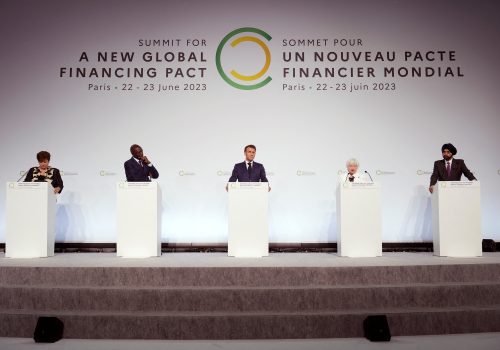
Lessons from the Paris Summit for a New Global Financing Pact

By Hung Tran

Dressing up concrete measures as parts of a “new global financial architecture” risks conflating them with the geopolitical conflict about the future of the current world order.

China
Economy & Business