Featured analysis

Latest analysis

EconoGraphics

Aug 23, 2021

IMF delivers fiscal firepower

By Niels Graham and William Howlett

On August 23 the IMF released a historic $650 billion allocation of Special Drawing Rights (SDRs)

Inclusive Growth
International Financial Institutions

EconoGraphics

Jun 29, 2021

Global Sanctions Dashboard: 5th edition

By Julia Friedlander, Michael Albanese and Castellum.AI

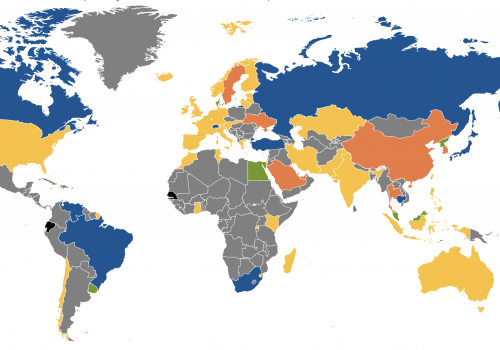
China’s anti-foreign sanctions bill, mapping Belarusian KGB sanctions, and building an anti-kleptocracy playbook.

Belarus
China

EconoGraphics

May 14, 2021

Global Sanctions Dashboard: April

By Julia Friedlander, Michael Albanese and Castellum.AI

UN sanctions, UK’s new anti-corruption authority, the Kremlin’s use of sanctions as a law enforcement mechanism.

European Union
Financial Sanctions and Economic Coercion

EconoGraphics

May 6, 2021

Chipwreck: Visualizing the downsides of semiconductors

By Niels Graham, Josh Lipsky

The global chip shortage has impacted automakers far more than initially projected.

China
Japan

EconoGraphics

Apr 28, 2021

Rollout of the digital yuan

By The GeoEconomics Center

28. That’s the number of cities where China’s about to test drive the digital yuan. Our new animated map shows the rapid expansion planned for the mainland over the next eight months.

China
Digital Currencies

Central Bank Digital Currencies

Apr 20, 2021

The Rise of Central Bank Digital Currencies

By GeoEconomics Center

What exactly is a Central Bank Digital Currency (CBDC) and how does the research compare globally?

Digital Currencies
Digital Policy

EconoGraphics

Apr 14, 2021

Global Sanctions Dashboard: March

By Julia Friedlander, Michael Albanese and Castellum.AI

Growing international sanctions response to Chinese behavior, the Iran nuclear deal talks in Vienna, and the crisis in Myanmar.

China
European Union

EconoGraphics

Mar 22, 2021

China’s ‘Two Sessions’ goes off script

By Niels Graham, Josh Lipsky

Since their peak in mid-February, Chinese markets have lost $1.3 trillion dollars in value. The market route was likely caused by Beijing’s announcement of tighter fiscal policy and worries about inflation risks in America. Nevertheless, it is still unclear if the Chinese can tolerate the kind of volatility capitalist countries are accustomed to.

China
Financial Regulation

EconoGraphics

Mar 19, 2021

Happy St Pats to Ireland: Boom, bust, and recovery for Europe’s most resilient

By GeoEconomics Center

This week, the Atlantic Council’s GeoEconomics Center dressed in green and took a moment to reflect on the Irish economy, one of the most resilient in the European Union.

Digital Policy
Eurozone

EconoGraphics

Mar 11, 2021

Global Sanctions Dashboard: February

By Michael Albanese and Castellum.AI

Aligning with allies against human rights abusers and authoritarian regimes, lack of coordinated response to the ongoing genocide in Xinjiang.

China
European Union

Content

EconoGraphics

Jul 25, 2017

The Apprentice

By Samuel Weitzman

On June 15, 2017, US President Donald J. Trump issued Executive Order 13801, which sought “to promote affordable education and rewarding jobs for American workers” by increasing the number of apprenticeship opportunities. Trump’s stated goals are ambitious. With a proposed ApprenticeshipUSA budget of $200 million (roughly double the previous amount), the president wants to increase the number of US apprenticeships from 505,000 in 2016 to 5 million by 2022.

Economy & Business
United States and Canada

EconoGraphics

Jul 6, 2017

The Big Chill(ing effect)

By Samuel Weitzman

In March 2014, the United States and the European Union (EU) issued the first in a series of sanctions against the Russian Federation for its destabilization of Ukraine and annexation of Crimea. These restrictions, which initially focused on senior Russian government officials and private individuals, have expanded to include large corporations, financial institutions, and even entire economic sectors. In retaliation, Russia has adopted counter-sanctions of its own.

Economy & Business
European Union

EconoGraphics

Jun 20, 2017

Balancing Act

By Samuel Weitzman

On June 12, in US President Donald J. Trump’s first full cabinet meeting, the new US Trade Representative Robert Lighthizer briefly encapsulated the young administration’s philosophy on international trade: “Deficits do matter, and ours are coming down.” This is not a particularly partisan view; Trump’s opponent in the 2016 presidential election, former Secretary of State Hillary Clinton, spoke out against the Trans-Pacific Partnership (TPP) during her campaign despite supporting it previously.

Economy & Business
Trade and tariffs

EconoGraphics

Jun 9, 2017

A Vital Foreign Policy Tool

By Ole Moehr

This is the first EconoGraphic as part of our recently launched Economic Sanctions Initiative. The initiative aims to promote dialogue between the public and the private sector to investigate how to improve the design and implementation process of economic sanctions.

Economy & Business
European Union

EconoGraphics

Apr 19, 2017

The European Stability Mechanism

By Lu Ding & Ole Moehr

The global economic and financial crisis, which originated in the United States in 2008, ultimately triggered a sovereign debt crisis in Europe in 2010. As a result of sky high debts, economies lacking in competitiveness, and over lenient banking regulations, the credit ratings of the Eurozone members Cyprus, Greece, Ireland, Portugal, and Spain plummeted. These countries began facing prohibitively high interest rates when they attempted to borrow from international credit markets.

Economy & Business
European Union

EconoGraphics

Mar 17, 2017

The United States Needs Europe And Vice Versa (Pt. 3)

By Lu Ding & Ole Moehr

This EconoGraphic is the final edition of a three-part series on why the United States and Europe need each other. The series highlights excerpts from the EuroGrowth Task Force’s inaugural report on European economic growth and why it matters for US prosperity.

Economy & Business
Europe & Eurasia

EconoGraphics

Mar 7, 2017

The United States Needs Europe And Vice Versa (Pt. 2)

By Lu Ding & Ole Moehr

US economic ties with the European Union (27) generate the largest global bilateral trade flows, worth an estimated $2.4 billion per day. The massive volume of US-EU (27) bilateral trade promotes prosperity on both sides of the Atlantic.

Economy & Business
Europe & Eurasia

EconoGraphics

Feb 22, 2017

The United States Needs Europe and Vice-Versa

By Lu Ding & Ole Moehr

The United States is the world’s largest recipient of global foreign direct investment (FDI). On a current-cost basis, the US FDI stock was more than three times larger than that of the second largest destination country in 2014, the most recent year from which statistics are available. Despite the current fragile global economy and great political uncertainty, foreign investment in the United States remains strong.

Economy & Business
European Union

EconoGraphics

Dec 12, 2016

Refer-Ending Renzi’s Government

By Filippos Letsas

On December 4, Italian voters rejected former Prime Minister Renzi’s constitutional reform referendum. The result of the referendum renewed concerns about the economic recovery in Italy, stability of the Euro, broader European economic integration, and rising populism across Europe. In the week following the referendum, global markets have focused their attention on the ailing Italian banking sector.

Economy & Business
Europe & Eurasia

EconoGraphics

Nov 29, 2016

The United States Needs China and Vice-Versa

By Filippos Letsas

Over the last decade, China’s large holdings of US debt have helped the Bank of China keep the value of the renminbi artificially low. This strengthened China’s competitive position in the global markets, allowing for cheaper Chinese exports and contributed significantly to China’s large trade surplus, which now accounts for about half of the total US trade deficit.

China
Economy & Business