Experts

Content

Event Recap

Feb 12, 2014

The Danger of Divergence: Discussion of Brussels, EU Reforms at the European Parliament

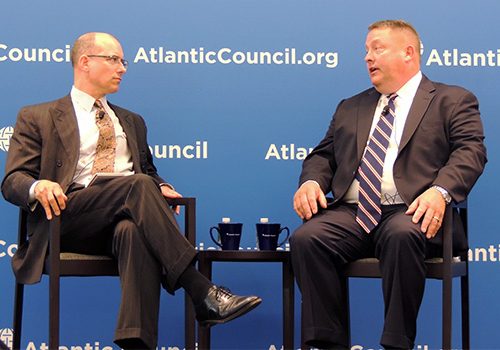
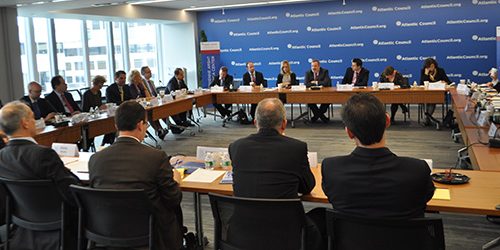
The United States and the European Union must consider not only the transatlantic but the global market if their joint financial reform efforts are to succeed, argued experts from the European Commission, the private sector, the media, and academia at a Brussels event cosponsored by the Atlantic Council, Thomson Reuters, and TheCityUK. The February 12th, […]

Economy & Business
Trade and tariffs
REUTERS/Kai Pfaffenbach

LatAmSource

Feb 10, 2014

Next Steps: How President Obama Should Advance US-Cuba Relations

By Ted Piccone

In 2009, President Obama began relaxing tough sanctions on Cuba, expanding the free flow of people and remittances and planting the seeds of a new paradigm for U.S.-Cuba relations – one that looks beyond the outdated Cold War-era approach that has been employed for so long.

Cuba

LatAmSource

Feb 10, 2014

The Beginning of the End

By Pedro Freyre and Matthew Aho

The results of the Atlantic Council’s Adrienne Arsht Latin America Center poll on Americans’ attitudes on U.S.–Cuba relations can be interpreted in only one way: the tide of U. S. public opinion has turned away from isolation and toward engagement and normalization.

Cuba

LatAmSource

Feb 10, 2014

Twin Failures

By Peter Hakim

Last month’s meeting in Havana of the Community of Latin American and Caribbean States (CELAC), which incorportates every country of the hemisphere except the United States and Canada, was a celebration of the single point of consensus among the Community’s member states: their opposition to US policies that seek to isolate and punish Cuba, which […]

Cuba

LatAmSource

Feb 10, 2014

Prospects of Relationship between Cuba and the United States

By Miriam Leiva

(translated from Spanish) Cuba has been used in the confrontation with the United States to isolate Cubans from the outside world, justify the failures of the plans executed by the will of Fidel Castro , violate the rights and suppress any different opinion than that authorized by the government.

Cuba
Latin America

LatAmSource

Feb 10, 2014

Changing the Political Calculus on Cuba

By William M. LeoGrande

When it comes to controversial issues, the public is often far ahead of politicians in supporting sensible policy alternatives. Issues that are intensely salient to small constituencies scare the daylights out of elected officials because the committed single-issue voter poses a greater electoral threat than the pragmatic general public, whose votes are rarely determined by […]

Cuba
Latin America

Cyber 9/12 Project

Feb 9, 2014

2014 Cyber 9/12 Student Challenge Competition results

First Place Team Phoenix Mike Hooper (National Intelligence University) Maggie Smith (Eastern Michigan University) Rock Stevens (Eastern Michigan University) Jason Rivera (Georgetown University) Second Place ECIR  Bill Young (MIT) Josephine Wolff (MIT) Evann Smith (Harvard University) Third Place Tartans Michael Cook (Carnegie Mellon University) Kate Meeuf (Carnegie Mellon University) Blake Rhoades (Carnegie Mellon University) Matthew […]

Cybersecurity

Cyber 9/12 Project

Feb 8, 2014

A challenge for students: How to manage a cyber catastrophe

Teams comprising nearly a hundred students, from twenty-four universities as far afield as Turkey and Estonia, gathered in Washington this month to compete at solving this challenge: Imagine that you are cyber-security specialists summoned to advise the US National Intelligence Council on policies that the American president should adopt in response to a massive cyber […]

Cybersecurity

In the News

Feb 8, 2014

Greene: How Germany Just Undercut the Euro

By Megan Greene

Global Business and Economics Program Senior Fellow Megan Greene writes for Bloomberg Opinion on the battle brewing between the European Central Bank and Germany’s Constitutional Court:

RDTEandProcurementAccount-Graph

Defense Industrialist

Feb 7, 2014

RDT&E Must Remain Resilient to Austerity

By Kristin Oakley

No peace dividend for you: US military spending plans are sharply reducing RDT&E spending relative to procurement Austerity in defense spending may very well decrease military spending on research, development, testing and evaluation (RDT&E). As robust RDT&E spending has long been important to US military capabilities, we should think seriously before cutting these accounts.

Events