
So what’s the strategy for NATO’s transformation?
Host Matthew Kroenig is joined by Admiral Pierre Vandier, Supreme Allied Commander of NATO’s Allied Command Transformation (ACT) to discuss how NATO is confronting the changing nature of war and the evolving threats facing the alliance. NATO ACT leads the Alliance’s military adaptation, coordinating efforts across member nations. ACT works to identify challenges and opportunities to ensure that the Alliance maintains a warfighting edge over its adversaries.
Listen to So What’s the Strategy wherever you get podcasts



About the podcast
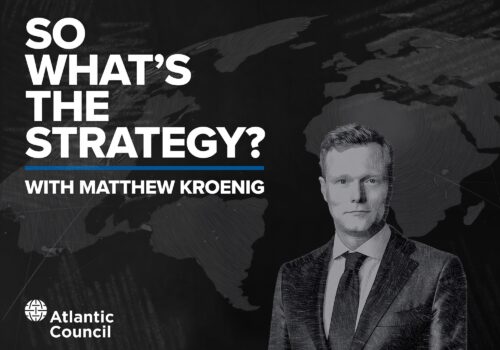
Host Matthew Kroenig, senior fellow with the Atlantic Council’s Scowcroft Center for Strategy and Security, sits down with senior US and allied officials and leading experts to explore the strategies shaping today’s most pressing global security challenges. Inspired by General Brent Scowcroft, who famously asked his team “So what’s the strategy?” the series dives into how leaders think about power, policy, and the decisions shaping the future of international security. Watch and listen wherever you get your podcasts.
Transcript
Read the full episode transcript below
Expand to read
00:00:00.000 — 00:00:19.080 · Pierre Vandier
We’ve seen how Russia has changed its way of fighting. And so it’s now a demand signal to change, because if we don’t, we will fight the older enemy and not today’s enemy and the future enemy. So transformation has never been so important than it was in the recent history for NATO.
00:00:19.240 — 00:01:22.890 · Matthew Kroenig
Welcome to So what’s the strategy? I’m your host, Matthew Kroenig. Today’s episode will focus on NATO’s transformation strategy to ensure the alliance can remain at the forefront of battlefield developments. Today, we are recording on location at the Atlantic Council’s Distinguished Leadership Awards in Washington, DC, and our guest today is one of our honorees, Admiral Pierre Vandier, Supreme Allied Commander Transformation at NATO.
NATO Allied Command Transformation, or ACT, leads the Alliance’s military adaptation and coordination efforts across member states. ACT works to identify challenges and opportunities to ensure that the Alliance maintains a warfighting edge over its adversaries. Previously, Admiral Vandier served as Chief of Staff of the French Navy, where he led major efforts to modernize France’s maritime forces and adapt them to the demands of high intensity conflict.
Over the course of his distinguished career, he has held a range of senior operational and strategic roles with deep experience in naval warfare, joint operations, and defense transformation. As you can see, Admiral Vandier is the perfect person to talk about NATO’s transformation strategy.
00:01:28.570 — 00:01:50.250 · Matthew Kroenig
Former National Security Adviser General Brent Scowcroft used to challenge his team with a simple question, “So what’s the strategy? What do you want to do and how are you going to do it?” That’s the focus of this show. On So What’s the Strategy? We talk with senior government officials and leading experts about the strategies for addressing the most important security challenges facing the United States and the world.
Let’s get started.
00:01:56.330 — 00:01:58.810 · Matthew Kroenig
Admiral Vandier, welcome to So What’s the Strategy?
00:01:58.930 — 00:02:00.340 · Pierre Vandier
Thank you for having me.
00:02:00.380 — 00:02:25.740 · Matthew Kroenig
Yes. It’s an honor to have you. And, um, let’s start with the strategic context for your command. You’re responsible for transformation. Uh, always an important, difficult topic. But now, as we see the character of warfare changing in Ukraine and Iran, with drones, with AI, are we living through a revolution in military affairs?
And how do you assess the changing nature of conflict?
00:02:25.980 — 00:03:23.060 · Pierre Vandier
Everybody is speaking of NATO 3.0. In fact, NATO has been built after the Cold War, which is now thirty-two nations, which is as a very wide area for responsibility. It’s the first time in this history of this new NATO that it’s confronted to a long-lasting threat. And what we’ve seen in Ukraine during this beginning fifth year of war, that we see a change of character, of war.
And even if we you can argue that the Ukrainians are not fighting with all the stuff we have in the inventory, in NATO, the enemy gets a vote. And we’ve seen how Russia has changed its way of fighting. And so it’s now a demand signal to change, because if we don’t, we will fight the older enemy and not today’s enemy and the future enemy.
So, transformation has never been so important than it was in the recent history for NATO.
00:03:23.660 — 00:03:44.460 · Matthew Kroenig
And as you and our viewers may know, NATO has some recently approved regional plans, their capability targets tied to those. But I’ve heard some experts say, you know, war is changing so quickly that maybe those plans need to be updated already. Is that correct? Or you think we’re good with the plans and the capability targets we have currently?
00:03:44.500 — 00:04:46.670 · Pierre Vandier
So the big endeavor we have today is that the capability targets are capabilities and effects. It’s not an inventory that means that we translate the plans and capabilities. And then we have a discussion of what means these capabilities that, um, so you can fulfill goals and effects with different ways.
And the big discussion and the transformation we are conducting today is how you can answer new demands, new problems, new capability demands with new stuff. Not only tanks for tanks, ships for ships, aircraft for aircraft. Uh, we have some pretty good examples of what we are doing at the moment. Uh, we have now multiple, um, initiatives of USV fleets to make some ISR—o its intelligence surveillance missions— in the approaches of Europe, in the Baltic, in the Med, or at the moment we speak, we have a large-scale experiment of counter-drones systems in Romania, and we are working on how integrating that to the IMD.
00:04:46.790 — 00:05:03.400 · Matthew Kroenig
Very interesting. I didn’t appreciate that, but that’s an important point, focusing on the effects, not on the inventory. That was um, well said. And then, uh, how would you describe the goal for your command. Is it to ensure that NATO maintains a military edge over adversaries, or how would you define it?
00:05:03.400 — 00:05:51.640 · Pierre Vandier
So in a nutshell, what we are doing is from foresight to war fight. So we look ahead. We are given the role of defining the NATO’s military strategy, and we work on that. So what is the future of the enemy? What is the long-term confrontation with Russia? We make some very interesting large-scale wargames with this, trying to find the good direction to deal with.
And then we translate that from capabilities. So it’s the discussion we just had. And then we are looking at the innovation piece. So what brings new bang for the buck. It’s the new bang for new buck. So it’s what we work on. And then we integrate that in the learning machine, in the concept machine. And to make the nations fight as one.
00:05:51.680 — 00:05:56.440 · Matthew Kroenig
What do you mean by learning machine or concept machine? How do you go about learning lessons.
00:05:56.490 — 00:06:00.690 · Pierre Vandier
Short of war. The only thing we have to improve our fighting is training.
00:06:01.730 — 00:06:35.970 · Pierre Vandier
I think Ukraine is learning by pain because they fight every night and if they don’t learn, they will lose. But we are not at war yet. So that means that the learning machine is how you incorporate lessons from outside. New demand signals new technology, and you bring that in a new way of fighting. And so that means that we need to train and we are innovating the way of training.
We with ACO, we secure we, have now a common program which is audacious training, where in fact we’ve changed the way and the goals of the training.
00:06:40.250 — 00:07:09.420 · Matthew Kroenig
So as you and our listeners probably know, last year at the NATO summit, there was this historic pledge. All allies are going to spend 5percent of GDP on defense, 3.5percent on core defense, 1.5percent on other security related spending. This must be a huge opportunity for you and your command. How are you, if at all, making sure that that money is spent in the right way, on the right capabilities to help with the transformation of the alliance?
00:07:09.420 — 00:08:17.180 · Pierre Vandier
So on the 3.5 (percent), um, is the ability to, um, to ramp up in fulfilling the plans. So this is a big endeavor. And now the question we have is a question of speed, at which speed we will fill the gaps. So it’s there’s 3.5 question. On the 1.5, it’s much more a national question or a European question. In fact NATO is defending its own AOR.
And the 1.5 is about resilience, um, medical support. Uh, all the grids, uh, to maintain power grid, communication, grid, space grid, all these things that are say much more on the civilian side, a little bit dual, uh, but where in fact a cohesive action is needed. For example, I give you the railway grid.
If you want to transport a brigade from Western Europe to the front, you need to have a seamless railway system where in a matter of hours you can transport all the things there. Today it’s a great work on the EU side to make that seamless with no customs and and compatibility problems. So the 1.5 are dealing with this.
00:08:17.180 — 00:08:43.300 · Matthew Kroenig
That makes sense. So then looking ahead to the upcoming NATO summit in Ankara, the expectation is that there’s going to be a big focus on the defense industrial base. And how does NATO produce the capabilities it needs to fill these capability targets? Does the Transatlantic Alliance have the defense industrial base it needs, and how do we make sure that we can actually produce these capabilities at scale and on time?
00:08:43.340 — 00:10:21.920 · Pierre Vandier
Yeah. So it’s really a great question. Uh, the last summit was about the buck, and I hope that Ankara summit will be about the bang and definitely industry is the producers of the bang. And the big question all of us we have. Would it be in the US or in European countries? Is do we have the industry which is fitted for the new fights we have to, to, to wage?
Um, I think we produce some very exquisite high end performance weapons today, but they have been defined in a stable world where the magnitude of the fight was somehow limited. Today we are confronted to large scale, protracted conflicts. And so we need to have the industry which is able to deal with this and which is adapted to what we are today.
Um, we we are not anymore in the ‘80s, with a lot of industry on our homelands, uh, a lot of thing has been done in globalization. Um, although the question of the supply chain, for example, which is still very worldwide, has to be put on the table, and we need to think about what are the weapons that make us, I would say, sovereign.
Uh, it’s all the, uh, the story of, uh, the the the gap between the forecastle and the mind, raw materials, all these things. So today, if you produce something which is so much dependent of what the adversary owns, you can’t pretend that you are able to make a long, protracted conflict with them. So I think the the weapon system we have to invent are probably new ones and not only doing more of the same.
00:10:21.960 — 00:10:38.720 · Matthew Kroenig
OK, well, you said inventing new weapon systems. So let me ask about that. How do you think about kind of legacy platforms? I don’t know, surface ships versus new technology, AI, drones. What does NATO need or is the answer a mix of both?
00:10:39.200 — 00:11:41.930 · Pierre Vandier
We are definitely working on mix. We have launched a program which. So my command I like common transformation launch a program which name is Force Lethality Enhancement, which is based on a multiple studies where we simulate with modeling and simulation tools. Even at secret level, what is the mix? So what kind of USV fleets you will work with?
Uh, surface combatant fleets? What effects you will have on the offensive and defensive layers? Uh, and that brings a lot of healthy thinking and reflections. As an example, we could have had today, um, a USV fleet in the Strait of Hormuz. That would be possible. The tech is there. So now we need to bring that in.
Will we need to put that in the planning in the NDPP and create the initiatives that will bring that for real. An example this summer you will have Finland, Sweden and Denmark that will put together the first USV fleet in the in the Baltic.
00:11:42.090 — 00:11:57.660 · Matthew Kroenig
So transformation a big task in a single country. You essentially have to do it for thirty-two countries. So how do you ensure interoperability across the Alliance. And how do you ensure that these thirty-two nations are all going in the same direction?
00:11:57.660 — 00:13:09.140 · Pierre Vandier
So it’s really a great question because we inherit thirty years of so-called peace, eternal peace, where the focus was not on interoperability. Today, roughly 50 percent of the common standards are not applied by the nations and even the big ones. So there is a lot of work to do to build a system that are interoperable and not interchangeable.
That means that we need to grant the fact that we have some different stuff. It will not be a whole same or the same everywhere. You will have some industry that will produce some different things, and it’s in fact it’s a it’s a ecosystem. It makes us more resilient because if you have multiple solutions, it will be very difficult for the enemy to hack everything at the same time.
So it gives resilience, it gives ideas and probably an idea which is today not that relevant will be relevant in a new, um, uh, operational situation with the we’ve seen that with drones. Um, you see what Ukraine is doing for the Gulf because in fact, they are ahead of the threat. Uh, and so they are useful in discussion.
00:13:09.180 — 00:13:18.220 · Matthew Kroenig
Well, I think we’re nearing the end of our time. Any final thoughts you’d like to leave with our listeners? What’s something important they should know about NATO ACT that maybe they don’t know?
00:13:18.380 — 00:13:46.380 · Pierre Vandier
I think we we we need to have the consciousness of the problem we have the geostrategic problem we have is not solvable by a single nation. Um, I think the, uh, the, some of the IQs of Europeans is, uh, in NATO is largely bigger than each IQ. And so that means working together, uh, common defense is really the only way I’m convinced on that.
The only way to deal with our future.
00:13:46.580 — 00:13:50.900 · Matthew Kroenig
Well, Admiral Vandier, thank you very much for joining us on. So, what’s the strategy? Thank you.
00:13:56.470 — 00:14:45.910 · Matthew Kroenig
Military historians talk about revolutions in military affairs that have fundamentally changed international politics and the character of warfare from the Gunpowder Revolution in the 1600s to the Nuclear Revolution in 1945. We might be living through one of those revolutions right now, as we see unmanned systems and artificial intelligence change the battlefield.
In Ukraine, for example, we saw a country without a navy essentially cripple Russia’s Black Sea fleet. So transforming the Alliance is difficult at any time, but right now, incredibly important to ensure that the free world can maintain its military edge. And as we heard today, Admiral Vandier and the NATO ACT is working every day to take on this important challenge.
This concludes our episode. Thank you for listening. Be sure to subscribe to So What’s the Strategy? wherever you get your podcasts. We look forward to seeing you again soon.
Related content

Explore the program
The Scowcroft Center for Strategy and Security works to develop sustainable, nonpartisan strategies to address the most important security challenges facing the United States and the world.
Image: A Bundeswehr soldier lets a Parrot reconnaissance drone take off during the large-scale exercise "Freedom Shield 2026" of the new 45 Armored Brigade. The series of exercises is the first brigade combat exercise of the large unit and its subordinate combat troops. 2,900 soldiers from 8 nations with 800 vehicles are taking part and will also be confronted with new threat scenarios.