

CHIȘINĂU—On October 8, Moldovan President Maia Sandu opened the Moldova Security Forum* with a hard-hitting reality check about Russia’s growing threat to her nation and the region: In the previous week, nine Russian drones violated Moldovan airspace. Over the month of September, more than twenty Russian drones flew into Moldovan airspace—more in a single month than in all of 2025—with some detonating and causing damage. Each attack, she added, was accompanied by anonymous Telegram messages telling Moldovans that the incursion was a consequence of their country’s support for Ukraine.
Russia’s escalation of drone attacks has not been limited to Moldova and Ukraine. On October 5, for example, a Russian drone struck a ship in Romania’s economic zone in the Black Sea, killing two people. The next day, Russian drones blasted two merchant ships in Bulgaria’s economic zone. Two sailors were injured on one ship, while the second ship sank quickly, leaving its entire crew missing and presumed dead. On Tuesday, one day after NATO’s top military commander delivered a major speech on the Alliance’s “Theory of Victory,” its updated plan to defeat a potential Russian invasion, Russia attacked another two merchant ships just twenty miles off the Bulgarian coast. Eleven crew members are missing from one ship, with one sailor saved. Fortunately, all fifteen crew members were rescued from the second ship.
These attacks build on numerous other Russian drone incursions into the territory of other NATO allies, including Russia’s September 2025 barrage of nearly two dozen unarmed drones deep into Poland over one night. But the lethality and clear intentionality of the latest attacks—one of the ships in Bulgarian waters was hit by at least two drones—are particularly notable.
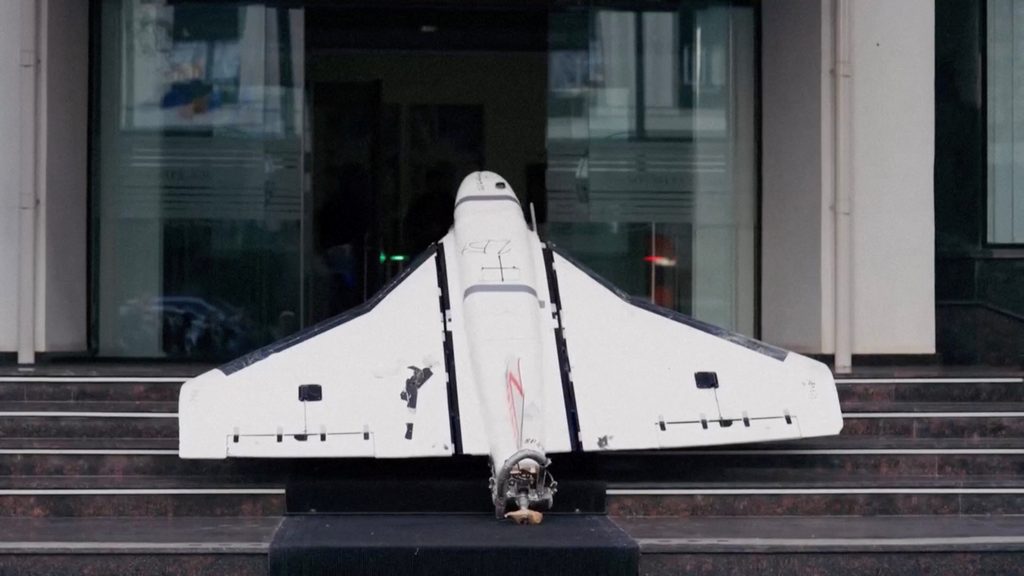
Make no mistake: These are military attacks. Russian President Vladimir Putin’s apparent goal is to stoke fear across the populations of NATO partners and allies and thereby undermine public support for Ukraine. He clearly wants to create doubt about NATO’s resolve to defend its member states and sow division among allies.
These drone attacks are an escalation in a broader, decades-long Russian campaign of kinetic and nonkinetic terrorism against the West. The Russian campaign includes harassment of NATO forces, information attacks, election meddling, cyberattacks, sabotage on land and at sea, and assassination attempts, including in the United States. By one count, Russia has carried out more than a hundred such incidents in the past year alone.
Stopping Russia’s aggression requires not simply counting the attacks but internalizing their underlying logic and responding in effective ways. Five principles should guide the West’s efforts to restore its deterrent posture:
First, Russia is at war not just against Ukraine. Putin is at war against the transatlantic community. This has been said repeatedly. But despite two decades of aggression, the West still struggles to recognize this reality.
Putin’s objectives are twofold. He is determined to reassert Russian control over the territory that was once the Soviet Union, if not more. Hence his 2008 invasion of Georgia, through which he seized and continues to occupy some 20 percent of its territory. His invasion of Ukraine, now intensifying in its brutality, follows the same logic. And his sustained efforts to subordinate Moldova, through disinformation campaigns, election interference, and this recent escalation of drone incursions, are attempts to gain control through means other than invasion.
Putin’s parallel objective is to dilute—if not destroy—the security architecture the transatlantic community established in Europe after World War II, which continues today with NATO as its institutional cornerstone. The motivation is in part retribution. It is this community of democracies and its military alliance that took down Putin’s cherished Soviet Union. More urgently, the Alliance has been a primary and prominent impediment to his effort to suborn Ukraine.
Second, Putin’s war on the West underscores that the transatlantic community’s deterrent posture is failing. If deterrence is not restored, the consequences of Putin’s attacks and the risk of wider war in Europe will continue to grow.
So far, the vast majority of Russia’s attacks have failed to generate a meaningful response from the West. When the West has responded, the reaction has been mostly defensive, including through enhanced vigilance and defensive measures, such as NATO’s Eastern Sentry and Baltic Sentry operations. The West’s responses have infrequently been punitive, and when they have been so—such as through economic sanctions—they have been weak and incremental. Their impact on Putin’s ambitions has been marginal. It is not surprising that US and European intelligence agencies warn that his campaign against NATO allies and other European countries will continue to escalate.
Third, restoring deterrence will become more difficult the longer decisive action is delayed. The West’s failure to respond more forcefully to Putin’s attacks communicates hesitance and disunity, if not intimidation. This has likely led Putin to conclude the Alliance has lost the will to fight in the defense of its territory, interests, and values—the same will that Putin personally experienced when the West prevailed in the Cold War. Given this situation, Putin likely now believes that he controls the escalation ladder in his relationship with NATO and that the West fears escalation more than he does.
Fourth, this failure of deterrence is due not to a lack of capability but, as Putin has correctly concluded, to a lack of political will. The transatlantic community’s overmatch in power is massive. The collective gross domestic product of NATO allies is at least $55 trillion, more than twenty-five times the size of Russia’s economy. The Alliance spends over $1.5 trillion on defense, compared to Russia’s roughly $200 billion. And allied forces are better trained, better equipped, and more motivated. Putin is not oblivious to this reality, and it probably explains why he has escalated his attacks on the West gradually over the past two decades. Again and again, he probed for weaknesses and consistently found too little resistance, which he then pressed to his advantage.
Fifth, restoring deterrence will require a course correction in the West’s approach to deterrence. During the Cold War, deterrence was never risk-free, nor was it inexpensive. The United States and its allies deployed hundreds of thousands of soldiers to counter Soviet aggression, and allied commanders were given great authority to use force if necessary to defend allied territory.
Following the fall of the Soviet Union, the United States and its allies sought risk-free and cost-free responses to Russian aggression. (Look how long it is taking Europe to wean itself off Russian energy!) This approach, which has proven to be more self-limiting than effective, plays into Putin’s strategy, emboldens him, and marginalizes the West’s overmatch in power.
Radek Sikorski, Poland’s deputy prime minister and foreign minister, put it well in an essay published by The Economist in August. He wrote: “Our objective cannot be merrily to avoid escalation. It is to convince Mr. Putin that escalation will get him nowhere, and that we are willing to sacrifice more than money to stand up for ourselves.”
Note: The author’s visit to Chișinău was supported by the Institute for European Policies and Reforms (IPRE), one of the hosts of the Moldova Security Forum.