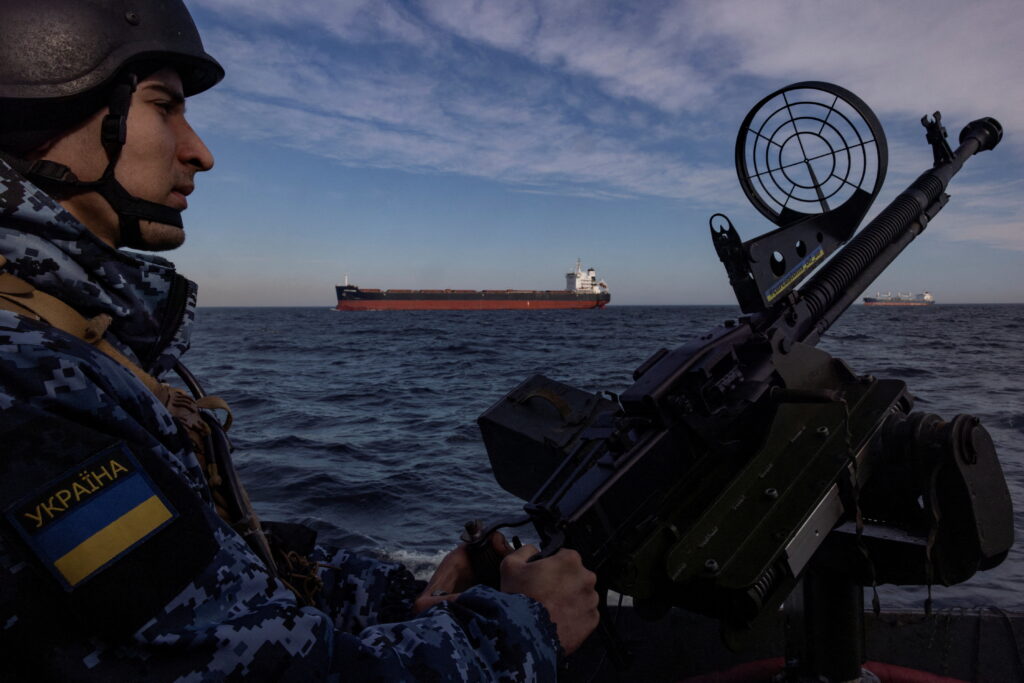
Russia has once again rejected proposals for a maritime ceasefire in the Black Sea. In August, Moscow dismissed Ukraine’s offer to halt attacks on civilian targets at sea as a “half-measure.” More recently, Russia rejected another limited Black Sea truce proposal forwarded by Turkey and the United Nations, stating that “piecemeal arrangements” cannot bring a peace settlement between Russia and Ukraine closer. Meanwhile, Russian attacks on merchant shipping, Ukrainian ports, and maritime infrastructure have increased.
Ukraine has shown it can constrain Russia at sea, but sustaining the advantage requires additional support from Black Sea and transatlantic allies.
Russia continues to escalate in and beyond Ukraine
In mid-September, the Ukrainian Ministry for Recovery, Infrastructure and Transport reported that, since the beginning of Russia’s full-scale invasion, 274 civilian vessels and 1,173 port infrastructure facilities had been damaged or partially destroyed. Since then, the escalation has continued, resulting in an increasing number of casualties. On September 17, a Russian drone hit a Tanzania-flagged civilian vessel heading toward a Ukrainian port, killing its captain and injuring three crew members. On October 3, another Russian strike hit a Liberian-flagged cargo vessel in an Odesa-region port, killing a motorman and injuring three others. In the most recent incident, two Russian drones hit a Turkish vessel carrying corn in neutral waters, killing the captain and a crew member.
Russia has also expanded its military activity beyond Ukrainian ports in a horizontal escalation across the Black Sea. Russian drones have repeatedly violated the airspace and territorial waters of regional states. According to Romanian Foreign Minister Oana-Silvia Țoiu, the country has experienced more than one hundred incursions by drones or drone fragments as Russia intensified attacks near the Danube and Black Sea in recent months.
In August, Romania destroyed an explosive-laden maritime drone only a few hundred meters from the Neptun Deep offshore gas project, after two other maritime drones had already been destroyed in Romania’s exclusive economic zone earlier that month. Romanian President Nicușor Dan blamed Russia for the incident.
Moldova’s Defense Ministry said that as of 24 September 2026, Moldova had registered forty-four airspace incidents in 2026, compared with seventeen in all of 2025. Since 2022, there had been eighty-one incidents involving Russian- and Iranian-made drones and missiles, fragments, and decoys.
Who can deter Russia?
With no ceasefire in sight, the key question is: who can deter Russia in the Black Sea militarily?
The answer is Ukraine—with the support of its allies.
Despite entering the war without a conventional navy capable of matching Russia’s Black Sea Fleet, Ukraine has shifted the balance from Russian sea control to Ukrainian sea denial. Ukraine’s unique cross-domain operations relying on artificial intelligence (AI)-enabled robotic systems and sophisticated uncrewed platforms have left the Russian fleet degraded, dispersed, and confined to harbors.
Ukraine is also rapidly innovating in the automation of naval warfare, while acting in a highly contested electronic environment. On September 12, a Ukrainian Sargan 3000 uncrewed surface vessel (USV) destroyed a Russian uncrewed boat in what the Ukrainian Navy described as the world’s first battle between naval drones. Ukrainian military intelligence detected the target before the naval drone engaged it, illustrating the increasingly networked character of warfare at sea.
Yet Ukraine’s key vulnerability—limited air defense capabilities—has prevented Kyiv from fully converting its operational successes at sea into a strategic advantage. Russian aircraft can still launch ballistic and cruise missiles, glide bombs, and loitering munitions while remaining beyond the reach of many Ukrainian systems. Meanwhile, ports, coastal infrastructure, and shipping routes remain exposed to Russian ground-launched missiles and jet-powered drones. Without sufficient stocks of air-to-air missiles for its F-16s and air defense interceptors, Ukraine’s ingenuity alone cannot protect its skies.
Nor can the other Black Sea states alone ensure credible deterrence of Russia.
Romania and Bulgaria still lack many of the coastal defense, radar, sensor, and other enabling capabilities required to deter Russia independently. Turkey possesses considerably greater military and missile-defense capabilities but continues to manage a delicate relationship with Moscow, combining support for Ukraine with careful escalation management and cooperation with Russia. Ankara is also a longtime proponent of regional ownership of Black Sea security, centered on the region’s littoral states.
Regional fragmentation adds to the complexity of the security situation. Black Sea states have different threat perceptions and political priorities, while the exchange and fusion of intelligence and maritime data remain limited. Unlike the Baltic, the Black Sea brings together NATO and non-NATO countries, EU and non-EU states. The maritime domain also encompasses militaries, coast guards, civilian authorities, and private operators with different mandates and levels of access to classified information.
These coordination gaps become particularly visible in efforts to protect critical undersea infrastructure. Even decisions defining which assets are “critical” are contested, and assets may be owned by one company, operated by another, and located in the waters of a different state. Thus, effective protection depends not only on technical surveillance but also on trusted mechanisms for exchanging sensitive information between governments and private companies.
The tools designed to overcome these difficulties remain limited.
The EU’s proposed Black Sea Maritime Security Hub is still primarily a concept. Bulgaria and Romania are developing it with EU support, while competing for the opportunity to host its facilities. The documents envisage possible participation by Ukraine, Turkey, and Moldova, but those arrangements have yet to be operationalized.
The trilateral Mine Countermeasures Task Group Black Sea (MCM), created by Turkey, Romania, and Bulgaria, is more promising. Its mandate was expanded in July to include protection of critical undersea infrastructure. But MCM currently maintains an operational presence for two months a year, lacks sufficient capabilities, and excludes the country with by far the greatest combat experience in the Black Sea: Ukraine. It is also a trilateral initiative among three NATO members rather than a NATO mission, limiting the political deterrent signal it sends to Moscow.
What should come next?
Here are five recommendations:
- Enable Ukraine to defend its ports and deter Russia. Strengthening Ukrainian air and missile defense is the immediate priority, particularly for ports, critical infrastructure, and merchant shipping. Ukraine’s NATO and EU partners should help Kyiv maintain the technological edge in naval warfare that has already imposed significant costs on Russia.
- Strengthen the capabilities of NATO’s Black Sea littoral states. Romania can develop into a stronger defensive hub on NATO’s eastern flank, while deeper defense-industrial cooperation with Ukraine and Turkey offers significant potential for strengthening European deterrence capabilities. More broadly, support for the littoral states, including Bulgaria and Moldova, should focus on strengthening air defense, infrastructure resilience, as well as intelligence, surveillance, and reconnaissance capabilities.
- Turn MCM Black Sea into a persistent patrol mission and bring Ukraine in. The initiative needs additional equipment and personnel if its expanded mandate is to be operationalized. The presence of Ukrainian representatives at the MCM headquarters and in exercises would significantly strengthen its posture.
- Sharpen deterrent signaling. The concept of deterrence rests on three Cs: capability, credibility, and communication. The Black Sea suffers from deficits in all three. A NATO 3.0 built around greater European burden-sharing should not become synonymous with American disengagement. Europeans can—and should—assume more responsibility for conventional defense. But the strategic enablers and nuclear deterrence provided by the United States remain critical for regional security. The United States does not need to physically “return” to the Black Sea to signal to Europe that the region will not be left alone with an unleashed Russia. Political backing, interoperability, and strategic reassurance can provide deterrent value without requiring large-scale US deployments or investments.
- Raise the cost of attacks on civilian maritime activity. The message from the EU, US, and other G7 partners to Moscow should be clear: every Russian attack on merchant shipping, seaports, or maritime infrastructure should trigger additional support for Ukraine, stronger sanctions, and intensified pressure on Russia’s shadow fleet.
Whatever comes next—a negotiated ceasefire or further escalation—the region must face it from a position of strength. For that, it needs credible deterrence, stronger defenses, and bold political signaling.
Yevgeniya Gaber is a nonresident senior fellow at the Atlantic Council Turkey Program. She previously served as a Ukrainian foreign policy adviser and diplomat, including serving in the Ukrainian embassy in Ankara from 2014 to 2018.
The views expressed in TURKEYSource are solely those of the authors and do not necessarily reflect the views of the Atlantic Council, its staff, or its supporters.
Explore the program

Within the Atlantic Council’s longstanding commitment to strengthening the transatlantic relationship, the Atlantic Council Turkey Program conducts research, provides thought leadership, and offers a platform for strategic dialogue between the US, Turkey, and NATO allies to address the region’s toughest challenges and explore opportunities, including in the fields of energy, business & trade, technology, defense, and security.
Related Reading

Image: A service member of Ukraine's coast guard mans a gun on a patrol boat as a cargo ship passes by in the Black Sea, amid Russia’s attack on Ukraine, February 7, 2024. (Thomas Peter via Reuters Connect)