Click to read the transcript
This transcript is AI-generated. Check against delivery.
Frederick Kempe:
Good afternoon, everyone, and hello to people all over the world listening to us virtually. Here we are on the sidelines of the UN General Assembly, or we could say the UN General Assembly is on the sidelines of Atlantic Council programming.
But that would, that would be wrong.
And welcoming this special edition of Atlantic Council Front Page, our premier platform for global leaders. It’s a particular pleasure for me and honor to speak with Albert Bourla, chairman and chief executive officer of the pharmaceutical company Pfizer. He and his company have been foundational pillars of global health that scale complex science to meet humanity’s most urgent needs.
Back in November 2021, Albert Bourla had really emerged as someone whose name people were hearing all over the world, as was Pfizer, as we were emerging from the COVID crisis. And in that month, we presented Albert our highest honor for leaders in the business world for historic achievements during that period.
In presenting him the award in Washington, and we had not convened ourselves for a couple of years for that award, European Union Commission President Ursula von der Leyen said, quote, you chose to put billions of dollars at risk because if you didn’t try, the whole world would pay the price, end quote. That choice, she said, and the vaccine it helped bring to the world contributed to saving millions of lives.
Today—and this is what we’ll talk about today—Albert confronts another historic hinge point in healthcare, artificial intelligence and its potential to transform the discovery, diagnosis, and—drug discovery, diagnosis, and human longevity.
And that just kind of scratches the surface of what’s going on in your industry. The global context is challenging. Populations are aging. Chronic disease is rising.
Cancer remains a persistent challenge. Health systems and health budgets are under pressure. In some parts of the world, declines in development assistance are taking a human toll.
At the same time, amazing scientific and technological tools are available to us, and they’ve never been more powerful. So this conversation will capture all that and is part of the Atlantic Council’s broader work at the intersection of technology, data, and global affairs. So let’s start there.
I’d like to begin by asking how the experience of leading the world through COVID compares to the beginning of your experience of leading the world through what Demis Hassabis, the founder of DeepMind, called the intelligence age.
Some people refer to both of these events as revolutions. So put on your historian’s cap. I think we’ve talked about this before, that the word revolution is overused.
Are we entering a revolution? How would you compare what it will take to navigate this period of time to what it took to navigate the COVID period?
Albert Bourla:
I think the COVID period was very different because it represented an existential threat and zero opportunity. There was nothing good that you could expect out of COVID. The only good thing that you could expect was to find the solution and put it behind us.
And I think we did well, and the world did well because there was tremendous collaboration, and we did put it behind us. Now with AI, it’s a very different set of animals. There there are threats, but there are tremendous opportunities that are ahead of us. And do I think that this is really something special or just another moment of technological innovation? I think it’s really special. I think it’s opening a completely new era that can only be compared to the wheel and the fire and the first engine, things that really changed society and, and the way that it was operating. And that’s what we are experiencing right now.
Frederick Kempe:
It’s so interesting to hear your comparison. I asked Demis Hassabis the same sort of question, and he compared it to the Industrial Age, the Industrial Revolution. I noted that the Industrial Revolution, with all the good it brought—and it brought a lot of good—it also brought mechanized warfare, two world wars. It also brought capitalism, communism. But in the healthcare world, let’s turn to the—
Albert Bourla:
I think what happened was that it was disruptive.
Frederick Kempe:
Yeah.
Albert Bourla:
Because every major big technology is disruptive and changes the status quo. That’s why we had all these events. There is no doubt that that can happen also now.
Frederick Kempe:
Hassabis said four times the impact of the Industrial Revolution at four times the speed. Is that possible? And talk to me about healthcare. You have said that your ambition for Pfizer is to be the most AI-forward company in the industry. What do you mean by that? And given the rate of technological change, you’re a company that measures things, how do you measure that?
Albert Bourla:
I think that AI, as I said, will be extremely disruptive, which means that will create new realities in the world, which means that will create new winners and new losers.
And the winners will be those that they get it right, how to be able to deal with it. The losers will be those that either they get it wrong or they are complacent.
So staying on the sidelines, it’s mathematically certain that it will bring you a disadvantage. And what we do is something noble. We are making breakthroughs that change patients’ lives. It’s not that we are not making cars that make life more pleasant or cell phones. We are saving lives of human beings. And for us, it’s a paramount importance. I see it that winning means winning for patients.
Now, what is the successful recipe to do that? Because as I said, some will get it right, some will—I don’t think we know. But it’s high time to make choices. So even in the midst of uncertainty, we are making choices about how to go about it.
For AI, I think we can distinguish two different eras. One, it is AI cannot do today everything, but can do way more than what we are using it for, way more.
And what is the limitation? The bottleneck is not technological limitations. Technology is there and can do much more. The bottleneck is the ability of organizations like ours to transform themselves into an AI-native organization, to transform themselves into an organization that is completely different in the way that it’s structured and operates, because now we have the tools that we can do things much better.
Frederick Kempe:
So, so that means not adapting to AI, but transforming through it.
Albert Bourla:
Everybody’s adopting AI. Very few have transformed, if any, so far because of AI. But that will be the secret, to be able to transform yourself.
Frederick Kempe:
So let’s talk a little bit about that. Your background is biotechnology focused on reproduction, more or less novel field when you were earning your PhD in the 1980s. How have your earliest encounters with cutting-edge science prepared you for our newest interventions in medical research and development, AI? How much does this resemble periods before but is just accelerated, and how much do you actually have to think much differently than you’ve thought before?
Albert Bourla:
I think it resembles other technological advancements, but in a scale and and speed that we haven’t seen before. I couldn’t imagine two years ago. I didn’t know that we would reach a level like that. So I think, as I said before, it’s something different. It’s not just one more important moment in the way that technology is advancing in the world. It’s a really transformational moment.
Frederick Kempe:
So let’s talk about the trepidation in the public about AI and how one deals with that. We, our Atlantic Council Technology Programs, did an AI commission report.
The commissioners represented a large part of the American stock market. And they had brilliant recommendations for government, for US competitiveness. But interestingly, what they were most concerned about was public backlash, public opinion turning against AI, which it hasn’t done in China. Which it hasn’t really even done it to this degree in Europe, interestingly enough.
You know, and then we had—this was not less problematic, made less problematic by the call upon by Dario Amodei, Elon Musk, you know, Sam Altman for a pause.
How do you look at this period in terms of public acceptance? What does what you saw from their pause say to you in your industry?
Albert Bourla:
I think people are getting excited, but also are getting very worried about it, and rightly so. Because as I said, the disruption will change everything, and people are concerned about it. And I think when I first heard Dario going out and speaking about it, clearly, I got concerned. It particularly forced me to go and understand what really happened with the OpenAI incident and what the drone—what the agents did. And I couldn’t believe it when I realized what these agents did.
And clearly, there is significant risk because they can act on their own. They can act independently, apparently, from from humans and those that they program them, and they have a lot of power to do things. So yeah, clearly that’s something that is concerning.
Still, I think that the risk-benefit ratio of this technology is very advantageous towards the benefit. There are risks, but they are very big, but the benefits are gigantic. I will do a distinction with nuclear power because many people are saying, look, nuclear is the same thing.
Imagine if when nuclear was there, we would let it just run without regulation. So, that’s equally powerful, we should do the same. I would say that with nuclear power, the risk-benefit was not that favorable.
At best, nuclear could help us have cheaper energy. At worst, it can kill us all. With AI, it’s very different. At worst, there are risks that can happen, but the benefit that if we get it right will be new medicines, cancer medicines, will be education for all, could be tremendous, the benefit. So, why I’m saying that? Because you can take a conservative stance and say, let’s put a lot of regulations to minimize the risks. You can take a very aggressive stance that says, let’s deregulate everything so we can maximize the speed and the benefits that we will see.
And as with everything in life, the balance is somewhere in between. And I think that’s what we need to do.
Frederick Kempe:
So I’d love you to get just a little bit more specific. You’ve observed that medicine is the most—I think you said this—the most demanding test AI will face in the real world, human world.
What do you mean by that? And then secondarily, if you’re looking at that test in research and development for healthcare at Pfizer, what would you need to see to say AI has truly transformed how medicines are developed? And is there a particular—you mentioned cancer. We also talked about this during COVID that meant that some of the breakthroughs then could be applied to cancer. Is there a particular milestone you’re watching for? Is it—is there anything you’re already seeing?
Albert Bourla:
There are a lot of things that I have already seen and I can speak about them. They are not maybe, I mean, depends how you see it. They are not as impressive, you know, we discover cancer cure, but they are impressive as to we liberated that many hours of scientists from bureaucracy to the bench and to the studies. But I’ll tell you how I see that eventually happening, right?
Of course, more medicines faster and better. Right now the development of a medicine takes on average ten years. And from that, four or five years is what we call preclinical. So this is—you don’t test anything on humans.
It is all in the bench, in laboratory animals, on the Petri dishes, all of this phase. Obviously this is the less regulated part. part of our work because once you go to humans, the regulations are very, very strict as to what you can and what you cannot do.
The four to five years, I can see a path that will become one. Because the human—the pieces on human, there are limitations that are, let’s say, connected with a disease. Or let’s say something which is you need to increase the survival of a cancer patient. That means that the study needs to take three years because that’s how—when you have statistically significant numbers of people that survive, you can condense that, right? Actually, if anything, you can prolong it because you make the three years, four, and five. But the limitations, they do not exist. If it is how can I design the molecule, how can I test it in animals, how can I do the pharmacokinetics, the toxicology, if I can do those things in silico, if I can develop the models that I don’t have to—I can really speed up things. And then still test them very well before I go to humans because the last test will be on animals. But instead of—doing for five years, it will be for a few months.
That’s a very tangible example. Is it going to make it less costly? No. Because in our drug discovery and development, the most expensive part—when I say the most expensive, 80 percent of the cost, is the last three, four years when you go to the big phase-three studies in humans. This part of preclinical and animals cost a lot of money, but in overall scheme of things is a small fraction. However, time is extremely important in that phase.
And in the way that we speak in Pfizer, we say it’s a very—that we introduced it during COVID, time is life. That’s what we used to say to all our people when they were working on on the vaccine, we’re saying time is life.
Every year that you are going to save makes the difference of a father or mother that will be able to see the graduation of their daughter or the wedding of their son or not. So it’s extremely important, right, this one year. So we can save tremendous amount of time in the drug development and discovery.
Frederick Kempe:
So looking at the people who are listening to us from all over the world here in the room, either themselves have fought with cancer, have family members dealing with Alzheimer’s, all the chronic diseases, things that we’ve had to live with for so long. Are you saying that we could really compress the moment that we get to those solutions? And then of course there are orphan problems that there’s not enough people suffering them, and therefore there hasn’t been a lot of focus on it.
I’ve been told that might also be an area where AI can get us to the solution faster.
Albert Bourla:
Yes, we—I think we can compress the time. We can improve probabilities of success. We can have medicines that we go to the clinical trials of humans, and we will see way more successes than what we see right now. Because when you go to a phase three study, it’s 60 percent chance of success and 40 percent that will fail, right? So you can make that 70, 80 percent. All of that as they accumulate will mean more medicines much faster and better.
Frederick Kempe:
And if you could choose AI to solve one problem in healthcare or one disease, what would you choose?
Albert Bourla:
We do a lot in cancer in Pfizer. With, with AI right now. The reason is after COVID, Pfizer pretty much invested everything that we made from COVID times two in acquiring technologies for oncology. So that was our biggest bet. And right now, we spend more—40, 45 percent of our research budget goes to cancer.
There was a reason why we did that. One was because the unmet medical need is huge. Cancer remains the biggest killer. Cancer remains the biggest scare of humanity, everybody is afraid that this will happen to them. And the second is not only was big need, but science was breaking. So biology was advancing in ways that made us feel comfortable we can make a difference.
AI will help us design those medicines much faster and much more effective. Particularly now, some new technologies that are emerging in cancer where you can program the cancer cells to kill themselves, and in order to do that, you need genetic, let’s say, material or data and huge computational power. These are areas that we couldn’t even dream before, and we can make that a reality today.
Frederick Kempe:
That’s terribly exciting. You said earlier that comparing it to nuclear, the nuclear world, ups and downs aren’t the same. On the other hand, we at the Atlantic Council have a bipartisan commission on biodefense, and they’ve been briefed recently by leaders in the AI world. And they’re worried. They’re worried, yes, you could get to cancer faster. Yes, you could solve these things faster. But you might also be able to get to bioweapon faster.
Albert Bourla:
It’s true.
Frederick Kempe:
It’s true.
Albert Bourla:
Yeah, it’s true.
Frederick Kempe:
Yeah.
Albert Bourla:
Because for both, you need significant scientific work to be able to use science for good or for bad. And as I said, AI is a powerful tool in the hands of evil people who will harm a lot, and in the hands of great people will produce greatness. Yes, it is a concern that people can discover a new COVID virus and engineer it in the lab. Can it happen better now that there are the AI tools? Yes.
Frederick Kempe:
Which means we’re really going to have to defend against it.
Albert Bourla:
Which means that we really have to defend against it. The risks are there. We should not, let’s say, kid ourselves that there, there is no risk, but can we do things when we use them in good, absolutely.
Frederick Kempe:
Thank you for that. So, uh, uh, we communicated a little bit before this, uh, this session, and you shared with me that your feeling was that collective will is more of a binding, binding constraint than the actual technology. So the question of the politics of AI might be end up being a bigger obstacle than the actual biology. Can, can you speak to that?
Albert Bourla:
You know, it’s very powerful. That creates competition between the companies. I’m sure that Anthropic and OpenAI, they are obsessed with one another, but also creates competition between France and Germany, between America and China. So all of that, because of the power of the technology, will be clearly in the forefront of the geopolitical and political debate.
In the US, will be a lot of debate between Congress and White House and players. In the world, will be a lot of discussions between China and the US. It’s one thing to say, let’s slow down things in the US. It’s very challenging to do it if China will not do the same. So it’s, it’s all of that complicate clearly the situation.
Frederick Kempe:
Well, that, that, let’s take that to competitiveness, the US-China competition. Our Global China Hub is going to take a, a group to China in November and will be looking at biotechnology and will be looking at pharma world. We’ve worked with you and other pharmaceutical companies together hosting roundtables of this sort.
Some have called the competition in your industry with China an arms race. And we at the Atlantic Council have been awfully impressed by China’s acceleration pharmaceutical and biotech field.
Deliberate national strategy, universities, regulators, intellectual property, etc. Are there areas where US and China must effectively cooperate as opposed to compete? And where should the US and its allies be determined to lead? I mean, this is a real-time issue for you and, and for all, all the people in your industry.
Albert Bourla:
I think the US and China should collaborate and should compete at the same time because competition is a good thing and produces better results, and particularly in the biotech area. First of all, let me say that I have been enormously impressed with the scientific capabilities that China developed in biotech.
There are a lot of discussions. They are stealing patents. That’s way behind us. We are way beyond that thing. They are very good in what they do. They publish in the most international peer-reviewed magazine papers. They dominate, not they publish. Four years ago, five years ago, they would have one article here and there. Now they will have 60 percent of the articles coming out of China. The progress that they have made is enormous.
And that creates issues. First of all, creates issues in the US biotech ecosystem. The ecosystem is working by those biotechs selling themselves to biggest pharma because they are very high risk. Ninety percent of them will fail, 10 percent will be successful, but 50 percent of them will fail in our hands. And we have created this ecosystem. Of course, when competition comes from China, I think it is a significant wake-up call for the US biotech industry, which I think is very positive.
But there are a little bit of hawkish, let’s say, voices that are emerging that we should put restrictions in the collaboration between China and the US when it comes to biotech. I disagree. I disagree completely. I’ll tell you why. First of all, it’s not that like, let’s put restrictions in NVIDIA because the chips are valuable and we don’t want to give it to them.
Which, I don’t say that we should do it. In case Jensen is listening. But what I’m saying is that in China case, we get their stuff. They don’t get from us. We get their molecules. We get their science, right? It’s the… The second, I understand when we have national security issues that should limit, let’s say, collaboration when it comes to even AI, but let’s say when it comes to things that they could become national security issues. This is cancer.
What’s the problem if Chinese come with a treatment that will save my kid? No, nothing. And actually, we should compete with them. So the mistake that we are doing for years now, it is that we are putting 80 percent. We worry. I’m very competitive. I don’t want to lose the superiority of the US biopharma to a Chinese one, which I see that happening in five years, right? I don’t want that to happen, but we are putting 80 percent of our energy to think how to slow them down rather than 80 percent of our energy to see how we can become better than them.
Because that was always the key element of success of of the US economy, the US innovation. And once we do that, we will see that we will liberate a lot of brilliant minds in thinking what needs to be done to advance, and competition helps.
Frederick Kempe:
So that’s a very important answer. I’m going to ask one more question. I’m going to try to get a couple of answers from—comments from the question. Albert, we’ve talked before about your quite remarkable mother, narrowly escaped death during the Holocaust, and how she taught you—and I remember you telling us this story—that life is miraculous and nothing is impossible.
You helped prove that during COVID. She would have been enormously proud. As you look at artificial intelligence, what seems impossible in human health that AI may make possible?
Albert Bourla:
You speak to someone that thinks nothing is impossible. So, in the, with AI even more so. So, I think not everything will happen in this generation, but I think that humanity is advancing, always progressing, and always to, for the best, always for the best.
I have a very strong view that if you look any point of time of human history and you compare it with fifty years ago, no matter if it is in 1600 or 1900 or 1200, so compare it fifty years ago, everything is always better than before. Poverty, health, education, human rights, you name it. Sometimes we have the tendency to look things at five-year intervals, and of course, we will see ups and downs because the line is going up, but it’s not a straight line. It’s going with peaks and valleys and depends where you are. But I think the world is moving always towards the best, and AI will be—is one of the human inventions.
Frederick Kempe:
Albert, in a world where so many people are looking at dark sides, maybe even in particular now, thank you for that answer. So let’s pick up a couple of questions from—oh, we got lots. So we’ll pick up here and there to start with, and I see one over here too. So we’ll pick them up one by one, please, and identify yourself. And do we have a microphone?
Constantinos Kouras:
Thank you. Constantinos Kouras. As a fellow Greek, I feel honored standing in front of you. As you know, you’re very well respected in Greece, particularly for your contributions during the COVID pandemic and more widely.
So you touched upon public acceptability of AI. I used to work for Our Future Health, which is a UK health research program, the largest one in the UK.
And Our Future Health is a consent-based program, which means that it’s built on participant trust. I wanted to know your views on how you think we can raise the public’s awareness of the benefits of AI and also of the impact of not using AI.
And I was also particularly interested in getting to know more about Pfizer’s work on how we can mitigate and minimize the risks that come with the use of AI, especially with participant data in the health research space? Thank you.
Albert Bourla:
But it’s, um, I don’t have the answer to, to this, unfortunately, and I think people are still thinking about it. For me, I see mostly that people get the benefits that can come out of it. However, they are very concerned with the issues that are coming together with them, particularly with disruptions in the workforce.
I worry about my son. My son is a software engineer, electric engineer, and he does software, right? And he tells me many times that I’m using now Claude and Gemini and it’s doing much better job than me, and I’m using it and we are progressing. So he said, I don’t know what the future will bring. And I tell him one thing, I don’t know how many people like you will exist in five years. Probably less. Probably much less.
But one thing I know for sure, that those that will be still there, will be those that they know AI. So that’s a way that it is here, I understand that there will be a lot of jobs that will be eliminated. And I believe truly that will be a lot of jobs that will be created because of AI. But unfortunately, there will be a gap.
The jobs, the speed with which jobs will be lost probably will exceed the speed with which jobs will be created. So, we need to go through that pain.
And the best advice that I give to people in that, it is that there is not much you can do about it other than embrace it.
Hafsa Benzi:
Thank you. Good evening, everyone. Hafsa Benzi, physician researcher at Mount Sinai hospital in New York. So my question is regarding health data and real-world evidence. Health data, I think, is splitting into blocks. So Beijing sees it as central to its—to the AI race in general. I think Washington is worried that Americans’ data is or will be reached by China. And Europe has its own rulebook. Africa is leaning more toward US than Europe. So my question is, as part of a company that’s betting its AI future on data, how does Pfizer decide how it shares its data across these lines?
This is my first question. And if you had to write maybe a global rule for data sharing, how would it be? Thank you.
Frederick Kempe:
And let me add one thing to that, which is, should a patient know when data derived from people like them help train an AI system that ultimately contribute to commercial medicine? So I think the data issue is really quite a fascinating one.
Albert Bourla:
The data are the holy grail of AI. I said before that it’s not technological limitations right now. AI can do a lot of things, but can only do if there are—if it has access to data.
And the data are not available to everyone. Particularly now that exists AI, everybody understood and locked the internet. So, it’s not the same like it used to be.
Pfizer, we truly think that one of the competitive advantages that we have is that because the company has very long history, we are celebrating 177 years of existence, believe it or not. We were founded in Brooklyn, 177 years ago. And we had during our history so many acquisitions and companies came together to build what eventually is Pfizer of today. We have tremendous amount of data.
Those data are proprietary because always we publicize the successes. You have one medicine is successful, you publish everything about that medicine. We never publicize this, or we don’t publicize it to that degree, the failures, which are 90 percent. Right?
So most of our data are not known by others other than us. And we—how we go about it, I would love to utilize them so that I can develop more medicines. But also, I’m very concerned if—OpenAI or Anthropic or any other trains their model on our data and then they say goodbye Pfizer. So the way I’m looking at it, I’m very careful about the data of Pfizer.
Most of them are in the US or in Europe. We do have data and there are restrictions in the way that data are circulated between the two, but there are not that many. There are a lot of restrictions in the way that data in China can cross. And we do have also data there, but they have to stay there.
But most of our stuff are in the US right now.
Frederick Kempe:
We have time, I’m afraid, just for one more question. So please, if you could take the microphone too and introduce yourself. Thank you.
Sawsan Rashdan:
My name is Sawsan Rashdan. I’m an oncologist, associate professor at UT Southwestern Medical Center in Dallas.
Frederick Kempe:
What a great audience, right?
Albert Bourla:
I’m very impressed.
Sawsan Rashdan:
My question about the cost of cancer medications in the era of AI. So I treat my patients here in the US. I have no problem despite the high cost. Usually we have no problem because insurance covers most of the costs. So I usually don’t have problem prescribing these medications to my patients, the latest, the standard of care. I go on humanitarian missions overseas to low-middle-income countries like Syria.
And there is a huge gap in access to these medications. Usually, I’ve seen real cases of patients who sell their land to get one dose of immunotherapy. So, and this is the case not only for Pfizer, but all cancer medications, extreme high cost, huge gap in access. Do you think that in the era of AI, we’ll see an improvement in the access of these medications in low-middle-income countries?
Albert Bourla:
Yeah.
Sawsan Rashdan:
That’s my question. Thank you.
Albert Bourla:
Thank you. First of all, let me acknowledge what you described is happening. And it’s not only—I’m afraid that some people will sell their property to buy the medicine for their kid, but many, they cannot buy it no matter what, even if the whole family sells their property.
And I think that—prices of medicines need to be tiered. So lower in low-income countries, higher in high-income countries. You know that these last two years with President Trump, big emphasis that America should not pay more than the Germans. This MFN and the discussion about prices, differences between nations, is coming to a very acute debate. But nobody’s talking, including President Trump, about we should have the same prices like Kenya or like Syria, as you said, right?
Frederick Kempe:
Yeah.
Albert Bourla:
They should have much lower prices. Now, what—good to say, but what are you doing is the question about it. I’ll tell you what we have done. In 2022, at the peak of our glorious days with COVID, we announced a program that we will offer all our medicines, not the vaccines, not the oncology, everything, whatever, and the future medicines at non-for-profit price, which means basically at cost to all the low-income countries and all the middle-income countries that graduated ten years ago from the low-income status. So that they still haven’t been approved.
So the—we announced that and next to me was the president of Rwanda. And actually Bill Gates also was on the other side. And it was the first country to embrace it. And we went very, very rapidly through a lot of processes which were bureaucratic and how to get the license and bring the products into his country. And still we encountered problems because they didn’t have expertise with how to manage warehouses and then—and they did it.
And right now, I visited the last country that we shipped was Kenya. And I visited and—Ibrance, a medicine for breast cancer that they couldn’t even dream to have there, we give it there for half percent of what we give it here.
If we give it one hundred here, it’s half, half dollar, right? And now it’s available because they can—and by the way, the half dollar that we are charging, it’s not because we can make some money. We could give it for free, right? It is because we want them to have skin in the game. They need to. But then other problems arise. They have the medicines. They don’t have diagnosis of the patients because they don’t have mammographs and they don’t have all the infrastructure.
And there is a stigma in some of these societies related with with cancer or with other types of diseases that makes the women very reluctant to go or makes the men forcing the women not to go. So, we need to break all of that. So, we have the Pfizer Foundation that we are running in parallel. We give the medicines, but also in parallel, we are running programs to create—so, that’s what we do. Have we saved those people? No, but we—it’s a significant effort. I wish other—we have twenty countries right now and seventy medicines that they are using the program. I wish we had forty, all forty, and I wish they could do it much earlier. And there are a lot of obstacles to do it, but I think—and I wish other companies also, because Pfizer doesn’t have all the medicines that—the world needs. But I think it’s a great—something that I’m equally proud as the COVID vaccine myself.
It’s this, we call it Accord for a Healthier World, that we did over there.
Frederick Kempe:
What a great place to end. Albert Bourla, chairman and CEO of Pfizer, recipient of the 2021 Atlantic Council Distinguished Leadership Award. Thank you so much for this fascinating conversation.
On Tuesday, September 22, at 3:15 p.m. ET, the Atlantic Council hosted Albert Bourla, chairman and CEO of Pfizer, for an Atlantic Council Front Page conversation as part of our AC in New York programming on the sidelines of the United Nations General Assembly.
Artificial intelligence is transforming healthcare and accelerating scientific discovery, with the potential to reshape how new medicines are developed, how healthcare is delivered, and how health challenges are addressed around the world. That potential could not be more urgent: populations are aging worldwide, driving a rise in cancer and chronic disease that demands faster, more effective development of next-generation therapies.
In this conversation, Bourla discussed how AI is changing drug discovery and healthcare and the focus required to advance innovation and science for patients in a rapidly evolving global landscape. He also explored the role of business and government in ensuring that innovation keeps pace with technological change while strengthening public trust and global health outcomes.
This event is part of the Atlantic Council Cyber Statecraft Initiative’s Data Rules Project, supported by Pfizer, which examines how global data governance policies are shaping the future of AI and health innovation.
This event is part of our #ACinNY series, happening on the sidelines of the United Nations General Assembly. See the rest of the line-up and register for more events here.

Featuring

Dr. Albert Bourla
Chairman and CEO,
Pfizer
Moderated by
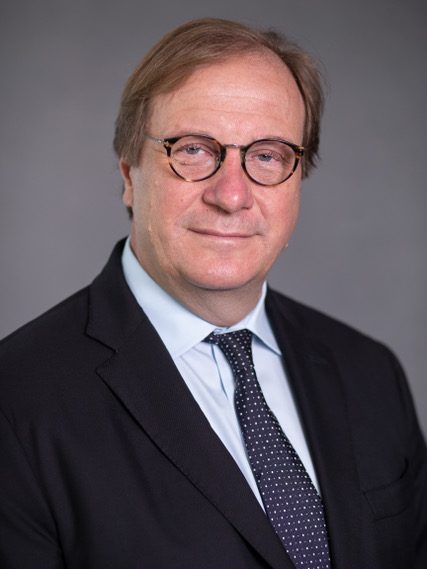
Frederick Kempe
President and CEO,
Atlantic Council
Supported by
Pfizer is a supporter of the Atlantic Council.
An #ACFrontPage Event
Atlantic Council Front Page is our premier live ideas platform for global leaders to discuss the defining challenges of our time. #ACFrontPage is a high-level event series featuring top newsmakers across multiple digital platforms. #ACFrontPage harnesses the convening power and expertise of the Council’s programs and centers to spotlight the world’s most prominent leaders and the most compelling ideas across sectors and to engage new audiences eager for nonpartisan and constructive solutions to current global challenges.
Related content



Explore the program

The Atlantic Council’s Cyber Statecraft Initiative, part of the Atlantic Council Technology Programs, works at the nexus of geopolitics and cybersecurity to craft strategies to help shape the conduct of statecraft and to better inform and secure users of technology.
Atlantic Council TV

Watch this event and more content on ACTV
Follow the conversations shaping our world. Available on all major platforms.