Click to read the transcript
This transcript is AI-generated. Check against delivery.
Frederick Kempe:
Good evening, everybody, and good evening to our international audience. Mr. President, I think this underscores the demand to listen to you. Perhaps we should have rented out a stadium, but thank you so much for being here.
I’m delighted to welcome you all here to this edition of Atlantic Council Front Page. This is our premier platform for global leaders who are working to make positive changes in the world.
I’m delighted to welcome you all and all of those on the livestream around the world, including so many tuning in tonight from Syria in the morning.
This conversation is part of the Atlantic Council’s AC in NY programming, which each year brings global leaders together on the sidelines of the UN General Assembly to take on the questions that will shape the decade ahead.
Tonight, it’s hosted by the Atlantic Council Syria Project, which is run by Victoria Taylor, part of the Middle East programs overseen and run by Will Wechsler. And I also want to welcome here Ambassador John Wilkes. This is an incredible team, Mr. President, we have working on Syria issues.
Before we begin, I want to recognize those who make this work possible. Our sincere thanks to Ilker Baburoglu, whose generous support anchors the Syria Project and its work on Syria’s transition. I also want to thank ConocoPhillips, our presenting partner for tonight’s program, and DT Institute, our supporting partner, for their generous support.
And your excellency, thank you for making time for the Atlantic Council during a demanding week in New York.
President Ahmed Al-Sharaa joins us today at a defining moment for Syria. Less than two years ago, the country stood at the threshold of a political transformation very few anticipated.
President Al-Sharaa is himself emblematic of Syria’s dramatic transformation, transitioning from the leader of a US-designated movement to a statesman welcomed in the Oval Office.
To lead the conversation, there is no one better placed than Brett McGurk. Brett served four presidents of both parties, spent a lot of time on the ground in Syria, as well as almost every other country—every other country in the Middle East. Built and led the global coalition against ISIS and coordinated Middle East policy at the White House. He’s now a distinguished fellow here at the Council.
For more than a decade, some of the region’s most difficult struggles converged in Syria. A popular uprising against authoritarian Assad regime, the international campaign to defeat ISIS and retake Iraqi and Syrian territory, and a competition between global powers eager to influence Syria’s orientation and take advantage of its geography.
We often say a country has outsized geopolitical importance. That’s really an understatement when it comes to Syria. The two people about to take the stage have each spent years at the center of those questions from very different vantage points. So, Mr. President, Brett, the floor is yours.
Brett McGurk:
Thank you. Thank you, Fred. Ahlan wa sahlan, it’s great to be here. You just came from a meeting with the president and leaders across the region, and we’re honored to have you here taking the time. We met briefly about a year or so ago with the Crown Prince of Saudi Arabia, and it’s great to see you again…
I’d like to start, Mr. President, if I can, because we are here in New York City, on the twenty-fifth anniversary of 9/11. And a question that I know many would want me to ask you, just given your background and the extraordinary evolution you’ve gone through.
In 2013, you pledged allegiance to Ayman al-Zawahiri, the leader of al-Qaeda at the time, of course, was a mastermind of that attack. You since, when you reorganized your armed forces, you moved away from that affiliation. But I just want to give you the opportunity—we’re here in New York City on this anniversary—to describe your evolution, give the opportunity to renounce that former pledge of allegiance, and just how you have changed since that time, now that you’re in this extraordinary role.
Ahmed Al-Sharaa:
Maybe last year we met with General Petraeus and we had an engagement in the battlefield, and then we had an engagement in the field of dialogue. And this is good this year that you were on the other side, on a political arena, and today we are together in this discussion. So I believe this is a success of this track.
First of all, talking about the 9/11, I had nothing to do with that. At the time, I was thirteen years old. I didn’t know anything about this stuff.
Of course, I am sorry for all the victims who perished in the United States or those who fell in—who had fallen in the Middle East because of the policies that were pursued there that victimized a lot of people. So, for sure, we are completely disengaged from what happened then and that act or action that took place in New York.
Brett McGurk:
Will you renounce that former pledge of allegiance? Not your, but you as the leader of Syria, as Ahmed Al-Sharaa, what you said in 2013. Do you renounce that ideology, that former pledge of allegiance that you gave? It’s a question that people ask, and I wanted to ask it just directly to you.
Ahmed Al-Sharaa:
There are so many questions that are part of the past now, so maybe we need to update ourselves. So I answered this question so many times before, and it’s now a repeated question.
I don’t believe that it is appropriate time to discuss things that happened twenty-five years ago. I was in a different age, and the conditions in the region were different, and they were pushing a lot of young people to go into that direction because of the pressure in that region. And then so many events happened, and then the Syrian revolution happened, and I evolved with the, with the levels of awareness. This, of course, the reason and the, the root cause that Allah—that pushed us to do that was to lift the injustice that people and the grievances that people were going through.
One of that was the injustice of the former regime that ruled Syria for the past sixty years. And of course, it was the worst terrorist crime that was perpetrated against the Syrians for sixty years that included bombing, detention, gassing people with chemical weapons, and killing people under torture. So I was part of this action.
So lifting that injustice is a noble act that any person would be honored to do… What happened, especially within the—amidst the conditions that are taking place right now in the region.
Brett McGurk:
Let me ask you, Mr. President, about the foundation of any transition like this is security for the people. And building a security force after the fall of a regime is extraordinarily difficult.
I just—as you’re building out this national force, thirty thousand foreign fighters came into Syria during the civil war. We had a terrible incident a year ago where a member of the internal security forces killed two US soldiers and an interpreter. I’m just—your approach to building out the national forces and the vetting process that goes into it to ensure that your security personnel are serving all the people and that if an American, American soldier, any Syrian citizen is next to a member of your security forces, they can trust them.
It’s a critical question of trust. Just your views on actually building out that force and the vetting that goes into this process, particularly if anything’s changed since that incident a year ago with the terrible incident with the two US soldiers.
Ahmed Al-Sharaa:
The place or the location where the American forces were present, it was an area that was under control of ISIS before, so that area was purified from that. So there was a security incident, just as such incidents happen in several areas in the world. So of course, the security building in Syria is going through several levels or several degrees. First of all was dismantling the factions and unifying the weapons under the umbrella of the state, and to be in under one army and under the, the state.
And then we started vetting and checking the standards for accepting new soldiers to be under the Ministry of Defense and in the Syrian army. And also they were part of training camps in order to make sure of those conditions. At the same time, we had the the duty to protect the country from the collapse of the country after the fall of the regime. So we attracted a large number of people who wanted to become soldiers quickly without having that high level of conditions, in order not to have this vacuum in Syria at the time.
So we were working on both sides at the same time. So we are—we were building training camps at the same time we were trying to fill that vacuum. So in any transition, there might be this default, and we might have incidents. So that wasn’t the only incident. There were several similar incidents, but they were not with American soldiers; they were in different places. Even within the Syrian security or Syrian army, such incidents happened.
So we also came beyond that degree or that level after one year and a half, and now we are at the level of professionalism in the security forces and good coordination. And there are some countries that are helping us in training our security forces to become a professional force.
Brett McGurk:
Mr. President, let me follow up a little bit on that. As you think about, again, going through this transition and the power between Damascus and the fourteen governorates, you have a constitutional declaration that doesn’t say that much about the governorates. Appointments are very much held at the center from you and your government.
And I’m just—as you look ahead, one thing I hear is concern about appointments from the center perhaps not reflecting the local community, particularly in the security file. And as you undergo this transition, how do you see the evolution of power between the center and the governance, which is Which can make a transition go wrong. I’ve seen this in other circumstances.
It’s a critical question I hear from many Syrians. I know you have strong views on it. When you look at the power of the governor—it’s a governor, local security officials—versus the centralization, how do you see that evolution over the coming months?
Ahmed Al-Sharaa:
I sit down with so many Syrians and they don’t ask this question. Anyway, in Syria we have an old law. When we arrived in Damascus, we didn’t abolish all the laws that were there in Syria. So there was the law of local administration that gave authority or powers to governorates in certain ways and in certain limits. There’s a law—law 107
And it was a decree, a presidential decree that was ratified in the People’s Assembly, and it was in place in Syria. Now, I’m not in a place to evaluate that law, whether it was good or not, but we are implementing the laws that we have. Now, then, we’re going to improve those laws through the People’s Assembly. There are wide powers for the governorates in the election of the municipal councils, etc., etc. And then the governors are appointed by the president as per the law.
Now, the People’s Assembly that is in session, that was elected a couple of months ago, as part of its task, it is to review so many laws that are in place in the country in order to improve the situation in the country and to have laws that are up to date.
Brett McGurk:
And the transition process laid out in the constitutional declaration talks about a five-year transition process with a constitution and getting to elections. Do you feel that you’re on track for that? Will we see a constitutional committee formed by the National Assembly over the coming months? How do you see that moving ahead?
Ahmed Al-Sharaa:
Part of the agenda—once again, we are going through several phases. The first phase was making sure that the security situation is in place and it is good. And then we had an inclusive national conference that included different parts of Syria.
That led to the constitutional declaration and also a cabinet that was also representative of the different denominations of Syria. And of course, we wanted not to go into a quota-sharing system in Syria that will lead to the division of the country on ethnic backgrounds or geographical or religious background, just as what happened in Iraq. So that’s what we wanted to have. We wanted to differentiate between participation in power and the share-taking in power, or the quota, taking on different backgrounds, whether the ethnicity or a school of thought or religion.
And so we had the different portfolios for different ministers based on, on the sharing of power. And then we went into the election of the People’s Assembly. It was not perfect elections, but it was appropriate for the phase. And then the People’s Assembly started its first sessions, and today they are doing hearing sessions to ministers in order to question some of the things that are taking place. And then now the People’s Assembly is going to appoint a committee that is going to review the different laws in Syria, and that another committee that will start drafting the constitution, and I believe that will be completed before the end of the five years.
Brett McGurk:
Sticking on Syria, and then we’ll turn to the region, Mr. President. I see Ambassador Barrack, and it’s great to have you here and all the work you’re doing, and the integration of the Syrian Democratic Forces in the northeast. And you’ve made some strides—your Decree 13 about Kurdish rights inside Syria. I think it’s an extraordinary document.
And yet there are still some serious concerns and incidents. We had an incident in Hasakah about a couple weeks ago where a Kurdish member of the security forces was tragically killed. And I’m just—as those types of events happen, Mr. President, how do you work with leaders in the local area to try to defuse tensions to make sure that these incidents don’t become communal divisions and worsen things? And if I could have one follow-up on that, there’s a big debate about Kurdish language rights and teaching the national curriculum in Kurdish.
I know this is something that is ongoing. I’d just welcome your views on it. But it gets to the larger question of ensuring that the diversity of Syria and all the local communities have a real stake and a say in the future that you’re leading?
Ahmed Al-Sharaa:
First, we need to know that we are living in a country that is very diverse in terms of religion, culture, and ethnicities for thousands of years, and things have been going all very well.
Very good, very well. And Syria is a role model in the world in terms of the coexistence of the diversity of the different groups. What happened in the past fourteen years and what happened in the past sixty years under the former regime that relied on terrorizing denominations and minorities by the majority, etc. That was—that had a negative impact, but that was a partial impact. Kurds are part of the Syrian society and they are living in the state.
And after the agreement that we reached with them, now the state is in control of all—almost all of the entirety of Syrian territories, especially the areas that were under control of SDF. The integration was great. I believe that before this integration, we issued a decree because this is a duty and it is a right for the Kurds who are living in Syria to recognize their cultural rights, linguistic rights in Syria. Of course, the details are in the, under the technical teams in the Ministry of Education and how this decree is going to be implemented.
At the end of the day, we agreed that the Kurds or Kurdish-inhabited areas are going to learn in Kurdish language. And I believe this decree was received very well and it was welcomed happily, because after one hundred years, the Kurds had their rights recognized, thanks to the Syrians and thanks to their patience and this government, to be part of the Syrian, Syrian society in order to live with other Syrians peacefully and securely.
Now, there are what—the integration that had, it was about a different—a group or a faction, and we’re not talking about the Kurdish community. So this differentiation is very important. We are talking about a group that was armed and that is not representative of the entire Kurdish people.
Brett McGurk:
Would you envision, Mr. President, that Decree 13 being incorporated into the constitution or the constitutional declaration, which is something I think you could do and I think would be an important—give it a real foundational element?
Ahmed Al-Sharaa:
For sure, it will be part of the constitution. It is already in place and in force, and we are—and the work is going on based on that decree.
Brett McGurk:
Mr. President, on the region, I know you just came from this meeting with the regional leaders and the president. And you live in such a difficult neighborhood. So let me ask about some of the issues that I’m sure you’re dealing with.
One is Lebanon. There’s still one million Syrians living in Lebanon, refugees. And I’ve heard President Trump a number of times say that Syria might be able to play a role against Hezbollah.
I’m curious about your relationship with President Aoun and kind of what you discussed with him, and what you see as Syria’s role in helping to stabilize Lebanon and helping President Aoun strengthen the sovereignty of Lebanon.
Ahmed Al-Sharaa:
The Syrian ideas that we have is to empower the Lebanese government to, to have better institutions and to empower their institutions. Also, to have the state taking control over all the weapons in the Syrian—in the Lebanese state, and not to have any weapons working or functioning outside the rule of law or the Lebanese state as well. At the same time, also to improve the Lebanese society and economic conditions there, in order also to overcome the problems that the Syrian regime caused in Lebanon. So we are engaging with the government on the best mechanism for political reform and the implementation of the Al-Taif Accord to be well implemented in Lebanon.
Brett McGurk:
Do you see Syria having a role when it comes to… Syria’s role—before the regime fell, Syria was a conduit for everything Iran wanted to do in Lebanon.
Syria’s role for helping Lebanon actually stand on its feet and helping to weaken the influence of Iran and Hezbollah—I’m just curious, what do you see as Syria’s role there?
Is there a role—I mean, I’ll tell you, because since President Trump says it’s something—is there a role for Syrian armed forces in Lebanon?
Ahmed Al-Sharaa:
It seems that it is a repeated question. I believe that Syria has its own problems and challenges inside Syria, but any instability in Lebanon affects Syria directly. Because the only land borders that Lebanon has are with Syria. So Syria is trying to help the Lebanese government as much as possible to empower the Lebanese institutions to do or to undertake their tasks, starting with economic aspects, societal aspects, and then political aspects.
Brett McGurk:
Moving east to Iraq, Mr. President, I think you’re going to see the Iraq—new Iraqi prime minister this week here. And I know you’re building a pipeline, helping to refurbish a pipeline, which can help alleviate the global challenge of—macroeconomic challenge of oil and energy prices. But your relationship with Iraq and the new prime minister of Iraq in particular, And the problem that, of course, Iraq is dealing with, with Iran’s influence and the Iranian-backed militia groups—where do you see the evolution of the Syria-Iraq relationship going?
Since two countries were such a font of instability, now there’s potential for both to be a center of stability, hopefully. But much will depend on your relationship with Baghdad.
Ahmed Al-Sharaa:
Of course, Iraq inherited a very heavy heritage due to the American war in Iraq that led to an increase of the Iranian influence in Iraq and their control in some of the junctures within Iraq. The current prime minister has a very heavy heritage. And I just met with him in a trilateral meeting with the Ambassador Barrack. And there are militias that are outlaw and they are working outside the institutions of the state, so the prime minister is trying to also control the arms of the militias and put them under the umbrella of the state.
So we have long borders with Iraq and we are trying to have some linkage—economic linkages between Iraq and Syria, and because this will lead to improvement in the relations for the best interest of both the countries. We are also trying to secure a safe passage of Iraqi products, especially oil products, through Syria. And there is a project to link the oil wells in Iraq to the Syrian ports—seaports—as an alternative to Bab el-Mandeb.
And the Suez Canal. Of course, that route was there since the 1950s, but because of the bad political relationship between Syria and Iraq, so this pipeline stopped. And we are trying now to reform what the errors and the problems that happened in the past half century.
Brett McGurk:
Mr. President, American forces have left Syria. They’re in the process of leaving Iraq. I lived through some of this a decade ago, and as a vacuum opened up, nothing good happened. I’m concerned, actually, about US forces simply leaving Iraq altogether. And I just want to ask you, would you be open to, if the president or a future president were to offer US military forces to help train your forces, to help be present, is that something that you are open to as you look to what your relationship will be with foreign military forces inside Syria?
Ahmed Al-Sharaa:
I believe the most successful exit of any American troops was in Syria because it was a safe exit under—and had happened under a good understanding and without having a war. And I believe that was the right decision.
There was a prior decision to withdraw troops from Iraq, and the Americans were upset because of that. And you were one of the people who were upset because of that decision, because of those expectations of other concerns, but I believe things happened very well and very smoothly there.
The withdrawal was very safe and the region remained calm, and no problems happened because of that vacuum. And the Syrian state and Syrian forces took control over the area. And as I said a while ago, the SDF in northeast were integrated into Syria, and the SDF has been dismantled and it is working now under the state. So emptying Syria from foreign bases and to be part of the region and to cooperate with different countries, and empowering Syria to have the unity of its territories and its sovereignty and the independence of its decision—that is a good approach.
We are dealing with so many countries. in order to improve or strengthen our country, whether we’re talking about training or getting some expertise and experiences of other countries.
Brett McGurk:
I have two more questions. I will say the counter-ISIS campaign, which lasted a decade, which is a huge success, working aside so many different Syrian fighting forces, including the Kurdish forces, including the SDF, and I think it helped make the world a much more stable place.
And ultimately now, with you in Damascus, I think there’s a potential to really build something that can be unique and lasting and stable for the world.
I do believe the United States will have an important role to play in that process. Leaving the easy part last, I have a couple more questions. One is your relationship with Israel. I know there have been talks under the auspices of the United States. You’ve talked about perhaps a return to the 1974 Separation of Forces Agreement or another security agreement as a gateway to peace.
Israel will have an election in a month. I’m wondering if you would have any message to, say, Israel has a new government, or just where those talks stand and where you might see them going.
Ahmed Al-Sharaa:
Since the fall of the former regime, Israel is repeating its attacks and aggressions against Syria. It is occupying new territories. There are territories that have been occupied after the 8th of December 2024. Until today, it is doing incursions, arrests inside Syria, and bombing different locations in Syria. Syria still chose to go through diplomacy and to solve that problem through talk and negotiations, as well as seeking the help of countries that are friendly to Israel, including the United States.
There were several sessions of negotiations with Israel, and we almost reached 90 percent of agreements. But at that point, Israel will withdraw from the agreement for different reasons that they put in place.
We are still in—we are still engaging in this track, and we are saying that—we are not saying that there will be lasting peace right now between Syria and Israel, but we need—we need to protect the security and the rights of the Syrians, because before that we can’t talk about peace. We can’t talk about peace if the rights of Syrians are usurped.
So—and the Americans are engaging with us in this dialogue and in these negotiations. However, things are not easy.
Brett McGurk:
Mr. President, could you envision having diplomatic relations with Israel? I know I’ve worked this issue in the past. Obviously, the issue of the Golan is a huge stumbling block. You have family history there.
Is it possible to have diplomatic relations with Israel in which you can have direct talks and help resolve some of these things before the issue of Golan is actually resolved? That could be resolved later. Or is that a precondition to actually establishing diplomatic relations with Israel?
Ahmed Al-Sharaa:
We are already having talks, direct talks with Israel, and these talks started around a year ago. But there is—there are two phases. The first phase is the new area that the Israelis have occupied after the 8th of December 2024. The talks were about—or we talked, first of all, that Israel should withdraw to the areas that they were occupying in 1974, and then we get into the discussions for security arrangements. If those arrangements succeed, then we can get into discussions about lasting peace.
The Golan Heights is Syrian territories under the recognition of the United Nations. And after voting—with the voting of more than 137 countries, they said that this is Syrian territory. So there is no discussion about about those territories and to whom they belong.
There are concerns of Israel. We always discuss those concerns, but not everything Israel does overcomes those concerns. Maybe we need an international committee to discuss those concerns in order to verify what is only a perception, what is genuine concerns, because we don’t want to always be under the umbrella or under the perception that we are talking about the concerns of Israel. I believe what we can achieve at this time is a historic moment that can be useful for all parties.
Brett McGurk:
One quick question on foreign forces before I turn it over to the audience. The Russians are still inside Syria. The Russians, of course, fought against you. Bashar al-Assad is believed to be in Russia. Do you envision Russian forces staying in Syria? And, of course, Turkey is a close partner and strategic partner of yours, and their forces are inside Syria.
What do you think the future of the role of Turkish forces are in Syria? But you’re particularly interested in the Russian question.
Ahmed Al-Sharaa:
As I mentioned, we are seeking not to have any foreign military bases in Syria and to have complete and pure sovereignty of the Syrian state. Russia was there in the past, and we inherited their presence when we arrived in Damascus. And we chose to go through dialogue with them, and this dialogue led to a result.
Those bases shrank into only two bases. They had around 170 military bases, and now there are only two bases. And after long discussions with them, we reached a point where we changed or we transformed those bases into training bases for the Syrian, Syrian army. So they are not military bases that can oversee or provide any logistical work for operations that are launched from those bases against other countries. However, we are still going through discussions with them, but the final stage was put in a memorandum of understanding that is being implemented right now.
As for the Turks, they were involved in a certain time because they were concerned about the security of their borders, and the region was on fire because of the conflicts and the wars.
Those bases also in northwest of Syria also got less and less. And now we are getting into having a legal status for them, because any presence or any foreign presence should be under the endorsement of the People’s Assembly and to have a legal status. So the Syrian state, I believe very soon we’ll not have the necessity to have any military or foreign military presence. And I believe we can go through the relations—diplomatic relations and respect with all the countries in the neighborhoods and the friends of Syria.
Brett McGurk:
Mr. President, one question just before we go to the audience. An issue that’s haunted me, my country, and also your country is Austin Tice. You know, you’ve met with his mother. He’s an American journalist who disappeared. We know that he was held by the Assad regime. I’ve met with members of the regime on this and laid out all the evidence, and they, of course, denied it. I know you’ve met with the mother. I just wanted to hear from you your commitment to following up on whatever stone has to be unturned to determine what happened to Austin.
And I just wanted to raise that with you and how important it is, I think, to everybody here, but also to hear your views.
Ahmed Al-Sharaa:
I met with the mother of Austin Tice, and she is a great woman, very passionate. And I also made her meet my mother, because my mother also lost me for seven years. She thought that I was killed, and then she found me, that I am still alive. So there is a similar story. And this gave hope to Austin Tice’s mother. Of course, I sympathize with her very much. And there we have around 150,000 Syrians who are missing people.
They were imprisoned by the regime, and then we emptied the prisons. And this number or this figure is not found yet. We have a national authority for looking for the missing people, and we are seeking some international expertise such as forensic—forensics and criminal investigation.
This matter, I cannot talk about everything about it because there is some intelligence, some security information about that, but we are trying to communicate every information we get about that for the family of Austin Tice.
Brett McGurk:
For some audience—this is a very informed audience, so these should be pretty good questions. Ibrahim, how about—
Ibrahim al-Assil:
Thanks, Brad. Mr. President, Ibrahim al-Assil. I’m with Harvard Kennedy School’s Middle East Initiative, where I lead the Syrian Transition Lab. Also, I’m a nonresident senior fellow here with the Atlantic Council. You’ve governed Syria now for almost two years, inheriting the position of the person who had the power to inflict pain on Syrians like nobody did throughout history. But the dilemma of transition is that usually presidencies still concentrate lots of power to lead the country throughout the position—the transition.
Are there any powers that you exercise today but you’ve come to believe that no Syrian president in the future should have after the transition? In other words, what is the Syrian presidency as an institution transitioning to under your leadership? Thank you.
Ahmed Al-Sharaa:
I think the transitional period cannot be taken as a model for the sustainability of the Syrian state. What we are trying to instill now, in Syria, is the respect of the law in these in these years, in order to make sure that the authority is an institution and not an individual that is ruling the country. So all the institutions of Syria are taking and playing their role based on the law or according to the law, and the president is the implementer of the laws that are approved or endorsed by the People’s Assembly.
Barak Ravid:
About the issue of Israel, you talked about the negotiations, and as you know, the Israeli society, uh, has been traumatized by the events of October 7th. I want to ask you first if you, do you understand those concerns of ordinary Israelis? And what’s your message to the Israeli public opinion, Israeli people, not the politicians?
Ahmed Al-Sharaa:
I understand what happened on the 7th of October for some of the innocent people, but at the same time, it is not possible that all policies are set based on an incident that happened in history, because at the same time we need to understand what happened in Gaza. And more than seventy thousand people have been killed there, and so many children, women have been killed and are being killed there. So what—it’s not appropriate that what happened on the 7th of October set the policy for Syria.
This is not logical, and this brings more security threats. So if you want to protect your own security, so you need to respect the security of others. So now we have a change in Syria—or sorry, Israel needs to change its policy because it is creating problems around it in order to maintain its security. And this is not working with them. So they need to change their security or their policy.
So there should be mutual respect and good economy and trade relations and mutual respect with other countries. I believe that is the good track to go through. I believe there were some policies that Israel is creating problems to Israel rather than securing Israel, because it is destabilizing areas around it and it is leading to those threats. I believe the region should be safe in order to help that everybody feels safe and secure so Israeli citizens as well feel that they are safe.
Why Syria has been bombed over two years every day? There are indiscriminate arrests that are taking place in Syria. Even the presidential palace have been bombed twice by the Israeli army. Our airports are being bombed, as well as all the military airports that we have. Will that bring security to the Israeli citizen?
Look at the relations that we have in Syria with the United States, with the UK, with the Gulf states, Iraq, and Lebanon. They are successful, and they are not—those relations are not successful with Israel. So I believe the problem is with Israel, not with Syria.
Mina Al-Araibi:
Mina Al-Araibi, I’m the editor-in-chief of The National in Abu Dhabi. Thank you. My question is, are you planning to be elected or to nominate yourself for elections in Syria when they happen? And the second question is, what is the main opportunity for you to overcome the challenges that you have?
Ahmed Al-Sharaa:
Well, I haven’t thought about being elected. I still have three years in the transitional period. Right now, we are focusing on serving people, and that’s what I have done in the past twenty years. I didn’t think about being in this position of presidency rather than developing the country economically and politically. So if this task needs me to be there in order to be implemented, so I’m not going to be—I’m not going to overlook that, yes.
And I will not be humble here. I will nominate myself in order to do that, because sometimes if you avoid responsibility or escape responsibility, it doesn’t make you lose that responsibility. Sometimes you need to take up the responsibility when you believe that you are capable of doing that, because we had some complex problems that happened in the past years before the liberation of Syria, as well as after liberating Syria in the past two years. So we have a very complicated and so many details in the worries.
So for me as a person, it is better to go back to my normal life because this road is really tiresome. But if I believe that if I thought that I need to remain in power, I will stay there.
I forgot the second question. It seems that we missed it.
Audience Member:
I wanted to follow up on the question of Israel. First of all, do you foresee the possibility of a negotiation and of an agreement with Israel under the leadership of the current Prime Minister Netanyahu, and what do you see as the future resolution for the Golan Heights?
President Trump’s administration declared Israeli sovereignty in his first term over the Golan. Is that something that needs to be discussed and negotiated, or is that something that you think cannot persuade either President Trump or Israel to reconsider?
Thank you, sir.
Ahmed Al-Sharaa:
President Trump stood to the side of Syria, supported Syria, and issued a historic resolution or decision to lift sanctions off Syria, and I have a very unique relationship with him. But once, when I visited him in the White House, I made a joke with him. And when he said about the Golan Heights that it has the sovereignty of Israel, I said, why don’t you give New Jersey to the Israelis? You don’t own Golan Heights to give it to them, but you own New Jersey.
And I believe that New Jersey is full of Democrats, and they are not voting for Trump. So it will be good to give it to the Israelis.
So at least this is something that you own. But President Trump doesn’t own the Golan Heights. So regardless of this joke, the Golan Heights, it is owned by its own people. So it’s neither the Syrian president or the American president or any other person to abandon them or to give them up to others.
Audience Member:
Thank you, Mr. President. I have two quick questions. How would you describe your relationship with the Kurdistan Regional Government? And second one, in politics you have to make compromises in order to stay in power. Do you believe that? Do you agree with that?
Ahmed Al-Sharaa:
I didn’t understand what is the connection between the two questions, but to answer the first question, we have very good relations with the KRG.
We have good economic relations, security relations, and we have good relations with Mr. President Masoud Barzani and Nechirvan and all the groups there. And I believe this is something that we are still in the beginning of this relation and we can build on that for the future. I believe we communicated with each other during the problem of SDF and the KRG had their input in order to help Syria for the integration of SDF in the Syrian state.
I didn’t understand the second question. It is very general, but we are doing everything that can be in the best interest of the Syrian people.
Brett McGurk:
I think there’s like fifty more questions, but unfortunately you’ll have to wait for it. We can do this again next year maybe, if you’re good with it.
Victoria Taylor:
Well, I’m Victoria Taylor. I’m the director of the Syria Project and the Iraq Initiative here at the Atlantic Council. I want to thank Brett and the president for this great conversation. And thank you, Mr. President, for spending some time with us this evening.
I want to thank again our sponsors to the Atlantic Council, Ilker Baburoglu, for his support to the Syria Project, as well as ConocoPhillips, our presenting sponsor, and DT Institute, our supporting sponsor. If I could ask the crowd to please clear. Thank you. If you could clear space so that the president can exit, and the rest of you can please hold. Thanks so much.
On Tuesday, September 22 at 5:30 p.m. ET, the Atlantic Council’s Syria Project hosted Syrian President Ahmed Al-Sharaa, for an Atlantic Council Front Page conversation as part of our AC in New York programming on the sidelines of the United Nations General Assembly.
Syria is navigating a pivotal transition as it works to rebuild state institutions, revive its economy, attract international investment, and deepen its engagement with the United States and the broader region.
In this conversation, Al-Sharaa discussed his vision for Syria’s future and his government’s priorities for reconstruction, economic recovery, and institutional reform. He also addressed the evolving US-Syria relationship, efforts to strengthen state institutions, and Syria’s continued regional reintegration.
This event is hosted by the Atlantic Council’s Syria Project, which advances policy engagement and international partnerships during Syria’s political transition through its work on US-Syria relations, economic growth and energy, governance, and regional reintegration.
This event is part of our #ACinNY series, happening on the sidelines of the United Nations General Assembly. See the rest of the line-up and register for more events here.
:للقراءة بالعربية
يوم الثلاثاء 22 سبتمبر، الساعة 5:30 مساءً بتوقيت نيويورك، يستضيف مشروع سوريا في المجلس الأطلسي رئيس الجمهورية العربية السورية أحمد الشرع في حوار ضمن سلسلة Atlantic Council Front Page، وذلك في إطار فعاليات المجلس الأطلسي في نيويورك على هامش أعمال الجمعية العامة للأمم المتحدة.
تمر سوريا بمرحلة انتقالية محورية، في وقت تعمل فيه على إعادة بناء مؤسسات الدولة، وإنعاش اقتصادها، وجذب الاستثمارات الخارجية, وتعزيز شراكتها مع الولايات المتحدة والمنطقة.
خلال هذا الحوار، سيعرض الرئيس الشرع رؤيته لمستقبل سوريا وأولويات حكومته في إعادة الإعمار، التعافي الاقتصادي، والإصلاح المؤسسي. كما سيتناول تطورات العلاقات بين الولايات المتحدة وسوريا، والجهود الرامية إلى تعزيز مؤسسات الدولة، ومواصلة سوريا مسار إعادة اندماجها الإقليمي.
يستضيف هذه الفعالية مشروع سوريا في المجلس الأطلسي، الذي يعمل على تعزيز الحوار بشأن السياسات وبناء شراكات دولية خلال المرحلة الانتقالية السياسية في سوريا، من خلال عمله في مجالات العلاقات الأمريكية-السورية، والنمو الاقتصادي والطاقة، والحوكمة، وإعادة الاندماج الإقليمي.
تأتي هذه الفعالية ضمن سلسلة #ACinNY التي ينظمها المجلس الأطلسي على هامش أعمال الجمعية العامة للأمم المتحدة. للاطلاع على بقية الفعاليات والتسجيل فيها، يُرجى زيارة الرابط هنا.

Featuring

H.E. Ahmed Al-Sharaa
President of the Syrian Arab Republic
Welcome remarks
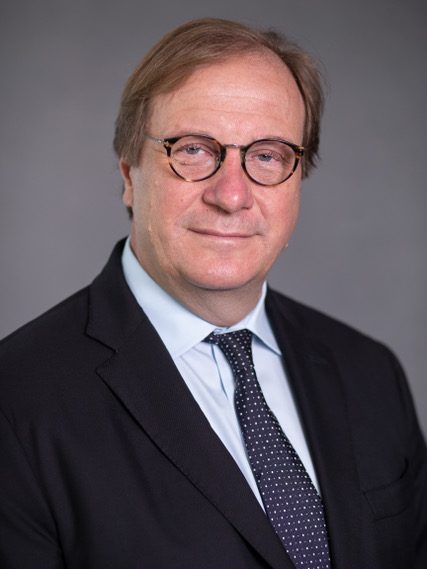
Frederick Kempe
President and CEO,
Atlantic Council
Moderated by

Brett McGurk
Distinguished Fellow, Middle East Programs,
Atlantic Council
Supported by


An #ACFrontPage Event
Atlantic Council Front Page is our premier live ideas platform for global leaders to discuss the defining challenges of our time. #ACFrontPage is a high-level event series featuring top newsmakers across multiple digital platforms. #ACFrontPage harnesses the convening power and expertise of the Council’s programs and centers to spotlight the world’s most prominent leaders and the most compelling ideas across sectors and to engage new audiences eager for nonpartisan and constructive solutions to current global challenges.
Related content
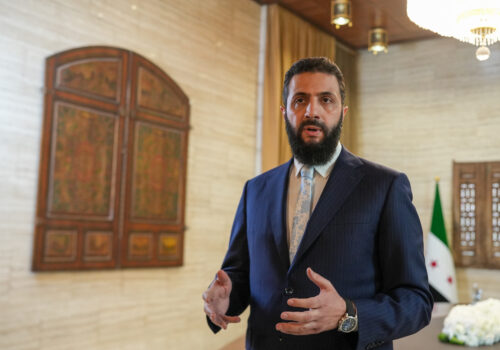


Explore the program

The Syria Project advances policy engagement and international partnerships during a pivotal political transition. It serves as a leading platform for independent analysis and high-level dialogue on US-Syria relations, economic recovery, governance, and regional reintegration, leveraging deep networks across Washington, Damascus, and the broader Middle East.
Atlantic Council TV
Watch this event and more content on ACTV
Follow the conversations shaping our world. Available on all major platforms.