
This issue brief is part of the Freedom and Prosperity Center’s “Voices of the Future” series, which highlights how graduate students are using the Freedom and Prosperity Indexes to explore pressing governance and development challenges across the world.
Bottom lines up front
- Women’s access to state jobs is consistently linked to greater political freedom and rule of law across the world.
- Despite this, women’s share of parliamentary seats shows no consistent link to either political freedom or rule of law once country differences are accounted for.
- Further research is needed to assess specific determinants of women’s parliamentary representation across the world, as well as to assess the societal outcomes associated with female leadership.
Introduction
Female leadership has emerged as a critical factor in shaping governance systems. Beyond the symbolic value of women occupying high leadership positions, women in some jurisdictions now hold positions from which they can influence the direction of political and legal reforms. This issue brief examines how female leadership in public service is associated with two institutional outcomes: political freedom and rule of law. Understanding the broader implications of women’s representation in leadership roles can inform strategies to preserve and promote freedom, democracy, and prosperity.
Using the Atlantic Council’s Freedom and Prosperity Indexes alongside World Bank data, this article investigates the relationship between female leadership and political and rule of law over the period 2000-2023. In this research, female leadership is captured by two variables: opportunities for minorities (the Prosperity Index minorities component) which serves as a proxy for women’s access to state jobs because one of its underlying sources is access to state jobs distributed by gender, and the share of women in national parliaments. To account for other factors that may shape the relationship, the analysis controls for income, women’s economic freedom, education, and inequality.
Literature review
While previous research highlights that women’s leadership can strengthen democratic governance, its effectiveness is frequently constrained by structural, institutional, and economic barriers that shape the conditions under which women lead.
Paola Rebeca Moreno Sandoval and Dafne Dzoara Pimentel Corona examined whether and how democracy is reshaped through feminist transformative leadership, drawing on Mexico’s 2019 constitutional parity reform and the 2024 election of Mexico’s first woman president. Building on democratic critical theory, they conceptualized democratic improvement as the exercise of democratic practices and their installation in public institutions, defining these practices as the strengthening of political pluralism, the increase in women’s civic engagement, and the diversity of leadership types in positions of power. They concluded that while the leadership of some women made legal recognition of women’s political rights in Mexico possible, entrenched patriarchal structures, political violence, and “glass cliff” dynamics continued to constrain transformative potential. They further concluded that democratic improvement depends not solely on individual feminist leadership but also on broader systemic conditions, such as supportive electoral rules, strong women’s movements, and political will, and cautioned against evaluating women leaders’ performance without accounting for these structural constraints.
Furthermore, Adrita Iman, Zafar Nazarov, and Anastassia Obydenkova found that, across post-communist societies in Eastern Europe and Central Asia, firm innovation among female-led firms increases with democratization, and that democratization eliminates most gender disadvantages in firm innovation. Their results suggest that democratic institutions create the enabling conditions under which women’s leadership translates into stronger firm-level innovation outcomes.
Similarly, the 2023 Women Political Leaders (WPL) “Representation Matters”report argued that women’s political representation is closely linked to legal equality of economic opportunity. It further suggested that such representation typically precedes, and may be necessary for, the realization of this legal equality. The report also noted that the representation of women in politics is associated with improved overall economic performance, which it links to the relationship between representation and legal equality of economic opportunity, although it describes this as an initial observation requiring further analysis.
Further, a study by the ifo Institute and University of Munich provided evidence that the entry of one female leader can lead to a lasting increase in women’s political representation. The study used a synthetic control analysis of Germany’s unexpected 1993 appointment of the first woman to serve as head of a state government and panel data covering 177 countries from 1966 to 2023. It found that this effect is highly persistent and driven by the direct appointment of women rather than broader shifts in women’s political engagement, underscoring how influential women in leadership can create durable pathways for others to reach positions of power.
Finally, a Georgetown Institute for Women, Peace, and Security study connected women’s status to democratic strength, finding that performance on the Women, Peace, and Security (WPS) Index among free and partly free countries was significantly correlated with all three democracy metrics examined: clean elections, checks and balances, and freedom of association and assembly. These findings suggested that countries where women fare well in inclusion, justice, and security also tend to have fairer elections, more balanced and accountable government institutions, and more autonomous civil societies, with the relationship most strongly driven by women’s inclusion. The research concluded that safeguarding democracy and advancing women’s status are mutually reinforcing goals, though security remains only weakly linked to these democratic metrics, reflecting the limits of institutional indicators in capturing broader social and cultural barriers to gender equality.
Research significance
Prior research has demonstrated that the relationship between female leadership and democratic outcomes can be complex. This article takes a closer, more systematic look at this dynamic using quantitative cross-country data. Drawing on the Atlantic Council’s Freedom and Prosperity Indexes and World Bank data, this analysis examines how female leadership, operationalized through opportunities for minorities (a proxy for women’s access to state jobs) and the share of women in national parliaments, correlates with political and rule of law. By controlling for income, education, inequality, and women’s economic freedom, this study examines how female leadership is associated with these institutional outcomes, offering broader empirical context for the relationships identified in the existing literature and informing strategies to advance freedom, democracy, and prosperity globally.
Research questions
- How do opportunities for minorities (a proxy for women’s access to state jobs) and the share of women in national parliaments correlate with political freedom?
- How do opportunities for minorities (a proxy for women’s access to state jobs) and the share of women in national parliaments correlate with rule of law?
Methodology
This study employs a panel analysis covering 2000-2023 containing 3,212 observations.
Date sources
Dependent variables
- Political freedom (Freedom Index, political freedom subindex)
- Rule of law (Freedom Index, legal subindex)
Independent variables
- Opportunities for minorities (Prosperity Index, minorities component), used as a proxy for women’s access to state jobs, as one of its underlying sources is access to state jobs distributed by gender
- Proportion of seats held by women in national parliaments (percentage) (World Bank Open Data)
Control variables
- Income (Prosperity Index, income component)
- Women’s economic freedom (Freedom Index, economic subindex)
- Education (Prosperity Index, education component)
- Inequality (Prosperity Index, inequality component)
Analysis
The econometric analysis examines the correlation between female leadership and political and rule of law, controlling for economic and social variables. Using a combination of pooled linear regressions with economic and social controls and country fixed-effects models, with and without year effects, we analyze how women’s participation in governance is associated with these freedoms. Standard errors are clustered by country in all models.
Our models incorporate control variables including income, women’s economic freedom, education, and inequality, to account for other factors that may shape the association between female leadership and freedom. Country fixed effects absorb unobserved, time-invariant heterogeneity across countries, while standard errors clustered by country allow for correlation of errors within national observations over time. We estimate two specifications:
- controlled pooled models including all socioeconomic variables; and
- country fixed-effects models, with and without year effects.
Descriptive patterns
Figure 1. Political freedom versus opportunities for minorities and women in parliament
Figure 1 reveals a positive association between opportunities for minorities (a proxy for women’s access to state jobs) and the political freedom subindex, though with noticeable dispersion. Observations with higher opportunities for minorities tend to have higher political freedom scores although the relationship flattens near the top of the index. Higher shares of women in parliament tend to coincide with greater political freedom and minority access to state jobs, although the pattern is not consistent across observations.
Figure 2. Rule of law versus opportunities for minorities and women in parliament
Figure 2 reveals a stronger and less dispersed positive association between opportunities for minorities (a proxy for women’s access to state jobs) and the rule of law subindex. Observations with a higher share of women in parliament also appear slightly more concentrated at higher levels of rule of law, particularly among observations with stronger minority access to state jobs, although substantial variation remains.
Regression results
Table 1. Impact of female leadership on political freedom and rule of law
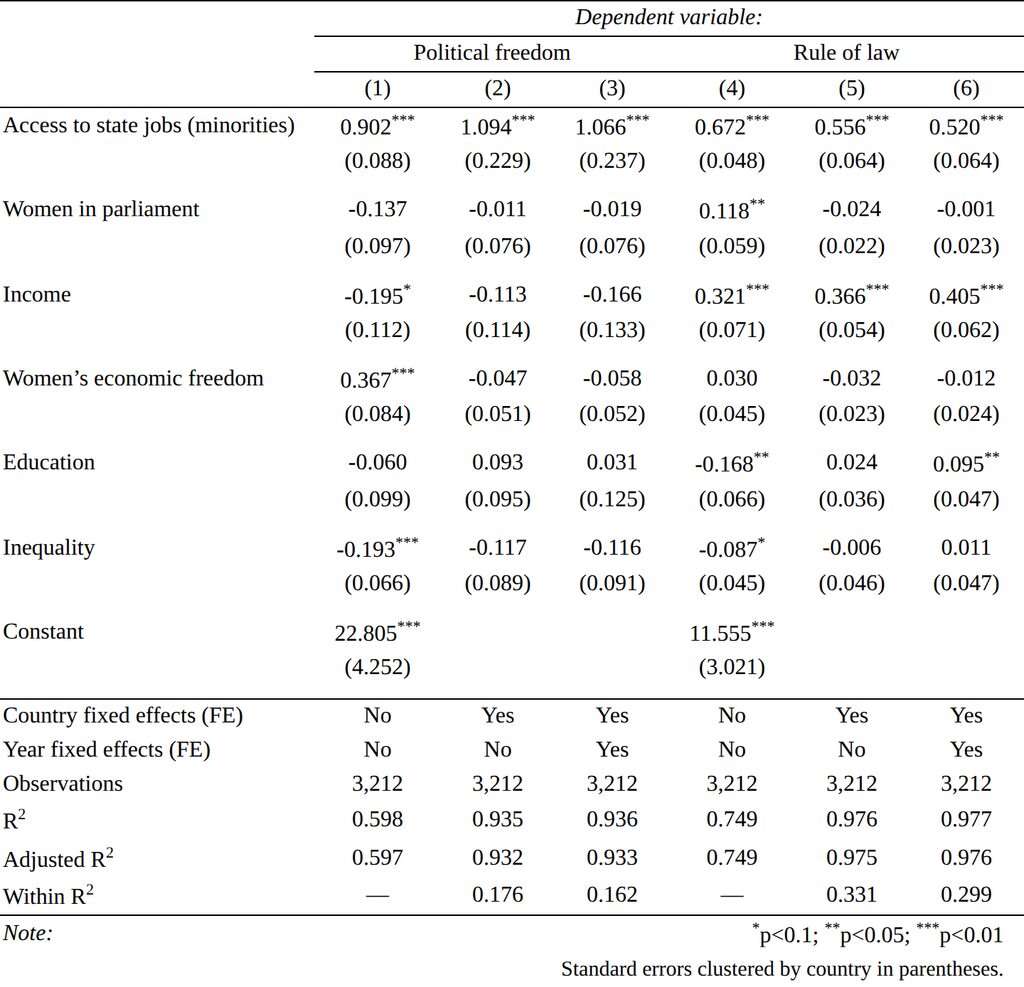
The multivariate regression results in Table 1 show the core of the empirical analysis, which models the association of political freedom and rule of law from 2000-2023, controlling for key socioeconomic variables. Standard errors are clustered by country. The initial specification (columns 1 and 4) has no fixed effects. The second specification (columns 2 and 5) adds country fixed effects, and the third (columns 3 and 6) adds both country and year fixed effects. The results show one consistent pattern, a positive association with opportunities for minorities (a proxy for women’s access to state jobs), while several other associations weaken or disappear once country fixed effects are included.
- Opportunities for minorities (a proxy for women’s access to state jobs): This variable is positively correlated with both political and rule of law. In the initial models, the coefficients (0.902 for political freedom and 0.672 for rule of law) are highly significant (p < .01), and they stay positive and significant at the 1% level in all four fixed-effects models (1.094 and 1.066 for political freedom; 0.556 and 0.520 for rule of law). This indicates that greater opportunities for minorities, which include more equal access to state jobs by gender, are strongly associated with enhancements in both fundamental freedom domains even after controlling for income, women’s economic freedom, education, and inequality, and after accounting for differences between countries and years. This is consistent with the idea that structural integration of women into governance roles strengthens democratic institutions, and enhances the rule of law. However, because the component also reflects other dimensions of minority opportunity, the association cannot be attributed to women alone.
- Parliamentary representation: The analysis shows no consistent correlation. For political freedom, the coefficient is negative in the pooled model (-0.137) but is not statistically significant, and it is close to zero in the fixed-effects models (-0.011 and -0.019). This lack of a clear relationship might reflect scenarios in which women are elected in contexts of declining democratic quality or where their presence is symbolic rather than substantive. For rule of law, the pooled coefficient is positive and significant at the 5% level (0.118, p < .05), but it falls to about zero and is no longer significant once country fixed effects are added (-0.024 and -0.001). This suggests that the pooled rule of law result mainly reflects differences between countries, with countries that have more women in parliament also tending to have stronger rule of law, instead of reflecting changes within countries over time.
- Control variables
- Income is negatively associated with political freedom (-0.195, p < .1) in the initial specification, but is not significant in the fixed-effects models (-0.113 and -0.166), while it is positively correlated with rule of law in all specifications (0.321, 0.366, and 0.405, all p < .01).
- Women’s economic freedom shows a positive correlation with political freedom (0.367, p < .01), but this disappears in the fixed-effects models (-0.047 and -0.058, not significant). It is not significantly associated with rule of law in any specification.
- Education shows no consistent pattern. It is negative for rule of law in the pooled model (-0.168, p < .05) but positive in the model with country and year fixed effects (0.095, p < .05), and it is not significant in the other columns.
- Inequality is negatively associated with both freedoms in the pooled models (-0.193, p < .01 for political freedom; -0.087, p < .1 for rule of law), but these associations shrink and are not statistically significant once country fixed effects are included.
The pooled models have R² values of 0.598 and 0.749, so they explain a substantial portion of the variation in political and rule of law. The much higher R² values in the fixed-effects models (0.935 to 0.977) mostly reflect the country and year effects. The within-R² values, which isolate variation within countries, are considerably lower (0.162 to 0.331).
Conclusion
The findings suggest a more nuanced picture than a simple, uniform relationship between women’s presence in government and democratic outcomes. Opportunities for minorities, a proxy for women’s access to state jobs, emerged as a positive correlate of both political and rule of law in every specification, including the models with country and year fixed effects, suggesting that the structural integration of women into public administration might be closely tied to broader institutional strength. Parliamentary representation showed no consistent pattern: a positive association with rule of law appeared only in the pooled model and disappeared once country fixed effects were included, and there was no significant association with political freedom in any model. This suggests that women’s presence in legislatures is not clearly linked to greater political or rule of law once differences between countries are accounted for. One possible explanation for this counterintuitive finding is that women’s presence in legislatures does not necessarily translate into greater political openness. Instead, it may reflect contexts in which representation is more symbolic than substantive, or in which women gain seats amid declining democratic conditions.
These findings should also be considered alongside certain data considerations. The opportunities-for-minorities component serves as a proxy that captures women’s access to state jobs only partially, through one of its underlying sources, and the parliamentary seat share is a useful but limited measure; neither fully captures the substantive quality or autonomy of women’s leadership in practice. Also, variation in coverage across the underlying Freedom and Prosperity Indexes and World Bank series might introduce some measurement imprecision. Country-specific institutional and cultural factors, of the kind documented in the Mexico and Germany studies reviewed above, likely shape these relationships in ways that a cross-national panel is not fully equipped to isolate. Fixed effects account for differences between countries that do not change over time, but not for factors that change over time and affect both female leadership and freedom, so the results should be read as associations rather than causal effects. Further research would help clarify the relationship, between parliamentary representation and political and rule of law, while more granular qualitative work could shed light on how the conditions under which women attain office shape the outcomes associated with their leadership.
about the author
Helena Fee Rasch is a former visiting fellow with the Atlantic Council’s Freedom and Prosperity Center. She holds an MPA in economic policy from the London School of Economics and Political Science.
explore the data
stay connected
explore the program

Political, economic, and legal freedoms are the foundation of prosperity. The Freedom and Prosperity Center generates evidence to drive policy reform and advance human well-being, particularly in emerging markets and developing economies.
Image: French Deputy Minister for equality between women and men and the fight against discrimination Aurore Berge during a session of questions to the government at the National Assembly, France's lower house of parliament, in Paris on October 27, 2026. Photo by Raphael Lafargue/ABACAPRESS.COM via Reuters
For the latest updates, follow us on social media