Through our Rafik Hariri Center for the Middle East and Scowcroft Middle East Security Initiative, the Atlantic Council works with allies and partners in Europe and the wider Middle East to protect US interests, build peace and security, and unlock the human potential of the region.

Meet our blogs

All commentary & analysis

MENASource

May 1, 2023

Should history rethink Paul Bremer’s role in the Iraq war?

By Andrew L. Peek

In the pantheon of Iraq war “villains,” perhaps no single official has been blamed for more disaster than Paul Bremer, the Coalition Provisional Authority leader who ruled Iraq for roughly one year.

Iraq
Middle East

Event Recap

May 1, 2023

20-Year retrospective: Reflecting on the ‘Mission Accomplished’ speech and its aftermath

By Amna Haider

On the first of May, 2003, six weeks after the US invasion of Iraq, former US President George W. Bush delivered the widely known “Mission Accomplished” speech while aboard the USS Abraham Lincoln. On the twentieth anniversary of this speech, the Atlantic Council’s Iraq Initiative hosted a virtual discussion with distinguished guest speaker General David […]

Conflict
Crisis Management

Podcast

Apr 27, 2023

What Russian mercenaries tell us about Russia

By Alia Brahimi

Host and nonresident senior fellow Alia Brahimi speaks with Russian defence analyst Pavel Luzin about what the proliferation of Russian mercenaries abroad tells us about Russia at home.

Conflict
Crisis Management

IranSource

Apr 27, 2023

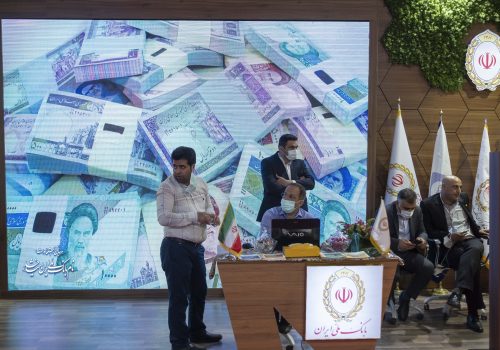
Tehran’s gold market is a reminder that Iranians have lost confidence in a future with the Islamic Republic

By Ali Dadpay

Iranians do not believe in the ability of the Islamic Republic to bring either economic stability or prosperity as a governing body, which is why they are looking for ways to reduce financial risk.

Economy & Business
Financial Sanctions and Economic Coercion

IranSource

Apr 24, 2023

What the ICJ ruling on the Central Bank of Iran means for the US and the Islamic Republic—and those seeking reparations for state-sponsored atrocities

By Celeste Kmiotek

On March 30, the International Court of Justice issued its final judgment on a case between the Islamic Republic of Iran and the United States on the fate of “Certain Iranian Assets.” The judgment contains wins and losses for both sides.

Iran
Middle East

New Atlanticist

Apr 21, 2023

Is Saudi-Iran reconciliation threatening the future of Israeli normalization?

By Sarah Zaaimi

The recent rapprochement between Saudi Arabia and Iran could signal a sea change in Arab-Iranian relations and pose practical hindrances to Arab-Israeli normalization.

Iran
Middle East

IranSource

Apr 21, 2023

Springtime in Iran signals the renewal of an environmental movement

By Shirin Hakim and Karen Makuch

Although there has been a decline in the size and frequency of protests in recent months, the onset of Spring serves as a reminder that the goals of the Woman, Life, Freedom movement are perennial.

Energy & Environment
Iran

MENASource

Apr 21, 2023

How WhatsApp upended Middle East diplomacy—and what the US can learn from it

By Joze Pelayo, Yulia Shalomov

In WhatsApp’s encrypted channels, diplomats feel freer to form and participate in groups where they privately share resources, coordinate meetings, strategize with colleagues, create informal alliances, lobby for their country’s positions, and coordinate policy decisions.

Middle East
Politics & Diplomacy

IranSource

Apr 20, 2023

The Islamic Republic is mobilizing all its forces against unveiled Iranian women, but they’re pushing back

By Mahnaz Vahdati

Despite all these brutal actions by the clerical establishment, many Iranian women are taking a prominent role at the forefront of the non-violent opposition to the gender apartheid system in Iran by defying the mandatory hijab.

Politics & Diplomacy

MENASource

Apr 17, 2023

Safeguarding the past: The Arab world’s cure to Holocaust amnesia

By El Mehdi Boudra

On the eve of Yom Hashoah, it is no longer considered taboo in the MENA region to promote Holocaust education and genocide prevention. The region’s youth are more receptive to discussing the events of one of the darkest chapters of human history, despite the political, religious, and educational challenges shrouding this historic move that has been praised in some nations in the region and criticized in others.

Civil Society
Education