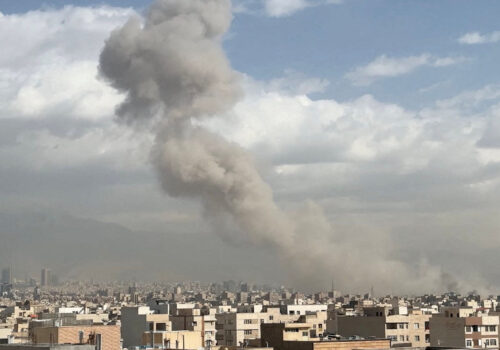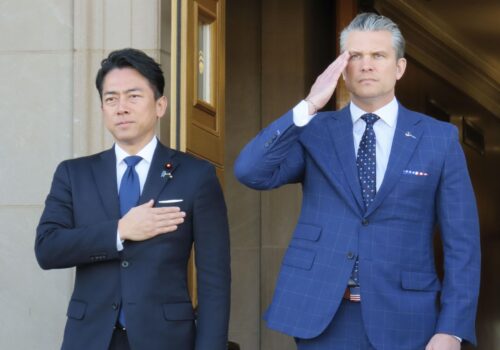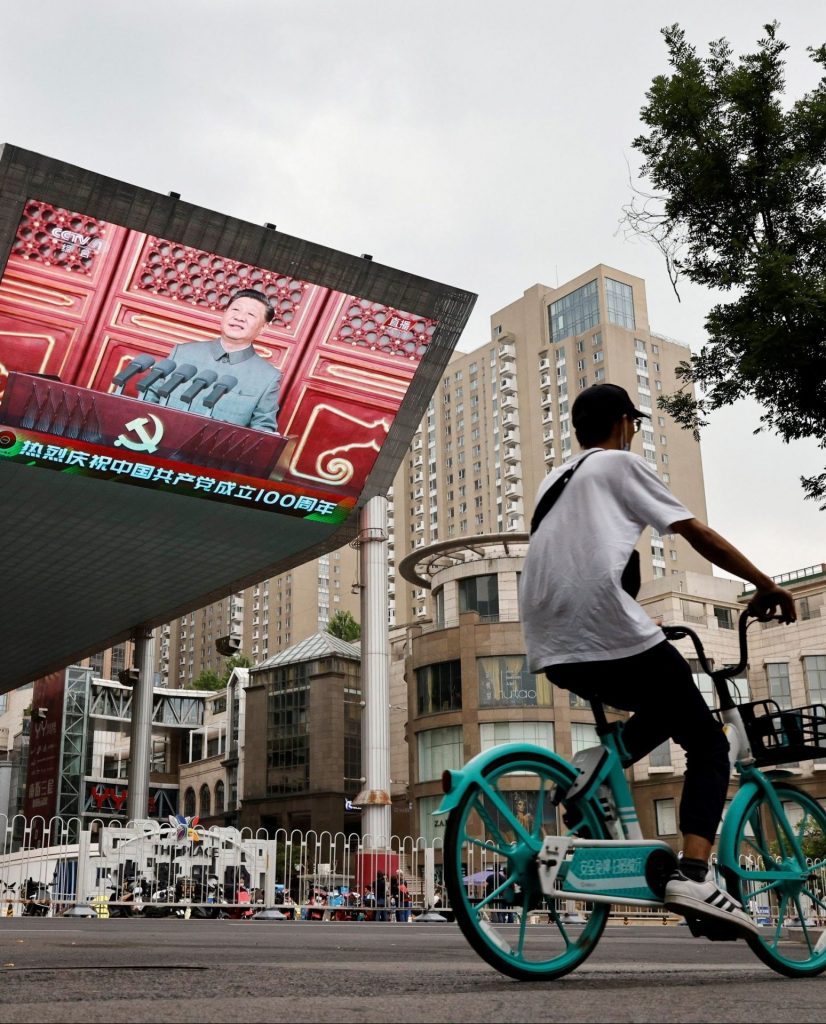
For one week in February, an Atlantic Council team and peers from Washington-based academic institutions and think tanks visited Tokyo, Hiroshima, Saijo, and Miyajima to learn about the culture, traditions, and international policies of Japan. We attended meetings with representatives of government agencies, private companies, and local think tanks. Japan’s Ministry of Foreign Affairs sponsored the trip. What follows is a combination of our observations.

Read More

Moldova’s presidential elections are shaping up to divide the electorate between pro-Europe and pro-Russia candidates even before campaigning officially gets underway.

On April 1, Moldova’s Parliament voted to hold direct presidential elections on October 30. It put off the official start of the election campaign until July 30 to allow Parliament time to pass electoral legislation and fill vacant seats in the Central Election Commission. The vote in Parliament followed a surprise Constitutional Court decision on March 4 that struck down a 2000 amendment, which required a supermajority of sixty-one out of 101 members of Parliament to select a President. The political consensus required to obtain such a supermajority turned out to be more difficult than anyone had expected.  In fact, a failure to achieve a supermajority led to a 900-day period between September 2009 and March 2012 when Moldova lacked an elected President.

Read More

Ukraine’s current political crisis is easy to understand. It was unleashed by an offensive by the Poroshenko Bloc to get greater control over the government. It started on February 3, when Economy Minister Aivaras Abramovicius resigned in protest against Ihor Kononenko, the gray cardinal of the Poroshenko Bloc, and it was aggravated by the failed vote of no confidence in the Yatsenyuk government on February 16.

Previously, the successful reform ministers Andriy Pyvovarskiy and Oleksiy Pavlenko had resigned quietly, apparently having been subjected to similar pressure from Kononenko. The only strong reform minister left standing was highly-respected Finance Minister Natalie Jaresko.

Read More

It’s been a rough several weeks for Ukraine in the news. From the firing of prominent reformer Davit Sakvarelidze from the Prosecutor General’s Office to the recent release of the “Panama Papers,” which seemingly link President Petro Poroshenko to several offshore accounts and sparked accusations from members of the Verkhovna Rada of abuse of office and tax evasion, the last few weeks may have led some in the West to doubt Ukraine’s commitment to democratic reforms.

According to the International Republican Institute’s (IRI) latest national municipal survey, which includes the perceptions of more than 19,000 Ukrainians from twenty-four major cities, more than 90 percent of Ukrainians believe corruption is a significant or serious problem in their community, and frustration with Poroshenko and the Verkhovna Rada stands at troubling levels.

But that’s not the full story. Ukrainians are more optimistic about their local government. Ukrainians told pollsters that they trust and approve of their local mayors more than in previous years. In the cities of Kharkiv, Lviv, and Ternopil, more than 60 percent approve of their mayor’s activities and reforms according to the municipal survey.

Read More

NATO has decided to bolster its military operations in Central Europe to better deter and, if necessary, defend against Russian aggression. Toward that end, Alliance military authorities have been tasked to develop plans for the deployment of multinational units, possibly battalions or brigades, that will be deployed on a persistent basis along NATO’s eastern frontier. NATO heads of state are expected to approve these plans at a summit meeting in Warsaw this July.

Ukraine should offer to contribute to this enhanced NATO presence. High-level Ukrainian national security officials have urged the international community to be bolder in its response to Russia’s provocative military actions. NATO’s July summit provides Ukraine with a significant opportunity to be consistent with its own rhetoric.

The deployment of a battle tested, Ukrainian infantry company or larger unit to reinforce the defense of NATO territory in Central Europe would be a positive contribution to the Alliance force posture in the region. As NATO commanders finalize their plans, now is the time to present such an initiative to the Alliance.

Read More

NATO Secretary General Jens Stoltenberg refused to wade into US domestic politics, but he delivered a forceful defense of the Alliance on April 6 in remarks that may be interpreted as a firm rebuttal to Republican presidential frontrunner Donald Trump’s criticism of the grouping as “obsolete.”

Noting that the mutual interests of the United States and Europe are best served by a strong North Atlantic alliance, Stoltenberg said: “Without NATO, transatlantic cooperation would be weaker, Europe and North America less safe, and the world a more dangerous place.”

Describing the security of Europe and North America as “indivisible,” he said that “only by standing together will we remain safe and secure.” Stoltenberg spoke at an event hosted by the Atlantic Council at the Ritz-Carlton hotel in Washington.

NATO’s Secretary General contended that the bonds of the transatlantic alliance had “carried us through the Cold War” and that security, prosperity, and open society would be at greater risk without NATO. “A safer, stronger Europe means a safer and stronger United States,” he said. “That was the rationale behind the decision to create the Alliance and it is just as valid today.” April 4 marked the sixty-seventh anniversary of NATO’s founding.

Read More

Absence of US Leadership May Have Consequences in Syria, Ukraine, and Beyond

The United States has been conspicuously absent during the latest crisis over Azerbaijan’s breakaway region of Nagorno-Karabakh (NK). The White House has not yet issued a statement on this unprecedented uptick in violence. US Secretary of State John Kerry’s statement released on April 2 is a vanilla condemnation of violence and call for a restoration of the ceasefire, which could apply to any of the numerous previous ceasefire violations. This approach leaves no sense of the intensity and danger posed by this latest flare-up of violence. Moreover, there is no indication that Kerry has contacted either Azerbaijani Foreign Minister Elmar Mammadyarov or Armenian Foreign Minister Edward Nalbandian. The only sign that Kerry is focused on the NK crisis is a statement by the Russian Foreign Ministry that Kerry and Russian Foreign Minister Sergei Lavrov discussed NK during a phone call on April 4.

Read More

For several months, the Minsk peace process has been in a stalemate. Meetings of the Trilateral Contact Group and the Normandy Four have failed to make progress on the issue of elections in the Russian-occupied areas of the Donbas.

The fourth provision of the Minsk II agreement envisages that local elections should be discussed “in accordance with Ukrainian legislation,” and the twelfth provision states that such elections should be “held in accordance with relevant OSCE standards and monitored by OSCE/ODIHR.” Ukraine insists that these provisions must be fully complied with in order to guarantee free and transparent elections. Given that Russia has failed to make its proxies observe a comprehensive ceasefire, Kyiv insists that an OSCE police mission should be deployed in the Donbas to ensure the elections’ security.

Russia and its proxies in the Donbas have an unusual vision for these elections: lacking the participation of Ukrainian parties and media, and depriving 1.5 million internally displaced persons of their voting rights. Such sham elections would legitimize the present puppet regimes controlled by the Kremlin and allow the newly ‘elected’ local authorities to legitimize the Russian-separatist combat units under the guise of the “people’s police,” and give them control over the border.

Such a scenario actually means the cynical legitimizing of Russia’s occupation of the Donbas. Nevertheless, it is the scenario that Berlin and Paris are pushing Ukraine to agree to. During a visit to Kyiv on February 22-23, as well as at the Normandy Four meeting on March 3, German and French foreign ministers tried to persuade Ukrainian authorities to quickly approve the electoral law for the occupied areas of the Donbas, and to hold elections in June.

Read More

We stand at a historic crossroad with the end of US President Barack Obama’s fourth and final Nuclear Security Summit this past weekend. While it is clear that the progress to date of the global effort to keep nuclear weapons out of terrorists’ hands has been dependent on Obama’s determined leadership, it is not clear what the future holds after he leaves office. 

As the official summit process ends—convening world leaders every two years to take action on nuclear security—the threat is growing. The Islamic State of Iraq and al-Sham (ISIS) continues its global terror attacks, confounding the intelligence and security capabilities of Europe and elsewhere. ISIS has declared an interest in acquiring a nuclear weapons capability, has claimed to have a dirty bomb capability, and has used weapons of mass destruction—chemical weapons—in Syria and Iraq. We know al Qaeda has the same intent. Our security, the security of our allies and partners, global security is clearly at stake. In order to achieve substantial progress on nuclear security and prevent terrorists from acquiring nuclear weapons, the next President of the United States must continue to provide determined US leadership. Retrenchment is not an option.

Read More

A new Atlantic Council report uses open-source data to debunk Russian claims that its military mostly struck Islamic State of Iraq and al-Sham (ISIS) targets, and links Russia to attacks on civilian facilities and the use of cluster bombs in Syria. So why haven’t Western governments that have more sophisticated intelligence capabilities employed similar technologies and techniques to counter Russian propaganda?

“Just as we saw an abuse of intelligence under the [George W.] Bush administration to make a case for specific action [in Iraq], I think you are seeing not as large an abuse but not proper use of intelligence right now because if they were to put this stuff out this would push their policy in a direction in which I don’t think they want to go,” said John E. Herbst, Director of the Atlantic Council’s Dinu Patriciu Eurasia Center.

Eliot Higgins, a Nonresident Senior Fellow at the Council’s Future Europe Initiative, said he didn’t think that the US government is using open-source data as much as one would assume. “In any bureaucratic establishment, it is going to take a long time for the wheels to turn and for this to be actually something that they do on a regular basis,” he said.

Herbst and Higgins are co-authors of the Atlantic Council report “Distract, Deceive, Destroy: Putin at War in Syria,” which was launched in Washington on April 5. The report’s other authors include Maksymilian Czuperski, Strategic Communications Adviser (Europe) and Special Assistant to Atlantic Council President and CEO Frederick Kempe; Frederic C. Hof, a Resident Senior Fellow in the Council’s Rafik Hariri Center for the Middle East; and Ben Nimmo, an Information Defense Fellow with the Council’s New Information Frontiers Initiative.

Read More