At the Atlantic Council, our culture is to start each day asking how we can be most relevant to US leaders and their allies and partners as they navigate fast-moving, profoundly complex developments. But as I look back on a very consequential 2025, what I see in the Atlantic Council’s work isn’t just sustained relevance. It’s our ever more evident preeminence.
This past year alone, we welcomed to our stages in Washington, DC, New York City, Athens, and Brussels Treasury Secretary Scott Bessent, Energy Secretary Chris Wright, Interior Secretary Doug Burgum, US Trade Representative Jamieson Greer, and many others from the Trump administration; then US Secretary of State Antony Blinken for a parting address from the Biden administration, as well as Democratic Party leaders such as Senator Jeanne Shaheen, Representative Gregory Meeks, and Representative Adam Smith; foreign leaders including French President Emmanuel Macron, Argentinian President Javier Milei, and Finnish President Alexander Stubb; and a wide array of private-sector leaders.
We continued to provide authoritative insight at speed and in depth on the defining issues of our time—across conflicts in Ukraine, the Middle East, and Venezuela, from the global tech race to the fight for a secure energy future. And we stayed true to the principles we have held since the Atlantic Council’s founding in 1961: The world is a better place when a strong and prosperous United States acts as a leader alongside allies and partners.
You’ll see the best examples of how we delivered on those principles below. These “greatest hits” are only a sliver of what our programs and centers accomplished over the last year, but they represent the Atlantic Council at its most relevant and preeminent—and set the stage for what we believe will be an even more impactful 2026.
Click to jump to a greatest hit:
Staging a blockbuster Global Citizen Awards
Establishing the Atlantic Council as a leading authority on the transformation of global trade
Owning the global energy space
Welcoming the Bipartisan Commission on Biodefense
Planting our flag in Bucharest with the opening of the Atlantic Council Romania Office
Transforming the debate on the future of Gaza
Shaping the global AI agenda with the launch of the GeoTech Commission on Artificial Intelligence
Influencing the conversation at a historic NATO Summit
Traveling to China to better understand the United States’ top competitor
Leading trips to the Middle East at a time of war and upheaval
Rethinking the intersection of security and resilience
Changing the conversation on Indo-Pacific security with Guardian Tiger
Charting the future of the transatlantic partnership with the US-EU Strategic Dialogue
Launching new editorial products to match the Council’s ambitions
Staging a blockbuster Global Citizen Awards
September’s Atlantic Council Global Citizen Awards, on the sidelines of the United Nations General Assembly, more than lived up to its billing as the “hottest ticket in town.” The gala brought together some seven hundred guests from forty countries to honor French President Emmanuel Macron, Argentinian President Javier Milei, and FIFA President Gianni Infantino. The warm exchange between Milei and US Treasury Secretary Scott Bessent made international headlines amid the US government’s efforts to rescue the Argentinian peso, and Macron’s stirring appeal about the perils of social media went viral . . . on social media. Seven-time Super Bowl champion Tom Brady even paid homage to global football as the United States prepares to co-host the World Cup next year. Infantino’s award and our major convening in December on the “new frontiers of sports diplomacy,” co-hosted by our Africa Center and Adrienne Arsht National Security Resilience Initiative, laid the foundation for much more work in this space in the coming year.
Establishing the Atlantic Council as a leading authority on the transformation of global trade
US President Donald Trump charged back into office this year with big plans to remake global trade—and the Atlantic Council established itself as the go-to source for assessing, analyzing, and forecasting these developments and their significance. In November 2024, we accurately predicted that Trump would launch a global trade war—and then we put the research together to map it. The linchpin of this work was the GeoEconomics Center’s Trump Tariff Tracker, a best-in-class data-visualization project to capture the president’s shifting tariff orders, the legal authorities behind them, and how they are playing out across the globe. Teams across the Council covered each new twist and turn in the president’s tariff regime and its global impact—resulting in the White House repeatedly citing Adrienne Arsht Latin America Center analysis. Throughout the year, the Europe Center, GeoEconomics Center, and others hosted high-level officials, including central bank governors and finance ministers from every corner of the world during the spring and fall International Monetary Fund-World Bank meetings, and leading policymakers from the United States and Europe at the Transatlantic Forum in Brussels. And we capped it off in December by organizing an Atlantic Council Front Page conversation with US Trade Representative Jamieson Greer, who made international news on US-Mexico-Canada trade and reacted to Atlantic Council research in real time.
Owning the global energy space
This June, the Atlantic Council held the largest event in its history. The ninth annual Atlantic Council Global Energy Forum brought together nearly two thousand participants from ninety-seven countries to grapple with the interplay of energy and geopolitics. The prominent speakers included CEOs, foreign officials, and a wide range of US government officials. Our Global Energy Center followed that up five months later with the sixth Partnership for Transatlantic Security Cooperation (P-TEC) in Athens, Greece, which included high-level panels and fireside chats, as well as deals signed onstage between US government officials, European energy ministers, and CEOs. Among the participants were Greek Prime Minister Kyriakos Mitsotakis, US Secretary of Energy Chris Wright, and US Secretary of the Interior Doug Burgum.
Welcoming the Bipartisan Commission on Biodefense
The COVID-19 pandemic illustrated the power of biological threats to reshape the world. This year, the Atlantic Council scaled up its work on this critical issue by welcoming the Bipartisan Commission on Biodefense to our Scowcroft Center for Strategy and Security. Established in 2014, the commission, led by former Secretary of Homeland Security Tom Ridge and former Secretary of Health and Human Services Donna Shalala, provides a comprehensive assessment of US biodefense efforts and fosters critical policy changes to counter biological threats. In December, the commission held its first public meeting at the Council—an all-day conference organized in the style of a congressional hearing featuring former government officials, industry representatives, and Atlantic Council leaders to discuss biodefense medical countermeasures, stockpiling, and supply chains. The conversation unfolded at a time when the Trump administration is encouraging state, local, tribal, and territorial governments to increase investments in their own biodefense stockpiles.

Planting our flag in Bucharest with the opening of the Atlantic Council Romania Office
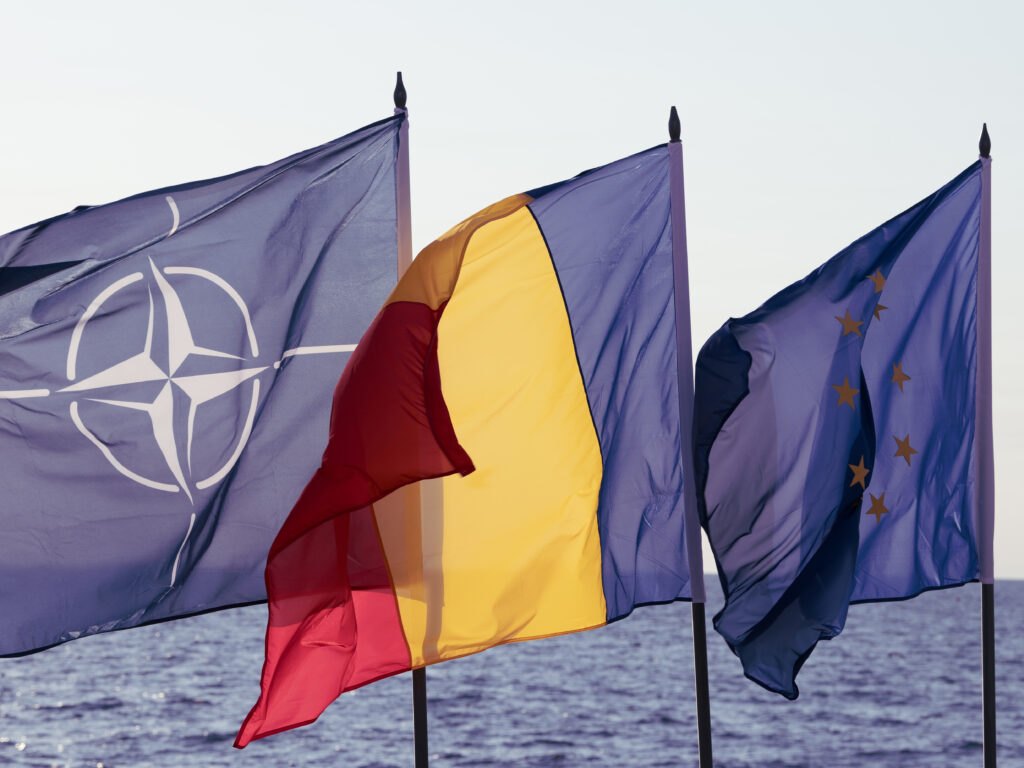
Add another home to the Atlantic Council’s growing global footprint. On June 30, we officially opened a regional office in Bucharest to lead and deepen our work across the Black Sea and Central Eastern and Southern Europe regions. The office will focus on four strategic pillars: energy and infrastructure; AI and technological cooperation; regional security and defense; and European Union EU integration and democratic resilience. With the launch event coinciding with the arrival of a new Romanian president and government, Romanian senior officials made their first public appearances during Atlantic Council events, also joined by business leaders, demonstrating a clear intent to strengthen transatlantic ties in areas ranging from commerce to defense to education and regional cooperation.
Transforming the debate on the future of Gaza
This year, the Atlantic Council launched the Realign for Palestine project, an ambitious effort to put radical pragmatism at the forefront of conversations about the Palestinian people. The project drew huge audiences across traditional and new media (including 1.5 million views of a debate on the YouTube show “Jubilee”). Ahmed Fouad Alkhatib, the head of Realign for Palestine, also participated in a humanitarian aid drop over Gaza. Meanwhile, as war between Israel and Hamas following the October 7 attacks gave way to a cease-fire, experts across our Middle East Programs helped illuminate fast-shifting developments in the Middle East while charting a path forward for Gaza and the broader region.
Shaping the global AI agenda with the launch of the GeoTech Commission on Artificial Intelligence
As AI shakes up both geopolitics and economics, technology is at the heart of the most consequential policy debates of our time. The Atlantic Council is building field-leading work on AI by shaping strategic governance frameworks, anchoring trusted partnerships across government and industry, and translating technical complexity into actionable policy pathways. The flagship of this effort is the GeoTech Commission on Artificial Intelligence, which convenes bipartisan congressional leaders, industry executives, innovators, and civil society leaders to chart a roadmap for US and allied leadership in AI, with targeted and actionable recommendations on the interdependent factors required to scale development, deployment, and use of this transformative technology. The companies represented on the commission make up more than 25 percent of US stock market value, one signal of the seriousness and reach of this ambitious effort.

Influencing the conversation at a historic NATO Summit
This year’s NATO Summit at The Hague included an unprecedented commitment by allies to raise their defense and defense-related spending to 5 percent of gross domestic product. And the Atlantic Council, led by the Transatlantic Security Initiative in the Scowcroft Center for Strategy and Security, helped set the terms of the debate and devise solutions for allies to deliver not just on numbers but on capabilities. Highlights of the Council’s engagement around the summit include a delegation trip to Brussels to advise NATO’s new Secretary General Mark Rutte, cutting-edge analysis through efforts such as the NATO Defense Spending Tracker, and events on the margins of the summit itself attended by European royalty, ministers of defense and foreign affairs, senior NATO officials, and C-suite industry leaders. We also announced a strategic partnership with the Munich Security Conference on the margins of the summit.
Traveling to China to better understand the United States’ top competitor
In November, the Atlantic Council organized its first delegation to China, led by former National Security Advisor and Executive Vice Chair of the Atlantic Council Board of Directors Stephen J. Hadley, to shed light on what innovation in the Chinese economy actually looks like and how Beijing is viewing relations with Washington. Our delegation met with top officials including Vice Premier He Lifeng, President Xi Jinping’s lead for US-China talks. The group also visited factory floors and tested some of China’s advanced AI products. The delegation’s top takeaway: The United States is not prepared for the China shock 2.0 that is headed this way.
Leading trips to the Middle East at a time of war and upheaval
In June, our Middle East Programs organized the first privately sponsored congressional delegation focused on regional integration in the wake of the Abraham Accords. The bipartisan delegation of four US House members traveled to Saudi Arabia, Bahrain, and the United Arab Emirates, arriving in the region on the day Israel struck Iran and launched the twelve-day war between the two countries—making the delegation’s mission all the more relevant. In August, the Middle East team followed up with the Council’s first delegation to Syria, meeting with officials at the highest levels of government and unearthing unique insight into how the country is rebuilding from the wreckage of the Assad era. Then, in October, just weeks after the Israel–Hamas cease-fire took effect, our Millennium Leadership Program brought a cohort of twenty-seven global leaders to the United Arab Emirates, Israel, and the Palestinian Territories for an immersive tour of the region. The visit marked the second iteration of the Millennium Leadership Intensive—a three-month hybrid program designed to equip professionals with deeper insight into pressing foreign policy challenges in the Middle East while strengthening their leadership capabilities.
Rethinking the intersection of security and resilience
Cyberattacks, pandemics, and natural disasters pose a threat to national security, but the tools needed to deal with them are outside the defense and security wheelhouse. That’s where the underappreciated connection between resilience and security comes in. In July, we launched the Adrienne Arsht National Security Resilience Initiative with a flagship report making the case for a “resilience-first approach” to security. This innovative work will help policymakers better prepare their citizens to withstand crises and move beyond traditional conceptions of what national security policy looks like. It will also improve the individual resilience of the national security practitioners working to keep us safe.
Changing the conversation on Indo-Pacific security with Guardian Tiger
This year, our Indo-Pacific Security Initiative in the Scowcroft Center for Strategy and Security published the Guardian Tiger I and II report, a bracing readout from two tabletop exercises exploring how to confront simultaneous nuclear threats from China and North Korea. These efforts garnered widespread attention and impacted how senior officials, military officers, and top thought leaders in the United States, South Korea, and other allied countries think, write, and speak with each other about deterrence in the region. And in May, the team conducted a new tabletop exercise as part of this year’s Guardian Tiger III effort, with over one hundred participants from eight countries across three days.
Charting the future of the transatlantic partnership with the US-EU Strategic Dialogue
As Trump entered his second term in office, the Europe Center convened current and former policymakers from the United States and the European Union for the US-EU Strategic Dialogue to shape the direction of an evolving US-European relationship. The informal deliberations in Washington and Brussels were designed to assess how the partnership must find new terms of engagement and identify areas for cooperation in a rapidly changing geopolitical context. The resulting report, published in January, included tangible recommendations regarding collaboration on defense spending and industrial policy, energy security and purchases, sectoral economic agreements, and trade policy—many of which rhyme with the Turnberry Deal that the United States and the European Union agreed to over the summer.
Owning the news cycle on the most important issues of the day through Fast Thinking, Experts React, and more
As efforts toward a peace deal in Ukraine progressed over the past year—swinging from an Oval Office blowup between Trump and Ukrainian President Volodymyr Zelenskyy to the latest high-stakes peace negotiations, our Eurasia Center has become the top source for rapid analysis and convenings on these developments, even making several trips to Ukraine throughout the year. Our experts from the Middle East Programs were similarly omnipresent in coverage of the twelve-day war between Iran and Israel—including the US bombing of nuclear sites inside Iran. As Trump steadily built pressure on Venezuela, the Adrienne Arsht Latin America Center and Scowcroft Center for Strategy and Security led the way on impactful convenings and insightful analysis of each new development. And on the urgent subject of critical minerals, the Africa Center, Global Energy Center, and others produced table-setting in-depth analysis, as well as rapid reactions to breakthrough moments such as the US-brokered deal between the Democratic Republic of the Congo and Rwanda. Our rapid responses to breaking news—through features such as Fast Thinking and Experts React—are routinely among the most widely read and cited work the Council produces, distributed across the website, newsletters, and social platforms such as the newly launched Atlantic Council WhatsApp channel.
Launching new editorial products to match the Council’s ambitions
We’ve always been a place that prides itself on relevance at speed—but there’s no question the speed has picked up during the Trump era. So in August we launched AC Intel, a daily newsletter that showcases our best work while bringing readers inside the Council and providing exclusive insight on world-shaping events that you cannot get anywhere else. Then, in December, we debuted our new flagship section for short-form work, Dispatches. We’ve chosen the name Dispatches because it’s one of the few crossover terms between government and media—the nexus we aim to occupy. And whether filed by a government official or foreign correspondent, the connotation is the same: speedy, urgent, and important writing.
Subscribe to our daily newsletter to receive the best expert intelligence on world-changing events
Want a sneak peek at 2026? Here’s a preview of some of the highlights coming next year:
- The Euro–Gulf Summit will provide a first-of-its-kind platform for dialogue between European and Gulf countries.
- The Freedom and Prosperity Center will start work on a new Entrepreneurship Policy Initiative to measure how countries are enabling private-sector development and empowering businesses to drive economic growth.
- The Reimagining European Defense and Innovation Task Force will tackle perhaps the most important issue coming out of this year’s NATO Summit—how Europe can more effectively take control of its own defense.
- The Atlantic Council Turkey Program will help pave the way for high-level programming around two major summits happening in Turkey—the NATO Summit in Ankara, alongside the Scowcroft Center for Strategy and Security and others, and COP31 in Antalya, alongside the Climate Resilience Center and others. The Turkey Program is also planning to host a biennial flagship energy and infrastructure conference in Istanbul in the fall.
- The Millennium Leadership Program will host a landmark global leadership convening in October.
- We will relaunch our Pakistan work with a grant from the Gates Foundation.
- Our rebranded initiative on Middle East regional normalization will have an expanded scope going into 2026, including a renewed focus on economic opportunities such as the India-Middle East-Europe Corridor, building on this year’s landmark report.
- We will grow our work on sports diplomacy, following our conference on the issue in December, just as the United States hosts the World Cup.
- We will play a major role in the US Group of Twenty (G20) presidency, including a series of task forces on issues ranging from digital assets to trade and a flagship event on the sidelines of the leaders’ summit in Miami in December.