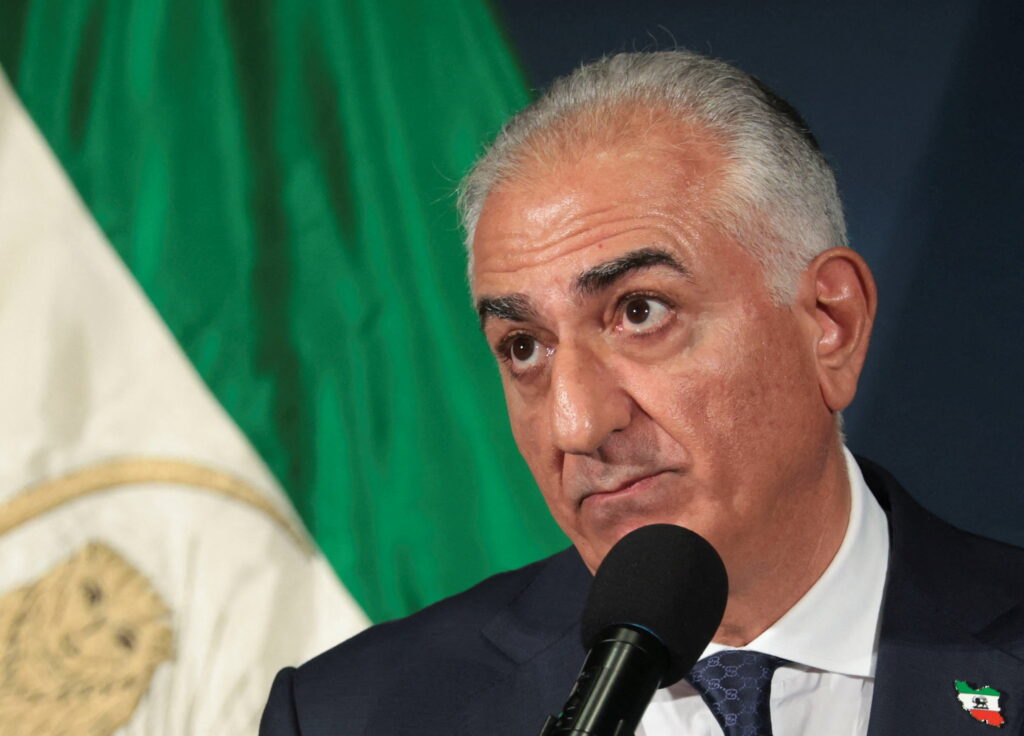
Following the US-Israeli raids that killed Iranian Supreme Leader Ali Khamenei, former Crown Prince Reza Pahlavi has re-emerged as the most prominent face of the Iranian opposition in a moment of crisis. Alongside this visibility has come renewed scrutiny. Critics question Pahlavi’s capacity, qualifications, and the coherence of the opposition movement. But beneath the criticisms lies a quieter fault line—one that is less about capacity and more about ideology. It concerns his support for Israel.
For decades, discussions of regime change in Iran have conjured warnings of chaos. Policymakers frequently invoke the specter of Iraq, Syria, or Afghanistan, expressing a preference for the devil they know over the uncertainty of transition. This posture has allowed the Islamic Republic to consolidate power—financially, militarily, and technologically—while continuing to suppress dissent at home.
Simultaneously, critics argue that the Iranian opposition is too fragmented to present a viable alternative. Yes, the opposition spans ideological, generational, and ethnic lines. Monarchists, federalists, republicans, reformists, labor organizers, and others often share grievances but lack Western standards of coordination.
Assessing Pahlavi
That raises the question of whether Pahlavi could be a unifying figure. One common criticism is that Pahlavi would replace one form of authoritarianism with another—the turban with a crown. This ignores Pahlavi’s repeated and consistent public position as a transitional figure—a bridge, not a destination. Pahlavi has asserted that he seeks to bring Iran to a free and fair referendum where the people select their political system.
He has not ruled out monarchy, but he has also refused to predetermine Iran’s future structure outside of a democratic process. This distinction is often overlooked.
This criticism also reflects Western discomfort with monarchy rather than Iranian political realities. Iran’s long historical connection with monarchy remains part of its political memory, and for some citizens it continues to carry hope and legitimacy. Dismissing this sentiment outright risks projecting Western assumptions and values onto a different culture.
Some critics focus on Pahlavi’s lifestyle or lack of governing experience. Yet such standards are applied inconsistently. Around the world, leaders often rise through public appeal, inspiring campaigns and family legacy, rather than administrative résumés. Young inexperienced candidates become mayors; socialites with prominent names are appointed to offices; many dwell in lavish lifestyles without comparable scrutiny.
In Iran the hypocrisy runs even deeper. The Iranian government routinely and arbitrarily disqualifies candidates on standards such as loyalty to the supreme leader. Those in power extend the privileges of the kleptocratic system to their families—many living abroad where they flaunt their extraordinary wealth. Those who enforce strict social and modesty codes are frequently exposed violating them privately–offenses that would bring severe punishment upon ordinary citizens–yet these double standards rarely dominate the international commentary.
Some have criticized the harsh tone of Pahlavi’s supporters as a reflection on his personality. While there is an undeniable tone of anger from many activists, there is evidence that Iran’s cyber army is fueling these tensions, posing as fake monarchists. Pahlavi has repeatedly admonished the rude tone. Nonetheless, it appears that populist tone of discourse is a phenomenon of today’s global political landscape. Although the hostile and disrespectful tenors are repulsive, Pahlavi himself has never engaged in such behaviors and has always discouraged it.
Perhaps the most persistent criticism of Pahlavi is that he lacks organization or boots on the ground. Recent developments complicate that narrative. Over the past several years, initiatives associated with his camp have included policy planning efforts such as:
- The Iran Prosperity Project, extensive day-after plans for transition of power and governance;
- The July 2025 Convention of National Cooperation to Save Iran in Munich, a large diaspora summit that convened over seven hundred opposition diverse political groups under four shared principles;
- The launch of the defections campaign for security forces, drawing over fifty thousand people as of July 2025; and
- The first ever call for coordinated protests in Iran on January 8 and 9, drawing over a million people to the streets of Iran across thirty-five provinces.
Whether or not one agrees with these initiatives, they represent a level of organization that disproves the critics. Most significantly, the presence of millions of pro-Pahlavi demonstrators inside and outside of Iran indicate the capacity to mobilize.
Assessing the protests
To understand the current moment, one must consider the constraints inside Iran where activists, journalists, and artists are systematically oppressed and silenced. The arrests of people like Narges Mohammadi, Fatemeh Sepehri, Heshmatollah Tabatzadi, Shervin Hajipour, Toumaj Salehi, and many more show how the regime will resort to violence to prevent the emergence of leaders and ideas.
In such an environment where systems fail to address the needs of the populace, political representation takes different forms. Graffiti, slogans, and chants become methods of change. Some point to protests as a cultural phenomenon in Iran, but neglect to note that they are a reaction to unmet needs.
The protests have evolved as the government’s failures persisted. Although thousands of protests have taken place since 2009, three major protest milestones represent a gradual break from the government leading to today’s mass unrest. The 2009 Green Revolution eroded trust in the electoral system and triggered a steady decline in voting. In the 2017–2019 protests over the economy, with chants of “neither Gaza, nor Lebanon, I sacrifice for Iran,” Iranian people linked their domestic struggles to the regime’s failed foreign policy of proxies and ideological wars. In 2023, the Woman, Life, Freedom movement asked for the most basic rights and dignity. Today, the protests are revealing that the country has broken from all factions of the government. Notably, the display of defiance illustrates a loss of fear of the government. They are no longer just chanting “death to the dictator,” they are chanting “long live the king.”
Many protesters in Iran (and the diaspora) have indeed expressed the pro-Pahlavi slogans. For some protesters, the Pahlavi-led demonstrations are about overthrowing the regime, not reinstating the monarchy. For others, it’s a desire to reset or return to the past, a notion that some academics mock as nostalgia or retrotopia, dismissing the memory of past achievements and perceiving the 1979 revolution as irreversible. The prominence of Pahlavi’s name does not necessarily represent a universal agreement with his political vision, nor does it imply a collective desire for monarchy. Rather, it confirms the emergence of a visible figure capable of being a transitional leader.
Although scarcity of internet access has not allowed for new surveys, data from 2025 suggests that Iranians largely favor the regime’s collapse, even if they are uncertain about the type of government they wish to have. Similarly, the 2024 GAMAAN survey demonstrated that while the entire country may not support Pahlavi, he would be the first or second choice for over 30 percent of the population in a hypothetical free election—far exceeding the popularity of any other contenders. But popular opinion is hard to judge in this moment of wartime, particularly with some of the leaders mentioned in this survey killed in the recent strikes.
The Israel factor
Among the members of the Iranian opposition who have refrained from supporting Pahlavi, one consequential critique is rarely discussed openly: Israel.
Pahlavi’s support for normalized relations with Israel is a defining fault line. For many Iranians, this position represents a break from costly decades of ideological foreign policy centered around the elimination of Israel. For others, it represents “a symbol of repression and dependence on foreigners.”
When Pahlavi and his wife, Princess Yasmine, famously visited Israel in 2023, they put the opposition’s sensibilities regarding the Jewish state to the test. Pahlavi’s critics have been explicit with their accusations, warning about a “Israel-appointed” ruler in Iran or saying that Pahlavi lost credibility by not criticizing Israel for its twelve-day war with Iran last year. Pahlavi’s inclinations to normalize relations with Israel create discomfort among many Iranians, which is often masked in criticisms of his capacity or character.
Interestingly, Pahlavi has never expressed an opposition to Palestinian statehood, rather seeing Hamas and the Iranian regime as impediments to their wellbeing. Nonetheless, the challenge for some activists is not the realization of a Palestinian state, but rather the existence of a Jewish one. The core reason for many is discomfort with Jewish sovereignty on lands that they perceive as Islamic. Against the backdrop of the protesters’ massacre in Iran, this sentiment is too controversial to discuss in the public narrative, yet it is hinted at in closed circles and social media. This divide is often masked by criticisms about personality, organization, or political philosophy.
The opposition’s divide can also be seen in the disintegration of the “Georgetown Coalition,” which was formed a few months before the Pahlavis’ Israel trip. Canada-based activist Hamed Esmaeilion was the first to leave the coalition—though Esmaeilion never commented directly on the trip or Pahlavi’s potential leadership of the country. Today, members of the Georgetown Coalition such as the Nobel Laureate Shirin Ebadi and actress Nazanin Boniadi are directly or indirectly supporting Pahlavi as a transitional leader, while they continue to criticize the tone of his team. Journalist Masih Alinejad claimed that “if he leads,” she will support him because she supports the Iranian people. The situation with the Kurdish political leader Abdullah Mohtadi and some other Kurdish leaders has become more precarious due to their inabilities to reconcile around accusations of “separatism.” The Kurdish community seems split on their support for Pahlavi, but it’s worth noting that Kurdish people and Israel have long enjoyed amicable relations—and the United States and Israel are reportedly backing the Kurds to join the war against the regime.
The Iranian opposition faces real challenges, from fragmentation and mistrust to unresolved leadership challenges. But the debate over Pahlavi often ignores an important issue: the question of his support for Israel and whether that is a red line for those who oppose him. For the protest movement, the prospect of ending the Islamic Republic and enabling Iranian self-determination must also contend with unresolved grievances regarding Israel.
Marjan Keypour Greenblatt is an advisory board member of the Atlantic Council’s Iran Strategy Project and New Union for Democracy in Iran, and the founder and director of the Alliance for Rights of All Minorities.
Related Reading
Image: Reza Pahlavi, the son of Iran's last shah and an Iranian opposition figure, holds a press conference in Washington, D.C., U.S., January 16, 2026. REUTERS/Jonathan Ernst