
WASHINGTON—Increasing competition among global powers has blurred the traditional boundaries of statecraft and war, challenging established international norms. This is demonstrated by the rise of so-called “gray zone” activities, which are often described as “competition below the threshold of conflict.” By design, the phrase evokes ambiguity; the action is neither clearly black nor white, neither war nor peace, but somewhere in the uncertain middle.
Even more unhelpfully, the phrase “gray zone” offers insufficient clarity about what is unfolding on the world stage: a struggle for influence, legitimacy, and control of the world order that has not yet escalated to military conflict to achieve it. It also does not explain the character of the revisionist efforts by US adversaries, which in many ways parallel an insurgency—protracted, subversive, and aimed at reshaping governance. But instead of traditional non-state actors, this contest involves nation-states, the population is global, and the governance they seek to alter, or outright replace, is the rules-based international order.
A better, more precise framework for understanding these pressing challenges to the liberal world order comes from adapting RAND scholar Gordon McCormick’s Magic Diamond from its familiar counterinsurgency origin to the political warfare domain. Applied to the increasing competition between the United States and the People’s Republic of China (PRC), this model draws from Mao Zedong’s theory of protracted war to interpret the Chinese Communist Party’s (CCP’s) long-game strategy for global influence.
What is the Magic Diamond?
The Magic Diamond is a conceptual model that simplifies the understanding of complex asymmetric conflict. Originally designed in the 1980s to analyze insurgent–state dynamics in internal wars, such as Peru’s communist Sendero Luminoso movement, the model establishes four interconnected actors—the insurgent, the counterinsurgent, the population, and the external supporters—and illustrates the dynamics of their interaction.
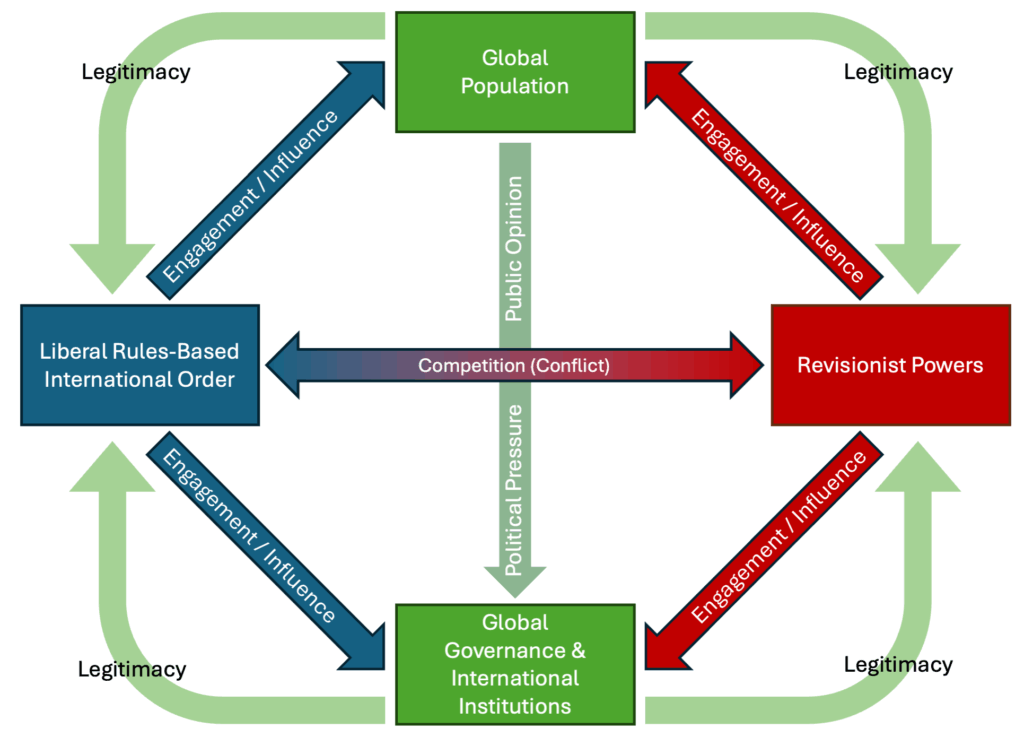
The insurgents erode the government’s legitimacy and mobilize the population against its rule, while the counterinsurgents strive to maintain control and legitimacy, including by attempting to negate support for the insurgents’ cause. This juxtaposition creates a mirrored system of tension and highlights the symmetry of competing efforts: Both are vying for the same population’s trust, external backing, and the ability to define “normal.” Here, McCormick illuminates the broader reality that legitimacy, rather than firepower, is the true center of gravity. The struggle is fundamentally cognitive and political.
Transposing today’s global gray-zone competition onto the Magic Diamond reveals striking parallels. Legitimacy, influence, and control remain the central objectives, but the arena now spans the interconnected global system. Applied to US-China competition, the CCP seeks “discursive power” to define norms, narratives, and “truths,” all of which are aimed at molding the global population and governing institutions to favor its political model and interests. At the same time, the United States seeks to preserve its global power standing and the free and open liberal order.
Although they employ different methods of exerting domestic and external influence, the reciprocal dynamics of this struggle for legitimacy underscore the importance of understanding how the rest of the world views these sides. Success in this irregular domain means shaping global perceptions sufficiently to minimize the need for military conflict—or ideally render it irrelevant.
Seeing China more clearly through the diamond
In this refreshed model, the PRC emerges as a revisionist global insurgent power: patient, legitimacy-driven, and methodically subverting the dominant international order. This view is reinforced by the continued reverence in China for Mao Zedong’s On Protracted War, which is a foundational text of the CCP’s strategic revolutionary culture. In the work, Mao envisioned a phased campaign: establish strategic defense, force a protracted stalemate, and then launch a counteroffensive. In many ways, the CCP’s global strategy today echoes this logic and translates Maoist insurgent theory into instruments of global statecraft under Chinese President Xi Jinping’s leadership. The CCP fuses political mobilization, cognitive and legal warfare, and economic coercion in a modern global “people’s war.” In recent years, Xi has operationalized a strategy of endurance and incrementalism to “displace the American-led order,” creating a persistent gray zone of ambiguity that clouds the bounds of soft power statecraft and avoids clear escalatory tripwires that would provoke outright conflict.
Whereas Mao mobilized peasants, Xi mobilizes state power through state-owned enterprises, diaspora networks, party-controlled media, and technology champions such as Huawei. Instead of rural battlefields, Xi’s campaign plays out in digital infrastructure, trade regimes, and global governance institutions. Domestically, the CCP cultivates legitimacy through economic growth, nationalism, and narratives of Western decline underpinned by strict censorship and control of information. Externally, international engagements, such as the Belt and Road Initiative, reshape the political and economic landscapes to embed influence and dependence. These projects cultivate global political and societal leverage, effectively creating a network of “safe havens.” Those zones of influence then serve as positional advantages, particularly in developing Global South countries, that strengthen the PRC’s position in the international system—allowing it to encircle the opposition and put in place its strategic defense.
The PRC’s “Three Warfares” strategy—public opinion, psychological warfare, and legal warfare—further supports a protracted competition. Like Mao, Xi aims to “win without fighting” by exhausting opponents over time, gradually eroding cohesion and political will. As regional security expert Kerry Gershaneck aptly described it, this is “political warfare in slow motion.” Control of technology nodes, such as undersea cables, TikTok algorithms, and 5G networks, gives the CCP powerful tools for shaping the flow of information and political sentiment—the modern-day equivalent of controlling the villages in contested provinces. Mis- and disinformation campaigns exploit these networks to amplify doubt in democratic governance and fracture coalitions. Coupled with volumes of international legal challenges—from maritime claims to trade disputes—the PRC creates a web of entanglements that impose a strategic delay, fixing the international community in a political and legal stalemate.
Like Mao’s guerrilla army, today’s PRC simultaneously builds military strength during the stalemate to gain parity with—or overmatch of—its opposition. Attributing China’s historic decline to its relative technological and military inferiority, Xi frequently invokes the “century of humiliation” narrative to justify the “great rejuvenation” modernization effort, vowing that “China will never be bullied again.” While the CCP pursues compellence without fighting, these efforts shape a deterrence signal and build a credible option to use military force if necessary. The PRC has studied its opposition’s military operations for decades, tailoring modernization to exploit perceived vulnerabilities and create dilemmas, especially in the space, cyber, and maritime domains. As Mao once wrote, “an increase in China’s own strength, an increase in (opposition) difficulties, and an increase in international support; it is the combination of all these forces that will bring about China’s superiority and the completion of her preparations for the counter-offensive.” The development of layered anti-access/area denial networks, precision strike capabilities, and assertive military posturing reflect preparation for high-end conflict, and Taiwan represents the clearest test case. Evoking a Maoist counteroffensive to recover China’s lost territories, a military campaign for “reunification” would validate the PRC’s modernization and demonstrate its readiness to project power for broader CCP ambitions.
How the United States fits in
Within this adapted Magic Diamond, the United States (and more broadly, the West) assumes the role of the counterinsurgent: the defender of the existing order and global norms. The challenge is not only to deter PRC coercion, but also to outcompete its legitimacy narrative by demonstrating that the liberal world model delivers security, prosperity, and political freedom. Much like the counterinsurgent’s role of winning hearts and minds, the United States must present a system and social contract more attractive than the insurgent—one that reinforces the internal cohesion and political equilibrium within the existing liberal system and also cultivates international confidence and credibility in open democratic governance. This is especially true when it comes to influencing middle-power nations in the Indo-Pacific and Global South, whose alignment could tip the scales to either system.
Alliances and international partnerships convey legitimacy. NATO and its Indo-Pacific partners, the Australia–United Kingdom–United States security pact known as AUKUS, and the Indo-Pacific Economic Framework are globally visible examples of multinational resolve and alignment. Expanding partnerships beyond mutual security and defense interests to include equitable trade, developmental growth, and shared values strengthens their appeal, deepens ties, and counters the PRC’s transactional and coercive influence.
Perhaps most important, the United States cannot solely focus on isolating revisionist malign global influence; it must wield its soft and hard powers together to reinforce the foundations of the liberal order faster than the PRC can undermine them. At the same time, it must avoid the trap of solely reacting to the PRC’s initiatives; proactive leadership is essential for sustaining legitimacy. Just as in counterinsurgency, one wins by proactively engaging and integrating with the population, not by isolating within defensive bases.
Although the battlefield has expanded, the logic remains the same. For scholars and policymakers, this adaptation offers fresh insight into a familiar framework, helping to translate gray zone competition into understandable lines of effort across all levels of government. It underscores that the next world order will not merely rely on military deterrence or dominance, but on persuasion, resilience, and partnership. Legitimacy is the key to victory.