
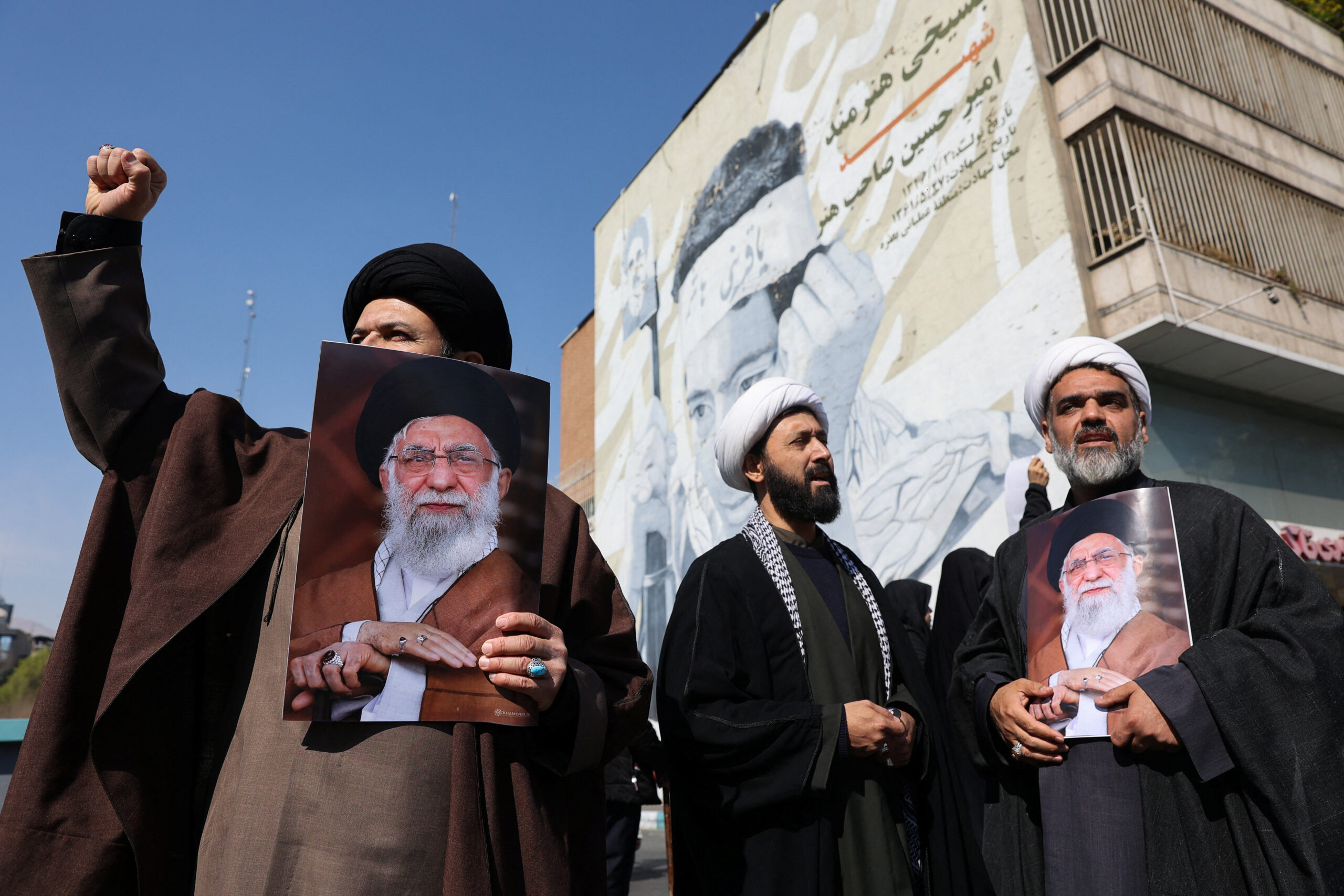
WASHINGTON—On Thursday, US President Donald Trump said that he must be “involved in” selecting Iran’s next supreme leader. This pronouncement came as signs in Iran pointed to Mojtaba Khamenei, the late Ayatollah Ali Khamenei’s son, as the leading candidate to replace his father.
However, it’s highly unlikely that Trump or any non-Iranian will direct the succession process, absent either an unlikely capitulation by the remnants of the Iranian regime or a massive escalation of the conflict from the United States that includes a sustained troop presence.
At this point, no one either inside or outside of Iran can say for certain who the next leader will be—or whether there will be multiple leaders before the Iran war ends. Nor should anyone assume that Iran will emerge from the conflict with another supreme leader. It is entirely possible that the country departs from Velayat-e Faqih (the philosophy underpinning the role of the supreme leader as head of state) and moves toward a military takeover or constitutional referendum instead.
But whoever emerges in charge will face an important decision. In a post-conflict scenario, a future Iranian leader must choose between prioritizing stability and the well-being of the Iranian people—by engaging rationally with the international community—and continuing to be driven by the revolutionary and ideological ambitions that defined Khamenei’s reign. In 2006, former US Secretary of State Henry Kissinger summed up this choice as deciding between “a nation and a cause.” Choosing the former could help quell decades of hostility between the West and Iran, while choosing the latter could perpetuate the confrontation well into the future.
In the weeks leading up to the conflict, and prior to the death of Khamenei, we consulted with a group of Iran experts to explore ways the United States and allied nations could coordinate efforts and coax change that might result in a more Western-leaning Tehran. The levers available to Washington are limited, but there are three areas where the United States and its allies can exert influence.
1. Iran’s economy and international integration
In a post-conflict Iran, one of the most important factors shaping a post-Khamenei government will be how it views Iran’s economy. Key economic indicators to watch include inflation, unemployment, the payment of public sector salaries, and the regime’s ability to make necessary subsidy reforms and diversify its revenue beyond oil sales.
To rebuild and transform its economy, Iran will need international investment; for that, Iran will need sanctions relief; and for that, it will need a complete overhaul of its foreign policy. Since the United States put in place many of the toughest sanctions on Iran, there are steps Washington can take to encourage the new Iranian leadership to recognize this reality.
However, this likely requires that regime elites face new eruptions of popular unrest over the failing economy and feel economic pressure in their own lives. One of the downsides of US sanctions is that they have created a robust black market that has allowed Iran’s Islamic Revolutionary Guard Corps and other elites to bypass and benefit from the current sanctions regime. There are numerous examples of the entrenched elites benefiting from the current system. If this trend continues during a transition, it makes a pivot toward a more Western-leaning state more difficult.
Western pressure on regime elites would need to be paired with clear carrots to encourage change. One of the failures of former Iranian President Hassan Rouhani’s rapprochement with the West was that he could not show how Iran’s nuclear concessions—and his more pragmatic approach—led to a better economic outcome for everyday Iranians. A future Iranian leader will need to be convinced that a pro-Western posture will be economically profitable for both the country and the leader’s interests.
Since the Carter White House, successive US administrations have enacted policies that punish countries that trade with the current regime. In a break with this approach, the United States and its allies could establish benchmarks that, if met, would create a path for a new Iranian administration to move away from trade with US adversaries and competitors. Recent commitments to investing in post–Bashar al-Assad Syria suggest a way forward, such as Riyadh’s pledge to commit $6.4 billion in investments this past July. Seeking ways for a new Iranian leadership to continue and grow emerging diplomatic ties, like the renewal of Iran-Saudi relations—notably brokered by China three years ago—could present initial building blocks for such an approach.
2. Iran’s government
Over the course of his tenure, Khamenei did a masterful job maintaining regime unity and avoiding high-profile defections. Any internal dissent has been sidelined without meaningful repercussions on his reign. Even during the recent massacre of Iranian protesters and the subsequent war, there were no significant defections among regime elites.
This elite cohesion presents a predicament for a potential transition to a Western-oriented state. Anti-regime opposition and human rights advocates understandably seek to hold the regime accountable for its crimes but use rhetoric that paints all members of the Iranian establishment with the same broad brush. This eliminates an outlet for those within the existing regime who may secretly want to free themselves but see no way out.
The 2003 US decision to bar Iraqis from the top tiers of the Baathist party from serving in government and disband the Iraqi military contributed to the challenges in governing Iraq’s multi-ethnic and religious population in the immediate aftermath of Saddam Hussein’s fall. To mitigate the risk of similar fallout, providing a process that isolates apparatchiks from ideologically ambivalent technocrats could spur fence-sitters in the regime to consider life beyond the current political and security construct. In short, to increase the odds of a pro-Western state emerging, there at least needs to be room for a figure like either Reza Pahlavi—the son of the deposed shah—or the Irish Republican leader Gerry Adams to emerge in Iran.
There is room for the United States and its allies to help lay the groundwork for a process that addresses the needs of the Iranian people for accountability and justice. In considering a rebuilding of the state administration, identifying ways to incorporate an Iran-specific truth and reconciliation mechanism could accomplish this. But critically, it would also need to be designed to signal that regime technocrats will not face retribution for their contribution to the running of the state. In this vein, the mechanisms applied in post-apartheid South Africa and Northern Ireland differed based on the nature of the conflicts and crimes committed. Each wrestled, for example, with the concept of amnesty in exchange for confession. Drawing from lessons of recent investigations, such as the United Nations’ Independent International Fact-Finding Mission on the Islamic Republic of Iran, could inform the process and direction of such an effort.
3. Iran’s security structure
In the run-up to the war, the Iranian security doctrine was a three-legged stool—a latent nuclear weapons capability, a robust and capable missile program, and Iran’s network of nonstate regional proxies known as the “Axis of Resistance.” The Islamic Republic’s commitment to this paradigm in the face of crippling sanctions, military threats, and domestic unrest reflect the paramount role that threat perception plays in driving Iranian policymaking.
This will be difficult to change with a new Iranian leadership keen to avoid the same fate of other leaders. In 2003, for example, Libya’s Muammar al-Qaddafi voluntarily dismantled his country’s nuclear program; in 2011, he was driven from power and killed. Hardliners in Iran have warned against limiting military capabilities, blaming Libya’s civil war and Qaddafi’s ultimate demise on forfeiting his weapons program. Khamenei himself criticized Qaddafi for abandoning his nuclear ambitions and chided the former leader of Libya for trusting the United States. Other Iranians point to Ukraine as another cautionary tale, in which Kyiv gave up its nuclear weapons following its independence from the Soviet Union in 1991 only to be invaded by Russia later.
However, the key driver shaping Iran’s transition and its future is establishing a security infrastructure acceptable to Iran and tolerated by Israel, the United Arab Emirates, and Saudi Arabia. On its face, this may not seem possible. But the current Iran-Israel hostility has not always existed. They share no borders, and Persians and Jews share more than a millennium of relatively peaceful co-existence.
For a Western-leaning state to emerge in Iran, it will almost certainly be incumbent upon new Iranian leadership to change Israeli perceptions about Iran’s intentions. The United States and its allies should make clear that the key indicator might very well be Iran’s continued support (and specifically lethal assistance) to Hamas, Hezbollah, and the Houthis. The irony is that these groups’ degradation since Hamas’s October 7, 2023, attacks makes them more of a liability to Iran than an asset. But even still, an end to Iranian backing for these proxies would be a massive ideological shift for a regime that built a large part of its internal legitimacy on opposition to Israel.
In many ways, Iran’s hostility to Israel, the United States, and the Gulf is more important than the exact specifications of Iran’s missile and nuclear program. If that hostility is reduced, diminished Israeli and US perceptions of threat could pave the way for limiting both programs in ways that are potentially acceptable to all parties.